
In modern industrial applications, the demand for precision reducers has escalated significantly, particularly in fields such as robotics, where high torque, compact size, zero-backlash, and efficient power transmission are paramount. As an engineer and researcher focused on mechanical transmission systems, I have extensively studied various worm gear drive configurations to address these challenges. Among these, the roller enveloping internal engagement worm gear drive stands out due to its unique design—featuring an external worm and an internal worm wheel—which promises high reduction ratios, efficiency, and multi-load output capabilities. In this article, I delve into the critical parameters affecting the contact and lubrication performance of this worm gear drive, leveraging mathematical modeling, numerical analysis, and simulation validation to provide insights for optimal design. The term “worm gear drive” will be repeatedly emphasized to underscore its centrality in this discussion, as it is the core mechanism under investigation.
The roller enveloping internal engagement worm gear drive is a derivative of the toroidal worm gear drive, but with an inverted structure that enables internal meshing. This configuration can potentially enhance load distribution and reduce backlash, making it suitable for precision applications. However, its performance is highly sensitive to design parameters such as center distance, transmission ratio, roller radius, and worm-wheel rotational deflection angle. My goal is to analyze how these key parameters influence the contact and lubrication characteristics, which are crucial for durability, efficiency, and noise reduction in worm gear drive systems. Through this first-person perspective, I will share my methodology, findings, and recommendations based on rigorous computational and modeling approaches.
To begin, I established a comprehensive mathematical model for the roller enveloping internal engagement worm gear drive. This involved setting up coordinate systems to describe the relative motion between the worm and the worm wheel. I defined static and dynamic coordinate systems for both components, along with a deflection coordinate system to account for the worm-wheel rotational deflection. The initial positions were aligned, and key geometric parameters were incorporated, including the center distance \(A\), roller radius \(R\), transmission ratio \(i_{21}\), deflection angle \(\beta\), and worm-wheel rotation angle \(\varphi_2\). These parameters form the foundation for analyzing the worm gear drive’s behavior.
The contact lines on the worm wheel tooth surface were derived using meshing theory, which describes the intersection between the worm wheel surface and its envelope. The parametric equations for the worm wheel tooth surface are given by:
$$ \mathbf{r}_0 = R\cos\theta\,\mathbf{i}_0 + R\sin\theta\,\mathbf{j}_0 + u\,\mathbf{k}_0 $$
where \(u\) and \(\theta\) are surface parameters, and their relationship is defined through the meshing equation. Specifically, \(\theta = F(u, \varphi_2) = \arctan(l_1 / l_2)\), with:
$$ l_1 = i u – u\sin\beta + a_2\sin\beta – a_2 i – A\cos\varphi_2\sin\beta + c_2\cos\beta\sin\varphi_2 $$
$$ l_2 = -a_2\cos\beta + A\cos\beta + b_2\cos\beta\sin\varphi_2 + u\cos\varphi_2\cos\beta $$
Here, \(a_2\), \(b_2\), and \(c_2\) are coordinates in the worm wheel system, and \(i\) is related to the transmission ratio. These equations encapsulate the geometric interaction in the worm gear drive, allowing for the computation of contact points and lubrication angles.
The lubrication angle \(\mu\) is a critical metric for assessing the oil film formation and wear resistance in worm gear drive systems. It is derived from the relative velocity and angular velocity vectors projected onto the contact plane. The expression for \(\mu\) is:
$$ \mu = \arcsin \frac{|\boldsymbol{\sigma} \cdot \boldsymbol{\nu}_{12}|}{|\boldsymbol{\sigma}| |\boldsymbol{\nu}_{12}|} = \arcsin \frac{|v_{12x}^p (v_{12y}^p / R – \omega_{12y}^p) + v_{12y}^p \omega_{12x}^p|}{\sqrt{(v_{12x}^p / R – \omega_{12y}^p)^2 + (\omega_{12x}^p)^2} \sqrt{(v_{12x}^p)^2 + (v_{12y}^p)^2}} $$
where \(\boldsymbol{\sigma}\) represents the slip direction, \(\boldsymbol{\nu}_{12}\) is the relative velocity, and the superscript \(p\) denotes projections in the local coordinate frame. A lubrication angle closer to \(90^\circ\) indicates better lubrication performance, which is desirable for minimizing friction and heat generation in worm gear drive assemblies.
Similarly, the induced normal curvature \(k_{12}^\sigma\) governs the contact stress and fatigue life. It is calculated as:
$$ k_{12}^\sigma = -k_{21}^\sigma = -\frac{(\omega_{12y}^p + v_{12x}^p / R_k)^2 + (\omega_{12x}^p)^2}{\Psi} $$
where \(\Psi\) is a denominator term derived from the meshing conditions. A smaller absolute value of induced normal curvature suggests better contact performance, reducing the risk of pitting and surface damage in worm gear drive components.
With these equations in hand, I performed numerical analyses using MATLAB to evaluate how key parameters affect the lubrication angle and induced normal curvature. The baseline parameters were set as: center distance \(A = 125 \, \text{mm}\), roller radius \(R = 8 \, \text{mm}\), transmission ratio \(i_{21} = 30\), deflection angle \(\beta = 35^\circ\), and worm-wheel rotation angle \(\varphi_2\) ranging from \(30^\circ\) to \(50^\circ\). Each parameter was varied independently while others were held constant to isolate its impact on the worm gear drive performance.
The results are summarized in the following tables, which consolidate the trends observed from the numerical simulations. These tables provide a quick reference for designers working on worm gear drive systems.
| Parameter Variation | Effect on Lubrication Angle \(\mu\) | Effect on Induced Normal Curvature \(k_{12}^\sigma\) | Recommendations for Worm Gear Drive |
|---|---|---|---|
| Increasing \(A\) | Minor decrease; more pronounced at higher \(\beta\) | Increase | Balance with \(\beta\); larger \(A\) may worsen contact but can be offset by adjusting other parameters. |
| Decreasing \(A\) | Slight increase; beneficial for lubrication | Decrease | Use smaller \(A\) for better contact, but consider space constraints in worm gear drive design. |
| Parameter Variation | Effect on Lubrication Angle \(\mu\) | Effect on Induced Normal Curvature \(k_{12}^\sigma\) | Recommendations for Worm Gear Drive |
|---|---|---|---|
| Increasing \(R\) | Increase | Decrease | Larger roller radii enhance both lubrication and contact; ideal for high-performance worm gear drive systems. |
| Decreasing \(R\) | Decrease | Increase | Avoid very small radii to prevent poor lubrication and high contact stress. |
| Parameter Variation | Effect on Lubrication Angle \(\mu\) | Effect on Induced Normal Curvature \(k_{12}^\sigma\) | Recommendations for Worm Gear Drive |
|---|---|---|---|
| Increasing \(i_{21}\) | Negligible change | Negligible change | Transmission ratio has minimal impact; focus on other parameters for optimization. |
| Decreasing \(i_{21}\) | Negligible change | Negligible change | Same as above; select \(i_{21}\) based on speed reduction needs in worm gear drive. |
| Parameter Variation | Effect on Lubrication Angle \(\mu\) | Effect on Induced Normal Curvature \(k_{12}^\sigma\) | Recommendations for Worm Gear Drive |
|---|---|---|---|
| Increasing \(\beta\) | Decrease | Decrease (for \(\varphi_2\) in 150°–260° range) | Optimal range is 0°–40°; beyond this, lubrication suffers but contact may improve in specific zones. |
| Decreasing \(\beta\) | Increase | Increase | Lower \(\beta\) benefits lubrication but worsens contact; trade-off required. |
| Parameter Variation | Effect on Lubrication Angle \(\mu\) | Effect on Induced Normal Curvature \(k_{12}^\sigma\) | Recommendations for Worm Gear Drive |
|---|---|---|---|
| Varying \(\varphi_2\) | Significant fluctuations, especially at high \(\beta\) | Sharp changes in 150°–260° range for \(\beta > 40^\circ\) | Use \(\varphi_2\) to define meshing zones; avoid critical ranges where performance drops. |
From these analyses, I observed that the worm-wheel rotational deflection angle \(\beta\) has the most substantial influence on both contact and lubrication performance in worm gear drive systems. Increasing \(\beta\) generally reduces the lubrication angle, which is detrimental, but it can also lower the induced normal curvature in certain rotation angle intervals, improving contact. This trade-off necessitates careful optimization. Based on my numerical results, I recommend keeping \(\beta\) within \(0^\circ\) to \(40^\circ\) for the best overall performance in roller enveloping internal engagement worm gear drive applications. Additionally, increasing the roller radius \(R\) consistently enhances both lubrication and contact, making it a favorable design choice. The center distance \(A\) and transmission ratio \(i_{21}\) have relatively minor effects, but they should be tuned in conjunction with other parameters to meet specific worm gear drive requirements.
To validate these findings, I proceeded with three-dimensional modeling using parameters derived from the analysis. I selected \(A = 125 \, \text{mm}\), \(R = 10 \, \text{mm}\), \(i_{21} = 30\), \(\beta = 40^\circ\), and \(\varphi_2\) from \(35^\circ\) to \(45^\circ\). The modeling process involved computing contact points from the mathematical equations in MATLAB, exporting them as a *.dat file, and importing into UG software to generate curves and surfaces. These were then stitched into solids to create the worm model for the worm gear drive.
The first step was constructing the worm tooth surface spiral lines. In MATLAB, I generated a set of contact points representing one side of the worm helix, as shown in the output plot. These points were imported into UG to create spline curves, ensuring high accuracy by using a dense point cloud. The resulting spiral lines formed the basis for the tooth profile in the worm gear drive.
Next, I used the curve group command in UG to generate surface patches from these spiral lines. Since patches cannot directly participate in Boolean operations, I stitched them into a solid entity representing the worm tooth gap. To minimize error accumulation, I divided the tooth surface into segments and processed them separately, which yielded a precise tooth gap geometry for the worm gear drive.
Finally, I created a blank model by revolving a profile and subtracted the tooth gap solid to produce the complete worm model. This approach allowed me to visualize the meshing characteristics and verify the parametric influences. The resulting model demonstrated that with a deflection angle \(\beta = 40^\circ\), the worm gear drive could achieve multiple tooth engagements, enhancing load distribution. For instance, at \(\beta = 0^\circ\), only three tooth pairs were in simultaneous contact, whereas at \(\beta = 13^\circ\), up to five pairs engaged, albeit with thinner worm teeth. This confirms that the deflection angle significantly affects the contact pattern and load capacity in worm gear drive systems.
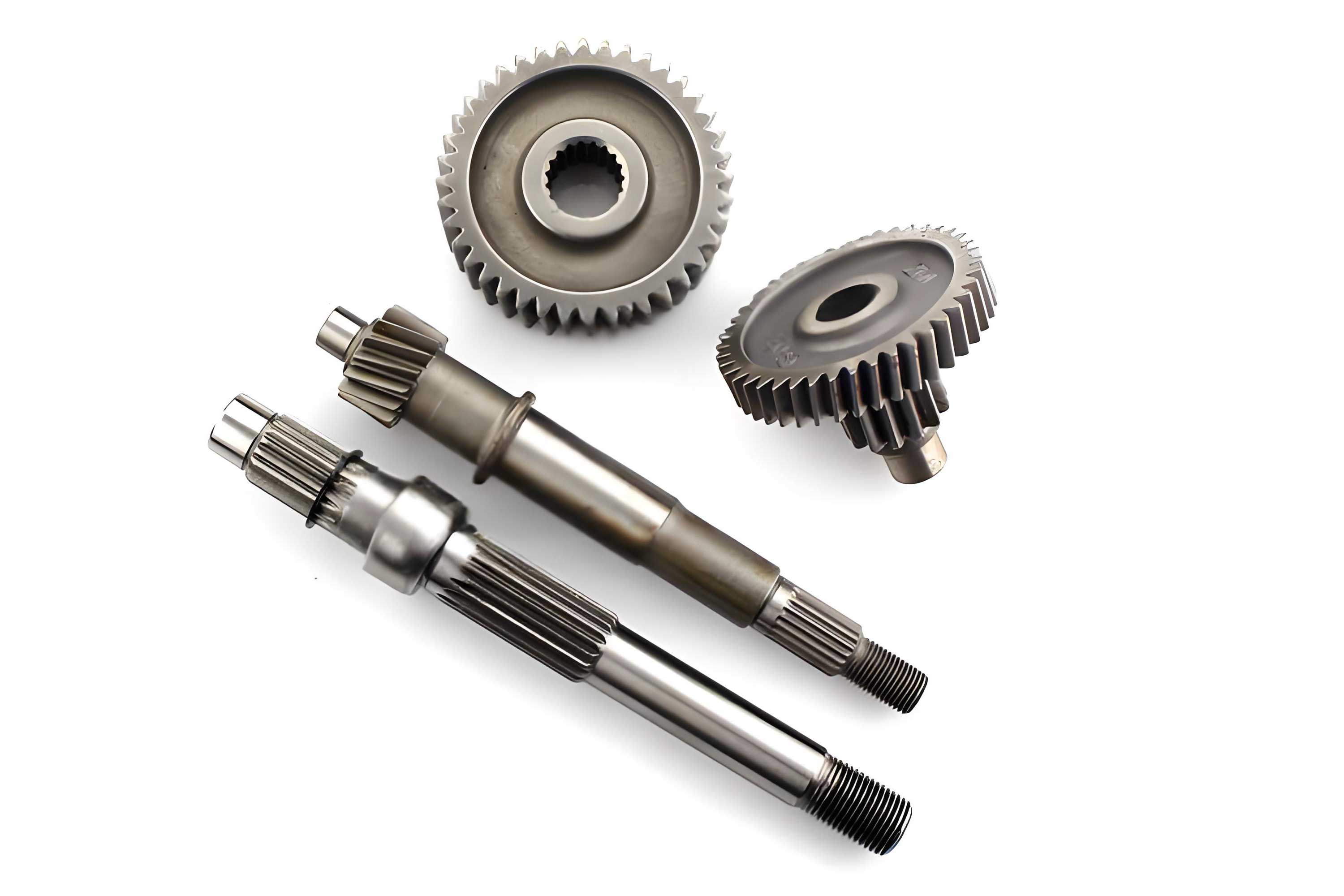
The image above illustrates a typical worm gear drive assembly, highlighting the meshing between the worm and worm wheel. In my model, similar principles apply, but with internal engagement and roller enveloping features. The visualization aids in understanding the geometric relationships and validating the contact analysis for this worm gear drive variant.
In conclusion, my investigation into the roller enveloping internal engagement worm gear drive reveals that key parameters profoundly impact its contact and lubrication performance. The worm-wheel rotational deflection angle \(\beta\) is the most influential factor, with an optimal range of \(0^\circ\) to \(40^\circ\) to balance lubrication and contact characteristics. Increasing the roller radius \(R\) uniformly improves both aspects, making it a straightforward design enhancement for worm gear drive systems. The center distance \(A\) and transmission ratio \(i_{21}\) have secondary effects but should be considered in holistic design optimization. Through numerical analysis and 3D modeling, I have verified that appropriate parameter selection can enhance load-sharing, reduce backlash, and improve efficiency in worm gear drive applications. This work provides a foundation for further research and development in advanced worm gear drive technologies, aiming to meet the stringent demands of modern industrial machinery. Future studies could explore dynamic effects, thermal behavior, and material interactions to refine the performance of worm gear drive systems even further.
To encapsulate the mathematical core, the governing equations for the worm gear drive are restated below for reference:
Meshing equation for contact lines:
$$ \theta = \arctan\left( \frac{i u – u\sin\beta + a_2\sin\beta – a_2 i – A\cos\varphi_2\sin\beta + c_2\cos\beta\sin\varphi_2}{-a_2\cos\beta + A\cos\beta + b_2\cos\beta\sin\varphi_2 + u\cos\varphi_2\cos\beta} \right) $$
Lubrication angle:
$$ \mu = \arcsin \frac{|v_{12x}^p (v_{12y}^p / R – \omega_{12y}^p) + v_{12y}^p \omega_{12x}^p|}{\sqrt{(v_{12x}^p / R – \omega_{12y}^p)^2 + (\omega_{12x}^p)^2} \sqrt{(v_{12x}^p)^2 + (v_{12y}^p)^2}} $$
Induced normal curvature:
$$ k_{12}^\sigma = -\frac{(\omega_{12y}^p + v_{12x}^p / R_k)^2 + (\omega_{12x}^p)^2}{\Psi} $$
These formulas, combined with the parametric insights, offer a comprehensive toolkit for designing high-performance worm gear drive systems. I encourage engineers to leverage these findings in their work, continually pushing the boundaries of what worm gear drive technology can achieve in precision applications.