
The pursuit of superior performance in power transmission systems for heavy-duty vehicles, aerospace applications, and other demanding fields has consistently driven the advancement of hypoid gear technology. Hyperboloid gears offer distinct advantages, including high load capacity, smooth torque transfer, and the ability to achieve significant speed reduction ratios with non-intersecting, offset axes. This offset configuration allows for lower vehicle chassis height and optimized drivetrain packaging. However, the very complexity of their hyperboloidal geometry and the localized tooth contact present significant challenges in final finishing processes to ensure quiet and durable operation.
Lapping, as a post-heat-treatment finishing process, is widely adopted in the mass production of automotive hyperboloid gears due to its cost-effectiveness and remarkable ability to reduce mesh noise and improve contact patterns compared to grinding. Traditional lapping methodologies rely on theoretical tooth surfaces generated from machine tool settings. A predetermined set of lapping machine adjustment parameters—typically the pinion offset (V), pinion axial (H), and gear axial (J) positions—are calculated based on the theoretical model and its simulated tooth contact analysis (TCA). The fundamental challenge with this approach stems from inevitable manufacturing errors and, more significantly, heat treatment distortions. These factors cause the actual, physical tooth surface of a produced gear pair to deviate from its ideal theoretical design. Consequently, when the theoretically derived lapping parameters are applied to the real parts, the actual contact point during the abrasive lapping process shifts from its intended location. This misalignment leads to suboptimal lapping results, including incomplete coverage, biased contact patterns, and inconsistent performance across production batches.
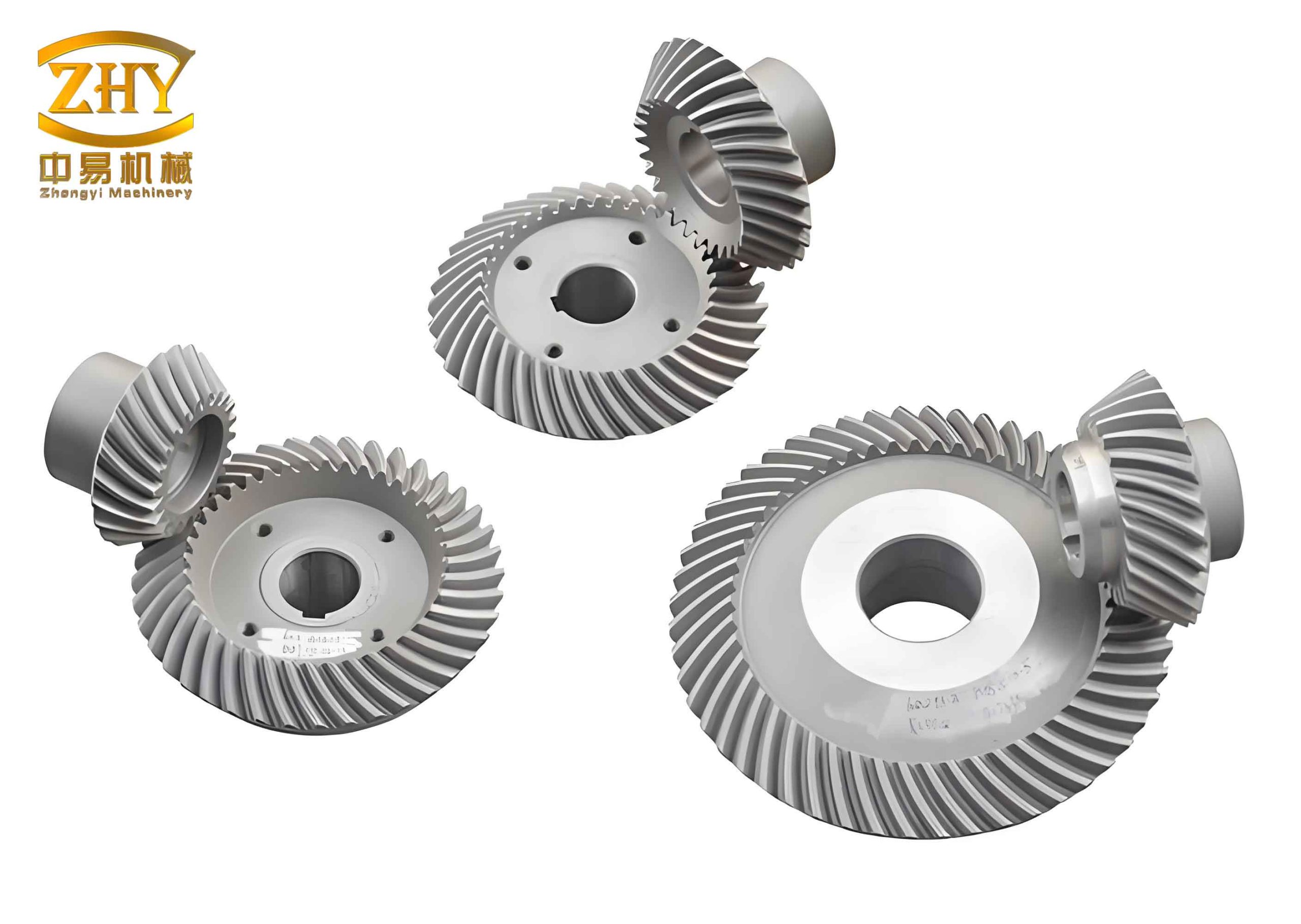
To overcome this limitation and achieve stable, high-quality lapping results, we propose and investigate a novel lapping position control methodology grounded in the real tooth surfaces of the manufactured hyperboloid gears. This approach bypasses the assumption of a perfect theoretical surface. Instead, it begins with the precise measurement of the actual gear and pinion flanks. A high-fidelity digital twin of the real tooth surface is constructed using Non-Uniform Rational B-Spline (NURBS) surface fitting. Based on this digital model, a real tooth surface contact analysis (RTCA) is performed to establish the precise mathematical relationship between the lapping adjustment parameters (V, H, J) and the resulting meshing contact position on the real flank. This enables the formulation of a control model capable of dictating both the lapping point location and its desired movement direction across the entire tooth surface. The ultimate goal is to achieve a controlled, conformal “full-tooth-surface lapping” process that adapts to the actual geometry of the manufactured gear pair.
Mathematical Modeling of the Lapping Process
The core of the lapping control strategy lies in a precise mathematical description of the relative motion and contact condition between the pinion and gear flanks during the abrasive process. We establish a coordinate system framework to model this interaction.
Let $S_1 (O_1 – X_1Y_1Z_1)$ and $S_2 (O_2 – X_2Y_2Z_2)$ be coordinate systems rigidly connected to the pinion and gear, respectively. A fixed machine coordinate system is denoted as $S_h (O_h – X_hY_hZ_h)$. Two auxiliary coordinate systems $S_d$ and $S_f$ are also defined for transformation convenience. The relative positioning of the gear pair during lapping is controlled by three primary adjustment parameters: $V$ (pinion offset direction), $H$ (pinion axial direction), and $J$ (gear axial direction).
During the lapping process, the two flanks are in continuous contact at a point. At this instantaneous contact point, both the position vectors and the unit normal vectors of the two surfaces must coincide when expressed in the same coordinate system (e.g., $S_h$). This yields the fundamental condition of contact:
$$
\mathbf{r}_h^{(1)}(u_1, v_1; \phi_1, V, H, J) = \mathbf{r}_h^{(2)}(u_2, v_2; \phi_2)
$$
$$
\mathbf{n}_h^{(1)}(u_1, v_1; \phi_1) = \mathbf{n}_h^{(2)}(u_2, v_2; \phi_2)
$$
Here, $u_k, v_k$ are the surface parameters for the pinion ($k=1$) and gear ($k=2$). $\phi_1$ and $\phi_2$ are the rotational angles of the pinion and gear, defining their relative rolling motion. The pinion surface vector $\mathbf{r}_h^{(1)}$ is explicitly dependent on the lapping adjustments $V, H, J$.
According to gear meshing theory, a necessary condition for contact is that the relative velocity at the contact point has no component along the common normal direction. This gives the meshing equation:
$$
\mathbf{n}_h \cdot \mathbf{v}_h^{(12)} = f(u_1, v_1, \phi_1, u_2, v_2, \phi_2, V, H, J) = 0
$$
where $\mathbf{v}_h^{(12)}$ is the relative velocity vector between the two flanks at the contact point in $S_h$.
Furthermore, during lapping, a specific backlash or clearance condition is typically maintained. This can be expressed as a kinematic constraint relating the adjustment parameters:
$$
J + H \tan \delta_1 + \sqrt{r_1^2 – E^2} – \sqrt{r_1^2 – V^2} = 0
$$
where $\delta_1$ is the pinion pitch angle, $r_1$ is the pinion nominal radius, and $E$ is the gear offset.
Equations (1), (2), and (3) form a system. Given a set of lapping parameters ($V, H, J$), one can solve for the seven unknowns ($u_1, v_1, \phi_1, u_2, v_2, \phi_2$) that define the contact point. However, for lapping control, the inverse problem is critical: given a desired contact point location on the tooth surface, determine the required adjustments $V, H, J$. We present a method for this inverse calculation, focusing on defining the target point on the gear flank (e.g., the convex side).
The gear flank is considered in a rotational projection within its axial plane. Let $P$ be the pitch point, $A$ the cone distance, $M$ the nominal contact point, and $M^*$ the target lapping point. The shifts from $M$ to $M^*$ along the tooth length and profile directions are denoted as $s_1$ and $s_2$, respectively. The coordinates $(X_2^*, Y_2^*)$ of $M^*$ in this 2D projection relate to the 3D coordinates $(x_2, y_2, z_2)$ of the gear surface $\mathbf{r}^{(2)}(u_2, v_2)$ by:
$$
x_2 = X_2^*
$$
$$
\sqrt{y_2^2 + z_2^2} = Y_2^*
$$
Given the target location $(X_2^*, Y_2^*)$, one can solve Equation (4) to find the corresponding surface parameters $(u_2, v_2)$. With $(u_2, v_2)$ known, Equations (1), (2), and (3) can be solved simultaneously for the adjustment parameters $V, H, J$, and the corresponding pinion parameters, using an iterative numerical method like Newton-Raphson. The Jacobian matrix for this system is constructed from the partial derivatives of the equations with respect to all unknowns. This framework constitutes the mathematical control model for full-tooth-surface lapping of hyperboloid gears.
| Description | Equation |
|---|---|
| Position Vector Equality | $\mathbf{r}_h^{(1)}(u_1, v_1; \phi_1, V, H, J) = \mathbf{r}_h^{(2)}(u_2, v_2; \phi_2)$ |
| Normal Vector Equality | $\mathbf{n}_h^{(1)}(u_1, v_1; \phi_1) = \mathbf{n}_h^{(2)}(u_2, v_2; \phi_2)$ |
| Meshing Equation | $\mathbf{n}_h \cdot \mathbf{v}_h^{(12)} = f(u_1, v_1, \phi_1, u_2, v_2, \phi_2, V, H, J) = 0$ |
| Backlash Constraint | $J + H \tan \delta_1 + \sqrt{r_1^2 – E^2} – \sqrt{r_1^2 – V^2} = 0$ |
| Target Point Projection (Gear) | $x_2 = X_2^*,\quad \sqrt{y_2^2 + z_2^2} = Y_2^*$ |
Digitization and Characterization of Real Tooth Surfaces
To implement the control model, an accurate digital representation of the real, manufactured tooth surfaces is paramount. This is achieved through coordinate measurement and advanced surface fitting techniques.
The real flanks of the hyperboloid gears are measured using a high-precision gear measuring machine (e.g., a CNC gear inspector). A grid of discrete points is captured over the entire active flank. A common sampling strategy involves taking points along the profile (tooth height) direction and the lengthwise (face width) direction. For instance, 5 points along the profile and 9 points along the length, resulting in 45 measurement points per flank, provide a sufficiently dense data set for high-quality surface reconstruction.
| Direction | Number of Points | Description |
|---|---|---|
| Profile (v-direction) | 5 | From root to tip |
| Lengthwise (u-direction) | 9 | From heel to toe |
| Total Points per Flank | 45 | 5 x 9 grid |
To create a continuous and differentiable mathematical model from these discrete points, we employ Non-Uniform Rational B-spline (NURBS) surface fitting. NURBS surfaces are industry-standard for representing free-form geometries due to their flexibility, accuracy, and excellent mathematical properties, including the computation of derivatives. A bi-cubic NURBS surface is defined as:
$$
\mathbf{S}(u,v) = \frac{\sum_{i=1}^{m} \sum_{j=1}^{n} N_{i,3}(u) N_{j,3}(v) w_{i,j} \mathbf{P}_{i,j}}{\sum_{i=1}^{m} \sum_{j=1}^{n} N_{i,3}(u) N_{j,3}(v) w_{i,j}}
$$
where $m$ and $n$ are the numbers of control points in the $u$ and $v$ directions, respectively; $\mathbf{P}_{i,j}$ are the control points; $w_{i,j}$ are the corresponding weights; and $N_{i,3}(u)$ and $N_{j,3}(v)$ are the cubic B-spline basis functions. The fitting process typically involves two steps: first, fitting B-spline curves through the rows of data points to obtain intermediate control points, and then fitting through the columns of these intermediate points to obtain the final control net for the surface.
The accuracy of the fitted NURBS surface as a representation of the real flank must be validated. This is done by comparing the fitted surface to a denser set of points from a known source (e.g., the theoretical surface or a much denser measurement). The normal distance $\delta$ from a verification point $\mathbf{r}_0 = (x_0, y_0, z_0)$ to the fitted NURBS surface $\mathbf{S}(u_c,v_c) = (x_c, y_c, z_c)$ is found by solving:
$$
x_c + n_x \delta = x_0
$$
$$
y_c + n_y \delta = y_0
$$
$$
z_c + n_z \delta = z_0
$$
where $\mathbf{n} = (n_x, n_y, n_z)$ is the unit normal vector of the fitted surface at the closest point $(u_c, v_c)$. For gear lapping applications, the required fitting accuracy is exceptionally high. Industry standards, such as those referenced from Gleason works, indicate that a surface separation as small as $0.00635 \text{ mm}$ can be detected as a contact pattern shift using marking compound. Therefore, the maximum fitting error $\delta_{\text{max}}$ should be significantly lower than this threshold. Our validation shows that with a well-conditioned 5×9 point grid, the maximum fitting error for hyperboloid gear flanks is typically well below $0.1 \mu\text{m}$, making the digital NURBS model a highly faithful and precise substitute for the physical real tooth surface in all subsequent analyses.
Curvature Analysis and Contact Simulation for Real Flanks
With the real tooth surface represented as a differentiable NURBS function $\mathbf{r}_k = \mathbf{r}_k(u_k, v_k)$, we can perform a local curvature analysis which is essential for predicting the contact ellipse—the area of contact under light load during lapping or roll testing. This prediction is a key component of the Real Tooth Contact Analysis (RTCA).
The first and second fundamental forms of the surface are required. The first derivatives, $\mathbf{r}_{u_k}$ and $\mathbf{r}_{v_k}$, are obtained by differentiating the NURBS representation, which involves computing derivatives of the B-spline basis functions $N_{i,3}^{(q)}$:
$$
N_{i,3}^{(q)} = 3 \left( \frac{N_{i,2}^{(q-1)}}{u_{i+p}-u_i} – \frac{N_{i+1,2}^{(q-1)}}{u_{i+p+1}-u_{i+1}} \right)
$$
where $q$ is the order of the derivative. Similarly, second derivatives $\mathbf{r}_{uu_k}$, $\mathbf{r}_{vv_k}$, and the mixed derivative $\mathbf{r}_{uv_k}$ can be calculated. The unit normal vector at any point is:
$$
\mathbf{n}_k(u_k, v_k) = \frac{\mathbf{r}_{u_k} \times \mathbf{r}_{v_k}}{||\mathbf{r}_{u_k} \times \mathbf{r}_{v_k}||}
$$
The coefficients of the first fundamental form $E, F, G$ and the second fundamental form $L, M, N$ are then computed:
$$
E = \mathbf{r}_{u} \cdot \mathbf{r}_{u}, \quad F = \mathbf{r}_{u} \cdot \mathbf{r}_{v}, \quad G = \mathbf{r}_{v} \cdot \mathbf{r}_{v}
$$
$$
L = \mathbf{r}_{uu} \cdot \mathbf{n}, \quad M = \mathbf{r}_{uv} \cdot \mathbf{n}, \quad N = \mathbf{r}_{vv} \cdot \mathbf{n}
$$
The principal curvatures $\kappa_1$ and $\kappa_2$ (the maximum and minimum normal curvatures) and their corresponding principal directions $\mathbf{T}_1, \mathbf{T}_2$ are found by solving the eigenvalue problem derived from the fundamental forms. The principal directions satisfy the differential equation for curvature lines:
$$
\begin{vmatrix}
(dv)^2 & -du\,dv & (du)^2 \\
E & F & G \\
L & M & N
\end{vmatrix} = 0
$$
For two surfaces in point contact under a light load $W$, the dimensions of the contact ellipse can be approximated using Hertzian contact theory. The relative curvature $\kappa_{\Sigma}$ at the contact point and the angle between the principal directions of the two surfaces are calculated. The semi-major axis $a$ and semi-minor axis $b$ of the contact ellipse are given by:
$$
a = \alpha^* \left( \frac{3W}{2E’ \kappa_{\Sigma}} \right)^{1/3}, \quad b = \beta^* \left( \frac{3W}{2E’ \kappa_{\Sigma}} \right)^{1/3}
$$
where $E’$ is the combined modulus of elasticity, and $\alpha^*, \beta^*$ are coefficients dependent on the curvature geometry. This capability to compute the contact ellipse for the real, measured flanks is what distinguishes the RTCA from conventional TCA. It allows for the simulation of the contact pattern that would actually appear during a roll test of the manufactured gear pair, providing a critical verification step before physical lapping and a guide for planning the lapping path.
Case Study: Simulation and Experimental Verification
To demonstrate the effectiveness of the proposed real tooth surface lapping control method, we present a detailed case study involving a specific hypoid gear pair. The basic blank geometry parameters of the gear set are listed below.
| Parameter | Pinion (Concave) | Gear (Convex) |
|---|---|---|
| Number of Teeth | 8 | 39 |
| Hand of Spiral | Left | Right |
| Pressure Angle | 22.81° | 22.81° |
| Face Width | 44.91 mm | 41 mm |
| Offset | 25.4 mm | |
| Spiral Angle | 45.07° | 33.92° |
The manufactured gear and pinion were measured using a precision gear measuring center. The coordinates of the 45 discrete points for each flank were acquired. These points were then fitted using the bi-cubic NURBS method described earlier, creating the digital real tooth surfaces.
First, a Real TCA (RTCA) was performed at the theoretical nominal assembly position ($V=25.4\text{mm}, H=0, J=0$). Solving Equations (1)-(3) using the NURBS surface models yielded the path of contact and the predicted contact ellipse on the gear convex flank. The simulation showed a centered contact pattern, validating the basic correctness of the digital models.
The core of the full-tooth-surface lapping strategy is to move the contact point systematically across the flank. We defined a lapping path consisting of five target points: the nominal center point (K1), a point shifted towards the toe (K2), a point shifted towards the root (K3), a point shifted towards the heel (K4), and a point shifted towards the tip (K5). For instance, shifting from K1 to K2 corresponds to a lengthwise shift $s_1 = -0.25b$ (where $b$ is the face width) and a profile shift $s_2=0$. The desired coordinates $(X_2^*, Y_2^*)$ for each target point were calculated accordingly.
For each target point $M^*$ on the gear flank, the corresponding surface parameters $(u_2, v_2)$ were determined via Equation (4). Subsequently, the system of Equations (1)-(3) was solved iteratively to find the required lapping adjustment parameters $V, H, J$ that would bring the real flanks into contact precisely at that desired point, while satisfying the meshing and backlash conditions. The calculated adjustments for moving from the nominal position (K1) to the other four target points are summarized below.
| Target Point | Shift $(s_1, s_2)$ | $\Delta V$ (mm) | $\Delta H$ (mm) | $\Delta J$ (mm) |
|---|---|---|---|---|
| K2 (Toe) | ($-0.25b$, 0) | 0.323 | -0.440 | 0.029 |
| K4 (Heel) | ($+0.25b$, 0) | -0.305 | 0.454 | -0.044 |
| K5 (Tip) | (0, $+0.25h$) | 0.297 | 0.427 | -0.042 |
| K3 (Root) | (0, $-0.25h$) | -0.318 | -0.445 | 0.034 |
Using these calculated $V, H, J$ values, a sequence of RTCA simulations was run. The results successfully demonstrated that the contact ellipse could be precisely positioned at the toe, heel, tip, and root regions of the gear flank, confirming the validity of the control model. A simulated “full-tooth-surface” lapping sequence, following the path K1→K2→K3→K4→K5, showed a comprehensive coverage of the active flank area.
To physically validate the method, a CNC lapping/rolling test was conducted. A lapping program was generated for the CNC rolling tester. This program sequentially commanded the machine axes to move to the calculated $(V, H, J)$ positions corresponding to the five target lapping points. The gear pair was run under light load with lapping compound at each position. The resulting contact patterns on the gear convex flank were recorded. The experimental contact patterns showed excellent agreement with the RTCA simulations. The pattern was successfully moved to the toe, heel, tip, and root as commanded, and the final composite pattern from the sequence indicated a complete and uniform lapping coverage over the entire tooth surface. This experimental evidence strongly corroborates the proposed methodology, proving that precise, controlled full-tooth-surface lapping of hyperboloid gears based on their real measured geometry is not only feasible but highly effective.
Conclusion
This study has established a robust and precise methodology for controlling the lapping process of hyperboloid gears based on their actual, manufactured tooth surfaces. The limitations of traditional lapping methods, which rely on theoretical geometry and are adversely affected by manufacturing errors and heat treatment distortions, have been addressed by shifting the foundation of the control model to the real gear flanks.
The core of the method involves three integrated steps: first, the high-fidelity digitization of the real tooth surfaces via coordinate measurement and NURBS fitting; second, the development of a mathematical lapping control model that explicitly links the machine adjustment parameters (V, H, J) to a specific contact point location on the real flank geometry; and third, the use of Real Tooth Contact Analysis (RTCA) to simulate and verify contact patterns prior to physical processing.
The case study and subsequent experimental validation on a CNC rolling tester provide conclusive evidence. By calculating the necessary machine adjustments to position the contact point at predetermined locations (toe, heel, tip, root), and then executing these adjustments in sequence, a complete and uniform lapping coverage across the entire active tooth surface was achieved. This “conformal lapping” strategy ensures that the abrasive process actively adapts to the unique geometry of each manufactured gear pair, leading to superior and more consistent lapping results compared to fixed-parameter methods.
This approach represents a significant step towards the intelligent, digital finishing of complex gears. It enhances process stability in mass production, reduces reliance on operator skill and trial-and-error, and ultimately contributes to the manufacturing of quieter, more reliable, and higher-performance hyperboloid gear drives for the most demanding applications.