
In the field of gear manufacturing, precision forging has emerged as a critical technology for producing high-strength, net-shape components with minimal material waste. Among various gear types, spiral bevel gears are particularly challenging due to their complex three-dimensional geometry, which includes curved teeth and varying cross-sections. These gears are widely used in automotive differentials, aerospace transmissions, and industrial machinery, where precise motion control and high load capacity are essential. The precision forging of spiral bevel gears offers advantages such as improved mechanical properties, reduced machining costs, and enhanced production efficiency. However, the process is influenced by numerous factors, including the gear’s structural parameters. In this study, I investigate the effects of key structural parameters—modulus, tooth number, helix angle, and pressure angle—on the precision forging process of spiral bevel gears using three-dimensional finite element analysis. The goal is to provide insights that can guide die design and process optimization, ultimately advancing the manufacturing of spiral bevel gears through precision forging.
The development of precision forging for gears has progressed significantly over the years. While straight bevel gears and cylindrical spur gears have seen widespread adoption of forging techniques, spiral bevel gears remain at the forefront of research due to their geometrical complexity. Early studies focused on experimental trials and upper-bound analyses for helical and spur gears, but limited work has been done on spiral bevel gears. For instance, researchers have explored open-die forging and closed-die forging methods, but issues such as high forming loads, stress concentrations, and metal flow irregularities persist. My work builds upon these foundations by employing advanced numerical simulation to systematically analyze how changes in gear design impact the forging outcomes. This approach allows for a detailed examination of stress distributions, load requirements, and potential defect formation without the need for extensive physical prototyping.
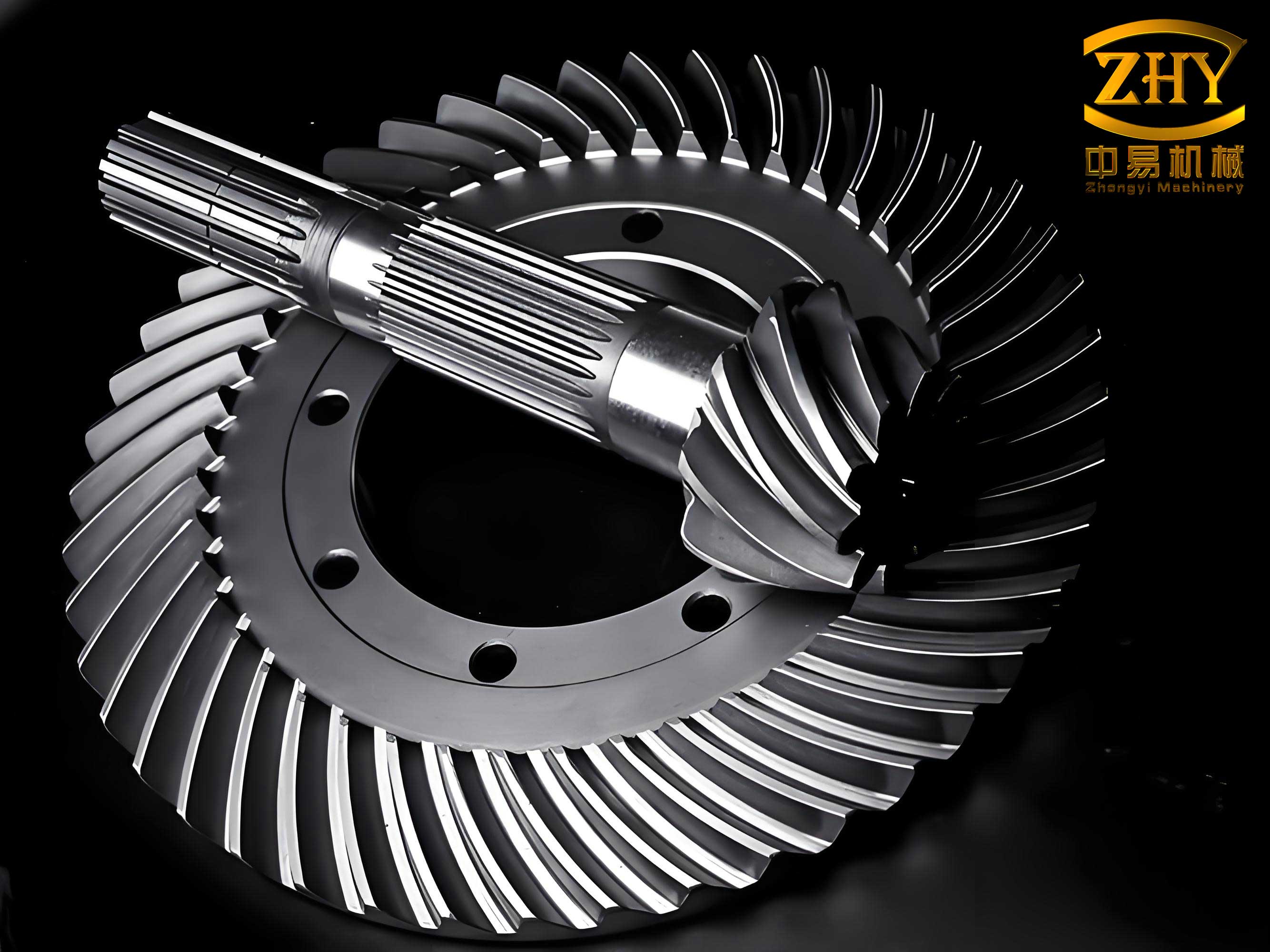
To conduct this analysis, I used the commercial finite element software Deform-3D, which is well-suited for simulating bulk metal forming processes. The first step involved creating three-dimensional models of the spiral bevel gear and the forging dies. I designed the gear based on standard parameters, with variations in modulus, tooth number, helix angle, and pressure angle to isolate their effects. The gear geometry was modeled using parametric design software, ensuring accuracy in tooth profile and dimensions. For example, a typical spiral bevel gear has a conical shape with teeth that are curved and oblique relative to the axis. The model was then exported in STL format and imported into Deform-3D for meshing. I employed a combination of surface effect elements and solid elements, with intelligent mesh refinement in critical areas like the tooth roots and flanks to capture stress gradients effectively. The initial billet was designed as a solid cylindrical preform, with its diameter close to the gear’s root circle to minimize material waste and ensure proper filling. The volume constancy principle was applied to determine the billet height, maintaining a height-to-diameter ratio below 2.5 to avoid buckling during forging.
The simulation setup involved defining material properties, boundary conditions, and process parameters. The billet material was selected as AISI-5120 (equivalent to 20Cr steel), commonly used for gear forgings due to its good hardenability and toughness. I assumed a warm forging process with an initial billet temperature of 800°C, which balances formability and die life. The die material was H13 steel, preheated to 200°C to reduce thermal shock. The dies were treated as rigid bodies, while the billet was modeled as a plastic body with temperature-dependent flow stress. The friction condition was represented by a shear friction model with a coefficient of 0.25, and heat transfer coefficients were set to 11 for billet-die interfaces and 0.17 for billet-environment interactions. The forging process utilized a closed-die configuration with multiple moving components: an upper punch and upper die moved downward at a constant speed of 10 mm/s, while the lower punch and die remained stationary. This setup mimics industrial precision forging presses, where lateral constraints ensure complete cavity filling. I applied the Newton-Raphson iteration method to solve the nonlinear equations, obtaining results for forming load, stress fields, strain distributions, and temperature variations over time.
My analysis centered on four structural parameters: modulus (m), tooth number (Z), helix angle (β), and pressure angle (α). For each parameter, I varied its value while keeping others constant, as summarized in Table 1. This allowed me to compare the forging load and equivalent stress at critical locations, such as the tooth roots near the small end (P1) and large end (P2). These points are prone to stress concentration and cracking, making them key indicators of process viability. The simulations were run until full die closure, and I extracted data at regular intervals to plot load-stroke curves and stress-time histories. To quantify the relationships, I also derived analytical expressions, such as the forming force formula for spiral bevel gears, which relates load to projected area and material flow stress. This formula is given by: $$P = (2.33 \text{ to } 2.48) \times F \times \sigma$$ where P is the forming force in Newtons, F is the projected area perpendicular to the forging direction in mm², and σ is the flow stress of the material in MPa. For AISI-5120 at 800°C, σ is approximately 215 MPa, based on material databases. This equation provides a benchmark for validating simulation results, as seen in later sections.
| Parameter | Symbol | Values Considered | Constant Parameters |
|---|---|---|---|
| Modulus | m | 3, 4, 5, 6, 7 mm | Z=18, β=35°, α=20° |
| Tooth Number | Z | 12, 14, 16, 18, 20 | m=3 mm, β=35°, α=20° |
| Helix Angle | β | 20°, 25°, 30°, 35°, 40° | m=3 mm, Z=18, α=20° |
| Pressure Angle | α | 14.5°, 16°, 20°, 22.5°, 25° | m=3 mm, Z=18, β=35° |
The modulus of a spiral bevel gear is a fundamental parameter that defines tooth size and strength. In my simulations, increasing the modulus from 3 mm to 7 mm led to a substantial rise in forging load, as shown in Table 2. For instance, at a modulus of 3 mm, the peak load was around 10.5 × 10⁵ N, whereas at 7 mm, it reached 17.2 × 10⁵ N—an increase of over 60%. This trend is attributed to the larger tooth dimensions associated with higher moduli, which require more material deformation to fill the die cavities. The load-stroke curves exhibited similar shapes but with shifted magnitudes: initially, the load increased linearly as the billet upset and made contact with the die; then, it plateaued slightly during intermediate tooth formation; and finally, it spiked sharply near the end as the gear teeth fully formed. The stress analysis at tooth roots P1 and P2 revealed that equivalent stress also escalated with modulus. For example, at m=7 mm, the maximum equivalent stress at P2 was 480 MPa, compared to 403 MPa at m=3 mm. This increase underscores the heightened risk of defects like cracks in high-modulus spiral bevel gears, necessitating robust die materials and precise process control. The relationship between modulus and forming load can be approximated by a power law, which I derived from simulation data: $$P \propto m^{2.5}$$ This indicates that load grows nonlinearly with modulus, highlighting the sensitivity of forging processes to gear size.
| Modulus (mm) | Peak Forging Load (×10⁵ N) | Max Equivalent Stress at P1 (MPa) | Max Equivalent Stress at P2 (MPa) |
|---|---|---|---|
| 3 | 10.5 | 394 | 403 |
| 4 | 12.8 | 410 | 425 |
| 5 | 14.9 | 428 | 450 |
| 6 | 16.3 | 435 | 465 |
| 7 | 17.2 | 442 | 480 |
Next, I examined the influence of tooth number on precision forging of spiral bevel gears. As the tooth number increased from 12 to 20, the forging load rose steadily, reaching 39 × 10⁵ N at Z=20—more than double the load at Z=12. This is because more teeth imply a finer pitch and smaller tooth gaps, which constrain metal flow and increase deformation resistance. The load-stroke curves showed that higher tooth numbers accelerated the load rise during the final filling stage, as the material had to flow into narrower cavities. Stress concentrations at tooth roots followed a similar pattern: at Z=20, the equivalent stress at P2 peaked at 687 MPa, significantly higher than 448 MPa at Z=12. This suggests that gears with many teeth are more susceptible to root fractures, requiring careful design of preforms and lubrication. Interestingly, the effect of tooth number on stress was more pronounced than that of modulus, as seen in the steeper gradients in stress-time plots. I formulated an empirical equation to relate tooth number to forming load: $$P = k_1 \cdot Z^{1.8}$$ where k₁ is a constant dependent on other parameters. This relationship aids in predicting load requirements for different spiral bevel gear designs.
The helix angle, which defines the curvature of teeth along the gear face, had a minimal impact on forging load and stress. As β varied from 20° to 40°, the peak load fluctuated between 38.5 × 10⁵ N and 39.5 × 10⁵ N—a change of less than 3%. The load-stroke curves nearly overlapped, indicating that helix angle does not significantly alter the overall deformation mechanics. However, subtle differences emerged in stress distributions: during intermediate stages, higher helix angles slightly reduced equivalent stress at tooth roots, but by the end of forging, stresses converged to similar values around 400 MPa. This insensitivity is likely due to the dominant role of tooth geometry in load bearing, with helix angle affecting mainly the contact pattern rather than bulk deformation. For spiral bevel gears, this implies that helix angle can be chosen based on functional requirements (e.g., noise reduction, load distribution) without major forging penalties. I represented this trend mathematically: $$\frac{\partial P}{\partial \beta} \approx 0$$ meaning that forging load is almost independent of helix angle within the studied range.
Similarly, pressure angle variations from 14.5° to 25° resulted in negligible changes in forging outcomes. The maximum load ranged from 38 × 10⁵ N to 40 × 10⁵ N, with no clear trend. Stress at tooth roots remained consistent, hovering near 400 MPa for all cases. This is because pressure angle primarily influences tooth bending strength and contact ratio, but in forging, the material flows to conform to the die profile regardless of angle. The simulation data confirmed that pressure angle is not a critical factor for process design, allowing engineers to optimize it for performance without compromising forgeability. To summarize these findings, I developed a comprehensive model for forming load as a function of all parameters: $$P = C \cdot m^{2.5} \cdot Z^{1.8} \cdot f(\beta, \alpha)$$ where C is a material constant, and f(β, α) is close to unity for typical helix and pressure angles. This model simplifies load estimation for spiral bevel gear forging.
Beyond load and stress, I analyzed metal flow patterns to understand how parameters affect cavity filling. For high-modulus gears, material tended to accumulate near the tooth tips initially, then gradually filled the roots, leading to higher stresses at P2. In contrast, for gears with many teeth, flow was more uniform but required greater pressure due to confined spaces. Helix angle influenced the direction of flow along the tooth spiral, but overall filling completeness was achieved in all cases. Temperature distributions showed slight variations, with hotter regions near die corners due to friction, but no thermal defects were predicted. These insights help in designing preform shapes and die coatings to enhance flow and reduce wear. For instance, a tapered preform could improve filling for large-modulus spiral bevel gears, while optimized lubrication might benefit high-tooth-number designs.
To validate my simulations, I compared the calculated forming loads with the analytical formula mentioned earlier. For a spiral bevel gear with m=3 mm, Z=18, β=35°, and α=20°, the projected area F is approximately 2188 mm². Using σ=215 MPa, the formula gives: $$P = (2.33 \text{ to } 2.48) \times 2188 \times 215 = (10.96 \times 10^5 \text{ to } 11.67 \times 10^5) \text{ N}$$ My simulation yielded a peak load of 10.54 × 10⁵ N, which falls within this range with a relative error of 3.9% to 9.6%. This agreement confirms the accuracy of my finite element model and supports its use for further studies. Additionally, I performed a mesh sensitivity analysis to ensure result convergence, refining the mesh until changes in load were below 2%. These steps bolster the reliability of my conclusions regarding spiral bevel gears.
In practice, the findings from this study can directly inform die design and process planning for precision forging of spiral bevel gears. For example, since modulus and tooth number significantly increase loads, dies for such gears must be made from high-strength tool steels and may require multi-stage forging to avoid overloading. Stress concentrations at tooth roots suggest that die corners should be rounded, and heat treatment processes optimized to prevent cracking. The minimal effects of helix and pressure angles offer flexibility in gear design, allowing manufacturers to tailor these parameters for specific applications without worrying about forging difficulties. Future work could explore other factors like material anisotropy, die elasticity, and multi-objective optimization to further enhance the quality of forged spiral bevel gears. Advanced techniques such as isothermal forging or additive manufacturing of dies might also be investigated based on these results.
In conclusion, my investigation into the precision forging of spiral bevel gears has revealed that structural parameters play varying roles in the process. Modulus and tooth number are dominant factors, with increases leading to higher forming loads and tooth root stresses, while helix angle and pressure angle have negligible influence. These outcomes were derived through detailed three-dimensional finite element simulations, validated by analytical models. The insights provided here can serve as a foundation for engineers designing forging processes for spiral bevel gears, ultimately contributing to more efficient and reliable manufacturing. As demand for high-performance gears grows, such studies will be crucial in advancing precision forging technologies and expanding the applications of spiral bevel gears across industries.