
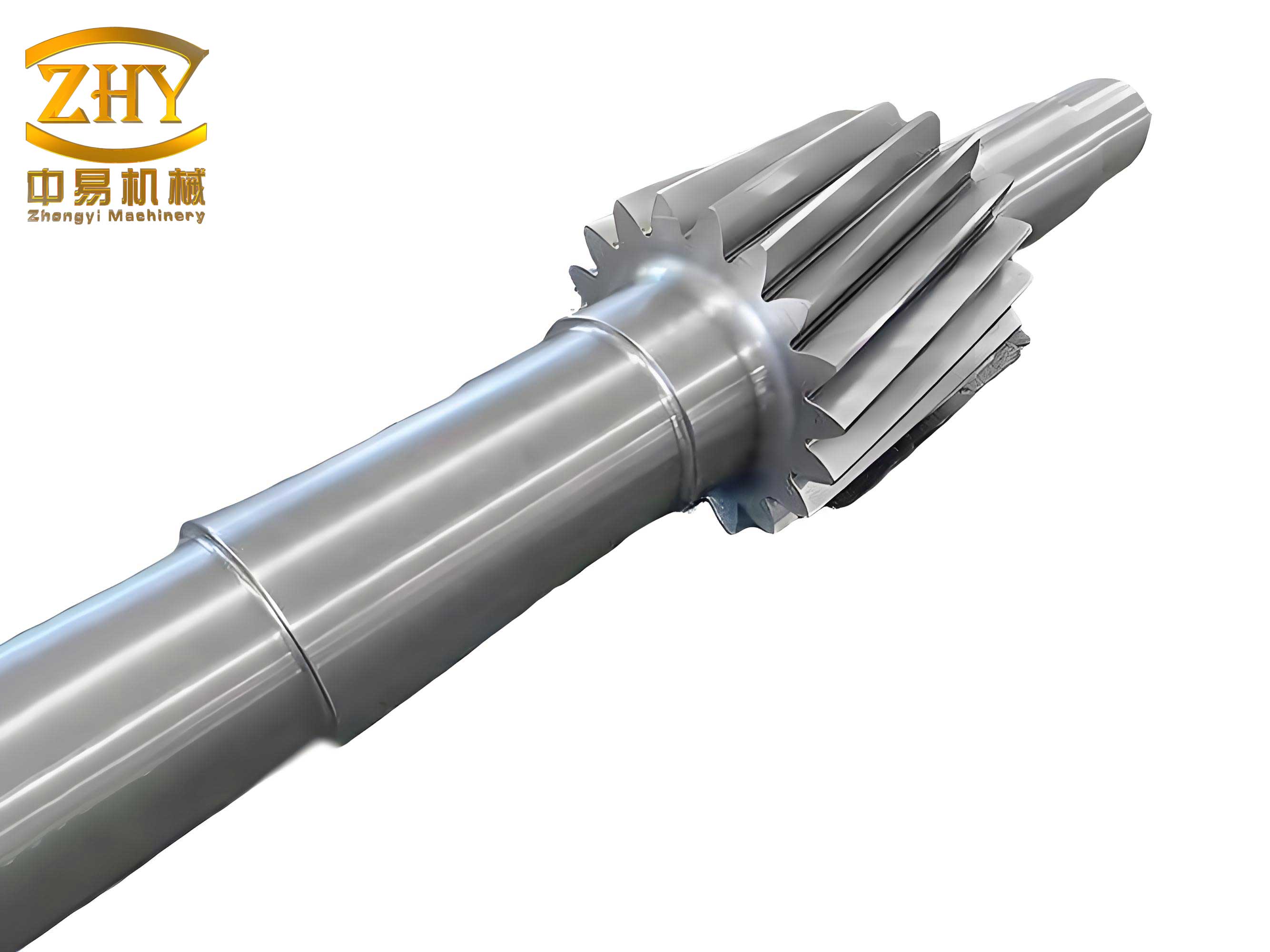
In modern industrial production, spanning sectors such as aerospace, transportation, general machinery, and printing, mechanical equipment invariably relies on critical components to ensure functionality. Among these, gear shafts stand out as fundamental elements in power transmission systems. The performance and longevity of the entire machinery are directly contingent upon the quality and precision of these gear shafts. Particularly within the diverse landscape of small and medium-sized enterprises, where production scales are varied and equipment is often heterogeneous, achieving consistent, high-quality output presents a significant challenge. The variety of gear shafts—each with distinct geometrical features, material requirements, and operational roles—necessitates a profound understanding and meticulous control over their manufacturing processes. To elevate the operational capability of machinery and guarantee the overall quality of mechanical products, a rigorous focus on the manufacturing quality of gear shafts is non-negotiable. This article delves into the prevalent issues encountered during the machining of gear shafts and systematically explores comprehensive pathways for process optimization and problem resolution.
Critical Challenges in Gear Shaft Machining
The machining process for gear shafts is influenced by a complex interplay of factors including raw material properties, operator skill, workshop environment, and the selected process parameters themselves. A thorough analysis of recurring problems is essential for continuous improvement. A predominant challenge lies in the precise control of component accuracy throughout the manufacturing sequence. It is imperative to enforce strict quality gates, prohibiting the use of substandard or out-of-tolerance components at any stage.
During machining, gear shaft blanks and intermediate workpieces are typically secured using fixtures and chucks. A common issue arises post-heat treatment: distortion or warping can cause end faces to become non-perpendicular to the axis. When such a component is clamped, it may not seat uniformly against the fixture’s locating surface, leading to instability and inducing vibrations during high-speed cutting operations. This vibration not only degrades surface finish and geometrical accuracy but also accelerates tool wear and can cause premature machine tool bearing failure. Therefore, developing robust methods for securing workpieces, compensating for inherent distortions, is a fundamental concern in gear shaft production.
Other frequent challenges include achieving the required surface roughness on gear teeth, maintaining precise tooth profile and lead accuracy, controlling micro-geometrical features like fillets and chamfers, and managing residual stresses induced during machining which can affect long-term dimensional stability. The cumulative effect of these issues can lead to increased noise, vibration, and harshness (NVH) in the final assembly, reduced load-carrying capacity, and shorter service life.
Principal Pathways for Enhancing Gear Shaft Machining
To address these challenges, a multi-faceted approach focusing on fixture management, process parameter optimization, auxiliary media selection, and metrology is required. The following analysis, using a model Y38 gear hobbing machine as a representative case, outlines key strategies.
1. Strengthening Fixture Management and Workholding Practices
Fixture integrity is paramount in gear shaft machining, as it directly governs the positional accuracy and rigidity of the workpiece during cutting. Inaccurate or worn fixtures translate directly into part errors. A rigorous management system for fixtures, including regular inspection and certification, is crucial.
The critical tolerance for a fixture is its radial runout (often measured as Total Indicator Reading, TIR), which directly affects the concentricity of the machined gear relative to the shaft’s bearing journals. The permissible runout is tightly linked to the desired gear quality grade. A typical specification is outlined below:
| Gear Accuracy Grade (AGMA/ISO Class) | Radial Runout Tolerance (mm) | Typical Application |
|---|---|---|
| A (Very High Precision) | ≤ 0.005 | Aerospace, high-speed drives |
| B (High Precision) | ≤ 0.010 | Automotive transmissions, precision industrial gears |
| C (Standard Precision) | ≤ 0.015 | General industrial machinery |
| D (Commercial Precision) | ≤ 0.025 | Agricultural equipment, non-critical applications |
The workholding procedure must be methodical:
- Blank Mounting: The machine spindle nose and fixture locating surfaces must be meticulously cleaned of oil, chips, and dirt. The gear blank should be placed with its designated datum face (usually the largest, most stable face) against the fixture’s support surface. No shims (copper sheets, paper, etc.) should be introduced between the blank and the support, as they introduce compliance and error. The blank must be evenly pulled down and seated uniformly. The clamping force must be sufficient to prevent movement but not excessive to cause elastic deformation of the blank or fixture. The deformation $ \delta $ under clamping force can be approximated for simple geometries, but for complex gear shaft blanks, finite element analysis (FEA) is often used: $$ \delta = f(F_{clamp}, E, \nu, Geometry) $$ where $F_{clamp}$ is the clamping force, $E$ is Young’s modulus, and $\nu$ is Poisson’s ratio.
- Shaft Alignment: For machining gears on an existing shaft (e.g., a pinion shaft), a dial indicator (thousandths gauge) must be used to check the radial runout of the bearing journal diameters and the gear’s pre-machined tip diameter near the fixture. The shaft is adjusted until the indicator reading over one full revolution is within the tolerance specified for the operation.
- Tool Arbor and Hob Mounting: Distinct arbors should be designated for roughing and finishing operations to prevent wear on the finishing arbor from affecting final quality. All spacers, bearings, and thrust washers must be clean and free of burrs. The hob must be slid onto the arbor gently; forceful hammering can damage the arbor’s precision taper and the hob’s bore, inducing runout. The hob’s axial location must be set according to the machine manual to ensure proper contact with the gear blank.
- Hob Head Alignment: The hob head, often mounted on a swivel base, must be set to the correct helix angle for the gear being cut. Misalignment leads to profile errors. The alignment is typically verified using a master gear or a precision level.
2. Optimization of Gear Hobbing Process Parameters
The selection of cutting parameters—cutting speed, feed rate, and depth of cut—is a science that balances productivity, tool life, and part quality. For gear shafts, this is particularly critical due to the interrupted cut and complex chip formation.
Determination of Cutting Speed ($v_c$): The cutting speed is primarily a function of the workpiece material, hob material (HSS, carbide), and desired tool life. It can be derived from Taylor’s tool life equation, adapted for hobbing:
$$ v_c \cdot T^n = C $$
where:
- $v_c$ is the cutting speed in m/min,
- $T$ is the tool life in minutes,
- $n$ is the Taylor exponent (typically 0.1-0.15 for HSS, 0.2-0.3 for carbide),
- $C$ is a constant dependent on material and tool.
A general guideline is to use lower speeds for roughing (to maximize metal removal rate and absorb shocks) and higher speeds for finishing (to improve surface finish). The module of the gear shaft also influences the choice; smaller modules can tolerate higher speeds. A reference table for common gear shaft materials is useful:
| Material | Hardness (HB) | Roughing $v_c$ (m/min) HSS Hob | Finishing $v_c$ (m/min) HSS Hob | Axial Feed $f_a$ (mm/rev) |
|---|---|---|---|---|
| Mild Steel (AISI 1020) | 150-200 | 40-60 | 50-70 | 1.5-3.0 |
| Alloy Steel (AISI 4140) | 200-250 | 30-45 | 40-55 | 1.2-2.5 |
| Alloy Steel (AISI 4340) | 250-300 | 25-40 | 35-50 | 1.0-2.0 |
| Case Hardening Steel (e.g., 20MnCr5) | 150-200 | 35-50 | 45-60 | 1.3-2.8 |
Determination of Number of Passes and Depth of Cut: The total stock to be removed and the required surface finish dictate the number of hobbling passes. For most gear shafts, a two-pass strategy (roughing + finishing) is standard. A three-pass strategy (roughing, semi-finishing, finishing) is used for high-precision gears or when material removal is substantial. The depth of cut for roughing $a_{p, rough}$ is typically 70-80% of the total tooth depth, leaving a finishing stock $a_{p, finish}$:
$$ a_{p, total} = a_{p, rough} + a_{p, finish} $$
$$ a_{p, finish} \approx (0.2 \text{ to } 0.3) \times \text{Module (m)} $$
If machine power or rigidity is limited, the roughing cut may be divided into two lighter passes.
Determination of Feed Rate ($f_a$): The axial feed rate per workpiece revolution is key to productivity. The maximum permissible feed is constrained by machine power, rigidity, hob strength, and desired chip geometry. For roughing, the highest feed within these limits is chosen. However, to avoid chatter—a self-excited vibration detrimental to gear shaft quality—the feed may need reduction if the system’s dynamic stiffness is low. Chatter avoidance involves complex dynamics, but a simplified stability lobe diagram concept applies: for a given spindle speed $N$, there is a limiting axial feed $f_{a,crit}$ below which cutting is stable.
$$ f_{a,actual} \leq f_{a,crit}(N, \text{System Damping, Stiffness}) $$
For finishing, the feed is chosen primarily based on the required surface roughness $R_z$. An empirical relation is:
$$ R_z \propto \frac{f_a^2}{r_\epsilon} $$
where $r_\epsilon$ is the tool nose radius (or hob’s equivalent). Thus, a finer feed is necessary for a smoother tooth flank on the final gear shaft.
3. Strategic Selection and Application of Cutting Fluids
The role of cutting fluid in gear shaft manufacturing is multifaceted: cooling the tool and workpiece, lubricating the cutting zone, and flushing away chips. The correct choice and application are vital for dimensional control, surface integrity, and tool life.
Each type of cutting fluid—straight oils, soluble oils (emulsions), semi-synthetics, and full synthetics—has distinct properties. For alloy steel gear shafts like 40Cr, a high-performance semi-synthetic or synthetic fluid with extreme pressure (EP) additives is often optimal. These EP additives react with the freshly cut metal surface under high pressure and temperature to form a protective tribofilm, reducing friction and tool wear.
| Fluid Type | Cooling Ability | Lubrication (EP) | Stability | Typical Use Case |
|---|---|---|---|---|
| Straight Mineral Oil | Low | Very High | High | Hard-to-machine materials, low-speed finishing |
| Soluble Oil (Emulsion) | Good | Good | Moderate (can spoil) | General purpose roughing and finishing |
| Semi-Synthetic | Very Good | Very Good | Good | High-performance alloy steel gear shafts |
| Full Synthetic | Excellent | Good to Very Good | Excellent | High-speed machining, difficult alloys |
Application best practices include:
- Flood Cooling: A copious, well-directed flood of cutting fluid must be applied at the cutting zone. This maintains a stable thermal regime, preventing the cyclic heating and quenching of the hob’s cutting edges which leads to thermal cracking. Stable temperature extends hob life and ensures consistent surface finish across all teeth of the gear shaft. The heat removal rate $ \dot{Q} $ can be approximated by: $$ \dot{Q} = \dot{m} \cdot c_p \cdot \Delta T $$ where $\dot{m}$ is the mass flow rate of fluid, $c_p$ is its specific heat capacity, and $\Delta T$ is its temperature rise.
- Chip Evacuation and Cleanliness: The fluid system must effectively wash chips away from the workpiece and fixture. Recirculated chips can score finished surfaces or become entrapped, causing inaccuracies. Regular filtration is essential. Furthermore, a clean workshop prevents external contaminants from compromising the machining process.
- Fluid Maintenance: The concentration and pH of water-mix fluids must be monitored and maintained. Contaminated or degraded fluid loses its cooling and lubricating properties, increases the risk of corrosion on the gear shaft, and can cause skin issues for operators. Increasing the flow rate and ensuring fluid freshness directly contributes to reducing the surface roughness parameter $R_a$ of the gear teeth.
4. Rigorous Control of Gear Shaft Component Accuracy
Precision in gear shaft manufacturing is not limited to the gear teeth alone. It encompasses all functional diameters, lengths, runouts, and surface finishes. A comprehensive dimensional control plan is required.
For long and slender gear shafts, deflection under their own weight and cutting forces becomes significant. This deflection $y$ at the point of cutting can be modeled for a simply supported shaft as:
$$ y_{max} = \frac{F \cdot L^3}{48 \cdot E \cdot I} $$
where $F$ is the radial cutting force component, $L$ is the distance between supports, $E$ is the modulus of elasticity, and $I$ is the area moment of inertia of the shaft section. This deflection causes profile errors. Counter-strategies include:
- Use of Steady Rests or Followers: Providing intermediate support close to the cutting zone drastically increases effective rigidity, reducing $L$ in the equation above.
- Compensatory Machining Techniques: For ultra-high precision gear shafts, the machine’s CNC system can be programmed to make micro-adjustments in tool path to compensate for predicted deflection.
- Sequential Machining Strategy: Performing roughing operations while the shaft is in a more rigid, shorter state (e.g., before final length is cut), and leaving finishing operations for last when all other diameters are final.
Furthermore, geometric tolerances like concentricity between gear pitch diameter and bearing journals, total runout of functional surfaces, and tooth alignment must be verified using advanced metrology equipment such as coordinate measuring machines (CMMs) and specialized gear testers. Statistical process control (SPC) should be implemented to monitor key characteristics over production runs, ensuring the consistency of every gear shaft produced.
Conclusion
The pursuit of excellence in gear shaft manufacturing is a continuous endeavor that demands a holistic and analytical approach. The challenges of vibration control, dimensional accuracy, and surface integrity are interconnected, often rooted in the fundamentals of workholding, process planning, and auxiliary process design. As demonstrated, strengthening fixture management establishes a foundation of stability. Optimizing hobbing parameters through scientific principles and empirical data balances productivity with quality. The intelligent selection and maintenance of cutting fluids directly combat thermal distortion and tool wear. Finally, a culture of rigorous dimensional control, supported by an understanding of structural mechanics and advanced metrology, ensures that each gear shaft meets its design intent.
The evolution of gear shaft加工工艺 does not end here. Emerging trends such as dry hobbing with coated carbide tools, the integration of in-process monitoring and adaptive control, and the application of artificial intelligence for parameter optimization represent the next frontier. However, mastery of the core principles outlined in this analysis remains the indispensable prerequisite for any manufacturer aiming to produce reliable, high-performance gear shafts that drive modern industry forward. By addressing these areas with diligence and expertise, significant improvements in machinery uptime, power transmission efficiency, and product quality can be consistently achieved.