
In the field of gear transmission, spiral bevel gears are critical components due to their ability to transmit power between intersecting shafts with high efficiency and smooth operation. The performance and longevity of spiral bevel gears are heavily influenced by their lubrication conditions, particularly under starved elastohydrodynamic lubrication (EHL) scenarios. After grinding, the tooth surfaces of spiral bevel gears exhibit improved geometric accuracy and surface finish, which reduces impact and power loss during meshing. However, under starved lubrication, failures such as pitting and scuffing can occur, limiting the development of spiral bevel gear transmissions. Therefore, investigating the EHL mechanisms and the survival capability of oil films under starved conditions is essential. In this study, we focus on the effects of surface roughness, including texture parameters and amplitude, on the EHL oil film life of spiral bevel gears. We establish a life prediction model based on grinding marks and validate it through experiments. Our findings aim to provide insights into optimizing surface roughness for enhanced lubrication performance in spiral bevel gears.
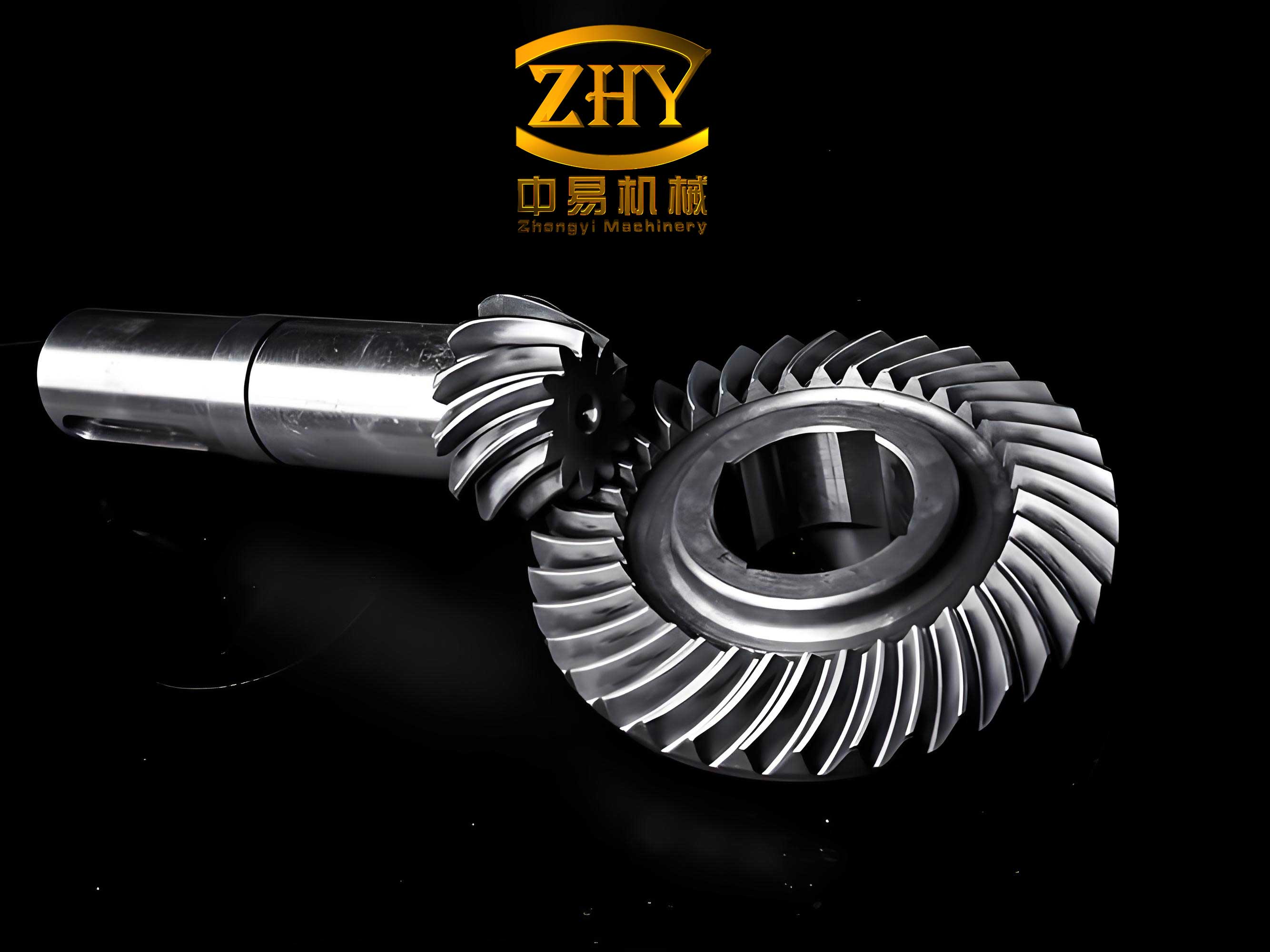
The surface roughness of spiral bevel gears after grinding plays a pivotal role in their lubrication behavior. Rough surfaces are typically characterized using parameters such as root mean square deviation, roughness height distribution, and surface texture parameters. For spiral bevel gears, the grinding process leaves distinct marks on the tooth surfaces, which influence the texture direction and roughness amplitude. We begin by defining key roughness parameters. The root mean square deviation, denoted as σ, is given by:
$$ \sigma = \sqrt{\frac{1}{n} \sum_{i=1}^{n} z_i^2} $$
where \( z_i \) represents the distance from the mean surface plane at sampling point \( i \), and \( n \) is the number of points. In practice, the arithmetic average roughness \( R_a \) is often measured, approximated as:
$$ R_a = \frac{1}{l} \int_0^l |z(x)| dx \approx \frac{1}{n} \sum_{i=1}^{n} |z_i| $$
with \( \sigma \approx 1.25 R_a \). The roughness height distribution typically follows a Gaussian pattern for ground surfaces, expressed as:
$$ f(z) = \frac{1}{\sigma \sqrt{2\pi}} e^{-\frac{z^2}{2\sigma^2}} $$
The surface texture parameter \( \gamma \) describes the anisotropy of roughness, defined as the ratio of correlation lengths in two perpendicular directions:
$$ \gamma = \frac{\tau_{0.5x}}{\tau_{0.5y}} $$
In engineering applications, this is approximated using the average spacing of profile irregularities \( s_m \):
$$ \gamma \approx \frac{s_{mx}}{s_{my}} $$
For spiral bevel gears, grinding marks are determined based on the grinding principle, where the grinding wheel interacts with the tooth surface. Using numerical methods, we simulate the grinding contact trajectory, which reveals that the texture direction aligns with the grinding path. Since the relative velocity direction during meshing is perpendicular to the grinding marks, the surface exhibits transverse texture, leading to \( \gamma > 1 \). Based on prior research, the surface texture parameter for spiral bevel gears typically ranges from 6 to 9. This texture affects lubricant flow and oil film formation, as discussed later.
Under starved EHL conditions, the lubricant supply is insufficient to maintain a full oil film, leading to a transition from fully flooded to starved lubrication. The oil film life refers to the duration from the onset of full film EHL to the end of starved EHL. To assess this, we first define criteria for starved lubrication. One method involves comparing the dimensionless inlet distance \( m \) with the minimum oil film thickness; another uses the dimensionless central film thickness \( H_0 \). We adopt the latter, where starved lubrication begins when \( H_0 \) is 3% less than the fully flooded central film thickness \( H_{0,f} \). The critical inlet film thickness \( H^*_{in} \) marks this transition. Thus, for full film EHL, \( H_{in} \geq H^*_{in} \); for starved EHL, \( H_{in} \leq H^*_{in} \).
The failure of starved EHL occurs when the oil film diminishes to a point where metal-to-metal contact initiates. We use the film thickness ratio \( \Lambda = h_0 / \sigma \) to judge lubrication states, where \( h_0 \) is the central oil film thickness. When \( \Lambda > 3 \), full film lubrication is maintained; when \( \Lambda \leq 3 \), mixed lubrication occurs. Additionally, we introduce an auxiliary parameter \( \sigma’ = h_0 / R_g \), where \( R_g \) is the average radius of lubricant molecules (taken as 30 nm). Based on lubrication state diagrams, we consider EHL to fail when \( \Lambda \leq 3 \) and \( h_0 \leq 100 \) nm, indicating the onset of boundary lubrication.
The influence of surface roughness on EHL oil film life is primarily through roughness amplitude and texture parameters, which affect lubricant flow. To account for surface texture, we introduce flow factors \( \phi_x \) and \( \phi_y \) that modify the lubricant flow rate between rough surfaces compared to smooth surfaces. According to established models, for transverse textures (\( \gamma > 1 \)), the flow factor in the direction of lubricant motion is:
$$ \phi_x = 1 + c \left( \frac{h}{\sigma} \right)^{-r} $$
where \( c \) and \( r \) are constants dependent on \( \gamma \), as summarized in Table 1. For spiral bevel gears with \( \gamma \) between 6 and 9, we use values corresponding to \( \gamma = 9 \). The flow rate through rough surfaces \( Q_r \) relates to the smooth surface flow rate \( Q \) by \( Q_r = \phi Q \).
| γ | c | r | h/σ Range |
|---|---|---|---|
| 1/9 | 1.48 | 0.42 | >1 |
| 1/6 | 1.38 | 0.42 | >1 |
| 1/3 | 1.18 | 0.42 | >0.75 |
| 1 | 0.90 | 0.56 | >0.5 |
| 3 | 0.225 | 1.5 | >0.5 |
| 6 | 0.52 | 1.5 | >0.5 |
| 9 | 0.87 | 1.5 | >0.5 |
Using a lubricant flow model that considers side leakage, the volume flow rate through the contact area is expressed as:
$$ Q_r = \kappa h_0 (\Gamma + 1) $$
where \( \kappa \) is a correlation coefficient, and \( \Gamma \) is the oil film life parameter. The change in lubricant volume \( dV \) over time \( d\tau \) is given by \( dV = \beta dh_0 \) and \( dV = -Q d\tau \), leading to:
$$ \phi \frac{dh_0}{h_0 (\Gamma + 1)} = -\frac{\kappa}{\beta} d\tau $$
Integrating this equation and applying initial conditions (at full film, \( h_0 = h_{in} \)), we derive the life prediction equation for rough surfaces:
$$ \frac{1}{\Gamma h_0^\Gamma} + \frac{c \sigma^r}{(\Gamma + r) h_0^{\Gamma + r}} = \frac{1}{\Gamma h_{0,f}^\Gamma} + \frac{c \sigma^r}{(\Gamma + r) h_{0,f}^{\Gamma + r}} + \frac{1}{\Gamma h_{in}^\Gamma} + \frac{c \sigma^r}{(\Gamma + r) h_{in}^{\Gamma + r}} $$
However, for spiral bevel gears, since \( \frac{1}{\Gamma h_0^\Gamma} \) dominates over \( \frac{c \sigma^r}{(\Gamma + r) h_0^{\Gamma + r}} \), the equation simplifies to the form for smooth surfaces:
$$ \frac{1}{h_0^\Gamma} = \frac{1}{h_{0,f}^\Gamma} + \frac{1}{h_{in}^\Gamma} $$
In dimensionless terms, with \( H_0 = h_0 / R \), \( H_{0,f} = h_{0,f} / R \), and \( H_{in} = h_{in} / R \), where \( R \) is the effective radius, this becomes:
$$ \frac{1}{H_0^\Gamma} = \frac{1}{H_{0,f}^\Gamma} + \frac{1}{H_{in}^\Gamma} $$
Defining \( L = H_0 / H_{0,f} \) and \( l = H_{in} / H_{0,f} \), we have:
$$ L = \frac{l}{\sqrt[\Gamma]{1 + l^{-\Gamma}}} $$
Assuming starved conditions progress over meshing cycles, with \( l(n+1) = L(n) \) and \( L(0) = 1 \), the central film thickness after \( n \) cycles is:
$$ L(n) = n^{-1/\Gamma} $$
Using the failure criterion \( h_0 \leq 100 \) nm, we calculate the number of meshing cycles \( n \) before EHL fails. For a specific spiral bevel gear pair with a pinion speed of 6000 rpm, we analyze the critical point (the fifth point on the meshing path) and compute \( n \) for different roughness amplitudes. The results are shown in Table 2, where dimensionless roughness \( R = \sigma / R \) is used.
| Dimensionless Roughness R | Starvation Parameter Γ |
|---|---|
| 0 | 2.0540 |
| 0.01 | 2.2677 |
| 0.012 | 2.3609 |
| 0.018 | 2.4261 |
Based on these parameters, we determine the meshing cycles and time until EHL failure, as summarized in Table 3. The time is calculated considering the pinion speed and gear geometry.
| Dimensionless Roughness R | Meshing Cycles n | Time (s) |
|---|---|---|
| 0.01 | 1471 | 14.71 |
| 0.012 | 1984 | 19.84 |
| 0.018 | 2672 | 26.72 |
The data indicate that within the calculated roughness range, higher surface roughness amplitudes lead to longer EHL oil film life in spiral bevel gears. This is attributed to enhanced lubricant retention and flow dynamics due to surface asperities. However, excessive roughness can degrade long-term lubrication by promoting wear and tear. Thus, an optimal roughness level exists for maximizing oil film life in spiral bevel gears under starved conditions.
To validate the oil film life prediction model, we conducted experiments using a weight measurement method to track lubricant mass changes on gear tooth surfaces. The test spiral bevel gears had a surface roughness of 0.4 µm (approximately \( R_a \)), corresponding to a dimensionless roughness within the studied range. We applied a gear oil (85W-90 GL-5) uniformly to the tooth surfaces, removed excess oil with absorbent paper, and installed the gears on a low-noise spiral bevel gear testing machine. The pinion speed was set to 600 r/min with a load of 40 N·m, simulating operational conditions. At regular intervals, we stopped the machine, extracted lubricant from the working tooth surfaces using cotton swabs, and measured the mass change with a precision electronic balance (accuracy 0.0001 g). The lubricant was evaporated using warm water to accelerate acetone removal, ensuring accurate mass readings. The experiment continued until the lubricant mass stabilized, indicating the end of the EHL phase.
The experimental results are presented in Table 4, showing the lubricant mass change over time. The initial mass includes the cotton swab and tray, and the change reflects the oil film mass on the gear surface.
| Group | Time (s) | Mass of Cotton Swab and Tray (g) | Mass After Oil Absorption (g) | Mass Change (g) |
|---|---|---|---|---|
| 1 | 0 | 13.1110 | 13.1621 | 0.0511 |
| 2 | 20 | 12.8885 | 12.9153 | 0.0268 |
| 3 | 40 | 12.9879 | 12.9996 | 0.0117 |
| 4 | 60 | 12.8780 | 12.8861 | 0.0081 |
| 5 | 80 | 12.9729 | 12.9842 | 0.0113 |
From the data, the oil film mass decreases rapidly initially and stabilizes after approximately 40 seconds, suggesting that the EHL oil film life is around 40 seconds under these conditions. Using our theoretical model, we calculated the EHL oil film life for the same spiral bevel gear parameters, obtaining a value of 51.27 seconds. The discrepancy between experimental and theoretical results is within acceptable limits, considering experimental errors such as manual timing, machine acceleration/deceleration, and operational variations. The experiment confirms the validity of our life prediction model, demonstrating its applicability to real-world spiral bevel gear systems.
In summary, this study investigates the impact of surface roughness on the starved EHL oil film life of spiral bevel gears. We analyzed surface texture parameters and roughness amplitudes derived from grinding marks, established a life prediction equation, and validated it experimentally. Our key findings are: (1) Surface texture parameters have minimal effect on the EHL oil film life of spiral bevel gear pairs, as the flow factor adjustments are negligible in the dominant terms of the life equation. (2) Within the calculated roughness range, moderately increasing surface roughness amplitude can enhance the EHL oil film life under starved conditions, due to improved lubricant dynamics. However, overly rough surfaces may lead to adverse effects in long-term operation. These insights contribute to optimizing spiral bevel gear design and manufacturing for better lubrication performance, ultimately extending gear life and reliability in applications such as automotive and aerospace transmissions. Future work could explore wider roughness ranges, different lubricants, and dynamic loading conditions to further refine the model for spiral bevel gears.
The life prediction model for spiral bevel gears relies on several key equations that encapsulate the EHL behavior. To recap, the central film thickness evolution is governed by:
$$ \frac{dh_0}{d\tau} = -\frac{\kappa}{\beta} \phi h_0 (\Gamma + 1) $$
With the flow factor \( \phi \) for rough surfaces, integration yields the life equation. For design purposes, engineers can use the simplified form:
$$ n = \left( \frac{h_{0,f}}{h_{0,\text{min}}} \right)^\Gamma $$
where \( h_{0,\text{min}} \) is the minimum film thickness for EHL failure (e.g., 100 nm). This allows quick estimation of oil film life based on gear parameters. Additionally, the surface texture parameter \( \gamma \) can be incorporated via the constants \( c \) and \( r \), though its influence is small for spiral bevel gears with transverse textures. For practical applications, maintaining surface roughness within an optimal range—say, \( R_a \) between 0.2 and 0.6 µm—can balance EHL performance and wear resistance. Further studies on spiral bevel gears should consider thermal effects and non-Newtonian lubricant properties to enhance model accuracy.
In conclusion, the interplay between surface roughness and starved EHL in spiral bevel gears is complex but manageable through analytical models and experimental validation. By leveraging grinding process controls and roughness optimization, manufacturers can improve the durability and efficiency of spiral bevel gear transmissions, meeting the demands of modern machinery. The ongoing development of spiral bevel gear technology will benefit from such lubrication-focused research, ensuring reliable power transmission in challenging environments.