
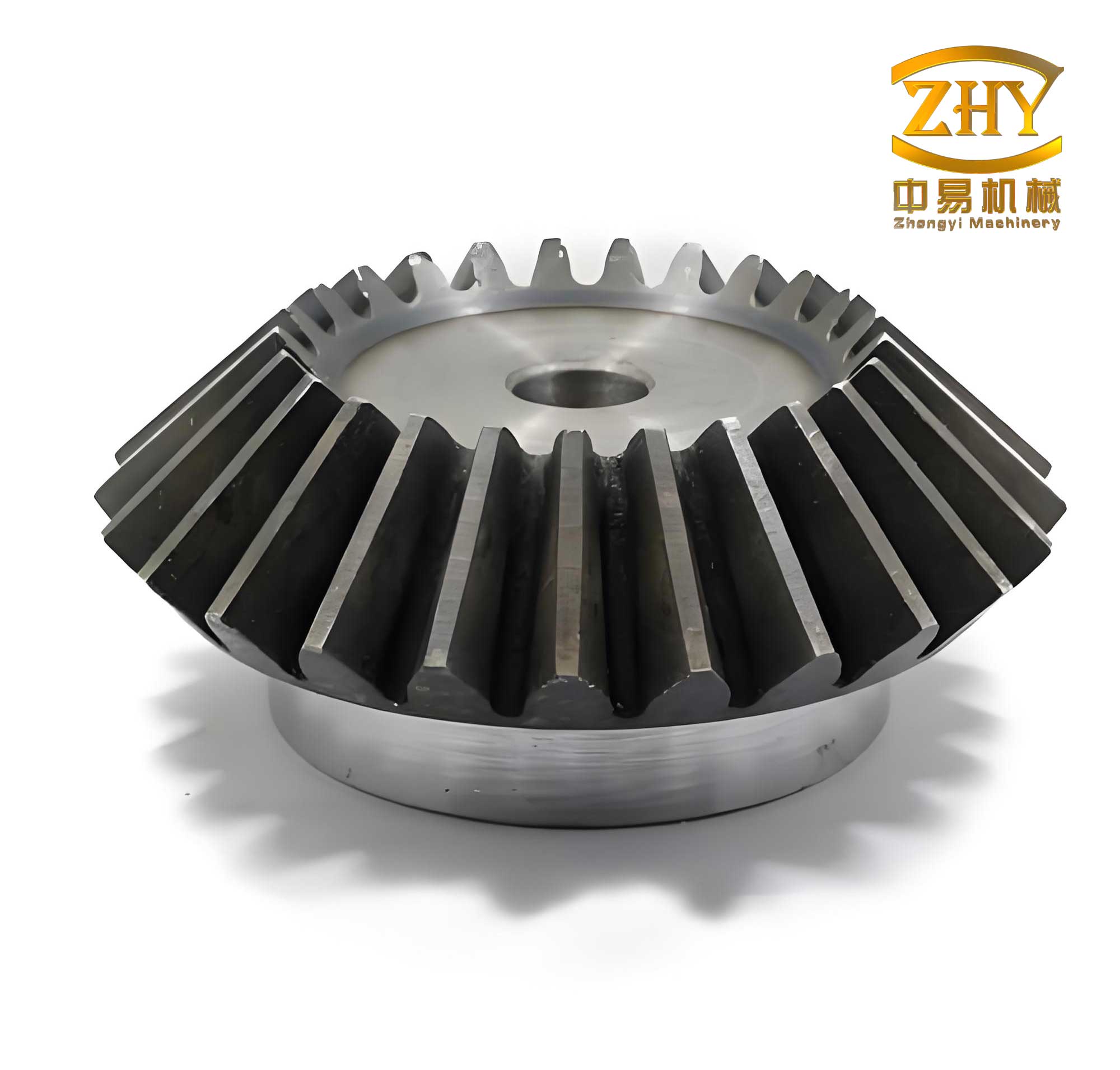
In the realm of automotive and industrial machinery, bevel gears play a pivotal role as core components in differential systems, enabling smooth power transmission between non-parallel shafts. As a manufacturing specialist, I have observed a growing emphasis on optimizing the production processes for bevel gears to achieve lower per-unit costs while maintaining high quality. This article delves into the technological advancements, cost analysis, and sustainable innovations surrounding bevel gears, drawing from industry trends and engineering principles. Bevel gears are ubiquitous in mass-production settings, with millions of units manufactured annually, making efficiency gains critical. Here, I explore how modern machining solutions, material science, and collaborative ecosystems are reshaping the landscape for bevel gears.
The fundamental geometry of bevel gears involves conical shapes that mesh at angles, typically 90 degrees, but can vary. The design parameters influence performance, noise, and durability. For instance, the tooth profile of bevel gears can be described using mathematical models. One common formula for the spiral bevel gear tooth curvature is based on the Gleason system, where the tooth surface is defined by parametric equations. Consider the coordinate transformation for a bevel gear tooth:
$$ x = r \cos(\theta), \quad y = r \sin(\theta), \quad z = f(r, \theta) $$
where \( r \) is the radial distance, \( \theta \) is the angular position, and \( f \) is a function representing the tooth curvature. The pressure angle \( \alpha \) and spiral angle \( \beta \) are key variables, often optimized for minimal stress concentration. For bevel gears, the gear ratio \( i \) between two meshing gears is given by:
$$ i = \frac{N_1}{N_2} = \frac{d_2}{d_1} $$
where \( N \) denotes the number of teeth and \( d \) the pitch diameter. These formulas underscore the complexity in designing bevel gears for high-load applications.
Manufacturing bevel gears traditionally involved multiple steps: forging, rough cutting, heat treatment, and finishing. However, recent innovations have streamlined this process. A notable advancement is the use of twin-spindle turning centers that simultaneously machine two identical bevel gears in a single setup. This approach drastically reduces cycle times. For example, with a robotic loading system and rotary table, the handling time can be as low as 4.5 seconds per gear. The machining process involves operations like facing, boring, and tooth profiling, all performed in one clamping. The clamping solution often utilizes a “negative mold” of the gear teeth, ensuring stability throughout. This method not only enhances precision but also cuts costs by minimizing idle time and tool wear.
To quantify the economic benefits, let’s analyze the per-unit cost for bevel gears. The total cost \( C \) per gear can be expressed as:
$$ C = \frac{F}{Q} + V $$
where \( F \) is the fixed cost (e.g., machine depreciation, setup), \( Q \) is the production quantity, and \( V \) is the variable cost per unit (e.g., material, energy, labor). With twin-spindle machining, the cycle time \( T_c \) is halved compared to single-spindle methods, leading to a higher output rate \( R \):
$$ R = \frac{2}{T_c} $$
Assuming a batch size of \( N \) bevel gears, the total production time \( T_t \) becomes:
$$ T_t = N \cdot \frac{T_c}{2} + T_s $$
where \( T_s \) is the setup time, which can be as low as 6 seconds for quick changeovers. This reduction directly lowers \( V \) by saving energy and labor hours. The table below compares traditional single-spindle machining with the twin-spindle approach for producing 10,000 bevel gears, based on industry estimates.
| Parameter | Single-Spindle Machining | Twin-Spindle Machining |
|---|---|---|
| Cycle Time per Gear (s) | 50 | 25 |
| Setup Time (s) | 30 | 6 |
| Total Production Time (hours) | 138.9 | 69.5 |
| Energy Consumption (kWh) | 500 | 300 |
| Labor Cost per Unit ($) | 2.5 | 1.8 |
| Overall Cost per Gear ($) | 15.2 | 10.1 |
This table illustrates how twin-spindle technology can cut costs by approximately 33%, making it a game-changer for high-volume bevel gear production. The savings stem from faster cycles, reduced energy use, and lower labor input. Moreover, the consistency in quality reduces scrap rates, further enhancing economy. Bevel gears produced via such methods exhibit superior surface finish and dimensional accuracy, critical for automotive differentials.
Beyond machining, material science plays a vital role in advancing bevel gears. The integration of specialized polymers and additives can enhance gear performance by reducing friction, wear, and noise. For instance, composite materials or coatings derived from sustainable solutions can extend the lifespan of bevel gears. The stress on a bevel gear tooth under load can be modeled using the Hertz contact theory:
$$ \sigma_H = \sqrt{\frac{F_n E^*}{\pi b R}} $$
where \( \sigma_H \) is the contact stress, \( F_n \) is the normal force, \( E^* \) is the effective modulus of elasticity, \( b \) is the face width, and \( R \) is the equivalent radius of curvature. By using advanced materials with higher \( E^* \) or tailored coatings, the stress tolerance improves, allowing for compact and efficient bevel gears. This aligns with industry shifts toward lightweight and durable components.
Innovation in bevel gear manufacturing is also driven by collaborative ecosystems, where suppliers and technology partners co-develop solutions. For example, global challenges focused on coatings and materials foster breakthroughs that benefit gear production. Such synergies enable testing of novel lubricants or surface treatments that reduce pitting and fatigue in bevel gears. The durability of bevel gears can be predicted using the AGMA (American Gear Manufacturers Association) rating for bending strength:
$$ S_t = \frac{Y J \sigma_{all}}{K_v K_s} $$
where \( S_t \) is the bending stress number, \( Y \) is the geometry factor, \( J \) is the stress correction factor, \( \sigma_{all} \) is the allowable stress, and \( K_v \) and \( K_s \) are dynamic and size factors. Collaborative R&D helps optimize these parameters through material innovations.
Sustainability is another key aspect. The production of bevel gears increasingly incorporates recycled materials and energy-efficient processes. Lifecycle analysis (LCA) for bevel gears considers emissions, resource use, and end-of-life recycling. The carbon footprint \( C_f \) per gear can be approximated as:
$$ C_f = \sum_{i=1}^{n} (E_i \cdot EF_i) $$
where \( E_i \) is the energy input at stage \( i \) (e.g., machining, heat treatment), and \( EF_i \) is the emission factor. By adopting renewable energy and closed-loop cooling systems, manufacturers can lower \( C_f \) significantly. The table below outlines the environmental impact metrics for conventional versus green manufacturing of bevel gears per 1,000 units.
| Metric | Conventional Manufacturing | Green Manufacturing |
|---|---|---|
| Energy Use (GJ) | 50 | 35 |
| Water Consumption (m³) | 20 | 12 |
| CO2 Emissions (tons) | 5.2 | 3.1 |
| Material Waste (kg) | 150 | 90 |
| Recyclability Rate (%) | 60 | 85 |
These improvements not only benefit the planet but also reduce operational costs, creating a win-win for producers of bevel gears. As demand for electric vehicles rises, the need for precise and quiet bevel gears in differentials grows, pushing further innovation.
Looking ahead, the future of bevel gear production lies in digitalization and AI-driven optimization. Simulation tools using finite element analysis (FEA) can predict wear patterns and optimize tooth geometry. The meshing efficiency \( \eta \) of bevel gears, defined as the ratio of output to input power, can be maximized through algorithmic design:
$$ \eta = 1 – \frac{P_l}{P_in} $$
where \( P_l \) is the power loss due to friction and misalignment. Machine learning models can analyze production data to predict tool failure or quality deviations, ensuring consistent output for bevel gears. Additionally, additive manufacturing (3D printing) is emerging for prototyping complex bevel gear designs, though mass-production still favors subtractive methods due to speed.
In conclusion, the evolution of bevel gear manufacturing embodies a blend of advanced machining, material science, and collaborative innovation. By leveraging twin-spindle technologies, sustainable materials, and data-driven processes, the industry achieves remarkable cost savings and quality enhancements. Bevel gears remain indispensable in automotive and industrial applications, and ongoing research promises even greater efficiencies. As we continue to refine these approaches, the focus on bevel gears will undoubtedly drive broader advancements in mechanical systems worldwide.
To further illustrate the technical details, consider the gear tooth contact analysis for bevel gears, which involves solving the equation of motion for meshing surfaces. The relative curvature \( \kappa_r \) at the contact point is given by:
$$ \kappa_r = \frac{1}{R_1} + \frac{1}{R_2} $$
where \( R_1 \) and \( R_2 \) are the radii of curvature for the two gear teeth. Optimizing this reduces noise and vibration, crucial for high-performance bevel gears. Moreover, thermal expansion during operation affects tolerances; the change in gear dimension \( \Delta L \) can be calculated as:
$$ \Delta L = L_0 \alpha \Delta T $$
with \( L_0 \) as the initial length, \( \alpha \) the coefficient of thermal expansion, and \( \Delta T \) the temperature rise. Using low-expansion alloys or composites mitigates this issue, ensuring reliable bevel gears under varying loads.
The integration of IoT sensors in machining centers allows real-time monitoring of bevel gear production. Data on cutting forces, temperatures, and vibrations feed into predictive maintenance systems, minimizing downtime. For instance, the tool wear rate \( W \) can be modeled empirically:
$$ W = k \cdot F^{a} \cdot v^{b} $$
where \( k \), \( a \), and \( b \) are constants, \( F \) is the cutting force, and \( v \) is the cutting speed. By adjusting parameters dynamically, tool life extends, reducing costs per bevel gear. This smart manufacturing approach aligns with Industry 4.0 trends, making bevel gear production more agile and responsive.
In summary, bevel gears are at the heart of many mechanical systems, and their production has seen transformative changes. From faster machining cycles to eco-friendly materials, each innovation contributes to lower costs and higher quality. As a practitioner in this field, I am excited by the potential of these advancements to reshape industries. The continued emphasis on bevel gears will spur further research, ensuring they meet the demands of future technologies like autonomous vehicles and renewable energy systems. By embracing these trends, manufacturers can stay competitive while contributing to a sustainable future.