
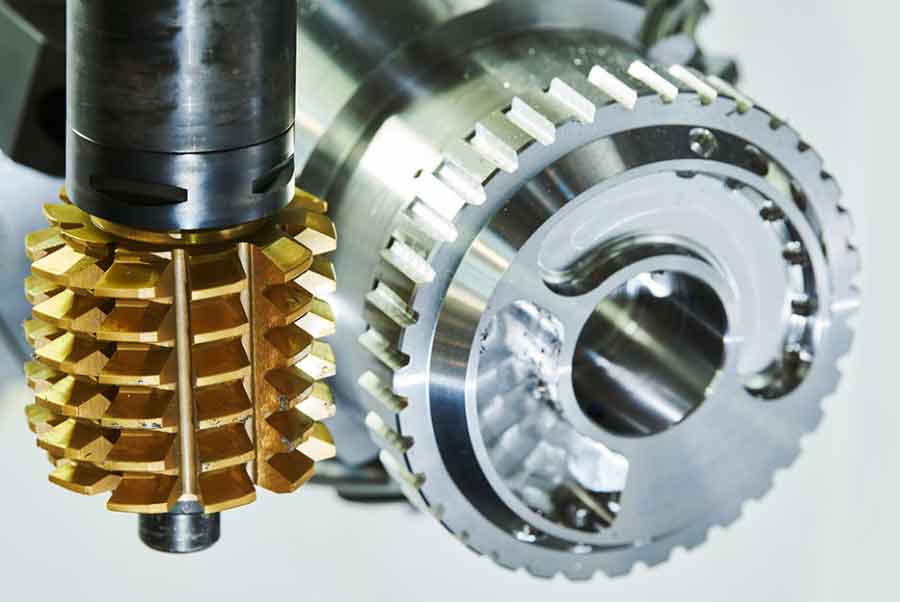
In the realm of gear manufacturing, gear hobbing stands as a fundamental process, leveraging the generative method to produce accurate gear tooth profiles. This technique essentially transforms one element into a cutting tool—the hob—and the other into the workpiece, with the gear hobbing machine enforcing precise meshing motions between them. During this operation, the cutting edges of the hob gradually envelope the desired tooth form on the workpiece. However, a critical challenge arises in gear hobbing when interruptions occur, such as for precision inspections or after roughing and semi-finishing stages, where the gear must be removed for subsequent processes like heat treatment. Upon re-clamping, realignment—known as secondary gear alignment—is essential to re-establish the correct meshing position between the hob and the gear tooth space. This process ensures continued accuracy in gear hobbing operations.
Traditionally, secondary gear alignment in gear hobbing relied heavily on operator skill and visual estimation, introducing significant human error and inefficiency. This approach falls short in meeting modern demands for high-precision and high-efficiency manufacturing. Later advancements incorporated contact probes to measure left and right tooth flanks, with angle calculations guiding the rotary table adjustment. Yet, this method remains prone to inaccuracies due to inherent variations in individual tooth profiles or spaces, leading to compromised gear hobbing quality. In this study, we present a novel secondary gear alignment apparatus designed for gear hobbing machines. This system is characterized by its simplicity, operational robustness, high accuracy, and full automation, substantially enhancing both the efficiency and precision of gear hobbing processes.
The core principle of our secondary gear alignment device involves utilizing a non-contact sensor positioned directly facing the gear tooth direction. As the workpiece rotary C-axis rotates at a constant speed, the sensor emits pulse signals to record the positions of gear tooth edges. The collected data is then processed to compute the gear’s angular position, enabling precise offset adjustments of the C-axis. To accommodate gears of varying sizes, the sensor can be adjusted along the X-direction to approach or retreat from the workpiece. For different workpiece heights due to fixture changes, Z-direction travel allows sensor height modification. During active gear hobbing, the sensor retracts from the machining zone via Y-direction movement and integrated pneumatic cylinder stroke, ensuring unobstructed operation. This setup is pivotal in gear hobbing for maintaining alignment integrity.
The structure of the secondary gear alignment apparatus primarily comprises a pneumatic cylinder and an inductive sensor. The cylinder can be equipped with two limit switches, a pressure sensor, and a one-way flow control valve to enhance motion precision and repeatability. The selection of cylinder stroke, positioning accuracy, sensor sensing distance, and response curve is tailored based on specific workpiece dimensions in gear hobbing applications. Below is a table summarizing key components and their functions:
| Component | Function in Gear Hobbing Alignment |
|---|---|
| Inductive Sensor | Detects gear tooth edges non-contactly, recording positional data for alignment calculations. |
| Pneumatic Cylinder | Provides linear motion for sensor engagement and retraction, ensuring clearance during gear hobbing. |
| Limit Switches | Define precise travel endpoints for the cylinder, enhancing repeatability in gear hobbing setups. |
| Pressure Sensor | Monitors pneumatic pressure for consistent force application, crucial in automated gear hobbing. |
| One-Way Flow Control Valve | Regulates cylinder speed for smooth operation, reducing vibrations in gear hobbing processes. |
The implementation of secondary gear alignment in gear hobbing involves a systematic procedure to ensure accuracy. First, the sensor is adjusted to within an effective detection range, typically 1–5 mm, depending on the sensor type. This range is critical for reliable signal acquisition in gear hobbing environments. Next, the workpiece C-axis is incrementally rotated, and the sensor records the angular positions at which gear tooth edges pass. Specifically, we capture the rising edge positions (denoted as A, C, E) and falling edge positions (B, D, F) of the tooth flanks. To mitigate errors from individual tooth irregularities, data from incomplete teeth at the start and end are discarded, and multiple positions are averaged—using an odd number of samples for absolute data consistency. This approach enhances reliability in gear hobbing alignment.
Let the number of gear teeth be $Z$. The average rising edge position $C_1$ and average falling edge position $C_2$ are calculated as follows:
$$ C_1 = \frac{A + C + E}{3} $$
$$ C_2 = \frac{B + D + F}{3} $$
From these, the effective angular value for a gear tooth space center $C_0$ and the gear tooth top center $C_0’$ can be derived:
$$ C_0 = -\left( \frac{C_1 + C_2}{2} + \frac{\pi}{Z} \right) $$
$$ C_0′ = -\frac{C_1 + C_2}{2} $$
These formulas are essential in gear hobbing for determining precise rotational offsets. The negative sign indicates directionality relative to the C-axis home position. A third step involves rotating the C-axis by an offset of $-C_0$ to align the tooth space center with the sensor reference. If alignment to the tooth top is desired, $C_0’$ can be used instead, leveraging the relationship between tooth space and top in gear hobbing geometry.
Subsequently, the hob position is adjusted along the axial direction (often termed the “shift axis”) to mesh with the workpiece. For gear hobbing machines lacking a dedicated shift axis, manual adjustment of the C-axis compensates for this, with the rotational offset incorporated into $C_0$. Finally, automatic phase synchronization is initiated to start gear hobbing. Systems with this feature ensure synchronous rotation of the hob spindle and workpiece C-axis, minimizing follow-up errors. If unavailable, iterative compensation based on trial cuts may be applied to refine $C_0$ for varying spindle speeds in gear hobbing.
For batch production in gear hobbing, once initial alignment is complete, subsequent parts require only steps 2, 3, and 5, streamlining the process. It is important to note that positional deviations from sensor detection of rising and falling edges are inherently addressed during hob adjustment in step 4, ensuring high fidelity in gear hobbing alignment.
To further elucidate the gear hobbing alignment process, consider the error analysis involved. The positional accuracy depends on sensor resolution, mechanical repeatability, and gear tooth uniformity. We can model the total alignment error $\Delta_{\text{total}}$ in gear hobbing as a combination of individual errors:
$$ \Delta_{\text{total}} = \sqrt{ \Delta_{\text{sensor}}^2 + \Delta_{\text{mech}}^2 + \Delta_{\text{gear}}^2 } $$
where $\Delta_{\text{sensor}}$ is the sensor detection error, $\Delta_{\text{mech}}$ is mechanical positioning error, and $\Delta_{\text{gear}}$ is gear tooth variation error. In optimal gear hobbing conditions, $\Delta_{\text{total}}$ can be minimized to under 0.01 degrees, significantly enhancing gear quality.
The application of this secondary gear alignment method has been extensively validated in our company’s gear hobbing machines, such as the YK3132 and YK3126 CNC models. These gear hobbing systems demonstrate stable and reliable performance, catering to diverse customer requirements across industries. Feedback indicates substantial improvements in gear hobbing efficiency and precision, with reduced setup times and enhanced consistency. The table below compares traditional and modern secondary gear alignment methods in gear hobbing:
| Aspect | Traditional Manual Alignment | Contact Probe Method | Proposed Non-Contact Method |
|---|---|---|---|
| Accuracy | Low (human-dependent) | Moderate (prone to tooth errors) | High (averaged data, automated) |
| Efficiency | Slow (skill-based) | Moderate (requires probing cycles) | Fast (automated, batch-friendly) |
| Consistency in Gear Hobbing | Variable | Affected by single-tooth measurements | High (multi-point averaging) |
| Automation Level | None | Semi-automated | Fully automated |
| Suitability for High-Precision Gear Hobbing | Poor | Adequate | Excellent |
Beyond basic alignment, this gear hobbing technology integrates with advanced CNC systems for real-time monitoring and adaptive control. For instance, sensor data can be fed back to adjust hob wear compensation or thermal drift corrections during prolonged gear hobbing sessions. The mathematical framework for such adaptations involves dynamic offset calculations. Let $C_{\text{actual}}(t)$ represent the real-time angular position during gear hobbing, accounting for temporal drifts:
$$ C_{\text{actual}}(t) = C_0 + \delta(t) $$
where $\delta(t)$ is a time-dependent correction derived from sensor feedback or empirical models. This ensures sustained accuracy in gear hobbing over production runs.
Moreover, the secondary gear alignment apparatus facilitates integration into smart manufacturing lines for gear hobbing. By coupling with IoT platforms, alignment data can be logged for predictive maintenance and quality traceability. For example, statistical process control (SPC) charts can monitor alignment variations across gear hobbing batches, triggering alerts if deviations exceed thresholds. The formula for process capability index $C_p$ in gear hobbing alignment can be expressed as:
$$ C_p = \frac{\text{USL} – \text{LSL}}{6\sigma} $$
where USL and LSL are upper and lower specification limits for alignment error, and $\sigma$ is the standard deviation from historical gear hobbing data. A $C_p > 1.33$ indicates robust process control in gear hobbing.
In terms of sensor technology, various non-contact types have been evaluated for gear hobbing alignment, including inductive, capacitive, and optical sensors. Each offers distinct advantages in gear hobbing environments. Inductive sensors, as used in our design, excel in metallic gear applications due to immunity to oil and debris common in gear hobbing. Their sensing characteristics can be modeled with an inverse square law approximation for distance $d$:
$$ V_{\text{output}} \propto \frac{1}{d^2} $$
where $V_{\text{output}}$ is the sensor voltage, calibrated to detect tooth edges within the 1–5 mm range for reliable gear hobbing alignment.
The pneumatic system’s design also merits detailed analysis for gear hobbing. Cylinder stroke $S$ and diameter $D$ are selected based on force requirements to overcome friction and inertial loads during sensor deployment. The force $F$ exerted by the cylinder in gear hobbing setups is given by:
$$ F = P \cdot A $$
where $P$ is pneumatic pressure and $A = \pi D^2 / 4$ is the piston area. Optimizing $F$ ensures swift yet stable motion, minimizing alignment cycle times in gear hobbing.
Practical implementation in gear hobbing machines involves rigorous calibration routines. We developed a calibration protocol where the sensor scans a master gear with known geometry, establishing a baseline for positional data. This process reduces systematic errors in gear hobbing alignment. The calibration offset $\Delta_{\text{cal}}$ is computed as:
$$ \Delta_{\text{cal}} = C_{\text{master}} – C_{\text{measured}} $$
where $C_{\text{master}}$ is the theoretical angular position from the master gear, and $C_{\text{measured}}$ is the sensor-recorded value. Applying $\Delta_{\text{cal}}$ to subsequent gear hobbing jobs enhances absolute accuracy.
Looking forward, the evolution of secondary gear alignment in gear hobbing is poised to incorporate machine learning algorithms. By training models on diverse gear profiles and hobbing conditions, predictive alignment can pre-empt errors. For instance, a neural network could map sensor data to optimal C-axis offsets, refining gear hobbing precision beyond static formulas. The learning process might minimize a loss function $L$ over $N$ gear hobbing samples:
$$ L = \frac{1}{N} \sum_{i=1}^{N} (C_{0,\text{predicted}}^{(i)} – C_{0,\text{actual}}^{(i)})^2 $$
Such advancements will further solidify gear hobbing as a cornerstone of high-precision gear manufacturing.
In conclusion, this study addresses the critical need for accurate secondary gear alignment in gear hobbing through an automated, non-contact apparatus. By leveraging multi-point sensing and computational averaging, the method surpasses traditional approaches in precision and efficiency. The integration of mechanical, pneumatic, and sensor components creates a robust system adaptable to various gear hobbing scenarios. Empirical applications confirm its reliability, contributing to elevated gear quality and productivity. As gear hobbing continues to advance toward smart manufacturing, this alignment technology provides a foundational step for data-driven optimization and seamless production line integration, ensuring gear hobbing remains at the forefront of industrial innovation.