
In the field of mechanical engineering, the design and modeling of screw gears, including worm gears and worm wheels, are critical for transmitting motion and torque between non-parallel, non-intersecting shafts. Traditional modeling approaches in CAD software often involve manual, step-by-step processes that are time-consuming, labor-intensive, and prone to errors. As an engineer specializing in computer-aided design and automation, I have explored the use of AutoLISP, a programming language embedded within AutoCAD, to develop a parametric modeling framework for screw gears. This framework leverages geometric parameterization to achieve high precision, quality, and efficiency in generating screw gear models. In this article, I will detail the methodology, implementation, and benefits of this approach, incorporating tables and formulas to summarize key concepts. The term “screw gears” will be frequently referenced to emphasize the focus on worm gear systems, which are essential in various mechanical applications such as automotive, industrial machinery, and robotics.
AutoCAD, developed by Autodesk, is a widely used computer-aided design tool that supports customization through AutoLISP. AutoLISP is a dialect of the LISP programming language, integrated into AutoCAD for secondary development and automation tasks. It allows users to create custom commands, automate repetitive processes, and implement complex geometric calculations. In my work, I utilize AutoLISP to parameterize the design of screw gears, enabling automatic generation of 3D models based on input parameters. This not only reduces manual effort but also ensures consistency and accuracy. The parametric approach involves defining geometric parameters such as module, number of teeth, pressure angle, and dimensions, which are then used to construct the screw gear entities programmatically. By adopting this method, I aim to address the challenges associated with traditional screw gear modeling, where even minor changes require extensive rework.
Screw gears, specifically worm gears and worm wheels, are used for motion transmission between shafts that are oriented at 90 degrees but non-intersecting. The worm gear is essentially a screw-like component with a helical thread, while the worm wheel is a gear that meshes with the worm. These screw gears offer high reduction ratios, compact design, and self-locking capabilities, making them ideal for applications requiring precise control. However, their complex geometry poses modeling difficulties. Based on manufacturing methods and tooth profiles, screw gears can be classified into various types. For instance, cylindrical screw gears are common, and they can be further categorized by their tooth generation method, such as Archimedean, involute, or straight-sided profiles. In my parametric modeling framework, I focus on the Archimedean type due to its simplicity and widespread use. The geometric parameters of screw gears are extensive, as summarized in the table below, which outlines key dimensions for both worm gears and worm wheels.
| Component | Parameter | Description |
|---|---|---|
| Worm Gear (Screw) | Module (m) | Basic size parameter for tooth dimensions. |
| Number of Threads (z1) | Number of helical threads on the worm. | |
| Pressure Angle (α) | Angle defining tooth profile, typically 20°. | |
| Pitch Diameter (d1) | Diameter at the pitch circle: $$d1 = m \times z1$$. | |
| Addendum (ha) | Tooth height above pitch line: $$ha = m$$. | |
| Worm Wheel | Number of Teeth (z2) | Total teeth on the worm wheel. |
| Face Width (b) | Width of the gear teeth along the axis. | |
| Pitch Diameter (d2) | Diameter at pitch circle: $$d2 = m \times z2$$. | |
| Dedendum (hf) | Tooth depth below pitch line: $$hf = 1.25m$$. | |
| Wrap Angle (θ) | Angle of engagement between worm and wheel. |
The parametric modeling of screw gears relies on mathematical relationships between these parameters. For example, the axial pitch of the worm gear, which is the distance between corresponding points on adjacent threads, is given by $$p_a = \pi \times m$$. Similarly, the lead of the worm gear, which is the axial distance traveled in one revolution, is $$L = p_a \times z1$$. These formulas are integral to the AutoLISP program, as they dictate the geometry of the screw gear models. By inputting a few key parameters, the program computes all necessary dimensions and generates the 3D entities accordingly. This approach not only streamlines the design process but also facilitates rapid prototyping and iteration for different screw gear configurations.
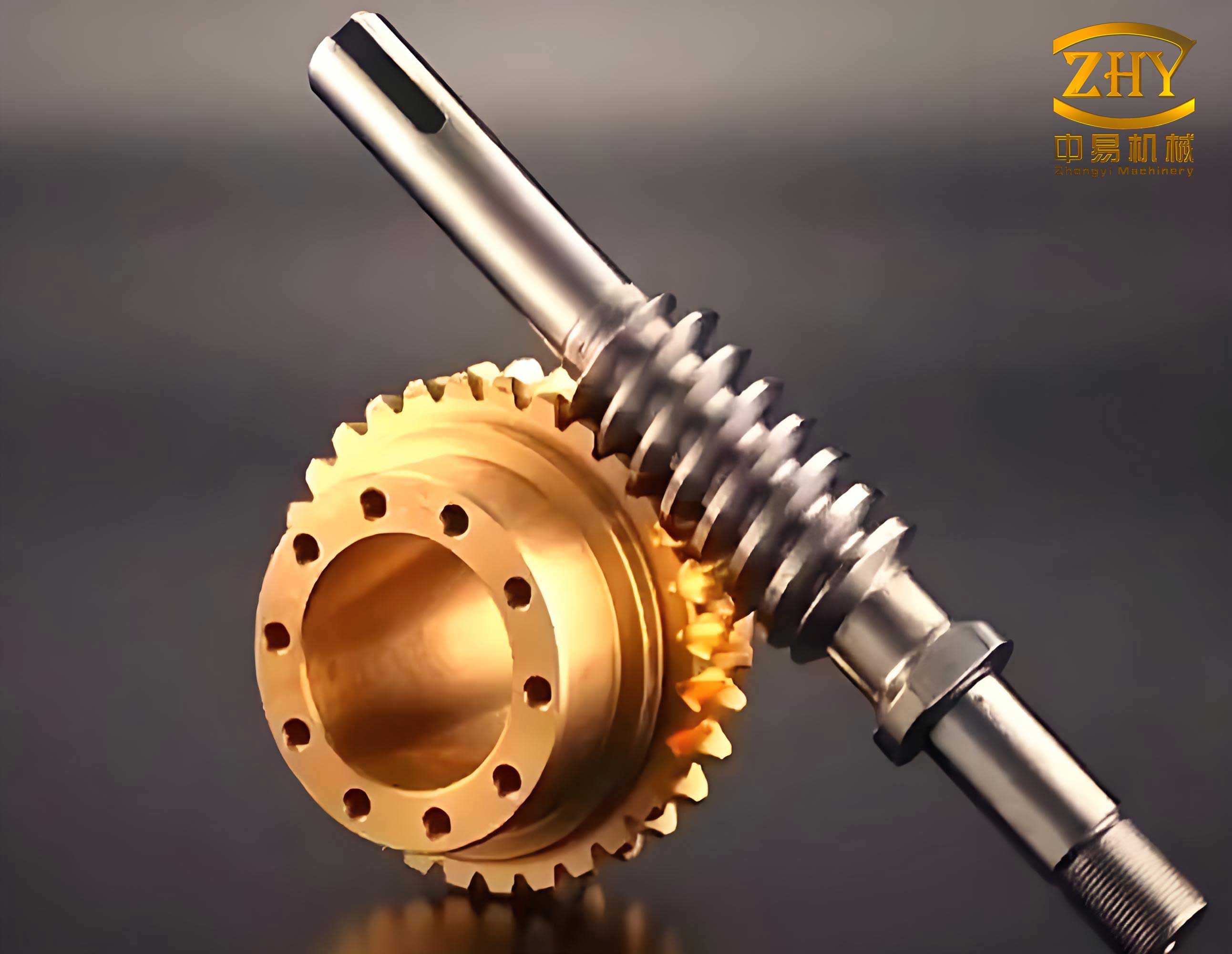
In my implementation, the modeling of screw gears begins with the worm gear. The worm gear is analogous to a threaded shaft, but with a trapezoidal tooth profile that matches the worm wheel. The AutoLISP program prompts the user to input parameters such as module, worm gear coefficient, length, and other structural dimensions. For instance, the worm gear coefficient (q) is used to determine the pitch diameter, where $$q = \frac{d1}{m}$$. This coefficient influences the stiffness and efficiency of the screw gear system. Based on these inputs, the program creates a cylindrical body representing the worm gear’s outer diameter. The tooth profile is then defined as a trapezoidal section with a pressure angle of 20°, and this profile is extruded along a helical path to form the threads. The process involves subtracting the tooth volumes from the cylinder using Boolean operations, repeated in a loop until all threads are generated. This method ensures accurate tooth spacing and alignment, which is crucial for proper meshing with the worm wheel. Below is a summary of the worm gear modeling steps in algorithmic form.
| Step | Action | AutoLISP Command/Calculation |
|---|---|---|
| 1 | Input parameters | Use getreal for m, z1, α, etc. |
| 2 | Compute dimensions | Calculate d1, ha, hf: $$d1 = m \times z1$$, $$ha = m$$, $$hf = 1.25m$$. |
| 3 | Create base cylinder | Use cylinder command with radius = d1/2 + ha. |
| 4 | Define tooth profile | Draw trapezoid based on m and α. |
| 5 | Extrude profile helically | Use extrude along a path defined by lead L. |
| 6 | Subtract teeth from cylinder | Use subtract in a loop for all threads. |
| 7 | Add shaft features | Create additional cylinders for journals and hubs. |
The worm wheel modeling follows a similar parametric approach but involves more complex geometry due to the curved tooth surfaces that envelop the worm gear. The worm wheel is essentially a gear with teeth that are cut to match the worm gear’s threads. In my AutoLISP program, the worm wheel is modeled by first creating a blank cylindrical body with an outer diameter based on the wheel’s parameters. Then, a virtual worm gear (similar to a cutting tool) is used to subtract material from the blank, forming the tooth spaces. This process mimics the hobbing operation used in manufacturing screw gears. The key parameters for the worm wheel include the number of teeth (z2), face width (b), and wrap angle (θ), which determines how much of the worm gear engages with the wheel. The wrap angle is typically between 90° and 120° for standard screw gears. The mathematical relationship for the worm wheel’s pitch diameter is $$d2 = m \times z2$$, and the center distance between the worm gear and worm wheel is $$a = \frac{d1 + d2}{2}$$. This center distance is critical for ensuring proper alignment and meshing of the screw gears.
To achieve high precision in the worm wheel model, the AutoLISP program calculates the tooth profile based on the worm gear’s geometry. The program creates a series of cutting operations where the virtual worm gear is rotated and translated relative to the worm wheel blank. Each cut removes a portion of material, and after multiple iterations, the complete set of teeth is formed. This iterative process is controlled by loops in AutoLISP, which adjust the position and orientation of the cutting tool for each tooth. The use of parametric equations allows for automatic updates when input parameters change, making the modeling of screw gears highly adaptive. For example, if the module is increased, all related dimensions such as tooth height and pitch diameter are recalculated, and the 3D model is regenerated accordingly. This flexibility is a significant advantage over manual modeling, where each change requires redrawing multiple features.
In addition to the basic tooth geometry, my parametric modeling framework includes features such as fillets, chambers, and hub designs for screw gears. These elements are important for reducing stress concentrations and improving the durability of screw gears in real-world applications. The AutoLISP program allows for the specification of additional parameters like fillet radius, hub diameter, and keyway dimensions. These are incorporated into the model through extrusions and Boolean operations. For instance, the hub of the worm wheel can be modeled as a cylinder with a given diameter and length, attached to the wheel body. The program also supports the creation of assembly models where the worm gear and worm wheel are positioned relative to each other based on the center distance. This enables interference checking and motion simulation within AutoCAD, further enhancing the design validation process for screw gears.
The core of the AutoLISP program lies in its ability to handle geometric transformations and calculations. AutoLISP provides functions for matrix operations, coordinate system manipulation, and entity handling, which are essential for 3D modeling. For example, during the worm wheel cutting process, the program frequently changes the user coordinate system (UCS) to align the cutting tool correctly. Commands like ucs, rotate, and move are used in conjunction with mathematical formulas to position the virtual worm gear. The rotation angle for each cut is derived from the tooth spacing, which is $$ \frac{360^\circ}{z2} $$ for the worm wheel. Similarly, the translation distance along the axis is based on the lead of the worm gear. These operations are encapsulated in loops, as shown in the pseudocode below.
Let me outline a simplified version of the cutting loop for worm wheel modeling. The program initializes by setting the worm wheel blank and virtual worm gear. Then, for each tooth position i from 1 to z2, it performs the following steps: rotate the worm wheel blank by $$ \Delta\theta = \frac{360^\circ}{z2} $$, adjust the UCS to align with the worm gear axis, rotate the virtual worm gear by a corresponding angle, copy the worm gear to the cutting position, and subtract it from the worm wheel blank. This loop continues until all teeth are formed. The AutoLISP code for this involves nested while loops and entity selection, ensuring that each cut is precise. The use of parametric variables allows this loop to adapt to different numbers of teeth, making the modeling of screw gears scalable.
To illustrate the mathematical foundations, here are key formulas used in the parametric modeling of screw gears. These formulas are implemented in AutoLISP as expressions for calculating dimensions.
For the worm gear:
– Pitch diameter: $$d1 = m \times q$$, where q is the diameter quotient.
– Addendum diameter: $$d_{a1} = d1 + 2m$$.
– Dedendum diameter: $$d_{f1} = d1 – 2.5m$$.
– Lead angle: $$ \gamma = \arctan\left(\frac{L}{\pi d1}\right) $$, where L is the lead.
For the worm wheel:
– Pitch diameter: $$d2 = m \times z2$$.
– Addendum diameter: $$d_{a2} = d2 + 2m$$.
– Dedendum diameter: $$d_{f2} = d2 – 2.5m$$.
– Throat diameter: $$d_{t2} = d2 + 2m$$ for enveloping screw gears.
These formulas ensure that the screw gears mesh properly without interference. The AutoLISP program computes these values dynamically and uses them to define the geometry of cylinders, extrusions, and cuts. For example, when creating the worm gear cylinder, the radius is set to $$ \frac{d_{a1}}{2} $$, and for the worm wheel blank, the radius is $$ \frac{d_{a2}}{2} $$. This parametric approach minimizes errors and ensures that the models adhere to engineering standards for screw gears.
In terms of performance, the AutoLISP-based parametric modeling of screw gears offers significant time savings. Manual modeling of a single screw gear pair can take hours, especially for high-tooth-count configurations. With the AutoLISP program, the same model can be generated in minutes by simply inputting parameters. This efficiency is crucial in iterative design processes, where multiple variations of screw gears need to be evaluated. Additionally, the program reduces human error, as all dimensions are derived from mathematical formulas rather than manual measurements. The consistency of the models is also improved, which is beneficial for manufacturing and assembly. For instance, in automotive applications where screw gears are used in steering systems, precise models are essential for safety and performance.
Beyond basic modeling, the framework can be extended to include analysis features such as stress calculation and lubrication simulation for screw gears. By integrating AutoLISP with other AutoCAD tools like AutoDESK Inventor or via APIs, one can perform finite element analysis on the generated screw gear models. This holistic approach supports the entire product development lifecycle, from design to validation. However, in this article, I focus on the modeling aspect, which forms the foundation for such advanced analyses. The parametric models of screw gears can be exported to standard formats like STEP or IGES for use in other CAD/CAM software, facilitating collaboration across engineering teams.
Challenges in parametric modeling of screw gears include handling complex tooth profiles for non-standard types, such as double-enveloping screw gears or those with modified pressure angles. My AutoLISP program currently supports Archimedean screw gears, but it can be adapted for other profiles by modifying the tooth definition formulas. For example, for involute screw gears, the tooth profile is defined by the involute curve equation: $$ x = r_b (\cos\theta + \theta \sin\theta) $$, $$ y = r_b (\sin\theta – \theta \cos\theta) $$, where $$ r_b $$ is the base radius. Incorporating such curves into AutoLISP requires additional trigonometric calculations, but it is feasible with the language’s mathematical functions. This adaptability underscores the power of parametric modeling for diverse screw gear applications.
In conclusion, the use of AutoLISP for parametric modeling of screw gears provides a robust solution to the inefficiencies of traditional CAD methods. By leveraging geometric parameterization, the framework enables rapid, accurate, and consistent generation of worm gear and worm wheel models. The integration of tables and formulas, as demonstrated in this article, helps summarize key parameters and relationships, making the design process more transparent and controllable. The frequent mention of screw gears throughout this discussion highlights their importance in mechanical systems and the value of automating their design. As technology advances, such parametric approaches will become increasingly vital for optimizing screw gear performance and reducing time-to-market. Future work may involve enhancing the program with graphical user interfaces or cloud-based parameter databases, further streamlining the modeling of screw gears for global engineering teams.
To recap, the parametric modeling of screw gears using AutoLISP involves: defining input parameters, computing dimensions via formulas, creating base geometries, applying Boolean operations for tooth generation, and adding ancillary features. This process not only improves efficiency but also supports customization for various screw gear types. I encourage engineers and designers to explore AutoLISP for their CAD automation needs, particularly for complex components like screw gears. With the provided framework, they can achieve higher productivity and innovation in mechanical design. The attached image illustrates a typical screw gear pair, showcasing the intricate geometry that can be modeled parametrically. Through continued development and application, such tools will drive progress in the field of gear engineering and beyond.