
In my extensive career in industrial engineering and field operations, I have witnessed numerous challenges related to worker safety and mechanical efficiency. Two particular innovations stand out: the implementation of wet process operations to mitigate dust hazards in foundries, and the revolutionary use of asphalt for lubricating spiral gears in drilling machinery. These advancements not only enhanced operational conditions but also led to significant cost savings and productivity gains. Through this narrative, I will delve into the technical details, supported by tables and formulas, to elucidate how these methods were developed and their profound impact. The keyword ‘spiral gears’ will be frequently emphasized, as it pertains to a critical component in drilling equipment where lubrication plays a pivotal role in performance and longevity.
My involvement began with a project at a mining engineering department, where we faced severe dust pollution in the casting workshop. The environment was characterized by manual operations without proper water supply, leading to dust concentrations that posed health risks to workers. Complaints included black sputum, throat irritation, dry nostrils, and blurred vision, which affected attendance rates. To address this, we launched an initiative under the guidance of leadership, with support from health and safety agencies. We focused on replacing dry box-breaking operations with wet processes, which involved spraying water on castings after pouring. This simple yet effective method dramatically reduced dust levels, as confirmed through systematic measurements.
To quantify the improvement, we conducted tests comparing dry and wet box-breaking. The dust concentration was measured in grams per cubic meter (g/m³). Initial dry process operations recorded concentrations as high as 1.77 g/m³, whereas after implementing wet methods, this dropped to 0.2 g/m³. This represents a reduction of approximately 88.7%, calculated using the formula: $$ \text{Reduction Percentage} = \left( \frac{C_{\text{dry}} – C_{\text{wet}}}{C_{\text{dry}}} \right) \times 100\% $$ where \( C_{\text{dry}} \) is the dust concentration in dry operations and \( C_{\text{wet}} \) is that in wet operations. Substituting the values: $$ \text{Reduction Percentage} = \left( \frac{1.77 – 0.2}{1.77} \right) \times 100\% \approx 88.7\% $$ This substantial decrease was achieved without compromising casting quality; no deformities, hardening, or cracking were observed. In fact, efficiency improved, with box-breaking time reduced from 8 hours to 2 hours and 30 minutes per cycle.
The wet process protocol involved spraying water on castings weighing under 500 kg within 2 to 3 minutes after pouring, with water weight about 1-2% of the casting weight. A second spray followed after 3-5 minutes, ensuring thorough saturation of the molding sand. After 10 minutes, the box could be opened, and cleaning proceeded with additional wetting as needed. We established management principles such as “three diligences” (frequent watering, cleaning, and inspection) and “two arrangements” (orderly placement and倾倒 of materials), which reinforced the system. The table below summarizes the key metrics before and after implementation:
| Aspect | Dry Process | Wet Process | Improvement |
|---|---|---|---|
| Dust Concentration (g/m³) | 1.77 | 0.2 | 88.7% reduction |
| Box-breaking Time (hours) | 8 | 2.5 | 68.75% time savings |
| Casting Quality Issues | None reported | None reported | No adverse effects |
| Worker Health Complaints | High (e.g., respiratory issues) | Low | Significant alleviation |
This success inspired us to explore similar innovations in other areas, particularly in mechanical systems involving spiral gears. In drilling operations, spiral gears are essential for transmitting motion in vertical shafts, but they often suffer from excessive wear due to high temperatures and inadequate lubrication. During a project in a desert region, we observed that conventional grease lubricants would thin and flow away under heat, leading to rapid gear degradation. For instance, one drilling machine could wear out 2-3 sets of spiral gears per month, sometimes even one set in three days, severely hampering exploration tasks. This prompted us to experiment with asphalt as an alternative lubricant, given its properties like high viscosity, strong adhesion, and heat resistance.
The performance of asphalt lubricant was evaluated based on its ability to maintain a protective film on spiral gear surfaces, reducing friction and heat generation. The key advantages include faster heat dissipation, resistance to flow at elevated temperatures, and enhanced adhesion that ensures continuous lubrication. From an economic perspective, the cost savings were substantial. Previously, each drilling machine consumed 30 kg of grease monthly, costing around 240 currency units, and required 2-3 gear sets at 120 units each, totaling approximately 600 units per month. With asphalt, consumption dropped to 10 kg per month at only 8 units, and gear life extended to 2-3 months per set, reducing monthly gear expense to about 40-60 units. Thus, the total monthly savings per machine amounted to roughly 532 units, calculated as: $$ \text{Savings} = (\text{Cost}_{\text{grease}} + \text{Cost}_{\text{gears}})_{\text{before}} – (\text{Cost}_{\text{asphalt}} + \text{Cost}_{\text{gears}})_{\text{after}} $$ where before costs are 240 + 360 (assuming 3 sets at 120 each) = 600 units, and after costs are 8 + 40 (assuming 0.5 sets per month at 80 per set) = 48 units, yielding savings of 552 units. This simplified model ignores operational downtime reductions, which further boosted productivity.
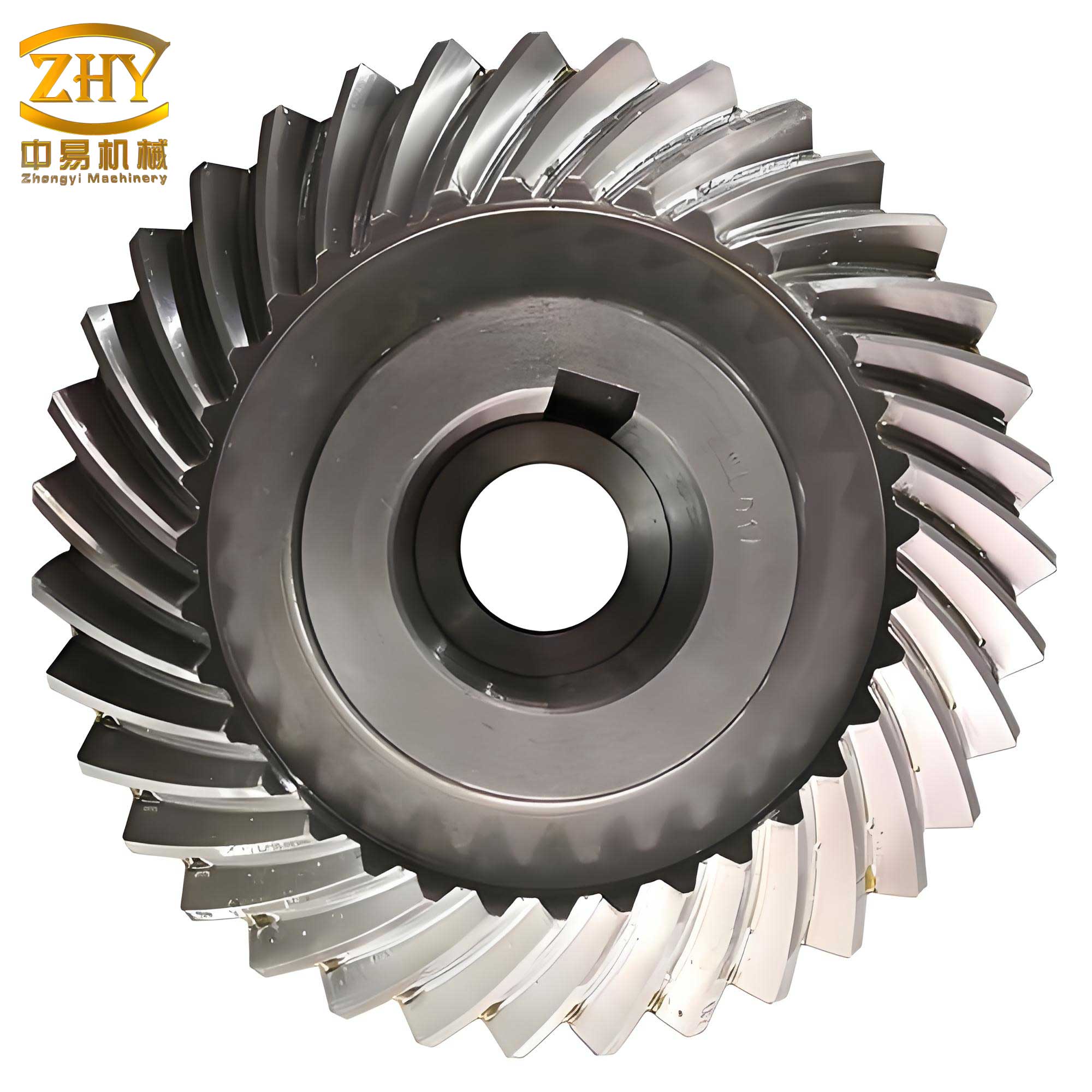
The application method for asphalt lubrication involved breaking asphalt into small pieces and placing them around the spiral gears, or melting it into a paste using hot water for easier application. We typically added lubricant twice per 24-hour period. Used asphalt could be collected and reused, enhancing sustainability. However, challenges arose in colder climates; during prolonged stops, preheating the gearbox with a blowtorch was necessary before operation, and disassembly required similar heating to avoid damage. These measures ensured that the spiral gears remained functional even under harsh conditions. To model the wear rate of spiral gears, we considered the Archard wear equation: $$ V = K \frac{F_n s}{H} $$ where \( V \) is the wear volume, \( K \) is the wear coefficient, \( F_n \) is the normal load, \( s \) is the sliding distance, and \( H \) is the material hardness. With asphalt lubrication, the wear coefficient \( K \) decreases due to better film formation, reducing \( V \) and extending gear life. The table below compares the performance metrics for spiral gears with different lubricants:
| Parameter | Grease Lubrication | Asphalt Lubrication | Notes |
|---|---|---|---|
| Lubricant Consumption (kg/month) | 30 | 10 | Based on per machine data |
| Cost per Month (currency units) | 240 | 8 | Assuming unit prices |
| Spiral Gear Life (months per set) | 0.33-0.5 | 2-3 | Average values observed |
| Gear Cost per Month (units) | 360-480 | 40-60 | Depending on replacement rate |
| Total Monthly Cost (units) | 600-720 | 48-68 | Including lubricant and gears |
| Heat Dissipation Efficiency | Low | High | Asphalt retains viscosity better |
| Operational Downtime | High due to frequent changes | Low | Fewer interruptions for maintenance |
In reflecting on these innovations, it is clear that both wet process operations and asphalt lubrication for spiral gears share a common theme: leveraging simple, low-cost solutions to address complex industrial problems. The success hinged on grassroots involvement, where workers contributed ideas and leadership provided support. For spiral gears, the shift to asphalt not only cut costs but also enhanced reliability in high-temperature environments, a critical factor in drilling operations where equipment failure can lead to significant delays. The mechanical advantages of spiral gears—such as smooth torque transmission and high load capacity—are further optimized with proper lubrication, underscoring the importance of this component in industrial machinery.
From a technical perspective, the dust control measures can be analyzed using fluid dynamics and particle sedimentation models. The wetting process increases the mass of dust particles, causing them to settle faster due to gravity. The settling velocity \( v_s \) for a spherical particle in air can be approximated by Stokes’ law: $$ v_s = \frac{2}{9} \frac{(\rho_p – \rho_f) g r^2}{\eta} $$ where \( \rho_p \) is particle density, \( \rho_f \) is fluid density, \( g \) is gravitational acceleration, \( r \) is particle radius, and \( \eta \) is dynamic viscosity. By adding water, \( \rho_p \) increases, enhancing \( v_s \) and reducing airborne concentration. Similarly, for spiral gears, the lubrication effectiveness can be modeled using the Reynolds equation for thin-film flow: $$ \frac{\partial}{\partial x} \left( h^3 \frac{\partial p}{\partial x} \right) + \frac{\partial}{\partial y} \left( h^3 \frac{\partial p}{\partial y} \right) = 6 \eta U \frac{\partial h}{\partial x} $$ where \( h \) is film thickness, \( p \) is pressure, \( \eta \) is viscosity, and \( U \) is surface velocity. Asphalt’s high viscosity ensures a thicker film \( h \), improving pressure distribution and reducing metal-to-metal contact.
The implementation of these methods required continuous monitoring and adaptation. For dust control, we established regular inspections to ensure water spraying was consistent, and we adjusted protocols based on casting sizes and environmental conditions. The three diligences—frequent watering, cleaning, and inspection—became a mantra for the team, fostering a culture of safety. In the case of spiral gears, we developed guidelines for asphalt application, emphasizing preheating in cold weather to maintain fluidity. We also documented best practices, such as avoiding direct contact with water to prevent clogging in diesel engine systems. These experiences highlight the iterative nature of industrial innovation, where trial and error lead to refined processes.
Looking broader, these advancements have implications for similar industries worldwide. The wet process can be adapted to any foundry or construction site with dust issues, while asphalt lubrication for spiral gears offers a viable alternative in mining, drilling, and heavy machinery sectors. The economic benefits are not just in direct cost savings but also in improved worker health, reduced environmental impact, and enhanced equipment longevity. For spiral gears specifically, the reduction in wear translates to lower maintenance frequencies and higher operational uptime, which is crucial in time-sensitive projects like mineral exploration.
In conclusion, my firsthand experience with these projects underscores the power of practical solutions in industrial settings. By embracing wet processes for dust suppression and asphalt for lubricating spiral gears, we achieved remarkable improvements in safety, efficiency, and cost-effectiveness. The data and formulas presented here provide a framework for others to replicate these successes. As industries evolve, continuous innovation in areas like dust control and gear lubrication will remain vital, with spiral gears playing a key role in mechanical systems. I encourage further research into optimizing these methods, perhaps integrating advanced materials or automated systems, to drive future progress.