
In the demanding field of radar antenna design, especially for mobile platforms such as ground vehicles and naval vessels, engineers constantly face stringent constraints regarding system mass, spatial envelope, deployment time, and operational reliability. Conventional transmission solutions, while effective for many applications, often fall short under these extreme requirements. Through extensive engineering experience, I have found that the unique characteristics of worm gears present compelling solutions for specific, challenging motion control tasks in radar systems. This article delves into the innovative application of worm gear reducers, focusing on their role in antenna elevation drives and folding mechanisms, substantiated with technical design methodology, quantitative analysis, and comparative evaluation.
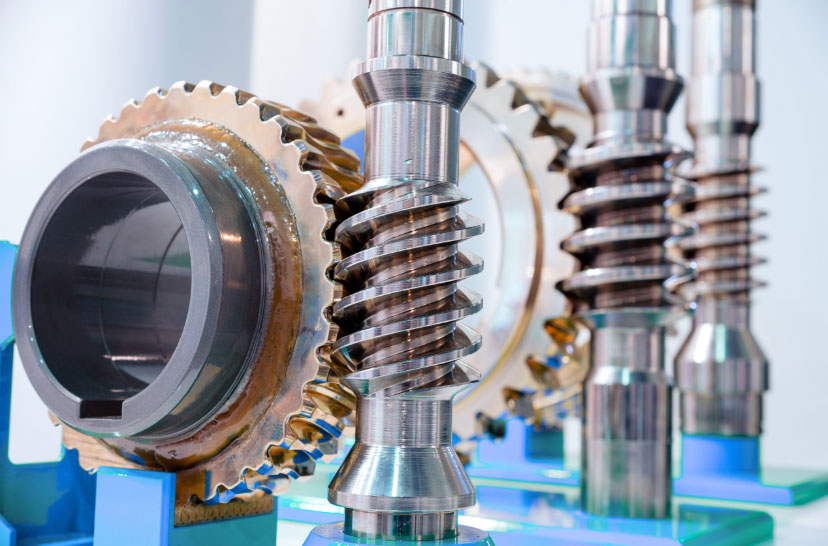
The fundamental appeal of worm gears lies in their distinct set of mechanical properties. As a power transmission mechanism for non-intersecting, perpendicular shafts, they offer an unparalleled combination of a high single-stage reduction ratio, high rated output torque, smooth and quiet operation, and crucially, the potential for self-locking. The self-locking feature occurs when the lead angle of the worm is less than the equivalent friction angle of the gear pair, effectively preventing back-driving from the output (worm gear) to the input (worm). However, this advantage comes with trade-offs, primarily lower transmission efficiency (often below 50% for self-locking types) due to significant sliding friction, associated heat generation under sustained high-speed operation, and relatively lower positional accuracy compared to precision gear trains. The strategic innovation lies not in using worm gears universally, but in deploying them where their core strengths directly solve critical design problems that other transmissions cannot address as efficiently.
Fundamental Characteristics and Design Equations
The design process for implementing worm gears begins with a clear understanding of their governing equations. The primary kinematic relationship defines the velocity ratio (i), which is exceptionally high for a single stage:
$$ i = \frac{N_g}{N_w} $$
where \( N_g \) is the number of teeth on the worm gear and \( N_w \) is the number of threads (starts) on the worm. The self-locking condition is approximated by:
$$ \lambda \leq \arctan(\mu) $$
where \( \lambda \) is the lead angle and \( \mu \) is the coefficient of friction. The output torque \( T_{out} \) is related to the input torque \( T_{in} \) by:
$$ T_{out} = T_{in} \cdot i \cdot \eta $$
where \( \eta \) is the transmission efficiency. For preliminary sizing, the required torque capacity of the worm gear set must be evaluated against the total load moment \( M_{total} \) on the antenna, which is a composite of several factors:
$$ M_{total} = \sqrt{M_J^2 + M_W^2 + M_G^2} + M_F $$
- \( M_J = J \cdot \alpha \): Inertial moment (Mass moment of inertia \( J \) × angular acceleration \( \alpha \))
- \( M_W \): Wind load moment (dominant in outdoor applications)
- \( M_G \): Unbalance moment due to gravity (mass × offset distance)
- \( M_F \): Frictional moment in bearings and seals.
Application I: Elevation Drive for a Large Double-Offset Reflector Antenna
Design Challenge and Conceptual Solution
A primary challenge in designing the elevation axis for a large 5-meter double-offset reflector antenna was the enormous gravity-induced unbalance moment (\( M_G \)). Traditional gear-driven elevation systems require massive counterweights to balance this moment, ensuring motor torque is used for dynamic motion rather than static load holding, and preventing catastrophic back-drive in case of power or brake failure. This counterweight adds significant, inert mass to the entire system, compromising transportability—a critical factor for road- or rail-mobile radars.
The innovative solution was to exploit the inherent self-locking property of worm gears. By employing a worm gear reducer as the final drive stage, the system can hold the static load securely without any brake. This eliminates the need for a counterweight altogether. The motor only needs to overcome inertia, wind load, and friction to move the antenna, not the gravity moment. To handle the immense total load and provide redundancy, a dual-drive configuration was adopted.
Transmission System Design and Analysis
The elevation drive was architected as two independent, synchronized drive trains, each terminating in a large, double-input worm gear reducer. Each reducer acts as both the final drive and the elevation bearing, creating a highly compact and integrated assembly. The detailed power flow and component selection are based on the calculated loads.
| Parameter | Symbol | Value | Notes |
|---|---|---|---|
| Total Load Moment | \( M_{total} \) | 56 kN·m | Calculated from dynamics, wind, gravity, friction. |
| Load per Reducer | \( M_{red} \) | 28 kN·m | \( M_{total} / 2 \) for dual drive. |
| Worm Gear Reducer (WZ117-2) | |||
| Rated Output Torque | \( T_{w,rated} \) | 140 kN·m | Manufacturer specification. |
| Safety Factor | \( S_w \) | 5.0 | \( T_{w,rated} / M_{red} \). |
| Reduction Ratio | \( i_w \) | 117 | |
| Efficiency | \( \eta_w \) | 0.35 | Typical for self-locking worm gears. |
| Torque per Input Worm | \( T_{in,worm} \) | 342 N·m | \( M_{red} / (2 \cdot i_w \cdot \eta_w) \). |
| Planetary Reducer | |||
| Rated Output Torque | \( T_{p,rated} \) | 1150 N·m | |
| Safety Factor | \( S_p \) | 3.4 | \( T_{p,rated} / T_{in,worm} \). |
| Reduction Ratio | \( i_p \) | 8 | |
| Efficiency | \( \eta_p \) | 0.95 | |
| Motor Rated Torque (per motor) | \( T_{m,rated} \) | 66 N·m | Must be > 45 N·m required torque. |
| Total System Ratio | \( i_{total} \) | 936 | \( i_w \times i_p \). |
| Max Output Angular Velocity | \( \omega_{max} \) | 12.8 °/s | Exceeds requirement of 10 °/s. |
The selection confirms the design’s feasibility. The high safety factor on the worm gear reducer is crucial for long-term reliability under shock and varying loads. However, the low efficiency of the worm gear stage is evident, necessitating motors with higher torque/power ratings compared to a counterweight-balanced gear system. The system’s maximum speed is inherently limited by the thermal and wear characteristics of the worm gears, making it suitable for moderate-speed tracking, not high-speed slewing.
Structural Integration and Stiffness Validation
Removing the counterweight shifts the entire structural burden onto the antenna pedestal and elevation structure. The unbalanced mass creates a constantly varying moment on the elevation bearings (worm gear reducers) and the supporting arms. Ensuring sufficient stiffness to maintain pointing accuracy under load is paramount.
A finite element analysis (FEA) was performed on the complete structure—pedestal, support arms, elevation frame (housing the feeds), and the reflector masses (modeled as point masses). The worst-case gravity load (antenna pointing to zenith) was applied. The optimization goal was to minimize mass while constraining stress and deflection. The material was steel with Young’s Modulus \( E = 2.06 \times 10^5 \) MPa and Poisson’s ratio \( \nu = 0.3 \).
The key results from the FEA were:
- Maximum Stress: 15 MPa, significantly below the yield strength of structural steel (e.g., 345 MPa).
- Maximum Total Displacement: 0.17 mm at the reflector interface.
- Angular Deflection about Elevation Axis: The displacement field was resolved into a rotation about the elevation axis, resulting in an error of 4.3 arcminutes. This value was within the specified budget for this class of antenna, validating the stiffness of the weight-optimized, counterweight-less design.
The structural success of this approach hinges on the integrated design where the worm gear reducer’s outer housing is fixed to the support arm, and its rotating output (the gear) is bolted directly to the elevation frame. This eliminates separate bearings and creates a very rigid connection.
Advantages and Critical Considerations for Elevation Drive
| Advantages | Considerations and Challenges |
|---|---|
|
|
Application II: Synchronized Folding Mechanism for a Planar Array Antenna
Design Challenge and Conceptual Solution
For a large (6m x 3.2m) vehicular planar array antenna, the challenge was to achieve rapid, reliable, and synchronized folding of two large panel sections to meet strict transport width limits. Conventional solutions using linear actuators (electric or hydraulic cylinders) or individual motors on each hinge involve complex sequencing, require separate locking mechanisms, and are prone to synchronization errors that can bind or damage the structure.
The innovative solution was to design a custom worm gear module based on the principle of a single worm driving two worm gears. Each output worm gear is directly attached to one of the folding antenna panels. When the central worm rotates, it drives both worm gears simultaneously and at exactly the same rate, guaranteeing perfect synchronization. The motion is exactly 90 degrees from fully deployed to stowed.
Transmission System Design and Analysis
The mechanism is a masterpiece of mechanical synchronization. The driving torque for each panel is calculated from its mass imbalance and friction. The selected worm gear pair must provide sufficient output torque and the all-important self-locking to act as the structural lock in both stowed and deployed positions.
| Parameter | Symbol | Value | Notes |
|---|---|---|---|
| Load per Panel (Unbalance + Friction) | \( T_{panel} \) | 3.1 kN·m | |
| Worm Gear Reducer (W7 Type) | |||
| Rated Output Torque | \( T_{wg,rated} \) | 4.5 kN·m | > \( T_{panel} \). |
| Reduction Ratio | \( i_{wg} \) | 47 | |
| Efficiency | \( \eta_{wg} \) | 0.35 | |
| Total Input Torque to Worm | \( T_{in} \) | 376.9 N·m | \( (2 \cdot T_{panel}) / (i_{wg} \cdot \eta_{wg}) \). |
| High-Ratio Planetary Reducer | |||
| Rated Output Torque | 300 N·m | > \( T_{in}/2 = 188.5 \) N·m. | |
| Reduction Ratio | \( i_{plan} \) | 200 | |
| Efficiency | \( \eta_{plan} \) | 0.95 | |
| Required Motor Torque (per motor) | \( T_{motor, req} \) | ~1.0 N·m | \( (T_{in}/2) / (i_{plan} \cdot \eta_{plan}) \). |
| Selected Motor Rated Torque | \( T_{motor} \) | 3.0 N·m | Small, low-power motor sufficient. |
| Total System Ratio | \( i_{total} \) | 9400 | \( i_{wg} \times i_{plan} \). |
| Folding Time for 90° | \( t_{fold} \) | ~3.9 min | Meets < 5 min requirement. |
This analysis reveals a key benefit: the enormous total reduction ratio allows the use of very small, low-power electric motors (e.g., 200W). These motors can often be powered through existing low-current signal slip rings, simplifying system integration. The self-locking property is doubly valuable here: it holds the panels securely in place without clamps or latches, and it allows the use of non-back-drivable, high-ratio reducers on the motor input without concern for the static load.
Mechanical Design and Synchronization Imperative
The core component is a rigid “worm carrier” housing that precisely locates the central worm shaft and the two output worm gear shafts. The alignment and center distance between the worm and each worm gear must be manufactured to tight tolerances (e.g., ±0.05 mm) to ensure smooth, low-backlash meshing and equal load distribution. The worm shaft is driven from both ends by two synchronized servo motors via high-ratio planetary reducers. This dual input provides redundancy and balances the load on the worm shaft.
The most critical control aspect is the precise electronic synchronization of the two drive motors. If the motors are not perfectly synchronized in speed and position, they will fight each other, applying opposing torques to the ends of the worm shaft. This can lead to excessive shaft stress, accelerated wear, binding, and ultimately mechanism failure. Therefore, the control system must implement tight velocity/current loop matching and include real-time monitoring to halt operation if a significant torque imbalance is detected.
Advantages and Critical Considerations for Folding Mechanism
| Advantages | Considerations and Challenges |
|---|---|
|
|
Synthesis and Guidelines for Application
The successful application of worm gears in these radar subsystems highlights a strategic design philosophy: use them where their unique advantages are indispensable and their disadvantages are manageable or irrelevant to the core requirement.
The following decision matrix can help in evaluating whether a worm gear solution is appropriate:
| Design Driver / Requirement | Favors Worm Gears | Favors Alternative (Gears, Actuators) |
|---|---|---|
| Need for Built-in Load Holding (Self-locking) | YES – Eliminates brakes/counterweights for static loads. | NO – If dynamic braking is sufficient or back-driving is acceptable/controlled. |
| Extreme Single-Stage Reduction Ratio | YES – Ratios from 10:1 to 100:1+ in one stage. | NO – If multiple gear stages are acceptable for space/cost. |
| High Torque in Compact Envelope | YES – Excellent torque density for low-speed outputs. | NO – If high speed is also required concurrently with high torque. |
| Operational Speed | LOW to MODERATE – Suitable for tracking, indexing, folding. | HIGH – For high-speed slewing, use high-efficiency gear trains. |
| Positioning Accuracy/Backlash | MODERATE – Acceptable for wider beamwidth antennas. | HIGH – For precision tracking of pencil beams, use precision gears or direct drives. |
| System Efficiency & Thermal Management | LOW – High power loss; requires thermal analysis. | HIGH – For power-constrained platforms or continuous operation. |
| Need for Perfect Mechanical Sync | YES – Single-input, multiple-output worm designs are excellent. | NO – Electronic sync of multiple actuators may be simpler for some geometries. |
In conclusion, the worm gear is not a one-size-fits-all component for radar drives. However, in specific, constrained scenarios common in mobile radar design—where mass, volume, safety, and synchronized motion are paramount—its intelligent application provides elegant and highly effective solutions. The elevation drive case demonstrates how self-linking enables radical mass reduction, while the folding mechanism showcases an ingenious method for guaranteed synchronization without complex controls. By carefully weighing their high torque capacity and self-locking benefit against their lower efficiency and speed limits, engineers can leverage worm gears to solve some of the most challenging structural and kinematic problems in modern radar antenna systems.