
In the manufacturing of automotive and tractor planetary gear systems, the post-quenching processing of miter gears is a critical step to ensure optimal performance. After quenching, these miter gears often exhibit distortions that necessitate grinding of the internal hole to achieve precise concentricity with the pitch circle. This concentricity is paramount for smooth operation, noise reduction, and extended service life of the gears. In our production facility, we have developed and implemented a specialized fixture for grinding the internal holes of miter gears, designed to maintain pitch circle runout within stringent tolerance limits. This fixture leverages a four-ball centering mechanism, axial face positioning, and a clamping system via a guide nut and pressure plate, resulting in a robust solution for high-volume manufacturing. The consistent quality and efficiency gains from this fixture have been substantial, as detailed in this comprehensive analysis.
The fundamental requirement for miter gears in planetary assemblies is the alignment of the internal bore with the pitch circle. The pitch circle, a theoretical circle upon which the tooth geometry is based, must be concentric with the mounting hole to avoid eccentric loads and vibrations. For miter gears, which are typically bevel gears with a shaft angle of 90 degrees, this alignment is even more crucial due to their role in transmitting torque between intersecting axes. The pitch circle diameter for a miter gear is given by the formula: $$d = m \times z$$ where \(d\) is the pitch diameter, \(m\) is the module, and \(z\) is the number of teeth. Any deviation from concentricity, measured as pitch circle runout, directly impacts meshing accuracy and acoustic emissions. Our fixture aims to control this runout to within 0.02 mm, as validated through extensive testing.
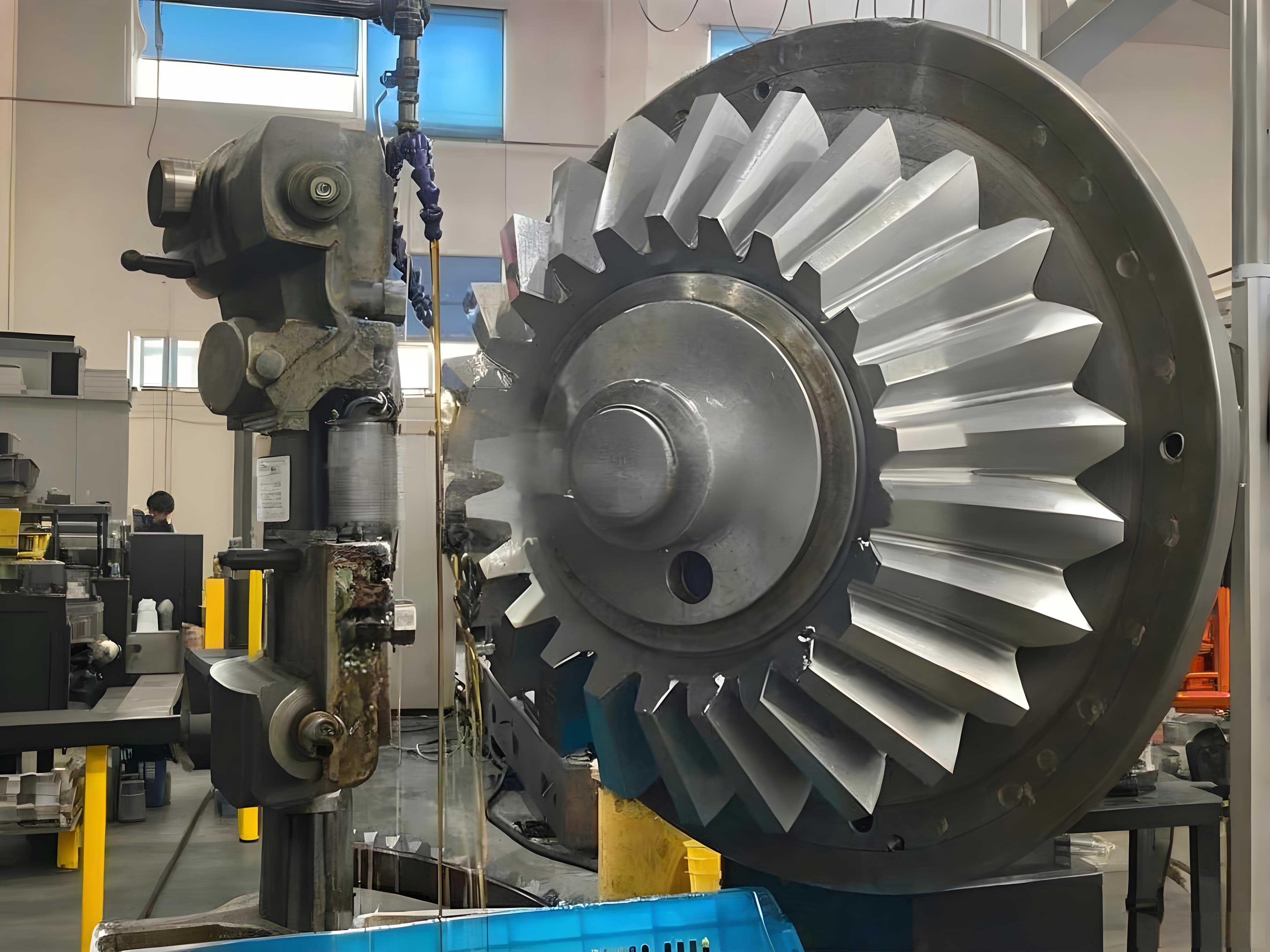
The design philosophy behind our miter gear grinding fixture centers on simplicity, reliability, and repeatability. The fixture body is mounted to the grinding machine spindle via a chuck base, ensuring stable rotation. Centering is achieved using four hardened steel balls positioned symmetrically around the pitch circle of the miter gear. These balls engage the gear teeth, providing automatic alignment without damaging the tooth profile. The axial location is controlled by a reference face on the fixture, which contacts the back face of the miter gear. Clamping is executed through a guide nut and an incomplete pressure plate; the guide nut is threaded onto the fixture body, and when tightened, it presses the pressure plate against the gear, securing it without inducing distortion. This design minimizes setup time and operator skill dependency, making it ideal for batch production of miter gears.
To quantify the performance, we conducted a sampling inspection on a batch of miter gears processed with this fixture. The gears were manufactured to an accuracy grade of 7-6-6 GM according to AGMA standards, with a module of 3.5 mm, 16 teeth, and a pressure angle of 20°. The pitch circle runout was measured using a dial indicator referenced to the internal hole after grinding. The results from 20 sampled miter gears are summarized in the table below, demonstrating the consistency achievable with proper fixture adjustment.
| Gear Sample Number | Runout Value | Deviation from Mean |
|---|---|---|
| 1 | 0.010 | -0.002 |
| 2 | 0.012 | 0.000 |
| 3 | 0.011 | -0.001 |
| 4 | 0.013 | 0.001 |
| 5 | 0.009 | -0.003 |
| 6 | 0.014 | 0.002 |
| 7 | 0.010 | -0.002 |
| 8 | 0.012 | 0.000 |
| 9 | 0.015 | 0.003 |
| 10 | 0.011 | -0.001 |
| 11 | 0.013 | 0.001 |
| 12 | 0.010 | -0.002 |
| 13 | 0.012 | 0.000 |
| 14 | 0.008 | -0.004 |
| 15 | 0.014 | 0.002 |
| 16 | 0.011 | -0.001 |
| 17 | 0.013 | 0.001 |
| 18 | 0.012 | 0.000 |
| 19 | 0.010 | -0.002 |
| 20 | 0.012 | 0.000 |
The statistical analysis of these miter gear runout values reveals a mean runout of 0.012 mm with a standard deviation of 0.0018 mm. Using the formula for process capability, we can assess the fixture’s performance: $$C_p = \frac{USL – LSL}{6\sigma}$$ where \(USL\) is the upper specification limit (0.02 mm), \(LSL\) is the lower specification limit (0 mm, as runout cannot be negative), and \(\sigma\) is the standard deviation. This yields a \(C_p\) value of approximately 1.85, indicating a highly capable process for miter gear production. The repeatability of the fixture ensures that over 99.7% of gears will have a runout within 0.02 mm, assuming a normal distribution.
The manufacturing tolerances for the fixture components are critical to its success. The fixture body must have the centering bore (\(\phi 100\) mm) and the mounting diameter (\(\phi 120\) mm) concentric within 0.005 mm. The face (\(A\)) must exhibit a runout of less than 0.005 mm relative to the centering bore. The guide nut, made from 40Cr steel with a hardness of HRC 35-40 after quenching, requires precise machining: its internal diameter (\(\phi 60\) mm) and the M48×1.5 thread must be concentric within 0.01 mm. Post-quenching, the thread is finished using a carbide tool to maintain this concentricity. The face of the guide nut must have a runout under 0.01 mm relative to its internal diameter. These tolerances ensure that the miter gear is clamped without introducing additional errors.
The operation sequence for grinding miter gears with this fixture is straightforward, contributing to high productivity. First, the fixture body is attached to the grinding machine spindle using four screws. The miter gear workpiece is inserted through the hole in the guide nut’s face. The incomplete pressure plate is placed into the fixture via three slots on the guide nut and then rotated to lock it in position. The guide nut is tightened manually using a handle, which applies clamping force through the pressure plate. Once secured, the internal hole grinding commences. After grinding, the guide nut is loosened by one turn, the pressure plate is rotated back, and the miter gear is removed. This process minimizes non-cutting time, allowing for the grinding of over 300 miter gears per 8-hour shift, a testament to the fixture’s efficiency in batch production.
The theoretical underpinning of this fixture involves the geometry of miter gears and their engagement with the centering balls. The balls contact the tooth flanks near the pitch circle, ensuring that the gear’s rotational axis aligns with the fixture axis. For a miter gear with pressure angle \(\alpha\), the contact force between the ball and tooth can be modeled as: $$F_c = \frac{F_t}{\cos \alpha}$$ where \(F_t\) is the tangential force from clamping. This force must be sufficient to prevent slippage yet low enough to avoid plastic deformation of the tooth surface. Our design uses four balls to distribute the load evenly, reducing stress concentration. The pitch circle runout (\(\Delta\)) is influenced by the cumulative errors of the fixture components, which can be expressed as: $$\Delta = \sqrt{\delta_1^2 + \delta_2^2 + \delta_3^2}$$ where \(\delta_1\) is the centering bore error, \(\delta_2\) is the ball diameter variation, and \(\delta_3\) is the gear tooth profile error. By controlling each term to within microns, we achieve the desired runout tolerance for miter gears.
In comparison to alternative methods such as mandrel-based or hydraulic expansion fixtures, our ball-centering approach offers distinct advantages for miter gears. Traditional mandrels require precise fitting to the gear bore, which can be time-consuming and prone to wear. Hydraulic fixtures, while providing uniform clamping, may not adequately address pitch circle concentricity. Our fixture directly references the gear teeth, making it inherently suitable for miter gears where the pitch circle is the functional datum. Moreover, the use of standard steel balls reduces cost and simplifies maintenance. The fixture’s adaptability to various miter gear sizes can be achieved by interchangeable ball sets or adjustable ball positions, though our current design is optimized for a specific module range.
The economic impact of this fixture in miter gear production is significant. By reducing setup times and ensuring consistent quality, we have lowered scrap rates and improved throughput. The table below compares key performance metrics before and after implementing the fixture for miter gear grinding, highlighting the benefits in a high-volume environment.
| Metric | Before Fixture (Traditional Method) | After Fixture (Ball-Centering Fixture) |
|---|---|---|
| Average Setup Time (minutes per gear) | 5 | 1 |
| Pitch Circle Runout Range (mm) | 0.01–0.05 | 0.008–0.015 |
| Production Rate (gears per 8-hour shift) | 150 | 300+ |
| Rejection Rate due to Runout (%) | 5 | 0.5 |
| Operator Skill Requirement | High | Moderate |
The fixture’s design also incorporates considerations for thermal stability during grinding. Miter gears, often made from alloy steels like 20CrMnTi, generate heat during the grinding process. The fixture materials—such as carbon steel for the body and hardened steel for the guide nut—are selected to minimize thermal expansion mismatches. The coefficient of thermal expansion \(\alpha\) for these materials is around \(11 \times 10^{-6} \, \text{K}^{-1}\), and the temperature rise \(\Delta T\) during grinding is typically less than 10°C. Thus, the dimensional change \(\Delta L\) can be estimated as: $$\Delta L = L_0 \times \alpha \times \Delta T$$ where \(L_0\) is a critical dimension like the centering bore diameter (100 mm). This yields a change of about 0.011 mm, which is within the tolerance budget when combined with other errors, ensuring that miter gears maintain concentricity even under operational conditions.
Future enhancements for this miter gear grinding fixture could include automated loading systems and in-process measurement feedback. Integrating sensors to monitor clamping force and runout in real-time would further improve quality control. Additionally, the principle of ball centering could be extended to other gear types, such as spiral bevel gears or hypoid gears, though modifications would be needed to account for tooth curvature. For miter gears, however, the current design represents an optimal balance of simplicity and precision. The widespread adoption of such fixtures in the industry could standardize the post-quenching processing of miter gears, leading to more reliable planetary gear systems in automotive and agricultural machinery.
In conclusion, our experience with this grinding fixture for miter gears underscores the importance of innovative tooling in precision manufacturing. By focusing on pitch circle concentricity through a four-ball centering mechanism, we have achieved stable runout control within 0.02 mm, enhanced productivity, and reduced noise in final assemblies. The fixture’s robust design, coupled with stringent manufacturing tolerances, makes it a cornerstone for high-volume production of miter gears. As demand for efficient and quiet gear systems grows, such solutions will play a pivotal role in advancing the state of the art in gear technology. The success with miter gears also prompts exploration into adapting this methodology for other critical components, reinforcing the value of modular, precision-focused fixtures in modern manufacturing.