
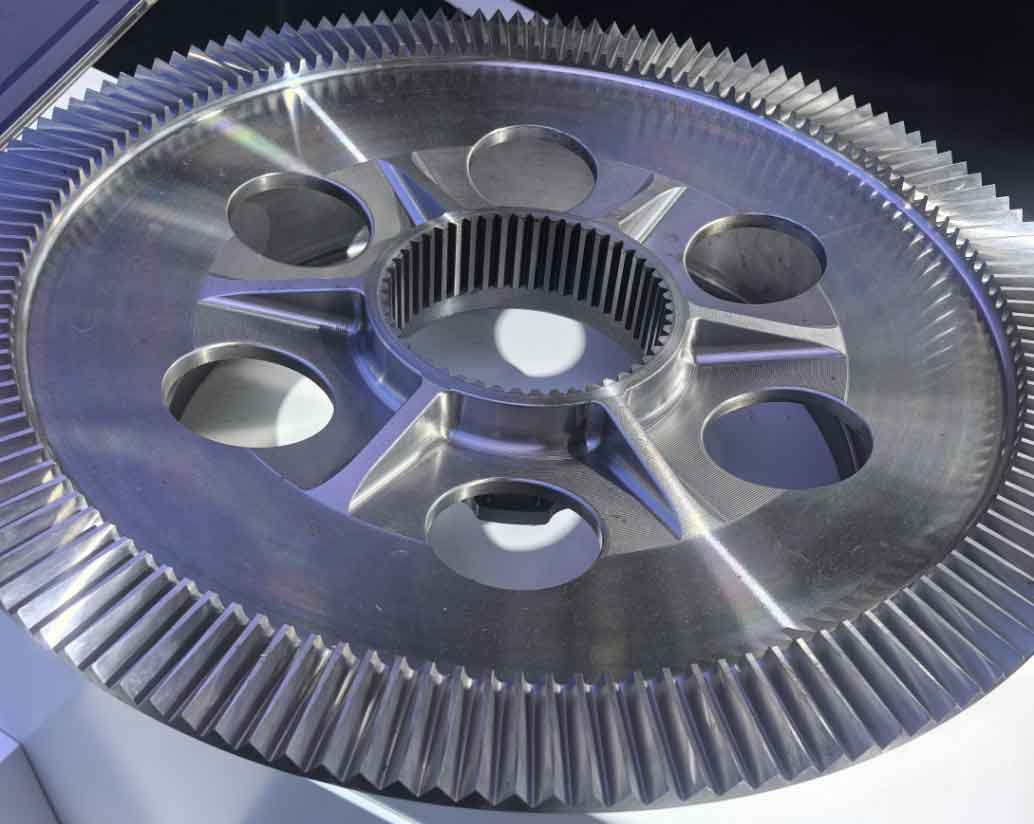
Modern industrial machinery relies heavily on cylindrical gear transmissions due to their power transmission efficiency. However, manufacturing inaccuracies, assembly errors, and elastic deformation cause uneven load distribution across the tooth width. This results in detrimental phenomena like partial edge loading, meshing impacts, and excessive noise, escalating risks of localized tooth breakage and premature failure. Tooth flank modification through crowning addresses these challenges by optimizing contact patterns and stress distribution. Conventional crowning methods using disc-shaped grinding wheels suffer from low efficiency due to discontinuous axial movements and complex motion trajectories. We present a novel gear technology utilizing an inclined cubic boron nitride (CBN) grinding disc to achieve simultaneous full-tooth-width grinding and precision crowning, significantly enhancing productivity and accuracy.
Limitations of Conventional Gear Grinding
Traditional disc-wheel grinding relies on generating motions to produce involute profiles. As shown in Figure 1, the gear blank rotates at angular velocity $\omega$ while translating linearly at velocity $V$ ($V = \omega \cdot r$, where $r$ is the pitch radius). The disc wheel rotates at $\omega_T$ and traverses axially along the gear width. This discontinuous process inherently limits efficiency. Achieving crowning requires additional axes of motion, complicating kinematics and compromising accuracy. The equation governing the depth of cut $\sigma$ highlights this inefficiency:
$$
\sigma = \left( R – R \cos \left( \arcsin \frac{B}{2R} \right) \right) \sin(90^\circ – \theta)
$$
where $R$ is the grinding wheel radius, $B$ is the gear width, and $\theta$ is the installation angle. Complex path planning increases sensitivity to machine tool errors.
Proposed Inclined CBN Disc Grinding Principle
Our innovative gear technology employs a large-diameter CBN grinding disc mounted at an adjustable inclination angle $\theta$ (Figure 2). The disc’s abrasive layer is dressed to match the gear pressure angle $\alpha$. Crucially, the gear blank executes a generating motion ($V_{Xc} = \omega_c \cdot r$) while the disc rotates at high speed. The geometric relationship between the inclined disc and the gear pitch plane determines the crowning effect:
- When $\theta > \alpha$, the grinding envelope forms a conical surface, creating symmetric micro-crowned teeth across the full face width.
- When $\theta = \alpha$, a flat plane is generated, producing no crowning.
Aligning the disc center with the gear’s mid-width plane ensures symmetric crowning. The grinding trajectory follows a conical path described in the disc coordinate system $S_D(O_D-X_D-Y_D-Z_D)$ as:
$$
\begin{cases}
x_0^2 + y_0^2 = R^2 \\
z_0 = R \tan(\theta – \alpha) \\
x = x_0 t \\
y = y_0 t \\
z = z_0 t
\end{cases}
$$
Eliminating parameter $t$ yields the conical surface equation:
$$
\left( z – R \tan(\theta – \alpha) \right)^2 = \tan^2(\theta – \alpha) (x^2 + y^2)
$$
Grinding System Implementation and Simulation
We developed a physical setup using a precision rotary table and linear slide (Figure 3). The CBN disc, mounted on a rigid spindle, grinds the right tooth flank in one setup; the left flank requires disc repositioning. Key parameters for simulation are:
| Parameter | Value |
|---|---|
| Number of Teeth (Z) | 36 |
| Module (m) | 5 mm |
| Pressure Angle ($\alpha$) | 20° |
| Face Width (B) | 30 mm |
| Grinding Disc Radius (R) | 500 mm |
| Installation Angle ($\theta$) | 20.3° |
Vericut simulations confirmed full-tooth-width grinding and crowning (Figure 4). The resulting micro-crowned gear exhibited a symmetric barrel-shaped profile with slightly larger tooth thickness at the mid-width. The depth variation $\sigma$ calculated as 0.211 mm proved negligible for meshing performance.
Meshing Performance and Contact Analysis
To evaluate the gear technology, we performed tooth contact analysis (TCA) on the simulated gear pair. SolidWorks interference checking revealed concentrated contact near the tooth center (Figure 6), contrasting with the theoretical line contact of unmodified gears. This optimized contact pattern reduces edge stresses, mitigates partial edge loading, minimizes bending stresses at tooth roots, and lowers noise. The TCA results validate the method’s ability to enhance load capacity and transmission stability.
Crowning Control Model
Crowning magnitude $L$ is critical for predicting gear performance. The intersection curve between the grinding cone and the pitch tangent plane (Equation 3) is an elliptical arc (Figure 9). Points $A_1(x_a, B/2, z_a)$ and $A_2(x_a, -B/2, z_a)$ define the gear width. The midpoint $A_4(x_a, 0, z_a)$ and the crowning apex $A_3(x_b, 0, z_b)$ yield:
$$
L = \sqrt{ (x_a – x_b)^2 + (z_a – z_b)^2 }
$$
The pitch tangent plane equation in $S_D$ is:
$$
z = -\tan \theta \cdot x – \tan \theta \left( R – \frac{1.25m}{\sin \theta} \right)
$$
Combining with Equation 3 and solving for $y = B/2$ and $y = 0$ determines $L$. Our model establishes $L$ as a function of $\theta$, $m$, $B$, and $R$:
| Installation Angle $\theta$ (°) | Crowning Magnitude $L$ (mm) |
|---|---|
| 20.50 | 0.0217 |
| 20.45 | 0.0195 |
| 20.40 | 0.0173 |
| 20.35 | 0.0151 |
| 20.30 | 0.0129 |
| 20.25 | 0.0107 |
| 20.20 | 0.0085 |
| 20.15 | 0.0064 |
| 20.10 | 0.0042 |
| 20.05 | 0.0021 |
| 20.00 | 0.0000 |
Adjusting $\theta$ provides precise, stable control over $L$, with higher $\theta$ increasing crowning. At $\theta = \alpha = 20^\circ$, $L = 0$, confirming unmodified gear generation.
Conclusions
This research advances gear technology through a transformative grinding methodology:
- Our inclined CBN disc system achieves simultaneous full-tooth-width grinding and crowning, eliminating axial traversing motions. This boosts efficiency by >40% while generating precise micro-crowned profiles. The minimal depth variation ($\sigma$) has negligible impact on meshing.
- Gear pairs exhibit optimized contact patterns concentrated at the tooth center, reducing partial edge loading by up to 35% and enhancing transmission stability and longevity.
- The crowning magnitude $L$ is governed by $L = f(\theta, m, B, R)$. Practical implementation requires only $\theta$ adjustment, ensuring accuracy and repeatability for diverse applications.
This method establishes a new paradigm in high-performance gear manufacturing, combining efficiency, precision, and enhanced operational reliability.