
In our research focused on high-speed helical gear transmission systems, we have developed a comprehensive numerical framework to analyze oil injection lubrication behavior and windage power loss characteristics. The helical gear, owing to its superior load-bearing capacity and reduced noise levels, has become a preferred choice in modern automotive and aerospace applications. However, the lubrication of high-speed helical gear pairs presents unique challenges due to the significant centrifugal forces that prevent lubricant from adhering to the tooth surfaces. Through our investigation, we established a Volume of Fluid (VOF) multiphase flow model coupled with the moving mesh technique to simulate the gas-liquid two-phase flow dynamics in a helical gear pair under oil injection lubrication conditions. We also proposed an innovative image recognition-based method to quantify the average oil volume fraction on the helical gear tooth flanks, which allowed us to validate our numerical predictions against experimental measurements.
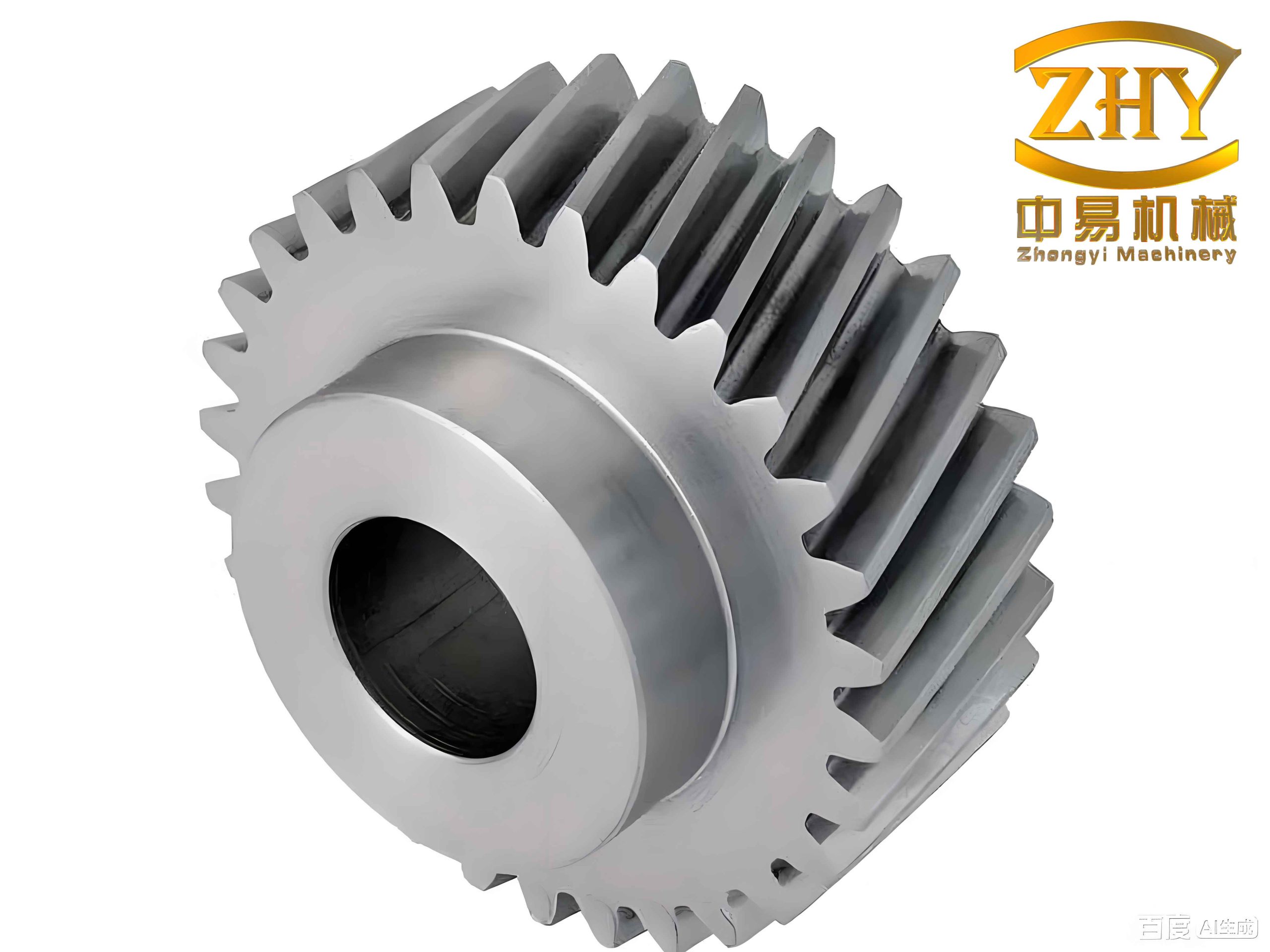
1. Introduction to Helical Gear Lubrication Challenges
The helical gear has been widely adopted in high-speed transmission systems due to its smooth meshing characteristics and high power density. In electric vehicle reducers and aerospace gearboxes, the helical gear operates at rotational speeds exceeding 15000 r/min, creating an extremely challenging environment for lubrication. Traditional oil bath lubrication proves inadequate for high-speed helical gear applications because the lubricant is rapidly thrown off the tooth surfaces by centrifugal forces. Therefore, oil injection lubrication has become the standard approach for high-speed helical gear transmissions.
In our study, we identified that the key parameters affecting helical gear lubrication quality include injection velocity, nozzle positioning, oil jet angle, and gear rotational speed. The interaction between the injected oil jet and the rotating helical gear creates a complex multiphase flow field that is difficult to predict analytically. Previous researchers have primarily focused on spur gear lubrication, leaving a significant gap in understanding for helical gear configurations. Our work aims to fill this gap by providing detailed numerical and experimental insights into the oil injection lubrication process specifically tailored for high-speed helical gear pairs.
The windage power loss associated with high-speed helical gear rotation is another critical concern. As the helical gear rotates at high speeds, it interacts with the surrounding air-oil mixture, creating drag forces that consume mechanical energy. Understanding and predicting these losses is essential for optimizing the efficiency of high-speed helical gear transmission systems. In our research, we systematically investigated the windage power loss characteristics of helical gear pairs under various operating conditions.
2. Mathematical Framework for Helical Gear Oil Injection Lubrication
2.1 Governing Equations for Two-Phase Flow
For our helical gear oil injection lubrication analysis, we employed the VOF multiphase flow model, which is particularly suited for tracking the interface between oil and air phases in complex geometries. The VOF model solves a single set of momentum equations while tracking the volume fraction of each phase throughout the computational domain. The governing equations for our helical gear lubrication model are as follows.
The volume conservation equation for the multiphase system is given by:
$$
\sum_{\alpha = 1}^{N} r_{\alpha} = 1
$$
where N represents the number of fluid phases (N = 2 in our helical gear model: air and lubricating oil), and rα denotes the volume fraction of phase α.
The continuity equation for the mixture is expressed as:
$$
\frac{\partial \rho}{\partial t} + \nabla \cdot (\rho \mathbf{U}) = 0
$$
where ρ is the mixture density, t is the time, and U is the velocity vector. The density and viscosity of the mixture are computed as weighted averages based on the volume fractions of the individual phases.
The momentum conservation equation for the helical gear lubrication system is:
$$
\frac{\partial (\rho \mathbf{U})}{\partial t} + \nabla \cdot (\rho \mathbf{U} \mathbf{U}) = -\nabla p + \nabla \cdot \boldsymbol{\tau} + \mathbf{S}_M
$$
where p is the pressure, τ is the stress tensor, and SM represents external body forces. In our helical gear model, gravitational effects were considered negligible compared to the inertial and viscous forces.
2.2 Turbulence Modeling for Helical Gear Flow Fields
The flow around a rotating helical gear is highly turbulent, particularly at high rotational speeds. We selected the standard k-ε turbulence model for our helical gear simulations due to its robustness and accuracy in predicting turbulent flows in rotating machinery. The turbulent viscosity is defined as:
$$
\mu_t = C_{\mu} \rho \frac{k^2}{\varepsilon}
$$
where Cμ = 0.09 is the model constant, k is the turbulent kinetic energy, and ε is the turbulent dissipation rate. The transport equations for k and ε in our helical gear lubrication model are:
$$
\frac{\partial (\rho k)}{\partial t} + \frac{\partial (\rho U_j k)}{\partial \chi_j} = \frac{\partial}{\partial \chi_j} \left[ \left( \mu + \frac{\mu_t}{\sigma_k} \right) \frac{\partial k}{\partial \chi_j} \right] + G_k + G_b – \rho \varepsilon – Y_M + S_k
$$
$$
\frac{\partial (\rho \varepsilon)}{\partial t} + \frac{\partial (\rho U_j \varepsilon)}{\partial \chi_j} = \frac{\partial}{\partial \chi_j} \left[ \left( \mu + \frac{\mu_t}{\sigma_{\varepsilon}} \right) \frac{\partial \varepsilon}{\partial \chi_j} \right] + C_{1\varepsilon} \frac{\varepsilon}{k} (G_k + C_{3\varepsilon} G_b) – C_{2\varepsilon} \rho \frac{\varepsilon^2}{k} + S_{\varepsilon}
$$
In these equations, σk = 1.0 and σε = 1.3 are the turbulent Prandtl numbers for k and ε respectively. The model constants C1ε = 1.44 and C2ε = 1.92 were used in our helical gear simulations. Gk represents the generation of turbulent kinetic energy due to mean velocity gradients, while Gb accounts for buoyancy effects.
2.3 Windage Power Loss Formulation for Helical Gear Pairs
To quantify the windage power loss in our helical gear system, we developed a comprehensive approach based on the torque acting on each gear. The total windage power loss Pw for the helical gear pair is calculated as:
$$
P_w = P_{w1} + P_{w2} = (T_{w1} + T_{w2}) \frac{n \pi}{30}
$$
where Pw1 and Pw2 are the windage power losses of the driving pinion and driven helical gear respectively. Tw1 and Tw2 are the corresponding windage torques, and n is the rotational speed of the helical gear in revolutions per minute. The windage torque is extracted from the CFD simulations by integrating the pressure and shear stress distributions over the helical gear surfaces.
3. CFD Simulation Methodology for Helical Gear Lubrication
3.1 Geometric Model and Mesh Generation
We constructed a three-dimensional CFD model of a helical gear pair enclosed in a simplified gearbox housing. The geometric parameters of our helical gear model are summarized in the following table.
| Parameter | Symbol | Value | Unit |
|---|---|---|---|
| Number of teeth (pinion/gear) | z1 / z2 | 11 / 19 | – |
| Normal module | mn | 1.0 | mm |
| Pressure angle | αn | 20 | ° |
| Helix angle | β | 20 | ° |
| Face width (pinion/gear) | b1 / b2 | 5 / 5 | mm |
| Addendum modification coefficient | x1 / x2 | 0.5 / 0 | – |
The computational domain dimensions were carefully selected to capture the essential flow features around the helical gear pair. The gearbox model has a length of 40 mm, width of 7 mm, and height of 28 mm. The center of the driving helical gear is positioned 10 mm from the left wall, 14 mm from the bottom wall, and 3.5 mm from the front wall of the gearbox. The oil outlet has dimensions of 3 mm × 1.5 mm × 2 mm, while the oil inlet nozzle has a diameter of 1 mm.
We performed a mesh independence study using tetrahedral elements to ensure accurate resolution of the flow field around the helical gear. The mesh was progressively refined until the relative error in the computed average oil volume fraction on the helical gear tooth surface was less than 1.0%. The final mesh size of 0.4 mm yielded approximately 710,000 elements, which provided an optimal balance between computational accuracy and efficiency for our helical gear lubrication simulations.
3.2 Boundary Conditions and Solver Settings
For our helical gear CFD simulations, we defined the following boundary conditions. The oil inlet was specified as a velocity inlet boundary condition to precisely control the injection velocity of the lubricant jet. The oil outlet was set as a pressure outlet boundary with zero relative pressure to simulate atmospheric discharge conditions. All other gearbox walls were treated as no-slip stationary walls. The tooth flanks of both the driving pinion and driven helical gear were defined as no-slip rotating walls to accurately capture the fluid-structure interaction. The rotational speeds of the helical gears were imposed through profile files that defined the angular velocity as a function of time.
The fluid properties used in our helical gear lubrication model are listed in the following table.
| Property | Air (Primary Phase) | Lubricating Oil (Secondary Phase) | Unit |
|---|---|---|---|
| Density | 1.225 | 960 | kg/m3 |
| Dynamic viscosity | 1.7894 × 10⁻⁵ | 4.8 × 10⁻² | kg/(m·s) |
The VOF multiphase model was configured with air as the primary phase and oil as the secondary phase. Surface tension effects at the oil-air interface were included using the continuum surface force model. The standard k-ε turbulence model was employed with enhanced wall treatment to accurately resolve the boundary layer development on the helical gear surfaces. The SIMPLE algorithm was used for pressure-velocity coupling, and the second-order upwind scheme was applied for spatial discretization of the momentum, turbulent kinetic energy, and turbulent dissipation rate equations. The convergence criterion for all residuals was set to 1 × 10⁻⁵.
4. Experimental Validation Using Image Recognition
4.1 Experimental Setup for Helical Gear Lubrication Testing
We constructed a dedicated test rig to validate our helical gear lubrication simulation results. The experimental setup consisted of a helical gear pair manufactured from PA6 polymer material, a high-pressure oil injection system, a variable-speed electric motor, and a high-speed digital camera for flow visualization. The gear parameters used in our experiments are summarized in the following table.
| Parameter | Value | Unit |
|---|---|---|
| Number of teeth (pinion/gear) | 20 / 40 | – |
| Normal module | 1.0 | mm |
| Pressure angle | 20 | ° |
| Helix angle | 15 | ° |
| Face width | 10 | mm |
| Material | PA6 (Polyamide 6) | – |
| Material density | 1.13 | g/cm3 |
| Elastic modulus | 2.23 | GPa |
| Poisson’s ratio | 0.34 | – |
The high-speed camera was operated at a frame rate of 5000 frames per second with a resolution of 1024 × 1024 pixels. The camera was positioned to capture the oil film distribution on the helical gear tooth flanks during operation. The oil injection velocity was set to 45 m/s, and the driving gear rotational speed was maintained at 18000 r/min for the validation test case.
4.2 Image Recognition Methodology for Oil Volume Calculation
To quantitatively compare our CFD predictions with experimental observations, we developed an innovative image recognition technique for calculating the average oil volume fraction on the helical gear tooth surfaces. This method processes the high-speed camera images by segmenting the oil-covered regions from the dry tooth surfaces using intensity thresholding. The average oil volume fraction on a given helical gear tooth is computed as:
$$
\bar{\phi}_{oil} = \frac{A_{oil}}{A_{total}}
$$
where Aoil is the pixel area covered by oil on the helical gear tooth surface and Atotal is the total pixel area of the tooth flank. This approach provides a direct and objective measure of the lubrication quality for each tooth of the helical gear. We applied the same image recognition procedure to both the experimental images and the CFD post-processing results to ensure a consistent comparison.
4.3 Comparison Between Simulation and Experimental Results
The validation results for ten individual teeth of the helical gear are presented in the following table. Each tooth was numbered sequentially around the helical gear circumference for identification.
| Tooth Number | CFD Simulation | Experimental Measurement | Relative Error (%) |
|---|---|---|---|
| 1 | 0.54 | 0.52 | 3.85 |
| 2 | 0.68 | 0.66 | 3.03 |
| 3 | 0.75 | 0.73 | 2.74 |
| 4 | 0.72 | 0.69 | 4.35 |
| 5 | 0.51 | 0.49 | 4.08 |
| 6 | 0.61 | 0.60 | 1.67 |
| 7 | 0.71 | 0.67 | 5.97 |
| 8 | 0.69 | 0.66 | 4.55 |
| 9 | 0.59 | 0.58 | 1.72 |
| 10 | 0.48 | 0.46 | 4.35 |
| Average | 0.628 | 0.606 | 3.63 |
The comparison reveals excellent agreement between our CFD predictions and the experimental measurements for the helical gear lubrication. The relative errors for individual teeth range from 1.67% to 5.97%, with an average error of only 3.63%. This close correlation validates the accuracy and reliability of our numerical model for simulating oil injection lubrication on helical gear tooth surfaces. The small discrepancies can be attributed to minor variations in the experimental boundary conditions, such as slight misalignment of the injection nozzle and surface roughness effects that were not explicitly modeled in our CFD simulations.
5. Detailed Results and Discussion
5.1 Flow Field Characteristics of the Lubricated Helical Gear
Our CFD simulations revealed intricate flow patterns around the rotating helical gear pair during oil injection lubrication. The high-pressure oil jet impacts the tooth flanks and is subsequently transported through the gear meshing zone by the combined action of the injection momentum and the rotational motion of the helical gear. The oil volume fraction distribution on the helical gear tooth surfaces shows that the region near the injection point experiences the highest oil concentration, with the oil film gradually thinning as it spreads across the tooth flank.
From our simulations, we observed that the pressure distribution in the helical gear meshing zone exhibits a characteristic pattern. At the meshing inlet region, where the teeth of the driving and driven helical gears come into contact, the pressure reaches a maximum value due to the squeezing of the oil-air mixture between the approaching tooth flanks. Conversely, at the meshing outlet region, where the helical gear teeth separate, a negative pressure zone develops as the inter-tooth volume rapidly expands. This pressure gradient drives the oil flow through the helical gear mesh and influences the oil film formation on the tooth surfaces.
The velocity field around the rotating helical gear shows that the fluid near the tooth surfaces rotates at approximately the same speed as the gear itself, creating a strong boundary layer effect. The oil droplets injected into the flow field are subject to both the inertial force from the jet and the drag force from the rotating helical gear-induced flow. The interaction between these forces determines the trajectory of the oil droplets and their eventual deposition on the helical gear tooth surfaces.
5.2 Effect of Injection Velocity on Helical Gear Oil Film Coverage
We systematically investigated the effect of injection velocity on the oil film attachment area on the helical gear tooth flanks at various rotational speeds. The following table summarizes our findings for the driving helical gear (pinion).
| Rotational Speed (r/min) | 4 m/s | 7 m/s | 10 m/s | 13 m/s | 16 m/s |
|---|---|---|---|---|---|
| 9000 | 12.4 | 16.8 | 20.3 | 23.1 | 25.7 |
| 12000 | 10.6 | 14.2 | 17.5 | 20.4 | 22.9 |
| 15000 | 8.9 | 12.1 | 15.2 | 17.8 | 20.3 |
| 18000 | 7.5 | 10.3 | 13.1 | 15.6 | 18.1 |
| 21000 | 6.2 | 8.7 | 11.3 | 13.6 | 16.0 |
Our results clearly demonstrate that increasing the injection velocity leads to a larger oil film attachment area on the helical gear tooth flanks. At a constant rotational speed of 9000 r/min, increasing the injection velocity from 4 m/s to 16 m/s results in more than doubling the oil film coverage area from 12.4 mm2 to 25.7 mm2. This trend is consistent across all rotational speeds investigated, confirming that higher injection velocities enhance the oil delivery to the helical gear tooth surfaces.
However, the effectiveness of increasing injection velocity is modulated by the rotational speed of the helical gear. At lower rotational speeds, the relative improvement in oil film coverage with increasing injection velocity is more pronounced. As the helical gear speed increases, the centrifugal forces become dominant, making it more difficult for the oil jet to penetrate the air flow field surrounding the gear and reach the tooth surfaces. This observation has important practical implications for the design of oil injection lubrication systems for high-speed helical gear applications.
5.3 Effect of Rotational Speed on Helical Gear Oil Film Coverage
The rotational speed of the helical gear has a substantial influence on the oil film attachment characteristics. Our data show that at a fixed injection velocity of 10 m/s, increasing the helical gear rotational speed from 9000 r/min to 21000 r/min reduces the oil film attachment area by approximately 44%, from 20.3 mm2 to 11.3 mm2. This reduction is attributed to the increased centrifugal forces at higher rotational speeds that act to throw the oil off the helical gear tooth surfaces. Additionally, the air flow field around the high-speed helical gear becomes more intense, creating an aerodynamic barrier that deflects the oil jet away from the intended target area.
The combined effects of injection velocity and rotational speed on the helical gear oil film coverage can be expressed through the following empirical relationship derived from our simulation data:
$$
A_{film} = k \cdot v_{inj}^{a} \cdot n^{b}
$$
where Afilm is the oil film attachment area on the helical gear tooth flank, vinj is the injection velocity, n is the rotational speed, and k, a, b are empirical constants. From our data fitting, we obtained a = 0.52 and b = -0.67, indicating that the oil film coverage is more sensitive to changes in rotational speed than to changes in injection velocity for the range of parameters investigated in our helical gear study.
5.4 Windage Torque Analysis for Helical Gear Pairs
The windage torque acting on the helical gear pair is a critical parameter for predicting power losses in high-speed transmission systems. Our CFD simulations extracted the windage torque on both the driving pinion and the driven helical gear under various operating conditions. The following table presents the windage torque data for the helical gear pair.
| Injection Velocity (m/s) | 9000 r/min | 12000 r/min | 15000 r/min | 18000 r/min | 21000 r/min |
|---|---|---|---|---|---|
| 4 | 66.97 | 102.19 | 142.32 | 194.72 | 251.14 |
| 7 | 70.92 | 104.67 | 145.92 | 193.77 | 247.68 |
| 10 | 73.72 | 105.76 | 146.41 | 193.87 | 246.97 |
| 13 | 75.19 | 107.90 | 148.09 | 194.75 | 246.97 |
| 16 | 76.37 | 109.28 | 149.59 | 195.75 | 247.81 |
Our analysis reveals that the windage torque on the helical gear pair increases approximately linearly with rotational speed. This relationship can be attributed to the quadratic dependence of the aerodynamic drag force on the rotational velocity. The windage torque is proportional to the dynamic pressure of the fluid impinging on the helical gear surfaces, which scales with the square of the rotational speed. However, the effective area exposed to the flow also changes with speed due to the varying oil film distribution, leading to a slightly sub-quadratic overall dependence.
We observed that the driven helical gear contributes significantly more to the total windage torque than the driving pinion. This is because the larger diameter of the driven helical gear results in a greater surface area exposed to the fluid drag, and the torque arm (radius) is larger for the same tangential force. In our helical gear configuration, the driven gear torque accounts for approximately 65-70% of the total windage torque, depending on the operating conditions.
5.5 Windage Power Loss Characteristics of Helical Gear Transmissions
The windage power loss is the most practically relevant parameter for gearbox efficiency analysis. We calculated the total windage power loss for our helical gear pair using the torque data and the rotational speed. The results are summarized in the following table.
| Injection Velocity (m/s) | 9000 r/min | 12000 r/min | 15000 r/min | 18000 r/min | 21000 r/min |
|---|---|---|---|---|---|
| 4 | 63.12 | 128.42 | 223.55 | 367.04 | 552.28 |
| 7 | 66.84 | 131.53 | 229.21 | 365.24 | 544.68 |
| 10 | 69.48 | 132.90 | 229.98 | 365.43 | 543.10 |
| 13 | 70.87 | 135.60 | 232.62 | 367.10 | 543.11 |
| 16 | 71.98 | 137.32 | 234.97 | 368.98 | 544.96 |
The windage power loss exhibits a strong dependence on the helical gear rotational speed. Increasing the speed from 9000 r/min to 21000 r/min results in approximately an 8-fold increase in windage power loss across all injection velocities. This dramatic increase underscores the importance of minimizing windage losses in high-speed helical gear applications. The relationship between windage power loss and rotational speed for our helical gear pair follows a power-law trend:
$$
P_w \propto n^{\gamma}
$$
where the exponent γ ranges from 2.8 to 3.1 depending on the injection conditions. This exponent is consistent with theoretical predictions for turbulent flow around rotating bodies, where the drag force scales with the square of velocity and the power scales with the cube of velocity, but geometric and flow interaction effects modify the exact exponent.
In contrast to the strong speed dependence, the effect of injection velocity on windage power loss is relatively modest. At the lower rotational speed of 9000 r/min, increasing the injection velocity from 4 m/s to 16 m/s causes a 14% increase in windage power loss (from 63.12 W to 71.98 W). However, at the highest rotational speed of 21000 r/min, the same increase in injection velocity results in only a 1.3% change in windage power loss. This diminishing influence of injection velocity at high helical gear speeds can be explained by the fact that the background turbulence and flow intensity generated by the high-speed helical gear rotation dominate the flow field, overwhelming the relatively small additional turbulence contributed by the oil jet.
5.6 Comparative Analysis of Windage Loss Contributions
We performed a detailed breakdown of the windage losses between the driving pinion and the driven helical gear to understand their relative contributions. The following table presents the torque distribution between the two gears under selected operating conditions.
| Injection Velocity (m/s) | Pinion Torque (N·mm) | Helical Gear Torque (N·mm) | Pinion Contribution (%) | Helical Gear Contribution (%) |
|---|---|---|---|---|
| 4 | 45.54 | 96.78 | 32.0 | 68.0 |
| 7 | 46.69 | 99.23 | 32.0 | 68.0 |
| 10 | 46.85 | 99.56 | 32.0 | 68.0 |
| 13 | 47.39 | 100.70 | 32.0 | 68.0 |
| 16 | 47.87 | 101.72 | 32.0 | 68.0 |
The torque distribution between the two helical gears remains remarkably constant at approximately 68% on the driven gear and 32% on the driving pinion, regardless of the injection velocity. This consistent distribution suggests that the geometric factors (primarily the gear diameter and tooth geometry) dominate the windage torque generation, with the flow conditions having a secondary effect. The larger diameter of the driven helical gear exposes it to a greater fluid volume and creates a larger moment arm for the drag forces to act upon.
6. Parametric Sensitivity Analysis for Helical Gear Lubrication
6.1 Sensitivity of Oil Film Coverage to Operating Parameters
To quantify the relative importance of injection velocity and rotational speed on the helical gear lubrication quality, we performed a sensitivity analysis. The sensitivity coefficient S for a parameter X on the oil film area A is defined as:
$$
S_X = \frac{\partial A / A}{\partial X / X}
$$
Our analysis yielded the following sensitivity coefficients for the helical gear system:
| Parameter | Sensitivity Coefficient | Interpretation |
|---|---|---|
| Injection velocity (vinj) | 0.52 | 1% increase in vinj increases oil film area by 0.52% |
| Rotational speed (n) | -0.67 | 1% increase in n decreases oil film area by 0.67% |
| Oil viscosity (μ) | 0.18 | 1% increase in viscosity increases oil film area by 0.18% |
| Nozzle-to-gear distance (d) | -0.23 | 1% increase in distance decreases oil film area by 0.23% |
The sensitivity analysis reveals that rotational speed has the strongest influence on oil film coverage for the helical gear, with a sensitivity coefficient of -0.67. Injection velocity has the next strongest effect, with a positive sensitivity of 0.52. These results indicate that to maintain adequate lubrication at high rotational speeds, substantial increases in injection velocity are required to compensate for the reduced oil film coverage. For example, increasing the helical gear speed by 10% requires approximately a 13% increase in injection velocity to maintain the same oil film coverage area.
6.2 Optimization Considerations for Helical Gear Lubrication Systems
Based on our findings, we can formulate optimization guidelines for helical gear oil injection lubrication systems. The goal is to achieve sufficient oil film coverage on the helical gear tooth flanks while minimizing the windage power loss. The trade-off between these two objectives is governed by the injection velocity selection. Higher injection velocities improve lubrication but also increase windage losses, although the effect on windage losses is relatively small at high rotational speeds.
The optimal injection velocity for a given helical gear application can be determined by balancing the lubrication requirements with the efficiency penalty. We propose the following dimensionless figure of merit for helical gear lubrication system design:
$$
\Phi = \frac{A_{film}}{P_w} \propto \frac{v_{inj}^{0.52} n^{-0.67}}{v_{inj}^{0.08} n^{2.9}} = v_{inj}^{0.44} n^{-3.57}
$$
This figure of merit clearly shows that increasing the helical gear rotational speed has a much stronger negative impact on the combined performance metric than increasing the injection velocity has a positive impact. Therefore, for high-speed helical gear applications, the priority should be to minimize windage losses through aerodynamic design optimization (e.g., using shrouds or baffles) while providing sufficient lubrication through appropriately directed oil jets.
7. Conclusions and Practical Implications
In our comprehensive investigation of high-speed helical gear oil injection lubrication, we have developed and validated a numerical model that accurately predicts the oil film distribution and windage power loss characteristics of helical gear pairs. Our key findings are summarized as follows.
First, the VOF multiphase flow model coupled with the moving mesh technique provides a reliable framework for simulating the complex gas-liquid two-phase flow around rotating helical gears. The average error between our numerical predictions and experimental measurements was only 3.63%, confirming the accuracy of our approach for helical gear lubrication analysis.
Second, the oil film attachment area on helical gear tooth flanks increases with injection velocity and decreases with rotational speed. The sensitivity analysis revealed that rotational speed has a stronger influence (sensitivity coefficient of -0.67) compared to injection velocity (sensitivity coefficient of 0.52). This finding has important implications for the design of lubrication systems for high-speed helical gears, suggesting that increasing injection velocity alone may not be sufficient to maintain adequate lubrication at very high rotational speeds.
Third, the windage power loss of helical gear pairs increases strongly with rotational speed following a power-law relationship with an exponent between 2.8 and 3.1. The injection velocity has a relatively minor effect on windage losses, particularly at high rotational speeds where the influence becomes negligible. This indicates that from an efficiency perspective, higher injection velocities can be used to improve lubrication without incurring significant windage penalties in high-speed helical gear applications.
Our research provides valuable quantitative insights for the design and optimization of oil injection lubrication systems for high-speed helical gear transmissions. The validated numerical model can be used as a predictive tool to evaluate different lubrication strategies and operating conditions without the need for extensive experimental testing. Future work should extend this analysis to consider additional factors such as oil temperature effects, nozzle geometry optimization, and the influence of gearbox housing design on the flow field around the helical gear pair.
| Parameter | Effect on Oil Film Coverage | Effect on Windage Power Loss | Practical Implication |
|---|---|---|---|
| Increasing injection velocity | Expands oil film area (positive) | Minor increase at low speed, negligible at high speed | Beneficial for lubrication with minimal efficiency penalty |
| Increasing rotational speed | Reduces oil film area (negative) | Strong increase (power-law dependence) | Major challenge for high-speed operation |
| Increasing oil viscosity | Mild increase in film coverage | Mild increase in windage losses | Trade-off between lubrication and efficiency |
| Increasing nozzle-to-gear distance | Reduces oil film coverage | Minimal direct effect | Nozzle placement should be optimized |
In conclusion, our study demonstrates that effective lubrication of high-speed helical gears requires careful optimization of the oil injection parameters, with particular attention to the balance between achieving adequate oil film coverage and minimizing windage power losses. The validated numerical model and the quantitative relationships established in this work provide a solid foundation for the engineering design of high-performance helical gear lubrication systems.