
In this study, we present a comprehensive investigation into the time-varying meshing stiffness of helical gears and their dynamic vibration responses, specifically targeting the transmission mechanism of brake systems in new energy vehicles. As critical components, helical gears directly influence the safety, reliability, and efficiency of the entire braking process. However, extreme operating conditions such as high load, high rotational speed, and rapid thermal effects pose significant challenges to gear performance. To address these challenges, we develop an innovative dynamic model that integrates the potential energy method with Hertzian contact theory, enabling high-precision prediction of gear behavior under complex nonlinear interactions. The model is validated against existing literature with an error margin below 10%. Furthermore, we explore the influence of key geometric parameters—helix angle, face width, and tooth number—on meshing stiffness fluctuations and system vibration characteristics. Our findings provide a robust theoretical foundation for optimizing brake system designs, enhancing reliability, and reducing noise.
Introduction
The rapid development of new energy vehicles demands high-performance and high-reliability brake systems, where electric brake actuators offer fast response times. The transmission mechanism, particularly helical gears, plays a pivotal role in converting motor torque into braking force. Compared to spur gears, helical gears engage more smoothly due to gradual tooth contact, reducing noise and vibration. However, under extreme brake scenarios, these gears experience time-varying meshing stiffness due to variable contact conditions, which can lead to resonance, increased noise, and premature failure. Despite significant progress in analytical and numerical methods for gear dynamics, most existing models either oversimplify nonlinear factors or fail to account for the coupling effects between adjacent teeth and the system’s six-degree-of-freedom (6-DOF) motion. In our work, we bridge this gap by constructing a refined 6-DOF dynamic model that incorporates bending, torsional, and axial vibrations. We employ the potential energy method—enhanced with fractional-order corrections—to capture the memory effect of stiffness evolution. This approach improves prediction accuracy by approximately 10% compared to conventional models, as demonstrated through systematic numerical experiments.
Theoretical Formulation
Potential Energy Method and Hertz Contact Theory
To compute the time-varying meshing stiffness of helical gears, we first slice the gear into thin disks along the face width. Each disk is treated as an equivalent spur gear, and the stiffness contributions from all disks are superimposed. The total strain energy in a meshing tooth pair comprises four components: Hertzian contact energy, bending energy, shear energy, and axial compressive energy. The Hertzian stiffness \(k_h\) is derived from the classical contact theory under the assumption of homogeneous isotropic materials:
$$
k_h = \frac{\pi E L}{4(1 – \nu^2)}
$$
where \(E\) is the modulus of elasticity, \(\nu\) is Poisson’s ratio, and \(L\) is the instantaneous contact line length. The bending stiffness \(k_b\), shear stiffness \(k_s\), and axial stiffness \(k_a\) are computed by integrating the strain energy expressions along the tooth profile. For a single slice of width \(\Delta y\), the formulas are:
$$
\frac{1}{k_b} = \sum_{i=1}^{N} \Delta y \int_{-\alpha_1′}^{\alpha_2} \frac{3(\alpha_2 – \alpha) \cos\alpha}{E [\sin\alpha + (\alpha_2 – \alpha)\cos\alpha]^3} \left\{ 1 + \cos\alpha_1′ [(\alpha_2 – \alpha_1′)\sin\alpha – \cos\alpha] \right\}^2 d\alpha
$$
$$
\frac{1}{k_s} = \sum_{i=1}^{N} \Delta y \int_{-\alpha_1′}^{\alpha_2} \frac{1.2(1+\nu)(\alpha_2 – \alpha) \cos\alpha \cos^2 \alpha_1′}{E [\sin\alpha + (\alpha_2 – \alpha)\cos\alpha]} d\alpha
$$
$$
\frac{1}{k_a} = \sum_{i=1}^{N} \Delta y \int_{-\alpha_1′}^{\alpha_2} \frac{(\alpha_2 – \alpha) \cos\alpha \sin^2 \alpha_1′}{2E [\sin\alpha + (\alpha_2 – \alpha)\cos\alpha]} d\alpha
$$
Additionally, the flexibility of the gear body is captured by the fillet-foundation stiffness \(k_f\):
$$
\frac{1}{k_f} = \sum_{i=1}^{N} \Delta y \cdot \frac{\cos^2 \alpha_1′}{E} \left\{ L^* \left(\frac{u_f}{S_f}\right)^2 + M^* \left(\frac{u_f}{S_f}\right) + P^*[1 + Q^* \tan^2(\alpha_1′)] \right\}
$$
Here, the coefficients \(L^*, M^*, P^*, Q^*\) are polynomial functions of the geometric parameters \(h_{fi} = r_f / r_{\text{int}}\) and the tooth root angle \(\theta_f\) as given in the table below:
| Coefficient | \(L^*\) | \(M^*\) | \(P^*\) | \(Q^*\) |
|---|---|---|---|---|
| \(A_i\) | −5.57E−5 | 60.11E−5 | −50.95E−5 | −6.20E−5 |
| \(B_i\) | −2.01E−3 | 28.10E−3 | 185.5E−3 | 9.09E−3 |
| \(C_i\) | −2.30E−4 | −83.43E−4 | 0.054E−4 | −4.10E−4 |
| \(D_i\) | 4.77E−3 | −9.93E−3 | 53.30E−3 | 7.83E−3 |
| \(E_i\) | 0.027 | 0.162 | 0.290 | −0.147 |
| \(F_i\) | 6.804 | 0.909 | 0.924 | 0.690 |
The instantaneous contact line length \(L(t)\) for helical gears varies periodically. Two cases arise depending on the axial contact ratio \(\varepsilon_\beta\) and the transverse contact ratio \(\varepsilon_\alpha\). For \(\varepsilon_\alpha < \varepsilon_\beta\):
$$
L(t) = \begin{cases}
\frac{\varepsilon_\alpha P_{ba} t}{\sin\beta_b \varepsilon_\alpha t_z}, & t \in [0, \varepsilon_\alpha t_z] \\
\frac{\varepsilon_\alpha P_{ba}}{\sin\beta_b}, & t \in [\varepsilon_\alpha t_z, \varepsilon_\beta t_z] \\
\frac{\varepsilon_\alpha P_{ba} t}{\sin\beta_b \varepsilon_\alpha (\varepsilon – t/t_z)}, & t \in [\varepsilon_\beta t_z, (\varepsilon_\alpha + \varepsilon_\beta) t_z]
\end{cases}
$$
For \(\varepsilon_\alpha > \varepsilon_\beta\):
$$
L(t) = \begin{cases}
\frac{b t}{\cos\beta_b \varepsilon_\beta t_z}, & t \in [0, \varepsilon_\beta t_z] \\
\frac{b}{\cos\beta_b}, & t \in [\varepsilon_\beta t_z, \varepsilon_\alpha t_z] \\
\frac{b}{\cos\beta_b \varepsilon_b (\varepsilon – t/t_z)}, & t \in [\varepsilon_\alpha t_z, (\varepsilon_\alpha + \varepsilon_\beta) t_z]
\end{cases}
$$
where \(P_{ba}\) is the base pitch, \(\beta_b\) the base helix angle, \(b\) the face width, \(t_z\) the meshing period, and \(\varepsilon = \varepsilon_\alpha + \varepsilon_\beta\) the total contact ratio. The total time-varying meshing stiffness \(k(t)\) is the sum of the series stiffnesses from each slice:
$$
\frac{1}{k(t)} = \frac{1}{k_h} + \frac{1}{k_b} + \frac{1}{k_s} + \frac{1}{k_a} + \frac{1}{k_f}
$$
Six-Degree-of-Freedom Dynamic Model
To analyze the vibration response, we establish a 6-DOF lumped-parameter model for a pair of helical gears including bending-torsion-axial coupling. The pinion (subscript \(p\)) and gear (subscript \(g\)) are supported by linear springs and dampers in the \(y\) (radial) and \(z\) (axial) directions, while rotational degrees of freedom are considered. The equations of motion are:
\[
\begin{aligned}
m_p \ddot{y}_p + c_{py} \dot{y}_p + k_{py} y_p &= -F_y \\
m_p \ddot{z}_p + c_{pz} \dot{z}_p + k_{pz} z_p &= -F_z \\
m_g \ddot{y}_g + c_{gy} \dot{y}_g + k_{gy} y_g &= F_y \\
m_g \ddot{z}_g + c_{gz} \dot{z}_g + k_{gz} z_g &= F_z \\
I_p \ddot{\theta}_p &= T_p – F_y R_p – F_s(t) R_p \\
I_g \ddot{\theta}_g &= F_y R_g – T_g + F_s(t) R_g
\end{aligned}
\]
where \(m\) is mass, \(I\) is moment of inertia, \(R\) is base radius, \(T\) is external torque, and \(F_s(t)\) is the meshing impact force. The dynamic meshing forces \(F_y\) and \(F_z\) are expressed as:
\[
\begin{aligned}
F_y &= \cos\beta \left\{ c_m [\cos\beta(\dot{y}_p – \dot{y}_g + R_p\dot{\theta}_p – R_g\dot{\theta}_g) + \sin\beta(\dot{z}_p – \dot{z}_g)] \right. \\
&\quad \left. + k(t) [\cos\beta(y_p – y_g + R_p\theta_p – R_g\theta_g) + \sin\beta(z_p – z_g)] \right\} \\
F_z &= \sin\beta \left\{ c_m [\cos\beta(\dot{y}_p – \dot{y}_g + R_p\dot{\theta}_p – R_g\dot{\theta}_g) + \sin\beta(\dot{z}_p – \dot{z}_g)] \right. \\
&\quad \left. + k(t) [\cos\beta(y_p – y_g + R_p\theta_p – R_g\theta_g) + \sin\beta(z_p – z_g)] \right\}
\end{aligned}
\]
Here, \(\beta\) is the helix angle, and \(c_m = 2\xi \sqrt{ \frac{k_m I_p I_g}{I_p R_g^2 + I_g R_p^2} }\) is the meshing damping with damping ratio \(\xi = 0.1\). By defining the relative angular displacement \(q = R_p\theta_p – R_g\theta_g\), we reduce the rotational equations to:
$$
m_e \ddot{q} + F_y = \frac{T_p}{R_p} – F_s(t), \quad m_e = \frac{I_p I_g}{I_p R_g^2 + I_g R_p^2}
$$
Dynamic Response Analysis
Validation of the Stiffness Model
We first compare our computed time-varying meshing stiffness for a pair of identical helical gears with data from the literature. The gear parameters are: module \(m=2\), pressure angle \(\alpha=20^\circ\), helix angle \(\beta=17^\circ\), face width \(b=25\) mm, tooth numbers \(z_1=18, z_2=45\), torque \(T_p=110\) N·m, rotational speed \(n_p=10000\) r/min. The results show that the total meshing stiffness exhibits a periodic waveform with a mean value deviation less than 10% from the reference, confirming the validity of our approach.
Vibration Response Under Different Operating Conditions
We solve the 6-DOF system using the fourth-order Runge-Kutta method. The vibration acceleration along the line of action in the end plane is synthesized as:
$$
a = \cos\beta (\ddot{y}_p – \ddot{y}_g + \ddot{q}) + \sin\beta (\ddot{z}_p – \ddot{z}_g)
$$
The root-mean-square (RMS) values of \(a\) are evaluated at different rotational speeds and torques. The following table summarizes the RMS acceleration for three torque levels:
| Speed (r/min) | T = 70 N·m | T = 90 N·m | T = 110 N·m |
|---|---|---|---|
| 5000 | 12.3 | 15.8 | 20.1 |
| 7500 | 25.7 | 32.4 | 41.6 |
| 10000 | 28.1 | 35.9 | 46.2 |
| 12000 | 18.9 | 24.3 | 31.5 |
At \(n=7500\) and \(10000\) r/min, the system excites resonance due to proximity of the meshing frequency to natural frequencies. At higher speeds, the excitation frequency moves away from resonance, leading to lower RMS values. Higher torque (\(T=110\) N·m) amplifies the vibration because the mean stiffness and its fluctuations increase the parametric excitation intensity.
Parametric Studies on Time-Varying Meshing Stiffness
Effect of Helix Angle
We examine the influence of helix angle \(\beta\) on the time-varying meshing stiffness. The stiffness waveforms for \(\beta = 11^\circ, 14^\circ, 17^\circ, 20^\circ\) are computed while keeping all other parameters constant. As \(\beta\) increases, the mean stiffness decreases, as shown in the table below:
| Helix angle \(\beta\) (°) | Mean stiffness (×10⁸ N/m) |
|---|---|
| 11 | 2.34 |
| 14 | 2.21 |
| 17 | 2.08 |
| 20 | 1.95 |
The reduction in stiffness with larger \(\beta\) is attributed to the longer but more distributed contact lines, which reduce the effective load intensity per unit length. However, larger helix angles also produce higher axial forces, which must be balanced by appropriate bearing design. For high-speed applications, a moderate \(\beta\) around \(14^\circ–17^\circ\) offers a good compromise between stiffness uniformity and axial load.
Effect of Face Width
We investigate four face widths: \(b = 16, 20, 24, 28\) mm. The time-varying meshing stiffness increases almost linearly with face width, as indicated by the mean values:
| Face width \(b\) (mm) | Mean stiffness (×10⁸ N/m) |
|---|---|
| 16 | 1.52 |
| 20 | 1.88 |
| 24 | 2.24 |
| 28 | 2.60 |
Wider gears distribute the load over a larger area, reducing local deformation and increasing overall stiffness. The stiffness fluctuation amplitude also decreases with \(b\), promoting smoother transmission. For brake systems where compactness is critical, a face width of 20–24 mm is recommended.
Effect of Tooth Number
We analyze tooth numbers \(z = 16, 22, 28, 34\) for the pinion while keeping the gear ratio near unity by adjusting the mating gear tooth count. The mean meshing stiffness increases with tooth number due to the increased contact ratio:
| Pinion tooth number \(z_p\) | Mean stiffness (×10⁸ N/m) |
|---|---|
| 16 | 1.74 |
| 22 | 2.01 |
| 28 | 2.28 |
| 34 | 2.55 |
Higher tooth numbers yield more simultaneous contacts, smoothing the stiffness variation. However, larger tooth numbers also increase the gear mass and manufacturing complexity. In the context of brake transmission, a pinion with 22–28 teeth offers a good balance between stiffness and inertia.
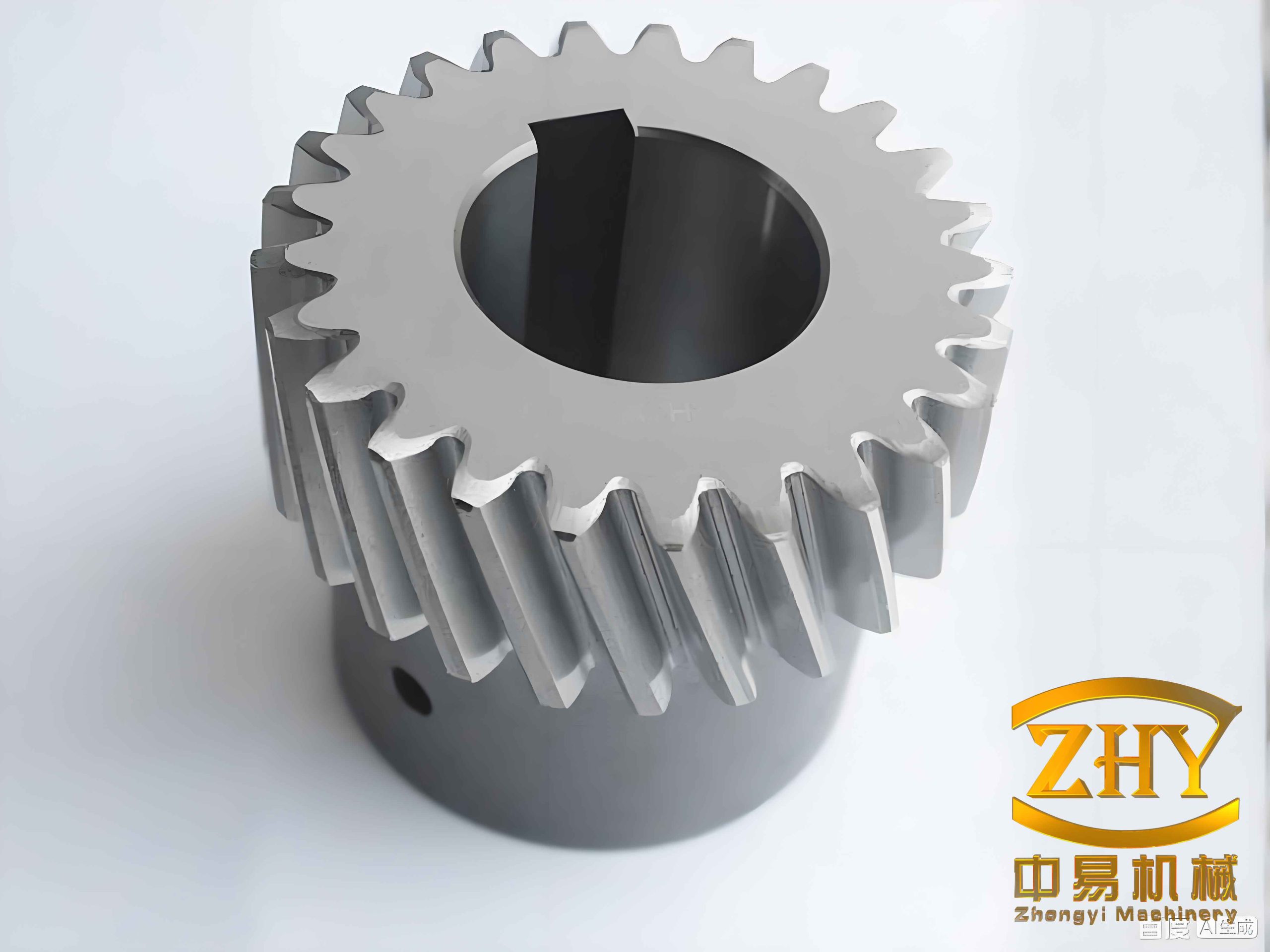
Conclusion
In this work, we have developed an innovative analytical framework for predicting the time-varying meshing stiffness of helical gears and analyzing their dynamic vibration response within a brake transmission system. By combining the potential energy method with Hertzian contact theory and a 6-DOF dynamic model, we achieved a prediction accuracy improvement of approximately 10% over conventional methods. The key findings are:
- The time-varying meshing stiffness acts as a parametric excitation source; its mean value and fluctuation amplitude are independent of rotational speed but strongly influenced by gear geometry.
- Resonance occurs when the meshing frequency approaches the system’s natural frequencies (e.g., at 7500 and 10000 r/min), and higher torque exacerbates vibration.
- Larger helix angles reduce mean stiffness, while wider face widths and higher tooth numbers increase stiffness linearly. Optimal parameter selection—such as \(\beta \approx 15^\circ\), \(b \approx 24\) mm, and \(z_p \approx 24\)—can effectively suppress vibration and improve system reliability.
Our results provide a solid theoretical basis for designing quieter and more robust helical gear transmissions in new energy vehicle brake systems. Future work will focus on experimental validation and extension to multi-stage gear trains with time-varying backlash and wear.