
In the automotive, engineering machinery, tractor, and metallurgical industries, the quenching of bevel gears and other disc-shaped components is critical for achieving desired mechanical properties such as hardness and durability. As a manufacturer and researcher in this field, I have observed that many quenching machines currently in use suffer from limitations in automation, safety, and data integration. These machines often rely on manual loading and unloading, lack comprehensive splash protection, and fail to provide real-time monitoring or interactive controls. This falls short of the digital and intelligent development goals required in modern manufacturing, where precision, efficiency, and connectivity are paramount. The need for intelligent enhancement of bevel gear quenching machines is urgent to meet the “from good to excellent” standards of advanced manufacturing. In this article, I will delve into strategies for upgrading these machines, focusing on modular robotics, automated safety features, human-machine interfaces, data informatization, and operational security—all tailored to improve the performance and adaptability of bevel gear quenching processes.
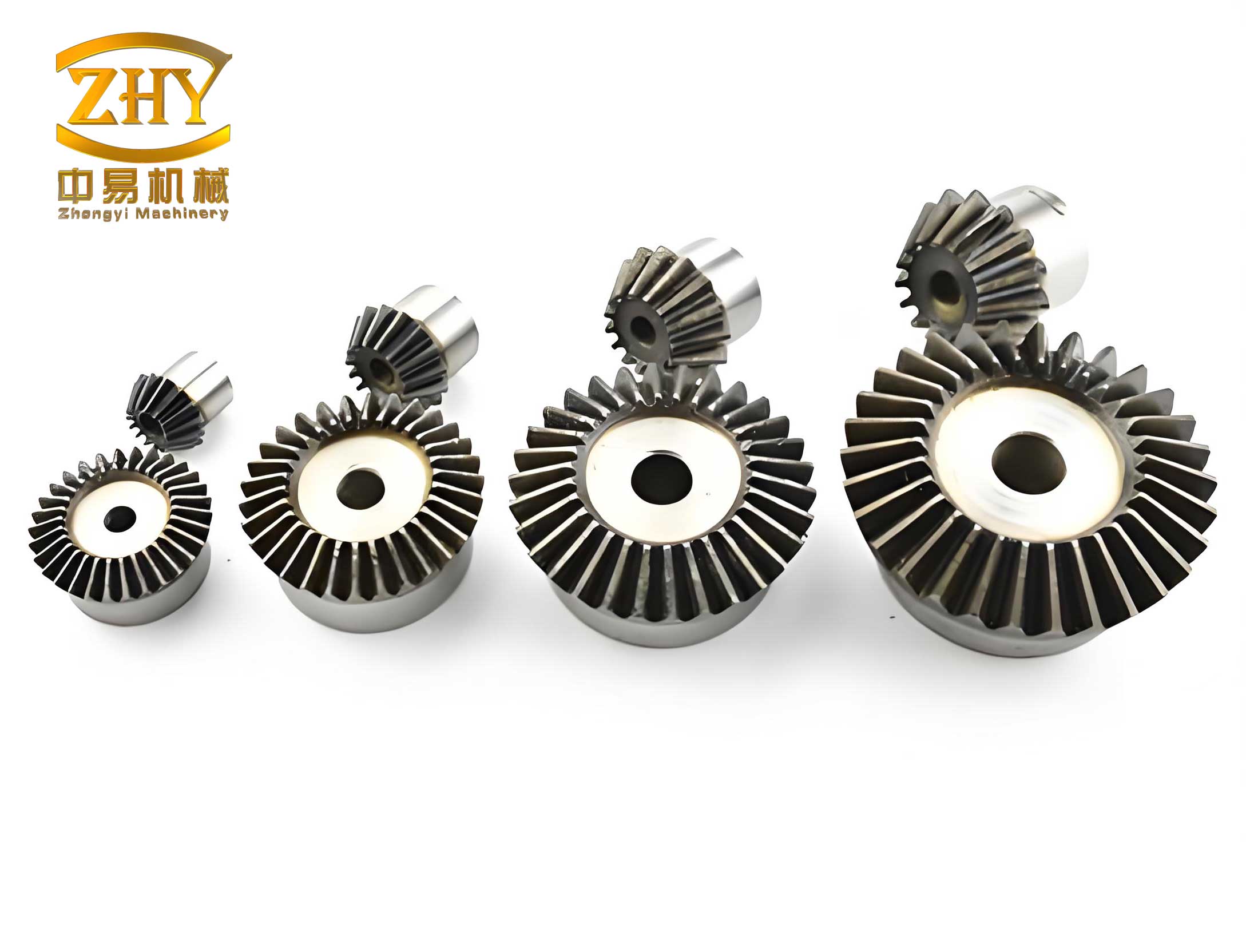
The foundation of intelligent quenching for bevel gears lies in understanding the thermal and mechanical dynamics involved. During quenching, bevel gears undergo rapid cooling to achieve martensitic transformation, which can be modeled using heat transfer equations. For instance, the temperature distribution in a bevel gear during quenching can be approximated by Fourier’s law of heat conduction: $$q = -k \nabla T$$ where \(q\) is the heat flux, \(k\) is the thermal conductivity, and \(\nabla T\) is the temperature gradient. Additionally, the cooling rate is crucial for minimizing distortion and residual stresses, often described by empirical formulas such as: $$T(t) = T_0 + \Delta T e^{-t/\tau}$$ Here, \(T(t)\) is the temperature at time \(t\), \(T_0\) is the ambient temperature, \(\Delta T\) is the initial temperature difference, and \(\tau\) is the time constant dependent on the quenching medium and gear geometry. By integrating such models into machine controls, we can optimize the quenching process for bevel gears, reducing defects and enhancing quality.
To address the limitations of current bevel gear quenching machines, I propose five key enhancement strategies. Each strategy is designed to incrementally improve intelligence, starting with robotic integration and culminating in comprehensive safety systems. These upgrades not only boost productivity but also align with Industry 4.0 principles, enabling smarter manufacturing environments. Throughout this discussion, I will emphasize the role of bevel gears as central components, highlighting how each upgrade directly benefits their processing. Below is an overview table summarizing the strategies and their impacts on bevel gear quenching.
| Enhancement Strategy | Key Features | Impact on Bevel Gear Quenching |
|---|---|---|
| Robotic Module Expansion | High-precision joint robots, customized signaling | Faster, more accurate loading/unloading, reduced temperature loss |
| Automatic Door Mechanism | Single or dual cylinder systems, full enclosure | Contained oil splash, cleaner workspace, improved safety |
| Touchscreen Interface Application | Embedded PLC, real-time monitoring, parameter setting | Enhanced user interaction, easier troubleshooting, process control |
| Production Data Informatization | Network connectivity, MES integration, SPC analysis | Real-time data tracking, predictive maintenance, quality assurance |
| Machine Operation Safety | Oil mist absorbers, automatic CO₂ fire suppression | Reduced fire risk, compliance with safety standards |
Expanding robotic modules is a pivotal step in modernizing bevel gear quenching machines. Traditionally, manual handling or gantry-style manipulators have been used to transfer heated bevel gears from furnaces to quenching presses, but these methods often lead to inconsistent speeds, temperature drops, and alignment issues. By adopting high-precision articulated robots—such as those from ABB, KUKA, or FANUC—mounted on floor tracks or inverted configurations, we can achieve smoother, more reliable transfers. These robots offer the flexibility needed to handle various bevel gear sizes and shapes, which is essential given the diversity in bevel gear designs. From my experience, integrating robots requires careful signal coordination between the quenching machine and the production line. The table below outlines the essential交互 signals for seamless operation, ensuring that bevel gears are loaded and unloaded without delays or errors.
| Signal Type | Signal Name | Description |
|---|---|---|
| Quenching Machine → Production Line | Request for Loading | Indicates the machine is ready to receive a bevel gear |
| Quenching Machine → Production Line | Request for Unloading | Signals completion of quenching for part removal |
| Production Line → Quenching Machine | Loading Completion | Confirms the bevel gear has been placed correctly |
| Production Line → Quenching Machine | Unloading Completion | Acknowledges removal of the quenched bevel gear |
| Robot → Quenching Machine | Position Feedback | Provides real-time location data for precise alignment |
| Robot → Quenching Machine | Automatic Mode Status | Indicates the robot is operating autonomously |
The kinematics of robotic handling can be described using forward and inverse kinematics equations. For a typical 6-axis robot, the position and orientation of the end-effector relative to the bevel gear can be computed as: $$x = f(\theta)$$ where \(x\) is the Cartesian coordinates, and \(\theta\) represents the joint angles. This allows for precise positioning, minimizing the risk of misalignment during the transfer of bevel gears. Moreover, the speed of transfer affects the quenching outcome; faster transfers reduce heat loss, which is critical for maintaining the austenitization temperature in bevel gears. The time required for transfer can be optimized using path planning algorithms, ensuring that bevel gears reach the quenching press within a specified window, typically less than 10 seconds for optimal results.
Adding automatic door mechanisms is another crucial upgrade for bevel gear quenching machines. Many existing machines feature only partial enclosures, leading to significant oil splatter during the quenching process. This not only creates a messy work environment but also poses safety hazards and increases maintenance costs. By implementing full-enclosure automatic doors, we can contain the quenching oil effectively. I recommend two design approaches: a single-cylinder dual-guide system for new machines and a dual-cylinder guide-less system for retrofitting older models. The force required to operate these doors can be calculated using pneumatic cylinder formulas: $$F = P \times A$$ where \(F\) is the force, \(P\) is the pressure, and \(A\) is the piston area. For bevel gear quenching machines, typical pressures range from 0.5 to 0.7 MPa, ensuring swift and reliable door operation without interfering with robotic access.
The integration of automatic doors also contributes to energy efficiency by reducing oil loss and minimizing the need for frequent cleanups. In terms of design, the doors should be made of transparent polycarbonate materials to allow visual inspection of the quenching process for bevel gears. This is particularly important for monitoring the immersion and pressure phases, where distortions in bevel gears can occur if not properly controlled. The door mechanism should be interlocked with the machine’s control system, such that the quenching cycle only initiates when the door is fully closed, enhancing safety for operators working with bevel gears.
Applying touchscreen interfaces revolutionizes the human-machine interaction in bevel gear quenching machines. Traditional control panels often rely on physical buttons and indicators, making it difficult to monitor complex parameters or diagnose issues in real-time. By embedding programmable logic controllers (PLCs) with intuitive touchscreen displays, operators can easily set quenching parameters, view live data, and troubleshoot problems. For bevel gear quenching, key parameters include oil flow rate, quenching time, pressure pulse frequency, and temperature settings. These can be adjusted via the touchscreen, with changes reflected immediately in the machine’s operation. The interface can also display graphical trends, such as temperature profiles over time, aiding in the optimization of bevel gear quenching cycles.
From a mathematical perspective, the control logic can be represented using state-space equations for the quenching process: $$\dot{x} = Ax + Bu$$ $$y = Cx + Du$$ where \(x\) is the state vector (e.g., temperatures, pressures), \(u\) is the input vector (e.g., valve commands), and \(y\) is the output vector (e.g., sensor readings). This model helps in implementing predictive control algorithms that adapt to variations in bevel gear dimensions or material properties. Additionally, the touchscreen can host simulation tools, allowing operators to preview the quenching effects on virtual bevel gears before actual production, reducing trial-and-error waste.
Data informatization is at the heart of intelligent manufacturing for bevel gear quenching. Modern quenching machines should be capable of connecting to broader production networks, such as Manufacturing Execution Systems (MES) or enterprise resource planning (ERP) systems. This enables real-time data exchange, where information on machine status, production counts, energy consumption, and quality metrics is continuously collected and analyzed. For bevel gears, this data can be used for statistical process control (SPC), identifying trends in distortion or hardness that may indicate process drift. The following table outlines the types of data that should be monitored and their significance in bevel gear quenching.
| Data Field | Type | Description | Relevance to Bevel Gears |
|---|---|---|---|
| Machine Status | Discrete | Running, idle, fault, etc. | Ensures availability for quenching bevel gears |
| Quenching Oil Temperature | Continuous | Real-time temperature in °C | Critical for cooling rate and bevel gear quality |
| Pressure Force | Continuous | Force applied during pressing in kN | Affects distortion control in bevel gears |
| Cycle Time | Continuous | Time per quenching cycle in seconds | Impacts productivity for bevel gear batches |
| Alarm Logs | Text | Records of faults or warnings | Helps in preventive maintenance for bevel gear lines |
The data flow can be structured using standard protocols like OPC UA or MQTT, allowing seamless integration with cloud platforms. For bevel gear manufacturers, this means the ability to perform big data analytics, such as predicting machine failures or optimizing quenching parameters based on historical data. The volume of data generated can be substantial; for instance, a single quenching machine processing bevel gears might produce several gigabytes per day, necessitating robust storage and processing solutions. I often use the following formula to estimate data generation: $$D = N \times (S_t + S_p + S_a)$$ where \(D\) is the daily data volume, \(N\) is the number of bevel gears quenched, and \(S_t\), \(S_p\), \(S_a\) are the sizes of temperature, pressure, and alarm data per gear, respectively. This helps in planning IT infrastructure for smart quenching systems.
Ensuring machine operation safety is non-negotiable in bevel gear quenching, given the risks associated with high temperatures, flammable oils, and high-pressure systems. Two key upgrades are essential: oil mist absorbers and automatic fire suppression systems. Oil mist absorbers remove vapors generated during quenching, maintaining air quality and reducing the risk of explosions. The efficiency of such absorbers can be modeled using adsorption isotherms, such as the Langmuir equation: $$\theta = \frac{KP}{1+KP}$$ where \(\theta\) is the fraction of surface covered, \(K\) is the adsorption constant, and \(P\) is the vapor pressure. For bevel gear quenching machines, this ensures that oil mist concentrations remain below hazardous levels, typically under 5 mg/m³.
Automatic CO₂ fire suppression systems, like the Tyco model mentioned, provide rapid response in case of ignition. These systems use smoke or flame detectors to trigger the release of CO₂, which displaces oxygen and extinguishes fires. The required CO₂ volume can be calculated based on the enclosure volume and the specific hazards of quenching oils: $$V_{CO_2} = C \times V_{enclosure}$$ where \(V_{CO_2}\) is the volume of CO₂ needed, \(C\) is a constant dependent on the fire hazard class (often around 0.34 kg/m³ for oil fires), and \(V_{enclosure}\) is the volume of the machine chamber. For bevel gear quenching machines, this calculation ensures adequate protection without over-engineering. Additionally, safety interlocks should be implemented, such as emergency stop buttons and pressure relief valves, to protect both the machine and operators during the handling of bevel gears.
Beyond these core strategies, there are ancillary enhancements that further boost the intelligence of bevel gear quenching machines. For example, adaptive control systems can use real-time sensor feedback to adjust quenching parameters dynamically. If a bevel gear exhibits unexpected thermal behavior due to material inhomogeneity, the system can modulate the oil flow or pressure to compensate. This relies on advanced algorithms like fuzzy logic or neural networks, which can be embedded in the machine’s PLC. The error minimization in such systems can be expressed as: $$E = \sum (y_{desired} – y_{actual})^2$$ where \(E\) is the error, and \(y\) represents key outputs like flatness or hardness of bevel gears. By minimizing \(E\) through iterative adjustments, the quenching process becomes more robust for diverse bevel gear applications.
Another aspect is predictive maintenance, which uses data from vibration sensors, temperature probes, and oil quality monitors to forecast potential failures. For bevel gear quenching machines, common failure modes include pump wear, seal leaks, or heater malfunctions. Using time-series analysis, we can predict these events before they cause downtime. The remaining useful life (RUL) of a component can be estimated using degradation models: $$RUL = \frac{L – D(t)}{r}$$ where \(L\) is the failure threshold, \(D(t)\) is the current degradation level, and \(r\) is the degradation rate. This proactive approach minimizes unplanned stoppages, ensuring continuous production of bevel gears.
The economic benefits of these intelligent upgrades are substantial. While the initial investment might be higher, the long-term savings in labor, energy, and material costs justify the expenditure. For instance, robotic loading reduces manual intervention, cutting labor costs by up to 30% in bevel gear quenching lines. Data informatization helps in reducing scrap rates, as deviations in bevel gear quality are detected early. To quantify this, I often use a return on investment (ROI) formula: $$ROI = \frac{Net Benefits}{Initial Cost} \times 100\%$$ where net benefits include savings from increased uptime, lower maintenance, and improved bevel gear yield. In many cases, ROI exceeds 20% within the first two years, making these upgrades financially attractive for manufacturers focused on bevel gears.
In conclusion, the intelligent upgrading of bevel gear quenching machines is a multifaceted endeavor that encompasses robotics, automation, interface design, data integration, and safety. As I have outlined, each strategy contributes to a more efficient, reliable, and connected manufacturing process for bevel gears. The integration of these elements transforms traditional quenching machines into smart systems capable of self-optimization and real-time communication. This aligns with global trends toward Industry 4.0, where digital twins and cyber-physical systems redefine production. For manufacturers of bevel gears, adopting these upgrades is not just a technological leap but a competitive necessity, enabling them to meet the ever-increasing demands for precision and sustainability. Looking ahead, I anticipate further advancements in AI-driven process control and green quenching technologies, which will continue to elevate the standards for bevel gear manufacturing. By embracing innovation today, we can build a foundation for smarter, safer, and more efficient quenching solutions that benefit the entire industry.