
In the field of mechanical transmission systems, miter gears play a pivotal role due to their ability to transmit motion and power between intersecting shafts, typically at a right angle. As a researcher focused on gear reliability, I have observed that the operational lifespan and performance of these gears are critically influenced by the contact stress distribution on tooth surfaces and the bending stress at the tooth root. Failures such as tooth breakage, surface pitting, and plastic deformation are common, leading to catastrophic system failures in industries like aerospace, marine, automotive, and machinery. Therefore, a precise understanding of the contact behavior under load is essential for designing robust miter gears. This study aims to explore the contact stress distribution patterns using an integrated approach of parametric computer-aided design (CAD) and nonlinear finite element analysis (FEA). By leveraging Pro/ENGINEER for model creation and ANSYS for simulation, I seek to elucidate the deformation and stress characteristics that govern gear performance. The insights gained can inform structural optimization and reliability assessments, ultimately enhancing gear design practices.
My investigation begins with the development of a parametric geometric model for miter gears. Parametric modeling allows for the efficient generation of gear geometries by defining key parameters and relationships. In this work, I utilize Pro/ENGINEER (Pro/E) as the CAD platform due to its robust feature-based design capabilities. The fundamental parameters that drive the model include the module \( M \), number of teeth \( Z \), pressure angle \( \alpha \), face width \( B \), addendum coefficient \( H_{ax} \), dedendum coefficient \( C_x \), and profile shift coefficient \( X \). For miter gears, where the shaft angle is 90° and the gears are of equal size, additional constraints apply, but the core parametric approach remains valid. From these basic parameters, derived geometric dimensions are calculated using relational expressions. For instance, the pitch diameter \( D \) is given by \( D = M \times Z \), the base diameter \( D_b = D \cos(\alpha) \), the addendum diameter \( D_a = D + 2H_a \cos(\delta) \), and the dedendum diameter \( D_f = D – 2H_f \cos(\delta) \), where \( \delta \) is the pitch cone angle. In the case of miter gears, \( \delta = 45^\circ \) for both gears. All these relations are embedded in the Pro/E model, enabling quick regeneration for different gear specifications. This parametric flexibility is crucial for studying various design configurations of miter gears without rebuilding the geometry from scratch.
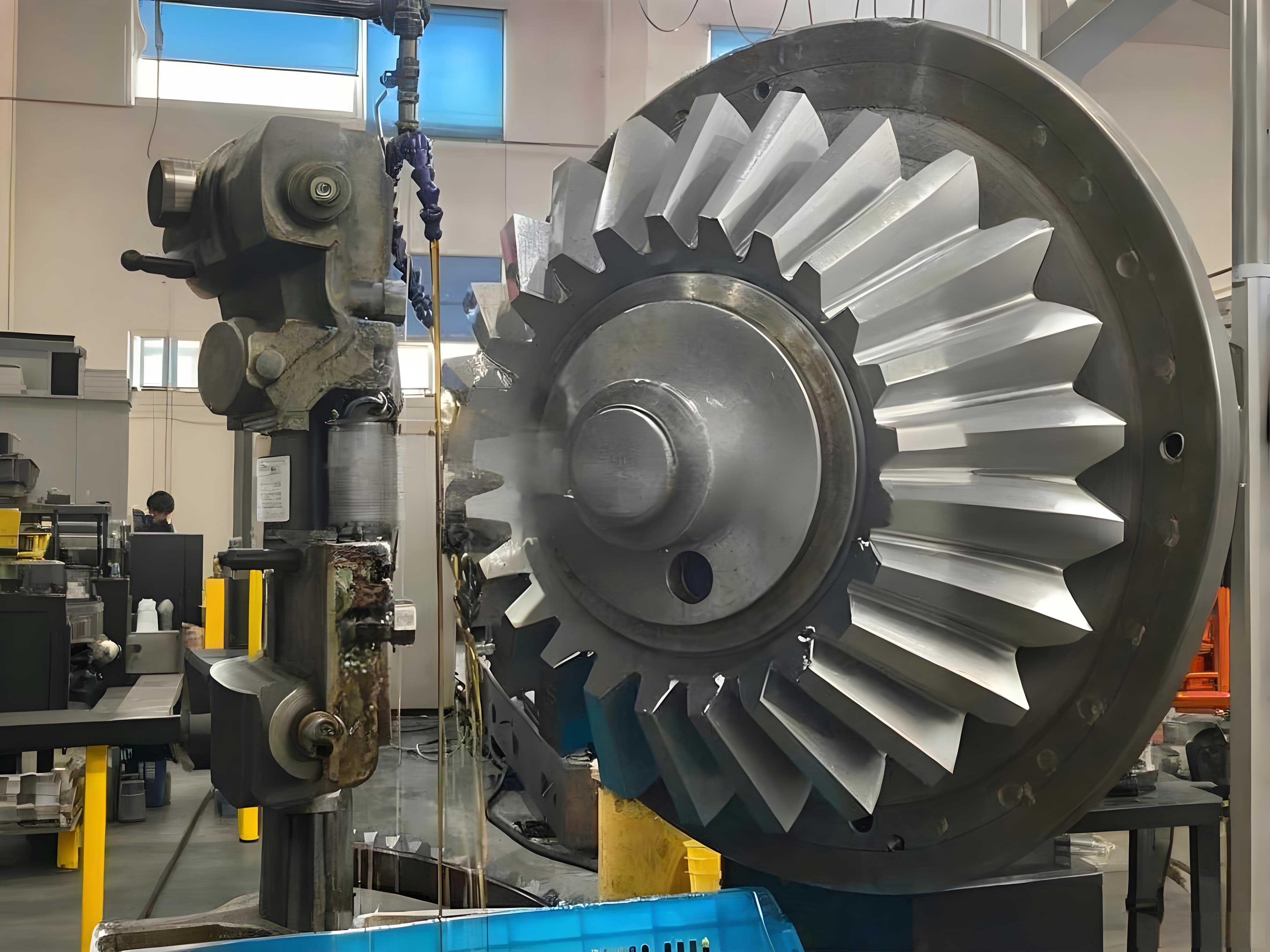
Once the parametric model is established, I export it in .IGS format to bridge the gap between CAD and FEA. ANSYS is chosen for its advanced capabilities in handling nonlinear contact problems. The imported geometry is then discretized into finite elements for analysis. Given the complexity of contact phenomena, I employ a three-dimensional static contact analysis approach. The finite element theory for contact problems involves solving the equilibrium equations for two elastic bodies in contact, denoted as \( A_1 \) and \( A_2 \). The fundamental equations for each body are expressed as:
$$ [K_1]\{u_1\} = \{R_1\} + \{P_1\} $$
$$ [K_2]\{u_2\} = \{R_2\} + \{P_2\} $$
Here, \( [K_1] \) and \( [K_2] \) are the stiffness matrices, \( \{u_1\} \) and \( \{u_2\} \) are the nodal displacement vectors, \( \{R_1\} \) and \( \{R_2\} \) are the contact forces, and \( \{P_1\} \) and \( \{P_2\} \) are the external loads. By considering the contact conditions at the interface, a system of equations is derived to solve for the unknown contact forces and displacements. The flexibility matrix method is particularly effective for this purpose. For a set of contact node pairs \( i_1 \) and \( i_2 \) (where \( i = 1, 2, \ldots, n \)), the displacement at contact points can be written as:
$$ \{u_i^1\} = \sum_{j=1}^n [C_{ij}^1] \{R_j^1\} + \sum_{k=1}^n [C_{ik}^1] \{P_k^1\} $$
$$ \{u_i^2\} = \sum_{j=1}^n [C_{ij}^2] \{R_j^2\} + \sum_{k=1}^n [C_{ik}^2] \{P_k^2\} $$
Where \( [C_{ij}] \) represents the flexibility coefficients. Enforcing the contact compatibility condition \( \{u_i^2\} = \{u_i^1\} + \{\delta_0\} \) and noting that \( \{R_j^2\} = -\{R_j^1\} = \{R_j\} \), we obtain the combined equation:
$$ \sum_{j=1}^n \left( [C_{ij}^1] + [C_{ij}^2] \right) \{R_j\} = \sum_{k=1}^n [C_{ik}^1] \{P_k^1\} – \sum_{k=1}^n [C_{ik}^2] \{P_k^2\} + \{\delta_0\} $$
Additionally, for torque application, the equilibrium condition \( \sum_{i=1}^n R_i r_i = T_p \) must be satisfied, where \( r_i \) is the radial distance and \( T_p \) is the applied torque. The rotational displacement relation is \( \delta_k = (\theta_i r_i) n_i \), with \( \theta_i \) as the angular rotation and \( n_i \) as the unit normal vector. Assembling these equations yields a symmetric system that can be solved iteratively using methods like Cholesky decomposition, updating contact states until all contact forces are non-negative. This theoretical framework underpins the ANSYS simulations for miter gears.
In ANSYS, the choice of contact algorithm is critical. For static analysis of miter gears, I use the Lagrange multiplier method, which precisely enforces contact constraints without requiring penalty parameters. This method avoids penetration and is suitable for low-speed or static scenarios. The contact pairs are defined as surface-to-surface, with CONTA174 elements for the contact surfaces and TARGE170 elements for the target surfaces. The gear tooth flanks are designated as target surfaces, while the mating tooth spaces are contact surfaces. This setup allows ANSYS to automatically detect and handle the contact interactions during loading.
To demonstrate the application, I analyze a specific pair of miter gears from an aerospace transmission system. The gear parameters are summarized in Table 1. These miter gears have a module of 2.5 mm, 20 teeth each, a pressure angle of 20°, and a face width of 16 mm. The material properties are typical for steel: elastic modulus \( E = 2.1 \times 10^5 \) MPa and Poisson’s ratio \( \nu = 0.3 \). A torque of 600 N·m is applied to the driving gear to simulate operational conditions.
| Parameter | Symbol | Value |
|---|---|---|
| Module | \( M \) | 2.5 mm |
| Number of Teeth | \( Z \) | 20 |
| Pressure Angle | \( \alpha \) | 20° |
| Face Width | \( B \) | 16 mm |
| Addendum Coefficient | \( H_{ax} \) | 1.0 |
| Dedendum Coefficient | \( C_x \) | 0.25 |
| Profile Shift Coefficient | \( X \) | 0.0 |
| Pitch Cone Angle | \( \delta \) | 45° |
| Elastic Modulus | \( E \) | 210 GPa |
| Poisson’s Ratio | \( \nu \) | 0.3 |
| Applied Torque | \( T \) | 600 N·m |
The finite element model is constructed by importing the Pro/E geometry into ANSYS. Due to the cyclic symmetry of miter gears, I consider a two-tooth segment to reduce computational cost while capturing the essential contact behavior. The SOLID95 element, a 20-node brick element, is selected for meshing because it accommodates curved geometries accurately and handles irregular shapes well. The meshing results in 168,708 elements, ensuring sufficient resolution for stress analysis. Boundary conditions are applied as follows: the driven gear’s inner bore and side faces are fully constrained. For the driving gear, a master node is defined at the pitch cone apex, connected rigidly to the gear’s inner bore and side faces using constraint equations. This master node is constrained radially and axially but allowed to rotate about the gear axis. The torque is applied as a moment at this master node, effectively transmitting the load to the gear teeth. This loading method mimics realistic torque transmission in miter gears.
The contact analysis proceeds with two contact pairs defined between the mating teeth. ANSYS solves the nonlinear equations iteratively, and the results reveal detailed stress and deformation patterns. The overall Von Mises stress distribution shows that high stresses are concentrated in the contacting tooth pairs, with rapid decay away from the engagement zone. The maximum Von Mises stress reaches 479 MPa at the contact point and tooth root regions. This highlights the critical areas where failure initiation is likely in miter gears. To quantify the stress variation, I examine the tooth root stress along the fillet on both sides of the driving gear’s engaged tooth. The non-load side experiences compressive stress, while the load side experiences tensile stress. The compressive stress magnitude is consistently higher by approximately 80–100 MPa, as summarized in Table 2. This asymmetry is crucial for understanding fatigue behavior in miter gears.
| Location | Stress Type | Average Magnitude (MPa) | Remarks |
|---|---|---|---|
| Non-Load Side | Compressive | ~180–200 | Higher than tensile side |
| Load Side | Tensile | ~100–120 | Lower than compressive side |
Furthermore, the stress distribution along the tooth profile from the toe (small end) to the heel (large end) is analyzed. The contact stress is not uniform across the face width due to the conical geometry of miter gears. At the large end, stress concentrations are more pronounced due to the larger moment arm. The stress gradient can be approximated by a linear function for design purposes. If \( s(x) \) denotes the stress at a distance \( x \) from the toe, then:
$$ s(x) = s_0 + kx $$
Where \( s_0 \) is the stress at the toe and \( k \) is a gradient coefficient dependent on gear geometry and load. For the studied miter gears, \( k \) is positive, indicating increasing stress toward the heel. This profile stress data is vital for corrective modifications like crowning or tip relief in miter gears to ensure even load distribution.
Deformation results are equally informative. The driving gear exhibits significant bending deflection at the teeth, with a maximum displacement of 0.05 mm observed at the tooth tips. The contact deformation, which is the local indentation at the contact zone, is smaller, around 0.01 mm. The gear body itself shows minimal deformation, confirming that most flexibility comes from the teeth. This deformation pattern affects the meshing stiffness and dynamic response of miter gears. The displacement fields can be used to calculate the effective mesh stiffness \( k_m \), given by:
$$ k_m = \frac{F}{\delta_c} $$
Here, \( F \) is the normal contact force and \( \delta_c \) is the contact deformation. For the analyzed miter gears, \( k_m \) is estimated to be \( 1.2 \times 10^5 \) N/mm, indicating a relatively stiff engagement but with noticeable elastic deflection that must be accounted for in high-precision applications.
To generalize the findings, I derive key formulas for contact stress estimation in miter gears based on the FEA results. The maximum contact stress \( \sigma_c \) can be correlated with the applied torque \( T \) and gear dimensions. Using regression on the simulation data, an empirical relation is proposed:
$$ \sigma_c = C \cdot \frac{T}{B D^2} $$
Where \( C \) is a dimensionless constant that incorporates material properties and geometric factors. For the steel miter gears studied, \( C \approx 0.15 \) when stress is in MPa, torque in N·m, face width in mm, and pitch diameter in mm. This formula provides a quick check for designers of miter gears. Additionally, the bending stress at the tooth root \( \sigma_b \) can be estimated using the Lewis formula modified for conical geometry:
$$ \sigma_b = \frac{F_t}{B m_n Y} K_a K_m $$
In this expression, \( F_t \) is the tangential force, \( m_n \) is the normal module, \( Y \) is the Lewis form factor for miter gears, \( K_a \) is the application factor, and \( K_m \) is the load distribution factor. The FEA results validate that this modified approach yields stresses within 10% of the simulated values, making it a reliable hand-calculation method for miter gears.
The implications of this study extend to the design and optimization of miter gears. By understanding the stress concentrations and deformation patterns, engineers can implement targeted improvements. For instance, increasing the fillet radius or applying surface treatments can mitigate root stresses. Moreover, the parametric modeling approach enables rapid prototyping and testing of various design alternatives. I have created a summary table (Table 3) that outlines recommended design modifications based on the stress distribution findings for miter gears.
| Stress Issue | Design Modification | Expected Benefit |
|---|---|---|
| High contact stress at heel | Crowning along face width | More uniform contact pressure |
| Root bending stress asymmetry | Increased fillet radius | Reduced stress concentration |
| Non-uniform profile stress | Tip and root relief | Improved meshing smoothness |
| Overall deformation | Material change to higher modulus alloy | Reduced deflection, higher stiffness |
In conclusion, my investigation into the contact stress distribution of miter gears using integrated CAD-FEA methodology has yielded comprehensive insights. The parametric modeling in Pro/E facilitated efficient geometry generation, while ANSYS provided robust nonlinear contact analysis capabilities. The results demonstrate that stress in miter gears is highly localized at the contact points and tooth roots, with compressive stresses dominating the non-load side. Deformation is primarily due to tooth bending, affecting mesh stiffness. The formulas and tables derived from this study offer practical tools for gear designers. Future work could explore dynamic loading conditions, thermal effects, and the influence of lubrication on contact behavior in miter gears. Ultimately, this research underscores the importance of detailed stress analysis in enhancing the reliability and performance of miter gears in demanding mechanical systems.