
In modern mechanical transmission systems, spiral bevel gears play a critical role due to their ability to transmit power between intersecting shafts with high efficiency and smooth operation. These gears are widely used in aerospace, automotive, and heavy machinery applications, where stringent mechanical performance requirements are essential. Traditional manufacturing methods for spiral bevel gears often involve cutting processes, which can lead to material waste, reduced strength, and higher costs. In contrast, cold forging—a near-net-shape forming technique—offers significant advantages, including improved mechanical properties, finer grain structures, higher dimensional accuracy, and cost-effectiveness. This study focuses on the numerical simulation of the cold forging process for spiral bevel gears using finite element analysis (FEA) to investigate deformation behavior, stress-strain distribution, and potential defect formation, such as cracking. The insights gained aim to optimize the forging process and enhance the quality of spiral bevel gear forgings.
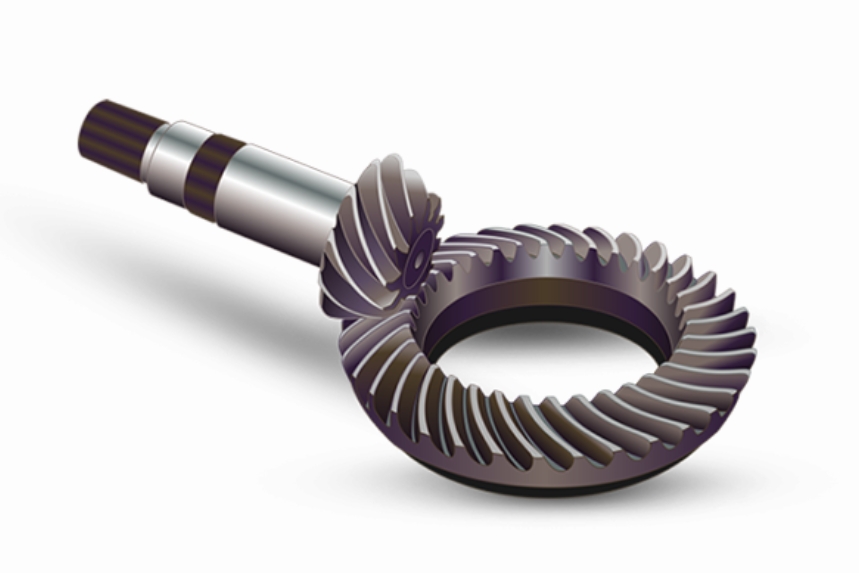
The spiral bevel gear examined in this work has a design with 20 teeth, a module of 3 mm, and a spiral angle of 35 degrees. The material is AISI-1045 steel, commonly used for its good forgeability and strength. The cold closed-die forging process, also known as cold闭塞式模锻, is employed to form the gear. This method involves a double-action hydraulic press where an outer slide first closes the die set—consisting of a背锥模具 (back cone die) and a齿形模具 (tooth profile die)—applying initial pressure. Then, an inner slide drives a punch to compress the billet, forcing metal flow into the die cavity to fill the complex tooth geometry. The die design places the parting line at the maximum outer diameter to facilitate part ejection, and the tooth profile die extends above this line to ensure complete tooth formation. A cylindrical billet with a diameter of 44 mm and a volume of 71058 mm³ is used, slightly larger than the final part volume to promote cavity filling, with excess material diverted through overflow channels in practical applications.
To simulate the cold forging process, the DEFORM-3D software, a specialized FEA tool for metal forming, is utilized. The model treats the dies and punch as rigid bodies, neglecting elastic deformations, while the billet is defined as a plastic workpiece. The material behavior of AISI-1045 steel at room temperature is characterized by a flow stress curve, which can be approximated by the Hollomon equation: $$\sigma = K \epsilon^n$$ where $\sigma$ is the true stress, $\epsilon$ is the true plastic strain, $K$ is the strength coefficient, and $n$ is the strain-hardening exponent. For AISI-1045 steel, typical values are $K = 1000$ MPa and $n = 0.2$, though the exact curve from DEFORM-3D’s library is used. The initial temperature for both the billet and dies is set to 20°C, and the punch speed is 10 mm/s. Friction between the billet and dies is modeled using the arctangent friction model, expressed as: $$\tau = m \cdot k \cdot \frac{2}{\pi} \arctan\left(\frac{v_{\text{rel}}}{v_0}\right)$$ where $\tau$ is the frictional shear stress, $m$ is the friction factor (taken as 0.12 for lubricated conditions), $k$ is the shear yield strength of the material, $v_{\text{rel}}$ is the relative sliding velocity, and $v_0$ is a small constant velocity. This model accounts for the mixed sticking-sliding conditions common in cold forging.
The simulation results reveal detailed insights into the deformation mechanics during the cold forging of spiral bevel gears. The equivalent strain distribution, as shown in Figure 4 of the reference, indicates that in the early stages, plastic deformation concentrates near the billet’s top surface where the punch contacts, gradually spreading axially downward. The strain values are higher in the tooth root regions and fillet areas due to constrained metal flow into the die cavities. The equivalent stress distribution, depicted in Figure 5, shows stress concentrations at the tooth roots, with maximum values reaching around 1000 MPa. This stress concentration arises because the tooth root areas are the first to contact the die and undergo significant resistance as metal fills the spiral tooth cavities. The stress propagates along the spiral curve from the root to the tooth surface, reflecting the increasing flow resistance in the tapered sections of the die.
A key output from the simulation is the load-stroke curve, which illustrates the forging force required throughout the process. Initially, the load increases slowly as localized plastic deformation occurs. As the punch descends, metal flow becomes more restricted, and friction builds up, causing a steeper rise in load. In the final stages, when the die cavity is nearly filled, the load spikes dramatically due to high hydrostatic pressure needed to complete corner filling. The maximum forging load reaches 6.09 MN at the end of the stroke. This curve is crucial for press selection and process optimization, as excessive loads can lead to die wear or failure.
To predict cracking defects, which are a common concern in cold forging due to limited material ductility, the metal flow velocities and circumferential stresses at specific points on the tooth surface are analyzed. Eight characteristic points are selected along the tooth profile from the root to the tip, as shown in Figure 7. The flow velocities and circumferential stresses at these points are summarized in Table 1 below. The data indicates that points near the tooth tip experience the highest flow velocities and tensile circumferential stresses, while points near the root have lower velocities and higher compressive stresses. The velocity differences induce additional tensile stresses that can exceed the material’s strength limit, leading to cracks. Specifically, transverse cracks are likely in the mid-tooth surface regions, and longitudinal cracks may occur at the tooth tip. This prediction aligns with the observation that non-uniform metal flow during cavity filling is a primary cause of surface cracking in spiral bevel gear forgings.
| Point Number | Location on Tooth | Flow Velocity (mm/s) | Circumferential Stress (MPa) |
|---|---|---|---|
| P1 | Tooth Root | 2.5 | -1200 |
| P2 | Root Fillet | 5.0 | -1000 |
| P3 | Lower Tooth Surface | 10.0 | -500 |
| P4 | Mid-Tooth Surface | 15.0 | 200 |
| P5 | Upper Tooth Surface | 18.0 | 400 |
| P6 | Near Tip | 20.0 | 600 |
| P7 | Tooth Tip Edge | 22.0 | 800 |
| P8 | Tooth Tip Center | 25.0 | 1000 |
The equivalent strain and stress distributions can be mathematically described using the von Mises criteria. The equivalent strain $\bar{\epsilon}$ is given by: $$\bar{\epsilon} = \sqrt{\frac{2}{3} \epsilon_{ij} \epsilon_{ij}}$$ where $\epsilon_{ij}$ is the strain tensor component. Similarly, the equivalent stress $\bar{\sigma}$ is: $$\bar{\sigma} = \sqrt{\frac{3}{2} s_{ij} s_{ij}}$$ with $s_{ij} = \sigma_{ij} – \frac{1}{3} \sigma_{kk} \delta_{ij}$ being the deviatoric stress tensor. These measures help quantify the deformation intensity and stress state during forging. For the spiral bevel gear, the maximum equivalent strain occurs in the tooth root areas, reaching values up to 3.60, indicating severe plastic deformation. The stress triaxiality factor, defined as the ratio of hydrostatic stress to equivalent stress, is also critical for ductile fracture prediction: $$\eta = \frac{\sigma_h}{\bar{\sigma}}$$ where $\sigma_h = \frac{1}{3} \sigma_{kk}$. Regions with high tensile stress and positive triaxiality are prone to cracking, which correlates with the findings for the tooth tip and mid-surface areas.
To further analyze the process, the effect of key parameters such as friction factor, billet size, and punch speed on the forging outcome is studied. Table 2 summarizes the influence of these parameters on maximum forging load and tooth fill quality. Lower friction reduces load and improves metal flow, while larger billet diameters enhance fill but increase load. Optimizing these parameters is essential for defect-free production of spiral bevel gears.
| Parameter | Range | Maximum Forging Load (MN) | Tooth Fill Quality | Remarks |
|---|---|---|---|---|
| Friction Factor (m) | 0.08 – 0.16 | 5.5 – 6.5 | Poor to Good | Lower friction improves flow and reduces cracks. |
| Billet Diameter (mm) | 42 – 46 | 5.8 – 6.3 | Incomplete to Full | Larger billets aid filling but raise load. |
| Punch Speed (mm/s) | 5 – 15 | 6.0 – 6.1 | Similar | Speed has minor effect on load but affects strain rate. |
The numerical simulation also allows for the evaluation of strain rate effects, which are important in cold forging due to strain rate sensitivity of materials. The strain rate $\dot{\epsilon}$ is computed as: $$\dot{\epsilon} = \frac{d\bar{\epsilon}}{dt}$$ For AISI-1045 steel, the flow stress can be modified to include strain rate dependence using a model like: $$\sigma = K \epsilon^n \left(\frac{\dot{\epsilon}}{\dot{\epsilon}_0}\right)^m$$ where $\dot{\epsilon}_0$ is a reference strain rate, and $m$ is the strain rate sensitivity exponent. In cold forging, $m$ is typically low (around 0.01), but incorporating this enhances simulation accuracy. The simulation shows that strain rates peak in the tooth root regions during initial contact, contributing to higher stress levels.
Another aspect investigated is the prediction of crack initiation using fracture criteria. The Cockcroft-Latham criterion is often applied for ductile materials: $$\int_0^{\bar{\epsilon}_f} \sigma^* d\bar{\epsilon} = C$$ where $\sigma^*$ is the maximum tensile stress, $\bar{\epsilon}_f$ is the equivalent strain at fracture, and $C$ is a material constant. For the spiral bevel gear, integrating this criterion along the tooth surface paths indicates that points with high tensile stress and accumulated strain, such as P4 and P8, exceed the critical value, confirming cracking risk. This theoretical approach supplements the velocity-based analysis.
In practice, to mitigate cracking in spiral bevel gear cold forging, several strategies can be adopted. These include optimizing die design with smoother transitions, applying advanced lubricants to reduce friction, and using pre-formed billets to distribute strain more evenly. The simulation results highlight the importance of uniform metal flow; hence, process modifications like multi-stage forging or tailored billet geometries may be beneficial. Additionally, post-forging heat treatments can relieve residual stresses and improve ductility.
The economic and environmental benefits of cold forging spiral bevel gears are substantial. Compared to cutting, material savings can exceed 20%, and the improved mechanical properties extend component life. The numerical simulation approach reduces trial-and-error in die development, shortening lead times and costs. As industries strive for sustainability, such efficient manufacturing techniques become increasingly valuable.
In conclusion, this study demonstrates the effectiveness of finite element numerical simulation in analyzing the cold forging process for spiral bevel gears. The results provide detailed insights into strain and stress distributions, forging loads, and cracking mechanisms. The spiral bevel gear’s complex geometry poses challenges, but with optimized process parameters and die design, high-quality forgings can be achieved. Future work could explore warm forging variants or advanced materials to further enhance performance. The integration of simulation tools like DEFORM-3D is pivotal for advancing the production of spiral bevel gears, contributing to more reliable and cost-effective transmission systems.
To reiterate, the spiral bevel gear is a critical component in many mechanical systems, and its manufacturing via cold forging offers significant advantages. Through numerical simulation, we can predict and address potential defects, optimize the process, and ensure the production of high-integrity gears. The continued refinement of these techniques will support the growing demand for efficient and durable spiral bevel gears in various industrial applications.