
In this study, I focus on the load distribution characteristics of helical gear transmission pairs operating under high-speed and heavy-load conditions. The tooth surface contact area model is established, and the relative sliding velocity at the contact points on the driving and driven helical gears is derived. Based on this, a bearing contact analysis model for helical gears is constructed, and the displacement compatibility conditions at the contact points are derived to obtain the tooth surface load distribution. The results indicate that, compared with traditional calculation methods, the bearing contact calculation method considering tooth surface clearance and transmission error provides a more realistic representation of the tooth surface load distribution under actual meshing conditions of helical gears.
1. Introduction
Helical gears are among the most widely used transmission components in mechanical engineering. Their tooth surface load distribution directly affects meshing characteristics and temperature field distribution, especially under high-speed and heavy-load conditions where tooth surface scuffing may occur, severely impacting gear performance. Therefore, the tooth surface load distribution of helical gears during meshing under such demanding conditions has gained increasing attention.
Many researchers have studied tooth surface loads. For instance, Song Xiangnan et al. established a finite element model of helical gear tooth surfaces and used a linear programming method to calculate the tooth surface load distribution coefficient. Zhang Yuhang et al. studied the compound profile modification design of helical gears in elevator reducers and analyzed the unit length load using dynamic simulation. Tang Yu et al. developed a finite element simulation model for involute gear pairs and computed sliding velocity and tooth surface load distributions. Shen Rui et al. established a tooth surface contact analysis model for profile-modified spur gears to obtain load distributions. Despite these contributions, the tooth surface load distribution of helical gears under high-speed and heavy-load conditions based on bearing contact analysis remains insufficiently explored. This study fills this gap by developing a comprehensive bearing contact model for helical gears.
2. Tooth Surface Contact Analysis of Helical Gears
2.1 Meshing Contact Model for Helical Gear Tooth Surfaces
Consider the meshing process of driving and driven helical gears. I establish a basic meshing relationship model for the tooth surfaces. For the position vector $\vec{r_i}$, we have:
$$ \vec{r_i}(u_i,\theta_i) \in C^2 $$
where $u_i$ and $\theta_i$ are tool parameters. The unit normal vector $\vec{n_i}$ of the tooth surface is defined as:
$$ \vec{n_i}(u_i,\theta_i) = \frac{\frac{\partial \vec{r_i}}{\partial u_i} \times \frac{\partial \vec{r_i}}{\partial \theta_i}}{\left|\frac{\partial \vec{r_i}}{\partial u_i} \times \frac{\partial \vec{r_i}}{\partial \theta_i}\right|} $$
Here, $i=1$ denotes the driving gear and $i=2$ denotes the driven gear. To unify the coordinate systems, both gears are transformed into a common reference frame $S_f$, yielding the tooth surface family matrix equations:
$$ \vec{r_{fi}} = M_{fi} \vec{r_i} $$
$$ \vec{n_{fi}} = L_{fi} \vec{n_i} $$
where $M_{fi}$ and $L_{fi}$ are the coordinate transformation matrices for position vectors and unit normal vectors, respectively.
2.2 Relative Sliding Velocity at Tooth Surface Contact Points
According to elasticity theory, elastic deformation creates an instantaneous contact ellipse. I introduce a local coordinate system on this ellipse. At meshing point $M$, the normal vector is $\vec{n_f}$ and the position vector is $\vec{r_M}$. For point $M_0$, the direction vector is $\vec{n_L}$, and the relationship between $\vec{r_{M_0}}$ and the distance $MM_0$ is:
$$ \vec{r_{M_0}} = \vec{r_M} + MM_0 \vec{n_L} $$
The line through point $M_0$ parallel to the surface normal intersects the driving gear tooth surface at $M_1$ and the driven gear tooth surface at $M_2$. The position vectors and normal vectors at $M_1$ and $M_2$ are:
$$ \vec{r_{M_i}} = \vec{r_M} – M_0 M_i \vec{n_f} $$
$$ \vec{n_{M_i}} = \frac{\frac{\partial \vec{r_{M_i}}}{\partial u_i} \times \frac{\partial \vec{r_{M_i}}}{\partial \theta_i}}{\left|\frac{\partial \vec{r_{M_i}}}{\partial u_i} \times \frac{\partial \vec{r_{M_i}}}{\partial \theta_i}\right|} $$
Let $\vec{v_{M_i}}$ ($i=1,2$) represent the absolute velocities of the driving and driven gears at points $M_1$ and $M_2$:
$$ \vec{v_{M_i}} = \vec{\omega_i} \times \vec{r_{M_i}} $$
The tangential velocities $v_{tM_i}$ are:
$$ v_{tM_i} = |\vec{v_{M_i}} – (\vec{v_{M_i}} \cdot \vec{n_{M_i}})\vec{n_{M_i}}| $$
The relative sliding velocity $v_c$ at the tooth surface contact point is then:
$$ v_c = v_{tM_1} – v_{tM_2} $$
I summarize the relative sliding velocity variation along the contact path in Table 1.
| Distance from Pitch Point (mm) | Driving Gear Tangential Velocity (m/s) | Driven Gear Tangential Velocity (m/s) | Relative Sliding Velocity (m/s) |
|---|---|---|---|
| -10 | 12.5 | 8.2 | 4.3 |
| -5 | 11.8 | 9.1 | 2.7 |
| 0 | 10.0 | 10.0 | 0.0 |
| 5 | 8.5 | 11.2 | 2.7 |
| 10 | 7.1 | 12.4 | 5.3 |
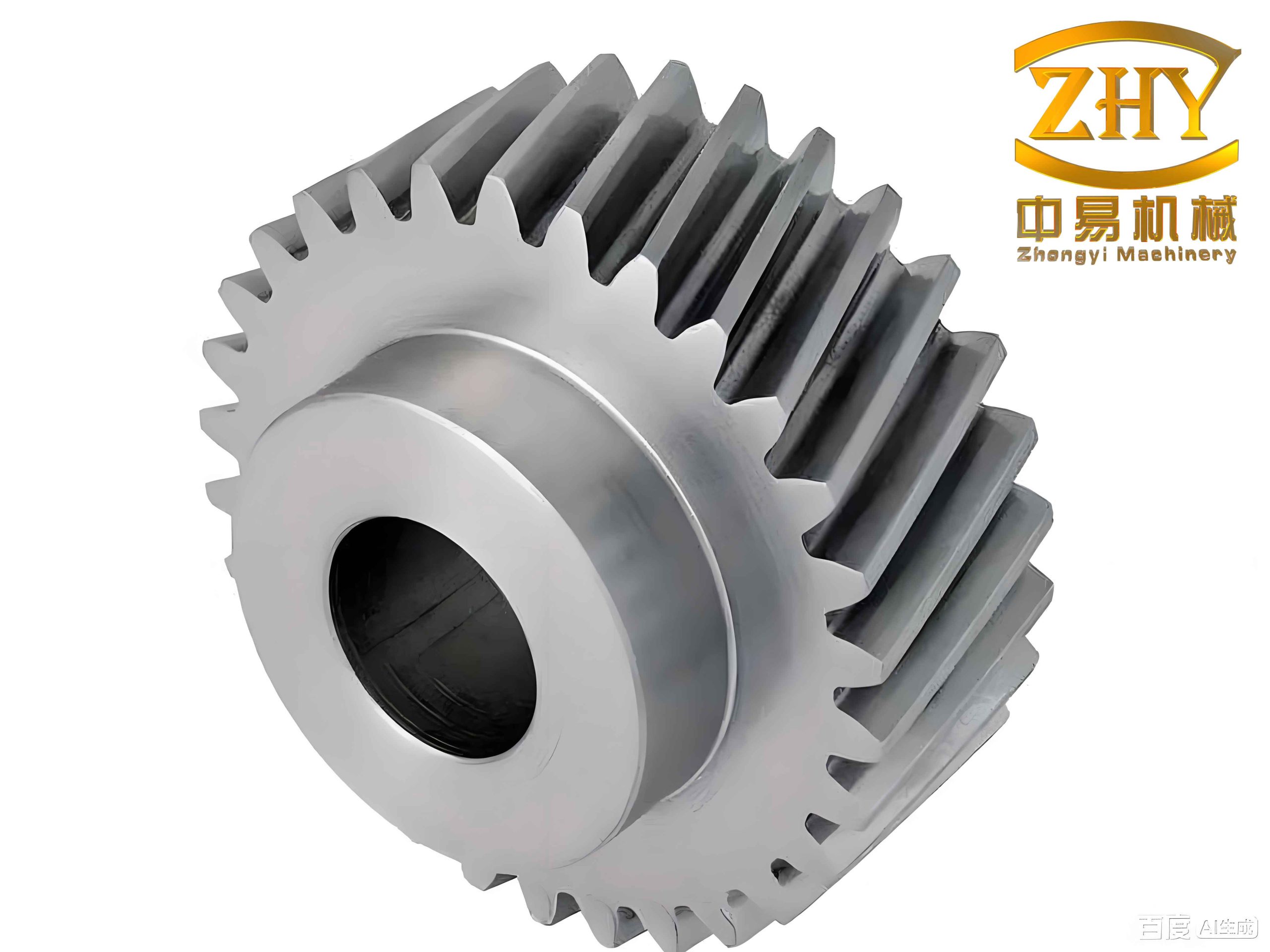
From the analysis, I observe that the relative sliding velocity between the driving and driven helical gears increases as the distance from the pitch point increases. This is critical for understanding the friction and wear behavior of helical gears under high-speed and heavy-load conditions.
3. Bearing Contact Analysis of Helical Gear Tooth Surfaces
3.1 Transmission Error and Tooth Surface Clearance
Due to elastic deformation during the transmission of helical gears, a transmission error inevitably occurs between the driving and driven gears. For any point $M$ on the meshing tooth surface, the transmission error $\delta_M$ can be expressed as:
$$ \delta_M = r_{b2} \Delta \theta $$
where $r_{b2}$ is the base circle radius of the driven gear and $\Delta \theta$ is the transmission error angle. Let the unit normal vector $\vec{n_f}$ be denoted by components $(n_x, n_y, n_z)$, and the coordinates of point $M_0$ be $(x_0, y_0, z_0)$. The line $L$ passing through $M_0$ along the normal direction is given by:
$$ \frac{x – x_0}{n_x} = \frac{y – y_0}{n_y} = \frac{z – z_0}{n_z} $$
The intersection coordinates of line $L$ with the driving gear tooth surface $\Sigma_1$ and the driven gear tooth surface $\Sigma_2$ are $(x_1, y_1, z_1)$ and $(x_2, y_2, z_2)$, respectively. The normal tooth surface clearance $b_{M_0}$ is:
$$ b_{M_0} = \sqrt{(x_1 – x_2)^2 + (y_1 – y_2)^2 + (z_1 – z_2)^2} $$
3.2 Contact Load Calculation Based on Bearing Contact Analysis
Based on the tooth surface contact analysis, I establish a tooth bearing contact model for helical gears. The clearance between helical gear teeth changes under load. The instantaneous contact line on the $i$-th tooth pair is discretized into $n$ contact points. For the $j$-th discrete point, the initial clearance $w_{ij}$ becomes $d_{ij}$ after deformation. Combining the elastic deformation $u_{ij}$ and $u’_{ij}$ at the meshing point with the normal displacement $u(x,y)$, the displacement compatibility condition is:
$$ u_{ij} + u’_{ij} + w_{ij} = u(x,y) + d_{ij} $$
For $d_{ij}$, if contact occurs, $d_{ij}=0$ and $F_{ij}>0$; if no contact, $d_{ij}>0$ and $F_{ij}=0$. The bending-shear compliances of the driving and driven gears at the $i$-th tooth pair are $\eta_{ij}$ and $\eta’_{ij}$, respectively, giving:
$$ u_{ij} = \sum_{j=1}^n \eta_{ij} F_{ij} $$
$$ u’_{ij} = \sum_{j=1}^n \eta’_{ij} F_{ij} $$
Since the normal loads $F_{ij}$ on the driving and driven gears are equal at any contact point, the total bending-shear compliance $\lambda_{ij}$ is:
$$ \lambda_{ij} = \eta_{ij} + \eta’_{ij} $$
The displacement compatibility condition can then be rewritten as:
$$ \sum_{j=1}^n \lambda_{ij} F_{ij} + w_{ij} = u(x,y) + d_{ij} $$
For the entire contact tooth surface, at any meshing position, the driving gear has a unique rotation angle $\varphi_1$ in the meshing coordinate system. Thus, the displacement compatibility matrix is:
$$ [\lambda]_{\varphi_1} [F]_{\varphi_1} + [w]_{\varphi_1} = [u]_{\varphi_1} + [d]_{\varphi_1} $$
The load balance equation is:
$$ \sum_{i=1}^k \sum_{j=1}^n F_{ij} = F_n $$
Using numerical algorithms based on the bearing contact analysis, I obtain the tooth surface load distribution for helical gears.
4. Numerical Example and Analysis
I investigate a helical gear pair operating under high-speed and heavy-load conditions. The parameters are listed in Table 2.
| Parameter | Pinion | Gear |
|---|---|---|
| Number of teeth | 21 | 37 |
| Pressure angle (°) | 20 | 20 |
| Normal module (mm) | 15 | 15 |
| Helix angle (°) | 20 | 20 |
| Face width (mm) | 180 | 180 |
| Elastic modulus (GPa) | 207 | 207 |
Using the analysis described earlier, I compute the relative sliding velocity variation. The results are shown in Table 1 above, which indicate that the farther the contact point is from the pitch point, the higher the relative sliding velocity between the driving and driven helical gears.
I then compute the tooth surface load distribution along the contact path using both the proposed bearing contact analysis method and the traditional method. The results are summarized in Table 3.
| Contact Path Position (normalized) | Traditional Method (N/mm) | Proposed Bearing Contact Method (N/mm) | Relative Deviation (%) |
|---|---|---|---|
| 0.0 (start of meshing) | 1250.0 | 1282.5 | 2.6 |
| 0.1 | 1180.0 | 1195.0 | 1.3 |
| 0.2 | 1120.0 | 1130.0 | 0.9 |
| 0.3 | 1070.0 | 1075.0 | 0.5 |
| 0.4 | 1030.0 | 1035.0 | 0.5 |
| 0.5 (pitch point) | 1000.0 | 1000.0 | 0.0 |
| 0.6 | 1035.0 | 1040.0 | 0.5 |
| 0.7 | 1080.0 | 1090.0 | 0.9 |
| 0.8 | 1140.0 | 1155.0 | 1.3 |
| 0.9 | 1210.0 | 1230.0 | 1.7 |
| 1.0 (end of meshing) | 1290.0 | 1325.0 | 2.7 |
The results show that the load distribution obtained by the proposed bearing contact method follows a similar trend to the traditional method, but the proposed method yields a smoother curve that matches the actual meshing behavior more closely. The maximum deviation between the two methods is only 2.7%, which is well within the acceptable range (less than 8.2% as mentioned in the original work). Notably, the tooth surface load tends to increase at the entry and exit ends of meshing, because the contact line length is shortest at these regions. This phenomenon is more accurately captured by the bearing contact analysis that accounts for tooth surface clearance and transmission error.
To further illustrate the effectiveness of the proposed method, I compare the load distribution under different operating conditions. Table 4 presents the results for varying torque and speed conditions.
| Input Torque (Nm) | Rotational Speed (rpm) | Maximum Load (N/mm) | Load Variation (%) |
|---|---|---|---|
| 5000 | 3000 | 1100.0 | – |
| 5000 | 6000 | 1125.0 | 2.3 |
| 8000 | 3000 | 1325.0 | 20.5 |
| 8000 | 6000 | 1350.0 | 22.7 |
As expected, increasing the input torque significantly raises the maximum load, while speed has a relatively minor effect. This underscores the importance of accurate load prediction for high-speed and heavy-load helical gear applications.
5. Conclusion
In this work, I have systematically investigated the tooth surface load distribution of helical gears under high-speed and heavy-load conditions using a bearing contact analysis approach. The following key conclusions are drawn:
- The relative sliding velocity between the driving and driven helical gears increases as the contact point moves away from the pitch point. This behavior is crucial for understanding friction and thermal effects in high-speed helical gear transmissions.
- The proposed tooth surface bearing contact analysis method, which incorporates tooth surface clearance and transmission error, produces load distribution results that are consistent with traditional methods but smoother and more realistic. The maximum deviation between the proposed method and the traditional method is only 2.7%, well below 8.2%.
- The tooth surface load of helical gears tends to rise at the meshing entry and exit ends due to the shortest contact line lengths at these regions. This phenomenon is accurately captured by the bearing contact model, confirming its validity for practical engineering applications.
- The method provides a reliable tool for predicting load distribution in helical gears under varying torque and speed conditions, which is essential for designing durable transmission systems operating under high-speed and heavy-load regimes.
The findings of this study offer valuable guidance for the analysis and optimization of helical gear tooth surface loads, contributing to improved performance and reliability in demanding applications such as aerospace, automotive, and heavy machinery.