
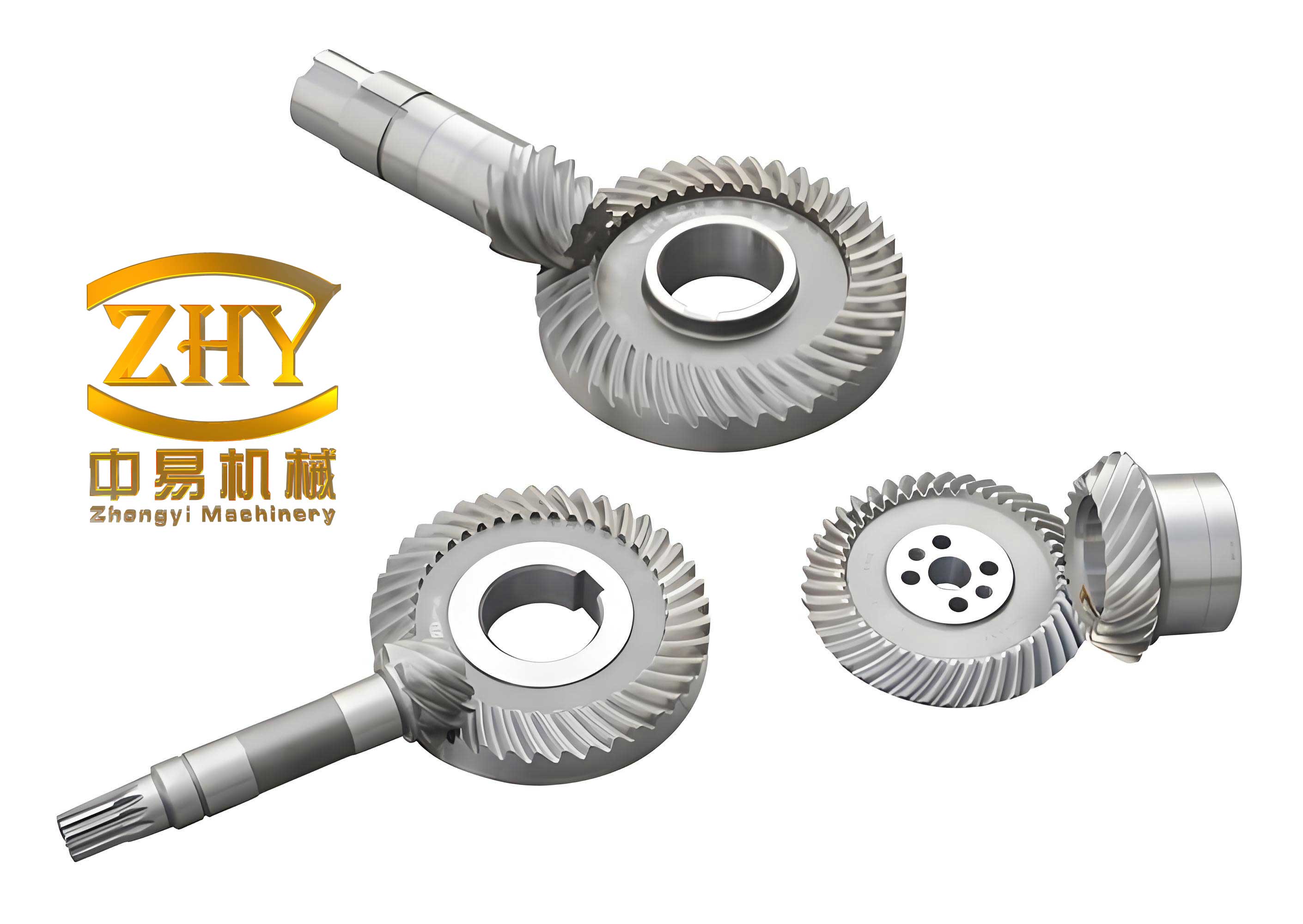
The transmission of rotational power between non-parallel, non-intersecting shafts is a fundamental requirement in modern machinery, from automotive drivetrains to aerospace systems and heavy industrial equipment. For these demanding applications, hypoid gears stand as the preeminent solution. Their unique geometry, characterized by offset axes, provides significant advantages over other gear types, including higher torque capacity, smoother and quieter operation due to gradual tooth engagement, and the ability to achieve high reduction ratios in compact spaces. These attributes make hypoid gears critical components in power transmission systems where reliability, efficiency, and compact design are paramount.
However, the very complexity that grants hypoid gears their superior performance also presents formidable manufacturing challenges. Traditional methods, primarily based on material removal through cutting, milling, or grinding, suffer from several inherent drawbacks. These subtractive processes are inherently inefficient, wasting a substantial portion of expensive alloy steel. They sever the natural grain flow of the material, creating stress risers and significantly reducing bending fatigue strength—a critical property for gear durability. Furthermore, achieving the precise, hardened tooth surfaces necessary for performance often requires multiple, time-consuming finishing steps after the initial forging. This multi-stage process increases production cycle time, cost, and introduces more potential sources of error.
To overcome these limitations, the manufacturing industry has increasingly turned to net-shape or near-net-shape forging processes. Precision forging of gear teeth offers the potential for dramatic improvements in material utilization, mechanical properties, and production rate. The process creates a favorable grain flow that follows the tooth contour, enhancing strength and fatigue life. Yet, applying this technology to hypoid gears has been particularly difficult. The complex, spatially curved surfaces of hypoid teeth often lead to challenges in completely filling the die corners during forging, resulting in incomplete form or defects. Consequently, a secondary finishing operation is typically required. If this finishing is done via traditional cutting, it negates the fiber-strengthening benefit of forging. If done via grinding, the high hardness of the forged surface drastically reduces tool life.
This article addresses these challenges by proposing an innovative cold rotary forging (also known as orbital forging or axial rolling) scheme specifically designed for the finishing of forged hypoid gears. The primary focus is on the ring gear (or “wheel”), which is typically the larger of the two mating gears and often the more critical from a bending fatigue perspective. The proposed method aims to refine the tooth flanks and root fillets of a pre-forged gear blank, achieving final dimensional accuracy and surface quality without cutting the metal’s fiber lines. Furthermore, a critical aspect of any cold forming process—springback—is addressed through the development of a systematic, simulation-based compensation iteration system. This integrated approach promises a streamlined manufacturing route for high-performance hypoid gears.
Proposed Cold Rotary Forging Scheme for Hypoid Gears
The proposed cold finishing scheme is inspired by the kinematics of form grinding but replaces the abrasive material removal with a localized, incremental plastic deformation process. The core innovation lies in the simplicity of the tooling and the nature of the contact.
Instead of a complex, full-tooth-space die, the tool is a simple trapezoidal-shaped rolling die. The axial cross-section of this die is designed to be congruent with the normal cross-section of the theoretical grinding wheel used in a form-grinding process for the target gear tooth space. This die is mounted on a conical pendulum head. A key setup parameter is the tilt angle of the die’s central axis relative to the machine’s main axis. This tilt is precisely calculated so that the lateral face of the trapezoidal die makes instantaneous line contact with the target tooth flank of the pre-forged hypoid gear blank.
During the operation, the rolling die undergoes a compound motion: it orbits (revolves) around the machine’s main axis while simultaneously rotating about its own geometric axis. The workpiece (the gear blank) is indexed and held stationary during the finishing of each individual tooth space. As the die orbits, the line of contact between the die and the workpiece sweeps along the tooth flank, precisely following the path that the grinding wheel would take. This results in a continuous, localized plastic deformation that smooths the surface, improves the profile accuracy, and induces beneficial compressive residual stresses.
The advantages of this scheme are multifold:
- Simplified Tooling: The trapezoidal die is far simpler and cheaper to manufacture and maintain than a complex full-tooth cavity die.
- Reduced Forming Force: Because contact is a line that moves, the instantaneous contact area is a small fraction of the total tooth surface area. This dramatically reduces the required forming force and machine tonnage compared to conventional coining or sizing.
- Improved Material Properties: The process cold-works the surface layer, enhancing hardness and creating a favorable residual stress state. The metal fiber flow from the initial forging is preserved and further aligned.
- Elimination of Secondary Machining: When properly controlled, the process can achieve the required surface finish and dimensional accuracy, potentially eliminating any need for subsequent grinding or honing.
The fundamental geometric relationship governing the setup can be described. Let the surface of the target (ideal) tooth flank be defined parametrically as:
$$\vec{S}_t(u, v)$$
where \(u\) and \(v\) are surface parameters. The surface of the rolling die is a cylindrical surface derived from its axial profile curve \(\vec{C}(w)\). The condition for instantaneous line contact is that the die surface is a tool envelope surface tangent to the family of gear tooth surfaces generated by the relative motion. The tilt angle \(\gamma\) and the orbital radius \(R_o\) are critical parameters solved from this tangency condition and the requirement that the die profile matches the gear’s normal section. The kinematic relationship ensures the die contact line \(L(t)\) sweeps the target surface:
$$L(t) = \left\{ \vec{P} : \vec{P} = \text{Trans}(R_o, \omega_o t) \cdot \text{Rot}(\gamma) \cdot \text{Rot}(\omega_d t) \cdot \vec{C}(w) \cap \vec{S}_t(u, v) \right\}$$
where \(\omega_o\) is the orbital angular velocity, \(\omega_d\) is the die’s self-rotation angular velocity, and \(\text{Trans}\) and \(\text{Rot}\) are transformation matrices.
The Challenge of Springback in Cold Forming
In any elastic-plastic forming process, springback is an unavoidable phenomenon that directly impacts the geometric fidelity of the final part. When the external tooling load is removed, the elastically strained portions of the material recover, causing the part to deviate from the shape it had under load. For high-precision components like hypoid gears, where micron-level deviations in tooth profile and lead can severely impact meshing noise, load distribution, and transmission error, controlling springback is not optional—it is essential.
The magnitude and pattern of springback are influenced by a complex interplay of factors:
- Material Properties: Yield strength, elastic modulus, strain-hardening exponent, and plastic strain ratio.
- Process Parameters: Amount of plastic deformation (strain), forming speed, friction conditions.
- Part Geometry: Section thickness, curvature, and feature complexity.
- Stress State: The through-thickness gradient of stress induced during forming.
For the proposed cold rotary forging of hypoid gears, the springback is particularly complex because the deformation is non-uniform across the tooth flank. Areas with higher plastic deformation (like the tooth tips and ends where metal flows more freely) will exhibit less elastic recovery, while areas with predominantly elastic deformation (like the mid-region of the tooth flank where constraints are higher) will spring back more. This can lead to a distorted tooth profile, often manifesting as a “crowning” or deviation from the theoretical conjugate surface.
Two broad strategies exist to mitigate springback: Process Control and Die Compensation. Process control methods involve adjusting parameters like forming force, stroke, or lubrication to alter the stress state. However, for a process aiming at final net-shape accuracy, these methods often lack the precision needed. Die compensation, on the other hand, is a more direct and effective strategy. It involves intentionally modifying the geometry of the forming die so that the part, after springback, conforms to the desired target geometry. The core challenge is predicting the required modification accurately.
Springback Error Compensation Iteration System
To efficiently and accurately design the compensated rolling die, a closed-loop iteration system is constructed. This system leverages Finite Element Analysis (FEA) as a virtual prototyping tool to replace costly and time-consuming physical trial-and-error, integrating CAD, CAE, and compensation algorithms.
The system operates through the following iterative steps, forming a structured design loop:
- Initial Die Design: The first iteration begins with a die designed directly from the target (ideal) tooth surface of the hypoid gear. The axial profile of the trapezoidal die is extracted from the normal section of this target geometry.
- FEA Simulation: A coupled explicit-implicit finite element analysis is performed. The explicit dynamic analysis simulates the cold rotary forging process itself. Once forming is complete, the part’s stress/deformation state is imported into an implicit static analysis to simulate the springback upon unloading. Process parameters (speed, friction) are optimized in this stage to ensure formability without defects.
- Error Evaluation: The deformed geometry of the workpiece after springback is extracted from the FEA results. This geometry is compared against the target geometry using 3D metrology software (conceptually like Geomagic Qualify). A comprehensive error map is generated, quantifying the springback deviation at numerous points across the tooth flank.
- Die Correction: If the maximum and/or mean error exceeds a predefined tolerance, a compensation algorithm is employed to calculate a modification to the die geometry. The most effective and widely adopted algorithm for this purpose is the Displacement Adjustment (or Offset) Method.
- Iteration: A new die is manufactured virtually (for simulation) based on the correction. Steps 2-4 are repeated with this new die. The loop continues until the springback error of the simulated part falls within the acceptable tolerance band.
The entire system can be summarized in the following process table:
| Iteration Step | Action | Tool/Method | Output |
|---|---|---|---|
| 1. Design | Create initial die geometry from target part. | CAD Software | Die CAD Model (Profile) |
| 2. Forming Simulation | Simulate plastic deformation under load. | Explicit FEA (e.g., Abaqus/Explicit) | Stressed Workpiece State |
| 3. Springback Simulation | Simulate elastic recovery after unloading. | Implicit FEA (e.g., Abaqus/Standard) | Final Part Geometry (with springback) |
| 4. Metrology & Comparison | Compare simulated part to target. | 3D Comparison Software | Error Map / Deviation Vectors |
| 5. Compensation Check | Check if error < tolerance. | — | Decision: Stop or Correct |
| 6. Die Correction | Apply displacement adjustment algorithm. | Mathematical Algorithm | Corrected Die Geometry |
| 7. Loop Back | Feed corrected geometry back to Step 1. | — | New Iteration Cycle |
Displacement Adjustment Method for Die Compensation
The Displacement Adjustment Method is a mathematical strategy for die correction based on a simple but powerful principle: to compensate for springback, modify the die shape in the opposite direction of the observed error. It treats the workpiece geometry as a discrete set of nodes, making it compatible with FEA output.
Let us define the following quantities:
- Let \( \mathbf{R} = \{ \mathbf{r}_i \}, i=1,…,n \) represent the nodal coordinates of the target gear tooth surface.
- Let \( \mathbf{S}^t = \{ \mathbf{s}^t_i \}, i=1,…,n \) represent the nodal coordinates of the formed gear tooth surface after springback from the \(t\)-th iteration. Here, \(t=0\) for the first simulation with the initial die.
- Assume a one-to-one correspondence between nodes in \( \mathbf{R} \) and \( \mathbf{S}^t \).
The springback error vector field for iteration \(t\) is simply:
$$\mathbf{E}^t = \mathbf{S}^t – \mathbf{R} = \{ \mathbf{s}^t_i – \mathbf{r}_i \}$$
This error shows how much and in which direction each point on the formed part deviates from the target.
The goal is to find a corrected “desired loaded shape,” denoted \( \mathbf{C}^{t+1} \). This is the geometry we wish the workpiece to have under the full forming load, so that after springback, it becomes the target \( \mathbf{R} \). The displacement adjustment method proposes the following update formula:
$$ \mathbf{C}^{t+1} = \mathbf{C}^{t} + \alpha (\mathbf{S}^{t} – \mathbf{R}) $$
where:
- \( \mathbf{C}^{t} \) is the desired loaded shape used to generate the die for the current (\(t\)-th) iteration. For the first iteration (\(t=0\)), \( \mathbf{C}^{0} = \mathbf{R} \).
- \( \alpha \) is a compensation factor, typically a negative value between -2.5 and -1.0. The factor \(\alpha\) accounts for the system’s sensitivity; a value of -1.0 assumes a linear, one-to-one compensation, but material and geometric non-linearities often require over-compensation (\(\alpha < -1\)).
Therefore, the sequence unfolds as follows:
- Iteration 1 (t=0): Start with \( \mathbf{C}^{0} = \mathbf{R} \). Run FEA to get \( \mathbf{S}^{0} \). Calculate error \( \mathbf{E}^{0} = \mathbf{S}^{0} – \mathbf{R} \).
- Correction 1: Compute the next desired loaded shape: \( \mathbf{C}^{1} = \mathbf{R} + \alpha (\mathbf{S}^{0} – \mathbf{R}) \).
- Iteration 2 (t=1): Design a new die based on \( \mathbf{C}^{1} \). Run FEA to get \( \mathbf{S}^{1} \).
- Correction 2: Compute \( \mathbf{C}^{2} = \mathbf{C}^{1} + \alpha (\mathbf{S}^{1} – \mathbf{R}) \).
- Repeat until the convergence criterion is met: \( \|\mathbf{S}^{t} – \mathbf{R}\|_{max} < \epsilon \), where \( \epsilon \) is the permissible tolerance.
For the specific case of the trapezoidal rolling die for hypoid gears, obtaining the die geometry from \( \mathbf{C}^{t+1} \) involves an additional step. The desired loaded shape \( \mathbf{C}^{t+1} \) represents the entire tooth space surface we want under load. The rolling die profile must be derived from a normal cross-section of this surface. Since springback is not uniform along the tooth length (face width), the ideal die profile would technically vary along its axis. For practicality, a representative profile is taken, typically from the mid-region of the tooth, and extended with consistent curvature to form the full trapezoidal die. This profile is then used to create the 3D cylindrical die model for the next simulation iteration.
Numerical Implementation and Case Study
To validate the proposed cold rotary forging scheme and the effectiveness of the springback compensation system, a detailed numerical case study was conducted using a commercial automotive ring gear as an example.
1. CAD Modeling and FEA Setup
The geometric parameters of the example hypoid ring gear are summarized in the table below:
| Parameter | Value |
|---|---|
| Number of Teeth | 41 |
| Outer Cone Distance | 101.26 mm |
| Whole Depth | 9.73 mm |
| Face Width | 28 mm |
| Pitch Cone Angle | 73.70° |
| Spiral Angle | ~50° (Mean) |
The target gear and the trapezoidal rolling die were modeled in CAD software. An eight-tooth segment of the gear blank was used for the FEA model to balance computational accuracy and cost, minimizing the influence of fixed boundary conditions on the localized deformation. The material was defined as an elastic-plastic alloy steel with isotropic hardening, typical for gear forgings (e.g., AISI 8620). Properties included a Young’s modulus of 210 GPa, Poisson’s ratio of 0.3, and a yield strength of approximately 450 MPa.
The forming stage was simulated using an explicit dynamic solver (Abaqus/Explicit) with a mass scaling factor to improve computational efficiency. The die was assigned a rotational orbital motion (20 rad/s). A penalty-based contact algorithm with a Coulomb friction coefficient of 0.2 was defined between the die and the workpiece. After forming, the part’s stressed state was imported into an implicit static solver (Abaqus/Standard) for the springback analysis, where all tool contacts were removed, allowing internal stress equilibrium to be found.
2. Simulation Results and Springback Analysis
The initial simulation (Iteration 0, \(\mathbf{C}^0 = \mathbf{R}\)) confirmed the feasibility of the process. The forming force was significantly lower than in full-die pressing due to the moving line contact. The effective plastic strain was highest at the tooth ends and tips, confirming the non-uniform deformation pattern.
After springback, the deviation was quantified. The results from the first iteration showed a clear springback pattern. The maximum error was on the order of 0.10 mm, with the mean error around 0.043 mm. The error map indicated that the tooth flank had “crowned,” with the central region deviating more than the ends. This magnitude of error is unacceptable for precision hypoid gears, necessitating compensation.
| Iteration (t) | Desired Shape \(\mathbf{C}^t\) Source | Max Springback Error \(\|\mathbf{S}^t – \mathbf{R}\|_{max}\) | Mean Error | Compensation Factor \(\alpha\) |
|---|---|---|---|---|
| 0 | Target \(\mathbf{R}\) | 0.101 mm | 0.0429 mm | — |
| 1 | \(\mathbf{C}^1 = \mathbf{R} + \alpha(\mathbf{S}^0-\mathbf{R})\) | 0.082 mm | 0.0285 mm | -0.5 |
| 2 | \(\mathbf{C}^2 = \mathbf{C}^1 + \alpha(\mathbf{S}^1-\mathbf{R})\) | 0.0775 mm | 0.0093 mm | -0.5 |
3. Application of Compensation and Convergence
The displacement adjustment method was applied with a compensation factor \(\alpha = -0.5\). Using the error vectors from Iteration 0, the corrected desired loaded shape \(\mathbf{C}^1\) was computed. A new rolling die profile was extracted from a normal section of \(\mathbf{C}^1\). A second FEA simulation (Iteration 1) was run with this modified die.
The springback error from Iteration 1 was reduced. The process was repeated once more (Iteration 2). After the third simulation cycle (i.e., two compensation iterations), the results showed significant improvement. The maximum springback error was reduced to approximately 0.0775 mm, and crucially, the mean error was brought down to below 0.01 mm. This level of accuracy was deemed within an acceptable range for a forged and finished component, considering subsequent heat treatment distortions might also be managed. The rapid convergence within 2-3 iterations demonstrates the efficiency of the proposed system.
The springback error \(\mathbf{E}^t\) can be visualized as a field over the tooth surface. The compensation algorithm effectively calculates an inverse field to pre-distort the die. The mathematical convergence can be expressed as seeking the fixed point where the mapping \(F\) from desired shape to final shape satisfies:
$$ \mathbf{R} = F(\mathbf{C}^*) $$
where \(\mathbf{C}^*\) is the optimal desired loaded shape. The displacement adjustment method is essentially a form of iterative approximation:
$$ \mathbf{C}^{t+1} = \mathbf{C}^{t} + \alpha (F(\mathbf{C}^{t}) – \mathbf{R}) $$
This resembles a Newton-like iteration for solving the nonlinear equation \(F(\mathbf{C}) – \mathbf{R} = 0\).
Verification via Loaded Tooth Contact Analysis (LTCA)
To holistically assess the quality of the finished gear, a Loaded Tooth Contact Analysis was performed on the gear pair incorporating the geometry from the final compensated cold rotary forging process. The goal was to verify that the meshing behavior under load was correct, not just that the unloaded geometry was within tolerance.
The tooth surface data from the final FEA result (after springback) was used to reconstruct the 3D CAD model of the finished ring gear. The mating pinion surface was generated theoretically based on the conjugate gear design. A finite element model consisting of five tooth pairs for both the pinion and the ring gear was created. This multi-tooth model allows for the analysis of load sharing and transmission error.
A torque of 9000 N·m was applied to the ring gear, while the pinion was driven at 500 RPM. The analysis, performed using dynamic explicit FEA, revealed the contact pressure distribution and stress fields on the tooth flanks under load. The results showed a proper contact pattern: for the ring gear’s convex side mating with the pinion’s concave side, the contact ellipse moved from the toe towards the heel and from the root towards the top under load, indicating a favorable “diagonal” contact pattern typical of well-adjusted hypoid gears. The contact pressure was concentrated in the central region of the tooth flank without edge loading, and the maximum contact stresses were within acceptable limits for the material. This LTCA confirms that the cold rotary finished gear, with compensated springback, forms a functionally correct mesh with its conjugate pinion, validating the entire manufacturing and compensation approach for hypoid gears.
Conclusion
This work presents a comprehensive methodology for the precision finishing of forged hypoid gears through an innovative cold rotary forging process coupled with a systematic springback error compensation strategy. The key outcomes and contributions are summarized as follows:
1. Innovative Forming Scheme: A novel cold rotary forging method is proposed, characterized by a simple trapezoidal rolling die that engages the workpiece via a controlled line contact. This design drastically reduces tooling complexity and required forming forces compared to conventional full-die sizing, while preserving the beneficial grain flow from the initial forging.
2. Robust Compensation System: A closed-loop iteration system is constructed, integrating CAD, elastic-plastic FEA, and the displacement adjustment algorithm. This system efficiently solves the critical problem of springback, which is inevitable in cold forming processes for high-accuracy components like hypoid gears.
3. Efficient Algorithmic Convergence: The application of the displacement adjustment method for die compensation proved highly effective. For the presented case study, the springback error was reduced to within functional tolerances after only two compensation iterations, demonstrating the method’s potential to drastically shorten the die development cycle and associated costs.
4. Functional Validation: The final gear geometry, produced via the simulated compensated process, was validated through Loaded Tooth Contact Analysis. The results confirmed the formation of a correct and favorable contact pattern under operational loads, proving that the process yields not just geometrically accurate but also functionally performant hypoid gears.
In conclusion, the synergy of the proposed cold rotary forging scheme and the model-based springback compensation system offers a viable and advanced manufacturing route for high-strength, high-precision hypoid gears. It aligns with the goals of anti-fatigue manufacturing by enhancing surface integrity and material properties, while simultaneously improving production efficiency and sustainability through near-net-shape forming. This approach holds significant promise for advancing the state-of-the-art in gear manufacturing for the automotive, aerospace, and heavy machinery sectors.