
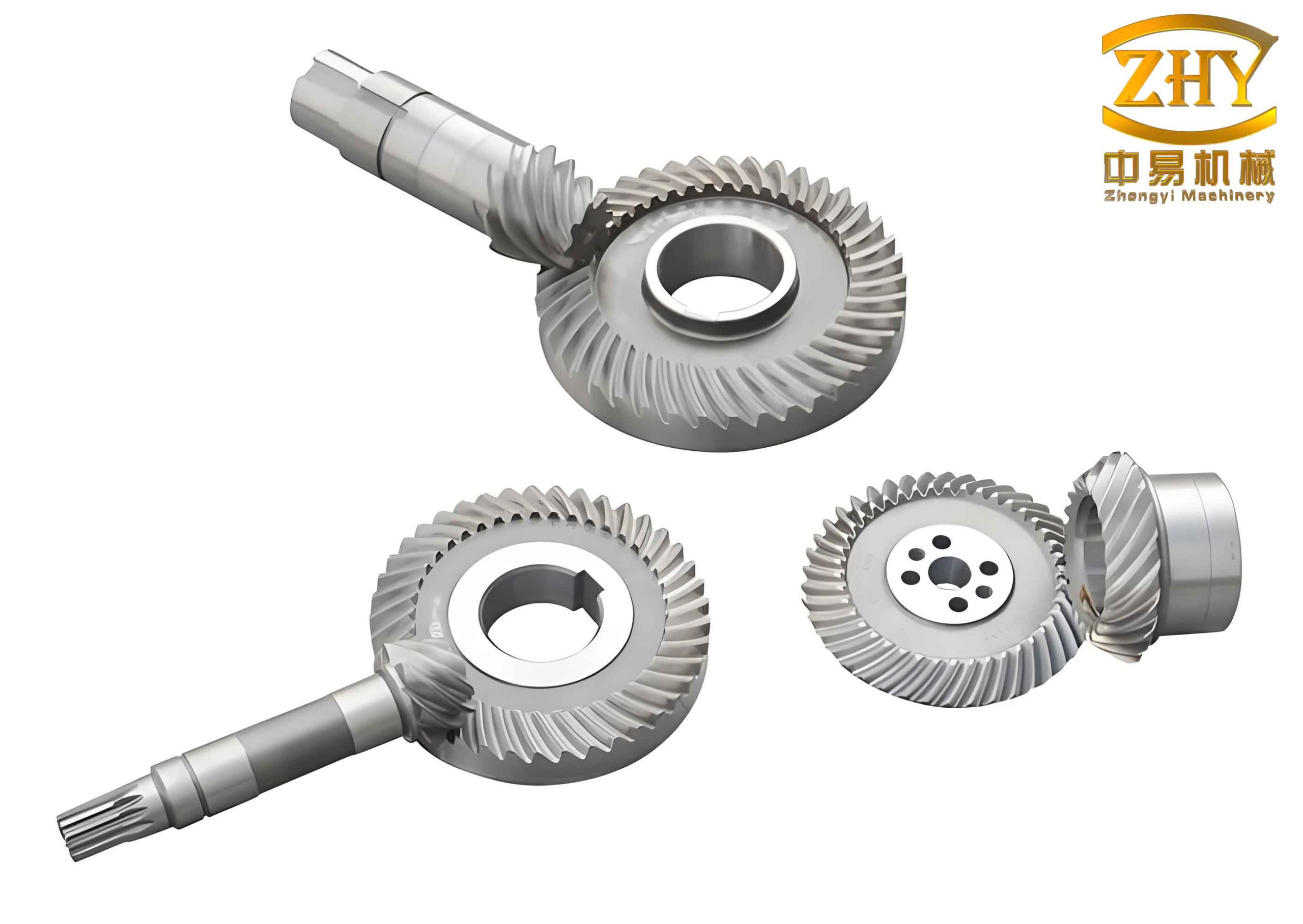
In the field of precision gear manufacturing, the finishing process for hyperboloid gears is critical due to the complex geometry and high performance requirements. Hyperboloid gears, also known as hypoid gears, are widely used in automotive and industrial applications for their ability to transmit motion between non-intersecting axes with high torque capacity. However, post-heat treatment distortions and inherent machining errors often degrade the meshing quality. Lapping emerges as a pivotal final process to refine tooth surfaces, improve contact patterns, reduce noise, and enhance load-bearing characteristics. This article presents a comprehensive study on the kinematic modeling of the lapping process for hyperboloid gears, focusing on establishing a precise relationship between machine adjustment parameters and tooth contact behavior. The model enables controlled lapping across the entire tooth surface, ensuring uniform material removal and optimal meshing performance.
The lapping of hyperboloid gears involves a delicate abrasive process where two gears are run in mesh under a controlled load with a lapping compound. The primary challenge lies in accurately positioning the contact point on the tooth surface to correct localized errors or to achieve even wear. Traditional mechanical lapping machines rely heavily on operator experience and visual inspection of contact patterns, leading to inconsistencies and suboptimal results. With the advent of CNC lapping machines, there is a growing need for a robust theoretical foundation to guide the process. This work aims to bridge that gap by developing a mathematical model that correlates the machine settings—specifically the V, H, and J adjustments—with the kinematic motion of the lapping contact point on the tooth surface of hyperboloid gears.
The fundamental principle of lapping hyperboloid gears is based on inducing controlled relative motion between the pinion and gear teeth while an abrasive slurry facilitates micro-cutting. The process can be conceptualized as two gears in mesh, where their relative spatial position is adjusted along three orthogonal directions: V (offset distance), H (horizontal displacement along the pinion axis), and J (vertical displacement along the gear axis). These adjustments directly influence the location and path of the contact point on the tooth surface. During lapping, a braking torque is applied to the gear, generating normal and tangential forces on the tooth surfaces. The normal force provides the pressure needed for the abrasive particles to embed and cut, while the tangential force drives the sliding motion that carries the abrasive grains across the surface. The abrasive grains, suspended in a fluid, roll and slide between the surfaces, removing minute amounts of material through a combination of scratching and plowing actions. Thus, lapping is essentially a precision finishing process that relies on kinematic control to homogenize surface errors and reduce roughness, ultimately improving the real contact condition of hyperboloid gears.
To mathematically describe the lapping process, we establish a coordinate system representing the relative position of the two gear surfaces. Let the pinion (gear 1) and gear (gear 2) have rotation axes along unit vectors $\mathbf{y}_1$ and $\mathbf{z}_2$, respectively. The angle between the axes is $\Gamma$, which is typically 90° for hyperboloid gears. The shortest distance line between the axes is along unit vector $\mathbf{x}$, defined as $\mathbf{x} = (\mathbf{y}_1 \times \mathbf{z}_2) / \sin\Gamma$. Points $C_1$ and $C_2$ are the intersections of the gear axes with the X-axis, representing the crossing points in space. The offset distance $V$ is the distance between $C_1$ and $C_2$, positive when moving away. The origins $O_1$ and $O_2$ of the gear-fixed coordinate systems are set at the theoretical crossing points. Adjustments $H$ and $J$ represent displacements of $O_1$ and $O_2$ along $\mathbf{y}_1$ and $\mathbf{z}_2$, respectively, positive when moving away. The position vectors from $C_1$ and $C_2$ to the contact point $M$ are $\mathbf{r}_1$ and $\mathbf{r}_2$, while $\mathbf{r}^{(1)}$ and $\mathbf{r}^{(2)}$ are vectors from $O_1$ and $O_2$ to $M$ in their respective body-fixed frames. The angular velocity vectors are $\boldsymbol{\omega}^{(1)}$ and $\boldsymbol{\omega}^{(2)}$.
The condition for tooth surface contact requires that the position vectors and the unit normal vectors at the contact point coincide. This yields the following vector equations:
$$ J\mathbf{z}_2 + \mathbf{r}^{(2)} = V\mathbf{x} + H\mathbf{y}_1 + \mathbf{r}^{(1)} $$
$$ \mathbf{n}_f^{(1)}(u_1, \theta_1, \phi_1) = \mathbf{n}_f^{(2)}(u_2, \theta_2, \phi_2) $$
where $u$ and $\theta$ are surface parameters, $\phi$ is the rotation angle, subscript $f$ denotes the fixed coordinate system, and $\mathbf{n}$ is the unit normal vector. Additionally, the meshing equation must be satisfied at the contact point:
$$ \mathbf{n}_f^{(2)} \cdot \mathbf{v}_f^{(12)} = f(u_1, \theta_1, \phi_1, u_2, \theta_2, \phi_2, V, H, J) = 0 $$
where $\mathbf{v}_f^{(12)}$ is the relative velocity vector. To maintain equal flank clearance and tip clearance during lapping, the adjustments $J$ and $H$ are coupled by:
$$ J = -H \tan \delta_1 $$
with $\delta_1$ being the pinion pitch angle. Expanding the vector equations into scalar components in the fixed frame yields five independent equations. Given the adjustment parameters $V$, $H$, $J$, these equations can be solved for the seven unknowns $(u_1, \theta_1, \phi_1, u_2, \theta_2, \phi_2)$ to determine the contact point. Conversely, for lapping control, we often need to determine the required $V/H/J$ adjustments to bring a desired point on the tooth surface into contact. This inverse problem is crucial for targeting specific areas on hyperboloid gears.
Consider the convex side of the gear tooth. In a rotational projection, let $P$ be the pitch point, $A$ the cone distance, and $M$ the nominal contact point (usually at the tooth center). Suppose the desired lapping point is $M^*$, typically the center of the contact pattern. The deviations of $M^*$ from $M$ along the tooth length and height directions are $s_1$ and $s_2$, respectively. The coordinates $(X^*_2, Y^*_2)$ of $M^*$ in the gear coordinate system $O_2X_2Y_2$ can be determined from tooth geometry. Relating these to the gear surface coordinates $(x_2, y_2, z_2)$ from the surface equation $\mathbf{r}^{(2)}(u_2, \theta_2)$ gives:
$$ x_2 = X^*_2 $$
$$ y_2^2 + z_2^2 = Y^*_2 $$
Solving these yields the surface parameters $(u_2, \theta_2)$ for the desired point. Substituting into the contact and meshing equations along with the coupling equation allows solving for the adjustment parameters $(V, H, J)$. Thus, the complete mathematical model for controlling the lapping of hyperboloid gears is established.
The effectiveness of this model is evaluated through Tooth Contact Analysis (TCA) simulation and rolling tests. TCA involves numerically solving the meshing equations to predict the contact path and contact ellipse pattern on the tooth surface. For illustration, consider a hyperboloid gear pair with 9 and 41 teeth, face width $b = 34.0$ mm, offset $E = 31.7$ mm, gear pitch diameter 205 mm, pinion mean spiral angle 52.5°, and mean pressure angle 19.0°. The pinion is left-handed. At the theoretical position $(V=31.7 \text{ mm}, H=0, J=0)$, TCA yields the contact pattern on the gear convex side as shown in the simulation. To demonstrate control, we prescribe different deviations $(s_1, s_2)$ and compute the corresponding adjustments using the model. The results are summarized in the table below.
| Length Deviation $s_1$ | Height Deviation $s_2$ | Adjustment $V$ (mm) | Adjustment $H$ (mm) | Adjustment $J$ (mm) | Flank Clearance $c_c$ (mm) |
|---|---|---|---|---|---|
| $-0.25b$ | 0 | 0.2102 | -0.3485 | 0.0694 | 0.163 |
| $0.25b$ | 0 | -0.270 | 0.3391 | -0.0609 | 0.170 |
| $0.2b$ | $0.2h$ | -0.1958 | 0.3271 | -0.0654 | 0.17 |
| $-0.2b$ | $-0.2h$ | 0.1641 | -0.3383 | 0.0715 | 0.168 |
Here, $h$ is the total tooth height. The theoretical flank clearance at the nominal position is 0.174 mm. The TCA simulations for these adjustment sets show that the contact pattern shifts precisely as intended: towards the toe or heel for length deviations, and combined shifts for height deviations. For instance, setting $s_1 = -0.25b$ moves the pattern towards the toe by a quarter of the face width, while $s_1 = 0.2b$ and $s_2 = 0.2h$ moves it towards the heel and tip simultaneously. The simulated contact patterns exhibit clear, controlled migration, validating the kinematic model’s predictive capability for hyperboloid gears.
To further corroborate the model, physical rolling tests were conducted on a Y9550 rolling tester. The gear pair was installed with the computed $V$, $H$, $J$ adjustments from the table. The actual contact patterns were transferred using marking compound and digitized. The experimental patterns closely matched the TCA simulations in terms of location and orientation. Moreover, the measured flank clearances $c_c$ remained consistent around the nominal value, confirming that the model maintains nearly constant clearance during adjustment, which is vital for proper gear function. These results collectively demonstrate that the developed kinematic model can accurately control the position and direction of the lapping point on hyperboloid gears, ensuring uniform material removal and preserving gear geometry.
The mathematical framework presented here has broader implications for the manufacturing of hyperboloid gears. By enabling precise control over the lapping process, it reduces reliance on operator skill and iterative trial-and-error. The model can be integrated into CNC lapping machines to automate the correction of contact patterns. Furthermore, it provides a foundation for optimizing lapping cycles—for example, by programming a sequence of adjustments to sweep the contact point across the entire tooth surface, thereby achieving comprehensive finishing. This is particularly beneficial for hyperboloid gears used in high-precision applications like automotive differentials, where noise vibration and harshness (NVH) performance is critical.
In addition to lapping, the model can be adapted for other gear finishing processes such as grinding or honing of hyperboloid gears, where similar kinematic control is required. The underlying principles of tooth contact analysis and adjustment parameter synthesis are generic. Extensions could include dynamic effects, such as variations in lapping pressure or speed, and their influence on material removal rates. Incorporating wear models of abrasive grains could further refine the process for hyperboloid gears.
From a theoretical standpoint, the model highlights the importance of differential geometry and kinematics in gear manufacturing. The surface parameters $(u, \theta)$ and the meshing function $f$ encapsulate the complex geometry of hyperboloid gears. The adjustments $V$, $H$, $J$ act as control inputs to the system, and the model essentially provides the Jacobian relating these inputs to output contact point coordinates. This can be expressed in a differential form for small adjustments:
$$ \begin{bmatrix} \Delta s_1 \\ \Delta s_2 \end{bmatrix} \approx \mathbf{J} \begin{bmatrix} \Delta V \\ \Delta H \\ \Delta J \end{bmatrix} $$
where $\mathbf{J}$ is a sensitivity matrix derived from the model. For hyperboloid gears, this sensitivity is nonlinear but can be linearized around the nominal point for real-time control.
To enhance the model’s practicality, we can derive explicit approximate formulas for common adjustments. For instance, for small shifts $\Delta s_1$ along the length, the required change in $H$ is roughly proportional:
$$ \Delta H \approx k_1 \Delta s_1 $$
with $k_1$ being a gear geometry-dependent coefficient. Similar relations can be found for height adjustments. These simplified relations facilitate quick setup changes on the shop floor for hyperboloid gears.
Another important aspect is the effect of lapping on tooth surface topology. The micro-cutting action of abrasives not only lowers roughness but can also introduce subtle changes to the surface curvature. Over multiple lapping cycles, this could alter the contact stress distribution. Therefore, combining the kinematic model with elastic contact mechanics simulations would allow predicting the final contact pressure pattern after lapping hyperboloid gears. This integrated approach would enable designing lapping sequences that produce desired contact patterns under load, optimizing both geometry and performance.
In terms of industrial application, the model supports the trend towards digital twins in gear manufacturing. A virtual replica of the lapping process, incorporating the kinematic model, can simulate outcomes before physical trials, reducing scrap and lead time. For hyperboloid gears, which are expensive to produce, this is particularly valuable. Moreover, the model can be used in quality assurance to diagnose root causes of contact pattern deviations—whether from cutting errors, heat treatment distortion, or mounting inaccuracies—and prescribe corrective lapping adjustments.
Looking ahead, future research could focus on real-time adaptive control of lapping for hyperboloid gears. Using in-process sensors to monitor contact pattern evolution, the adjustment parameters could be dynamically updated via the model to converge to a target pattern. Machine learning techniques could also be employed to refine the model parameters based on historical data from multiple gear sets. Additionally, environmental and sustainability considerations call for optimizing lapping compound usage and minimizing energy consumption, which could be guided by kinematic simulations.
In conclusion, the kinematic model developed for lapping hyperboloid gears provides a rigorous mathematical foundation for controlling the finishing process. It accurately relates machine adjustment parameters to the position and motion of the contact point on the tooth surface, as verified by TCA simulations and physical rolling tests. The model enables precise correction of contact patterns and uniform lapping across the tooth surface, thereby enhancing the meshing quality and performance of hyperboloid gears. This work advances the theoretical understanding of gear lapping and paves the way for intelligent, CNC-based finishing systems for hyperboloid gears, contributing to higher precision and efficiency in gear manufacturing.