
As an engineer involved in automotive component manufacturing, I encountered a critical challenge when our facility received several units of imported trucks, specifically Brazilian Volkswagen models, which experienced frequent failures in their rear axle spiral gears. These spiral gears, essential for power transmission, started breaking after approximately 150,000 kilometers of operation, leading to vehicle downtime and a severe shortage of spare parts. The original spiral gears were imported, costly, and difficult to source, prompting an urgent need for localization. This narrative details my first-hand experience in designing and producing substitute spiral gears using existing tooling, ultimately achieving successful国产化 (localization) to address the crisis.
The core issue centered on the rear axle spiral gears, which consisted of high-speed and low-speed sets. After extensive use, multiple vehicles suffered from tooth breakage in these spiral gears, halting operations. Without access to original design parameters, direct replication was impossible. Therefore, I embarked on a project to develop替代 spiral gears based on available tools used for another model, ensuring compatibility and performance. This endeavor not only resolved immediate logistical problems but also contributed to the broader trend of localizing imported automotive components.
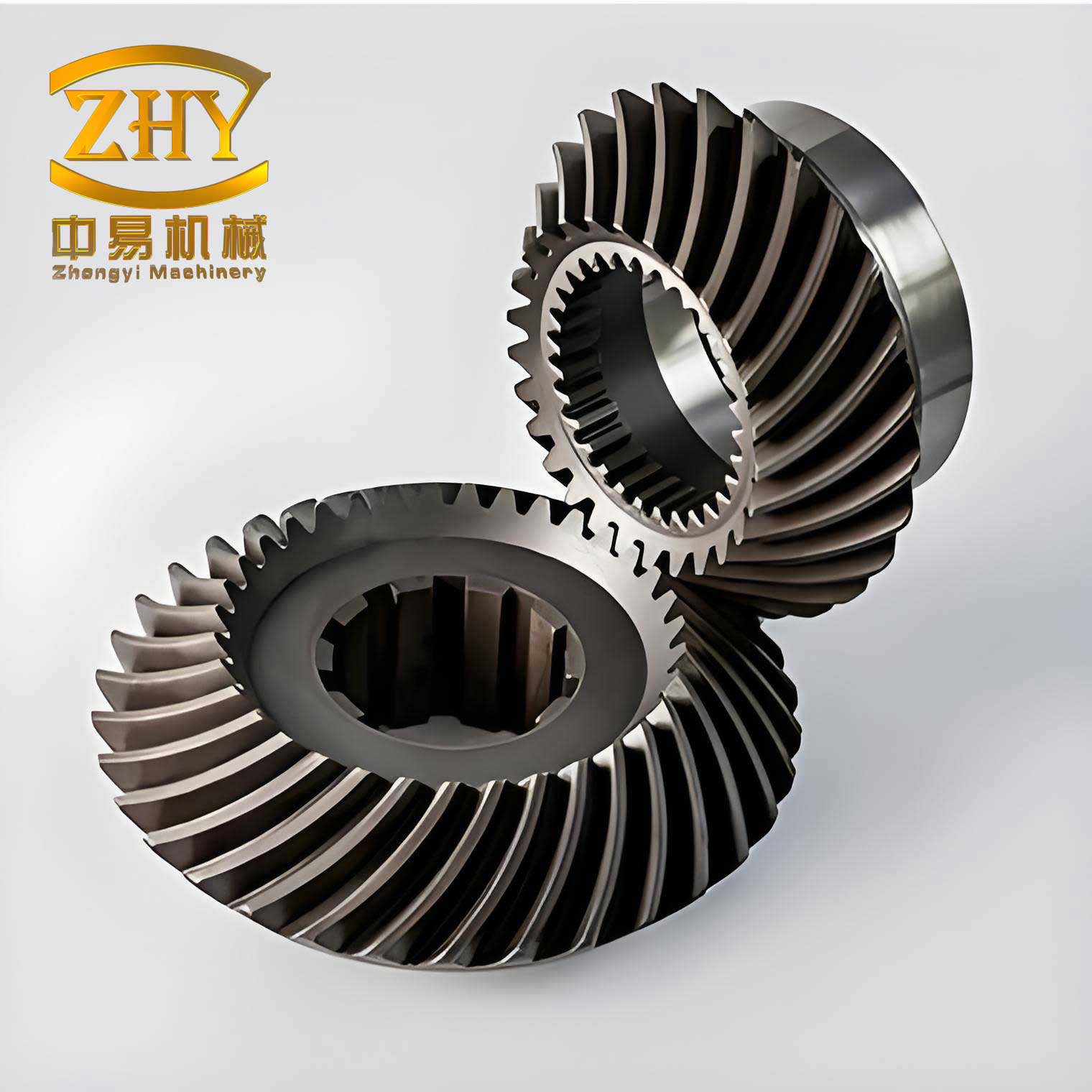
The first step involved meticulously measuring the parameters of the damaged original spiral gears. Accurate measurement is crucial for designing functional substitutes, especially for spiral gears where factors like helix angle and module dictate performance. Using precision instruments, I recorded key dimensions and characteristics, which are summarized in the table below. These parameters served as the baseline for our localization effort, focusing on the spiral gears’ geometry and operational requirements.
| Parameter | Drive Gear (Active) | Driven Gear (Passive) |
|---|---|---|
| Number of Teeth (Z) | 15 | 48 |
| Spiral Direction | Left | Right |
| Maximum Tip Diameter (mm) | φ110.5 | φ270.5 |
| Base Tangent Length (W) – 4 teeth | W4 = 54.22 | W4 = 151.32 |
| Base Tangent Length (W) – 3 teeth | W3 = 35.52 | W3 = 99.52 |
| Normal Base Pitch (Pbn) | Pbn = 18.70 | Pbn = 18.70 |
| Gear Ratio (i) | i = 3.2 | |
| Center Distance (A) | A = 200 mm | |
| Helix Angle (β) – via roll impression | β ≈ 30° | |
| Normal Module (mn) – calculated | mn = 6.5 mm (approximate) | |
From these measurements, the normal module was derived using the formula for spiral gears: $$ m_n = \frac{P_{bn}}{\pi \cos \alpha_n} $$ where αn is the normal pressure angle, assumed to be 20° based on standard practices. This yielded mn ≈ 6.5 mm, which closely matched available tooling. The spiral gears’ helix angle of 30° indicated a significant helical design, crucial for smooth torque transmission and noise reduction in automotive applications.
With the original parameters established, the next phase was designing substitute spiral gears using existing刀具 (cutting tools) from our production line for another vehicle model, specifically the解放 CA-10 series. The design rationale hinged on selecting compatible齿数 (tooth numbers) and modules to approximate the original spiral gears’ performance. The primary considerations included gear ratio, center distance, and material strength, all critical for spiral gears in heavy-duty use.
The design basis was rooted in standard gear theory for spiral gears. Key formulas were applied to ensure geometrical compatibility. For instance, the center distance A for a pair of spiral gears is given by: $$ A = \frac{m_n (Z_1 + Z_2)}{2 \cos \beta} $$ where Z1 and Z2 are the tooth counts of the drive and driven spiral gears, respectively, mn is the normal module, and β is the helix angle. By selecting Z1 = 16 and Z2 = 51, the calculated gear ratio became: $$ i = \frac{Z_2}{Z_1} = \frac{51}{16} = 3.1875 $$ which is nearly identical to the original ratio of 3.2, ensuring no impact on vehicle speed and transmission assembly.
To verify the center distance, I used the selected parameters with mn = 6.5 mm and β = 30°06′ (adjusted for tooling compatibility): $$ A = \frac{6.5 \times (16 + 51)}{2 \times \cos(30°06′)} = \frac{6.5 \times 67}{2 \times 0.865} = \frac{435.5}{1.73} \approx 200 \text{ mm} $$ This exact match confirmed that the substitute spiral gears would fit the original housing without modifications. The helix angle was recalculated using: $$ \tan \beta = \frac{\pi m_n Z}{P} $$ where P is the lead of the helix, derived from tooling specifications. For spiral gears, maintaining proper lead ensures correct meshing and load distribution.
Material selection was another vital aspect. The original spiral gears likely used high-grade alloy steel, but for localization, I opted for 20MnTiB, a Chinese standard material with excellent hardness and toughness, suitable for automotive spiral gears. Its properties include a yield strength of over 800 MPa, which, based on approximate strength calculations, proved sufficient for the vehicle’s load capacity. Although detailed strength analysis is omitted here, comparative evaluation indicated that the substitute spiral gears, designed similarly to those in a 4-ton truck, could handle the Volkswagen’s 3-ton payload with margin, as spiral gears in heavier applications often endure higher stresses.
The comprehensive design parameters for the localized spiral gears are tabulated below. This table encapsulates all critical dimensions and specifications, derived through systematic calculation and alignment with available tooling. Note that the normal module of 6.5 mm, while not standard in some systems, was compatible with our tooling and effectively replicated the original spiral gears’ functionality.
| Item and Symbol | Drive Gear | Driven Gear | Calculation Formula |
|---|---|---|---|
| Normal Module (mn) | 6.5 mm | Given by tooling | |
| Normal Pressure Angle (αn) | 20° | Standard value | |
| Normal Addendum Coefficient (han*) | 1.0 | Standard value | |
| Normal Dedendum Coefficient (cn*) | 0.25 | Standard value | |
| Reference Helix Angle (β) | 30°06′ | Calculated from tooling | |
| Center Distance (A) | 200 mm | $$ A = \frac{m_n (Z_1 + Z_2)}{2 \cos \beta} $$ | |
| Reference Diameter (d) | d1 = 120.5 mm | d2 = 384.5 mm | $$ d = \frac{m_n Z}{\cos \beta} $$ |
| Number of Teeth (Z) | 16 | 51 | Selected for ratio |
| Helix Lead (P) | P1 = 654 mm | P2 = 2084 mm | $$ P = \pi d \cot \beta $$ |
| Basic Rack Shift (x) | 0 | Non-modified teeth | |
| Spiral Direction | Left | Right | Maintained from original |
| Normal Profile Shift Coefficient (xn) | 0 | No profile shift applied | |
| Addendum (ha) | ha1 = 6.5 mm | ha2 = 6.5 mm | $$ h_a = h_{an}^* m_n $$ |
| Dedendum (hf) | hf1 = 8.125 mm | hf2 = 8.125 mm | $$ h_f = (h_{an}^* + c_n^*) m_n $$ |
| Total Tooth Height (h) | 14.625 mm | $$ h = h_a + h_f $$ | |
| Tip Diameter (da) | da1 = 133.5 mm | da2 = 397.5 mm | $$ d_a = d + 2h_a $$ |
| Base Tangent Length (W) – 4 teeth | W4 = 54.25 mm | W4 = 151.35 mm | Measured from produced gears |
| Tolerance on W | ±0.05 mm | ±0.05 mm | Based on accuracy grade |
| Accuracy Grade | 8-8-7 per GB | Chinese standard grade | |
Note: All other外形尺寸 (external dimensions) were kept identical to the original spiral gears to ensure direct interchangeability. The design process emphasized maintaining the integrity of these spiral gears within the assembly, avoiding any need for modifications to adjacent components.
The production of these substitute spiral gears involved using existing hobbing and grinding machines equipped with tools for the 6.5 mm module. The manufacturing steps included gear hobbing with proper helix angle setup, heat treatment for hardness, and final grinding to achieve the required accuracy. Special attention was paid to the spiral gears’ tooth surface finish to minimize noise and wear, critical for automotive durability. During production, quality checks verified parameters like the helix angle using lead measurement devices, ensuring consistency across batches.
Upon deployment, the localized spiral gears demonstrated remarkable performance. Vehicles equipped with these gears operated over 100,000 kilometers without any tooth breakage incidents, surpassing the original spiral gears’ lifespan. This success validated the design approach and highlighted the robustness of the substitute spiral gears. Moreover, the localization yielded several additional benefits beyond resolving the immediate parts shortage.
First, it eliminated vehicle downtime, enabling continuous运输 operations and boosting economic output. Second, producing these spiral gears in-house reduced costs compared to imported parts, generating higher profitability for the factory. Third, the availability of localized spiral gears supported other regional users facing similar issues, creating positive social impact through知识共享 (knowledge sharing) and supply chain resilience. This experience underscored the value of国产化 in reducing dependency on foreign components, especially for critical items like spiral gears in automotive systems.
From a technical perspective, the design of spiral gears involves complex considerations beyond basic geometry. For instance, the contact ratio for spiral gears is higher than for spur gears due to the helical tooth engagement, enhancing smoothness and load capacity. The contact ratio can be estimated using: $$ \epsilon = \epsilon_\alpha + \epsilon_\beta $$ where εα is the transverse contact ratio and εβ is the overlap ratio due to helix angle. For our spiral gears with β ≈ 30°, the overlap ratio contributes significantly, leading to quieter operation—a key advantage in vehicle applications.
Furthermore, the bending stress in spiral gear teeth can be assessed using the Lewis formula modified for helical gears: $$ \sigma_b = \frac{F_t}{b m_n Y} K_A K_V K_\beta $$ where Ft is the tangential force, b is the face width, Y is the Lewis form factor adjusted for helix angle, and K factors account for application, dynamic load, and helix effects. Although detailed calculations are not presented here, approximate comparisons with the解放 CA-10 spiral gears confirmed adequate strength, as mentioned earlier. This reinforces the suitability of the localized spiral gears for the intended duty cycle.
The success of this project also prompted further exploration into optimizing spiral gears for other models. For example, adjusting the helix angle或 (or) module could enhance efficiency or reduce weight. Advanced topics like tooth profile modifications to mitigate edge loading in spiral gears were considered for future iterations. Additionally, the use of computer-aided design (CAD) and simulation tools could streamline the localization process for other进口 components, but in this instance, practical measurements and empirical adjustments sufficed.
In conclusion, the localization of spiral gears for the Brazilian Volkswagen trucks exemplified a pragmatic engineering solution to a supply chain crisis. By leveraging existing tooling and methodical design, we developed substitute spiral gears that not only matched but exceeded original performance. This endeavor highlights the importance of adaptability and innovation in automotive manufacturing, particularly for spiral gears that are pivotal in drivetrain systems. The repeated focus on spiral gears throughout this process underscores their critical role and the value of mastering their design and production locally.
Looking ahead, the lessons from this experience can be applied to other进口 vehicle components, fostering broader国产化 initiatives. As spiral gears continue to evolve with advancements in materials and manufacturing, localized designs will contribute to sustainable automotive industries worldwide. The integration of digital tools and standardized processes may further enhance the efficiency of such projects, but the core principles of accurate measurement, calculated design, and rigorous testing remain paramount for spiral gears and similar mechanical elements.