
The pursuit of enhanced passenger comfort has elevated Noise, Vibration, and Harshness (NVH) performance to a critical design criterion in modern automotive engineering. Among the various noise sources within a vehicle, the driveline, particularly the final drive assembly, is a significant contributor. The final drive, or main reducer, is responsible for delivering torque from the propeller shaft to the driving axles while providing the final gear reduction. Its acoustic signature is a composite of several factors, including bearing noise, lubricant churning, and most predominantly, the meshing noise generated by the gear pair itself. Consequently, controlling gear meshing noise is paramount for achieving a quiet and refined driving experience.
Hypoid gears, a specialized type of spiral bevel gear, have become the standard in automotive final drives for rear-wheel-drive and all-wheel-drive vehicles. Their defining characteristic is the offset between the axes of the pinion and the ring gear. This configuration offers distinct advantages: it allows for a lower placement of the driveshaft, contributing to a lower vehicle center of gravity and improved packaging; it enables higher reduction ratios in a single stage; and it provides greater tooth strength due to the larger pinion diameter compared to a standard spiral bevel gearset. However, the complex spatial meshing action of hyperboloid gear pairs also presents challenges in predicting and minimizing excitation forces that lead to noise. The quest for low-noise operation thus involves a delicate balance between geometric design, manufacturing precision, and system dynamics.
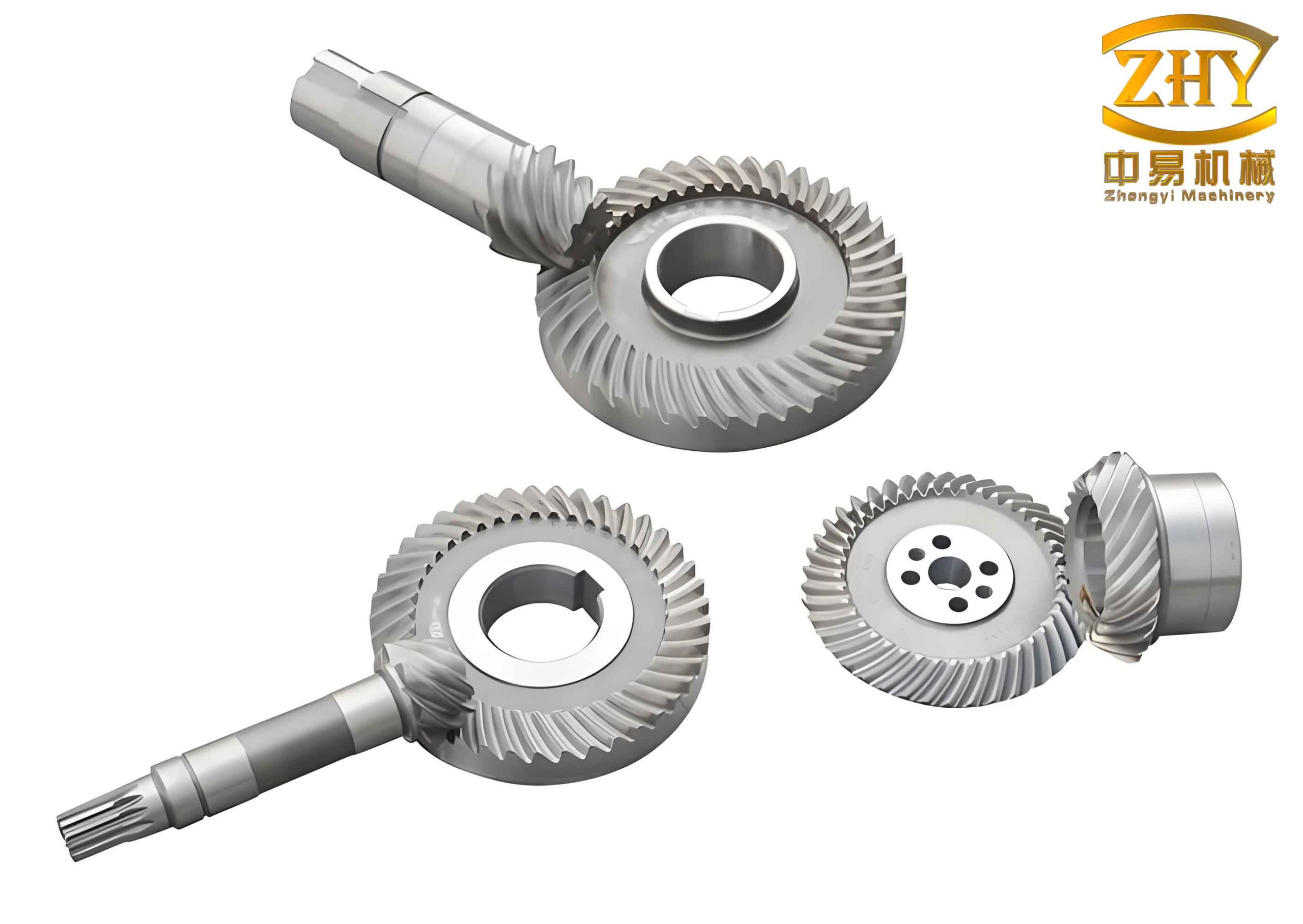
The primary strategies for reducing final drive noise can be broadly categorized into two approaches. The first focuses on precision manufacturing and meticulous assembly. This involves employing advanced grinding technologies, ensuring exceptional gear tooth surface finish, and achieving tight tolerances in gear alignment and housing bore locations. While effective, this approach often leads to exponentially higher production costs with diminishing returns on NVH improvement. The second, more fundamental approach is optimal gear design. By strategically selecting the geometric parameters of the hypoid gear pair, it is possible to inherently minimize the dynamic excitations that cause noise, even before manufacturing begins. This paper delves into the latter approach, presenting a comprehensive methodology for the low-noise optimization design of automotive final drive hyperboloid gear pairs, leveraging modern computational optimization techniques.
Gear Meshing Noise and the Transmission Error Paradigm
At its core, gear noise is a direct consequence of Transmission Error (TE). TE is defined as the deviation of the actual angular position of the driven gear from its theoretical position prescribed by a perfect, conjugate meshing action. Sources of TE include geometric deviations from the ideal tooth profiles (due to design, manufacturing, or wear), elastic deflections of teeth under load, and misalignments caused by manufacturing tolerances or assembly errors. This error acts as a kinematic displacement excitation, which, when transmitted through the gear shafts and bearings to the housing, induces structural vibrations that radiate as audible noise. Therefore, the overarching goal of a low-noise gear design is to minimize the amplitude and, importantly, smooth out the time-history of the TE excitation.
One of the most influential geometric parameters affecting the smoothness of load transfer and the TE characteristic is the contact ratio, also known as the overlap coefficient. This metric describes the average number of tooth pairs in contact at any given time during the meshing cycle. A higher contact ratio implies that the total load is shared among more teeth, reducing the load per tooth pair and, crucially, ensuring a more gradual transfer of load from one pair to the next. This smoother transition mitigates sudden changes in mesh stiffness and reduces impact velocities at the entry and exit of contact, thereby lowering the dynamic forces and resultant noise. For hypoid gears, the total contact ratio ($\sigma$) is the sum of the transverse contact ratio ($\sigma_\alpha$) and the face contact ratio ($\sigma_\beta$), where $\sigma_\beta$ is typically dominant due to the helical nature of the teeth.
$$\sigma = \sigma_\alpha + \sigma_\beta$$
Extensive experimental and analytical studies have established a clear correlation between the contact ratio and the acoustic emission of gear pairs, particularly for hyperboloid gear sets. The relationship is not monotonic but exhibits an optimal zone. As shown conceptually in numerous studies, the noise level decreases significantly as the contact ratio increases from low values, reaching a broad minimum in the region of $\sigma \approx 1.9$ to $2.1$. Within this range, the load transfer is exceptionally smooth. For a hyperboloid gear, empirical evidence strongly suggests that a total contact ratio as close as possible to 2.0 yields the minimum meshing noise. A value below this range leads to fewer teeth sharing the load and more pronounced single-tooth-pair contact periods, increasing dynamic excitation. A value significantly higher, while theoretically beneficial for load sharing, can sometimes introduce complex multi-pair contact dynamics or conflict with other design constraints like strength or size. Therefore, for low-noise optimization, we establish the target contact ratio as:
$$\sigma_{target} = 2.0$$
Mathematical Formulation of Contact Ratio for Hypoid Gears
To incorporate the contact ratio into an optimization framework, a precise mathematical model is required. The calculation for hypoid gears is more complex than for parallel-axis gears due to the offset and the varying curvature along the tooth face. A well-established formula for the total contact ratio ($\sigma$) of a hyperboloid gear pair, considering its dominant face contact component, can be expressed as a function of key geometric parameters. This formulation often involves the equivalent number of teeth concept and the gear’s spiral angle. One common representation is:
$$\sigma = \left( G_2 \cdot \tan \beta_m – \frac{G_2^3}{3} \cdot \tan^3 \beta_m \right) \cdot \frac{A_0}{\pi \cdot m_t}$$
Where:
$ \beta_m $ is the mean spiral angle at the pinion pitch cone.
$ A_0 $ is the pitch cone distance (also called the outer cone distance) of the ring gear.
$ m_t $ is the transverse module at the outer end of the gear.
$ G_2 $ is a dimensionless geometry factor for the ring gear, heavily dependent on the hypoid offset ($E$) and the gear blank dimensions. It can be approximated as:
$$G_2 = \frac{D_2}{A_0} – \sqrt{\left(\frac{D_2}{A_0}\right)^2 \left(1 – \frac{D}{A_0} \right)}$$
Where:
$ D_2 $ is the pitch diameter of the ring gear.
$ D $ is the face width (common for both pinion and gear).
This model clearly shows that the contact ratio $\sigma$ is governed by a core set of design variables: the spiral angle $\beta_m$, the pitch cone distance $A_0$, the transverse module $m_t$, the face width $D$, and the offset $E$ (implicit in $G_2$ and the overall geometry).
| Parameter | Symbol | Influence on Contact Ratio ($\sigma$) | Typical Design Trade-off |
|---|---|---|---|
| Mean Spiral Angle | $\beta_m$ | Strong positive influence. Increasing $\beta_m$ increases $\sigma_\beta$. | Higher angles increase axial thrust loads on bearings. |
| Transverse Module | $m_t$ | Inverse influence. Decreasing $m_t$ (finer teeth) increases $\sigma$ for a given size. | Smaller module reduces bending strength; requires higher precision. |
| Face Width | $D$ | Positive influence. Increasing $D$ provides more contact path length. | Limited by gear blank size, lapping tool clearance, and risk of misalignment sensitivity. |
| Pitch Cone Distance | $A_0$ | Direct proportional influence. Larger $A_0$ increases $\sigma$. | Directly related to the overall size and weight of the final drive assembly. |
| Hypoid Offset | $E$ | Complex influence through $G_2$. Optimal value exists for a given ratio and size. | Affects pinion strength, sliding velocities, and gear housing design. |
| Number of Teeth (Pinion/Gear) | $z_1$, $z_2$ | Determines $A_0$ and $D_2$ for a given module and ratio. Influences $\sigma_\alpha$. | Pinion teeth must avoid undercutting. Sum of teeth affects gear diameter and mesh frequency. |
Formulation of the Low-Noise Optimization Problem
The core objective is to determine the set of geometric parameters for a hyperboloid gear pair that minimizes the predicted meshing noise while satisfying all necessary performance constraints (strength, durability, size, etc.). We formulate this as a constrained nonlinear optimization problem.
Objective Function
Based on the established relationship, the primary goal is to make the calculated total contact ratio $\sigma$ as close as possible to the target value of 2.0. Therefore, a suitable objective function $F_{obj}$ to be minimized is the squared deviation:
$$F_{obj}(\mathbf{Y}) = \left( \sigma_{target} – \sigma(\mathbf{Y}) \right)^2 = \left( 2 – \sigma(\mathbf{Y}) \right)^2$$
Where $\sigma(\mathbf{Y})$ is computed using the formula from the previous section, which is a function of the design variable vector $\mathbf{Y}$.
Design Variables
The optimization searches for the best combination of key independent geometric parameters. We define the design variable vector as:
$$\mathbf{Y} = [\beta_m,\ m_t,\ D,\ z_1,\ E,\ A_0]^T = [y_1,\ y_2,\ y_3,\ y_4,\ y_5,\ y_6]^T$$
Note that the gear ratio $i$ is defined by the choice of pinion and gear teeth counts ($i = z_2 / z_1$), and $z_2$ can be derived from $z_1$ and the required axle ratio, or included as a separate variable if the ratio is also free.
Constraint Functions
A viable hyperboloid gear design must satisfy a comprehensive set of geometric, strength, and manufacturability constraints.
1. Geometric and Meshing Constraints:
These ensure proper gear generation and avoid kinematic issues.
- Tooth Number Limits: To prevent undercut on the pinion and ensure smooth meshing: $z_1 \ge z_{1,min}$ (typically 5-6 for generated hypoids, but often higher for automotive applications, e.g., 9-12). For automotive final drives, the sum of teeth often has a lower limit for noise and strength: $z_1 + z_2 \ge 40$ (trucks) to 50 (passenger cars).
- Face Width Limit: Excessive face width is impractical. A common rule is $D \le 0.3 \cdot A_0$ or $D \le 10 \cdot m_t$, whichever is more restrictive.
- Offset Limit: The hypoid offset is usually limited relative to the ring gear pitch radius to control sliding velocities and pinion shaft bending: $E \le 0.2 \cdot R_2$ (where $R_2 = D_2/2$).
- Spiral Angle Range: Practical limits exist for manufacturing and bearing loads: $\beta_{min} \le \beta_m \le \beta_{max}$ (e.g., $30^\circ \le \beta_m \le 50^\circ$).
2. Bending Strength Constraints (AGMA/ISO based):
The bending stress $\sigma_F$ at the root of both the pinion and gear teeth must be below the allowable fatigue strength $[\sigma_F]$. The simplified form of the stress equation is:
$$\sigma_{F1,2} = \frac{F_t}{b \cdot m_t} \cdot Y_F \cdot Y_S \cdot Y_\beta \cdot K_A \cdot K_V \cdot K_{F\beta} \cdot K_{F\alpha} \le [\sigma_{F1,2}]$$
Where $F_t$ is the nominal tangential load, $b$ is the net face width, $Y_F$ is the tooth form factor, $Y_S$ is the stress concentration factor, $Y_\beta$ is the helix angle factor, and the $K$ factors account for application, dynamic load, face load distribution, and transverse load distribution, respectively. In optimization, these are evaluated for the pinion (1) and gear (2).
3. Surface Durability (Pitting) Constraints:
The contact stress $\sigma_H$ on the tooth flank must be below the allowable stress $[\sigma_H]$ to prevent fatigue pitting.
$$\sigma_{H} = Z_E \cdot Z_H \cdot Z_\epsilon \cdot Z_\beta \cdot \sqrt{\frac{F_t}{d_1 \cdot b} \cdot \frac{u+1}{u} \cdot K_A \cdot K_V \cdot K_{H\beta} \cdot K_{H\alpha}} \le [\sigma_{H}]$$
Where $Z_E$ is the elasticity factor, $Z_H$ is the zone factor, $Z_\epsilon$ is the contact ratio factor, $Z_\beta$ is the helix angle factor, $d_1$ is the pinion pitch diameter, and $u$ is the gear ratio $z_2/z_1$.
4. Scoring Risk Check:
For hyperboloid gear pairs with high sliding velocities, a flash temperature criterion may be applied to guard against lubricant film failure and scoring.
| Component | Mathematical Description | Notes |
|---|---|---|
| Objective | Minimize $F_{obj}(\mathbf{Y}) = (2 – \sigma(\mathbf{Y}))^2$ | See Eq. for $\sigma(\mathbf{Y})$. |
| Variables | $\mathbf{Y} = [\beta_m,\ m_t,\ D,\ z_1,\ E,\ A_0]^T$ | 6 primary geometric parameters. |
| Constraints | $g_1(\mathbf{Y}): z_1 – z_{1,min} \ge 0$ | Minimum pinion teeth. |
| $g_2(\mathbf{Y}): (z_1 + z_2) – 45 \ge 0$ | Example min sum of teeth. | |
| $g_3(\mathbf{Y}): 0.3A_0 – D \ge 0$ | Max face width relative to cone distance. | |
| $g_4(\mathbf{Y}): 0.2R_2 – E \ge 0$ | Max offset limit. | |
| $g_5(\mathbf{Y}): [\sigma_{F1}] – \sigma_{F1}(\mathbf{Y}) \ge 0$ | Pinion bending strength. | |
| $g_6(\mathbf{Y}): [\sigma_{F2}] – \sigma_{F2}(\mathbf{Y}) \ge 0$ | Gear bending strength. | |
| $g_7(\mathbf{Y}): [\sigma_{H}] – \sigma_{H}(\mathbf{Y}) \ge 0$ | Surface durability (pitting). |
Optimization Methodology and Implementation
Solving the formulated problem requires a robust numerical optimization algorithm capable of handling nonlinear objectives and constraints with continuous and discrete (e.g., tooth count) variables. A common and effective approach is to use a gradient-based algorithm, such as Sequential Quadratic Programming (SQP), for continuous sub-problems, combined with strategies to handle the integer variables (like rounding or treating them as continuous during optimization and selecting the nearest standard value afterward). For more global exploration, metaheuristic algorithms like Genetic Algorithms (GA) or Particle Swarm Optimization (PSO) can be employed, as they can handle mixed-variable problems more naturally, albeit at a higher computational cost.
The implementation workflow typically involves:
- Parameterization: Creating a computational model (often in MATLAB, Python, or specialized gear software) that takes the design vector $\mathbf{Y}$ as input and calculates the objective function $\sigma(\mathbf{Y})$ and all constraint values $g_i(\mathbf{Y})$.
- Initialization: Starting from a feasible baseline design that meets the required axle ratio and fits within the packaging envelope.
- Iteration: The optimization algorithm systematically adjusts $\mathbf{Y}$ to minimize $F_{obj}$ while ensuring all $g_i(\mathbf{Y}) \ge 0$. The gear geometry and stress models are re-evaluated at each iteration.
- Convergence: The process stops when an optimal solution is found, or improvement falls below a threshold.
Advanced implementations integrate this optimization loop with sophisticated Loaded Tooth Contact Analysis (LTCA) software. LTCA can compute a more accurate hyperboloid gear contact ratio under load (which differs from the unloaded geometric value) and directly predict Transmission Error, providing a potentially more direct objective function: minimizing the peak-to-peak or RMS value of the loaded TE curve. However, this significantly increases computational expense per iteration.
Case Study: Analysis of an Optimized Hypoid Gear Set
To illustrate the effectiveness of the low-noise optimization approach, consider a case study for a passenger car final drive. The baseline design is a conventional hyperboloid gear set designed primarily for strength and compactness. The optimization task is to redesign it for lower noise while maintaining the same axle ratio, package space, and strength margins.
| Design Parameter | Symbol | Baseline Design | Optimized Low-Noise Design | Change |
|---|---|---|---|---|
| Pinion Teeth | $z_1$ | 11 | 10 | -1 |
| Gear Teeth | $z_2$ | 43 | 43 | 0 |
| Axle Ratio | $i$ | 3.909 | 4.300 | +0.391 |
| Mean Spiral Angle | $\beta_m$ | 42.5° | 47.8° | +5.3° |
| Transverse Module | $m_t$ (mm) | 5.85 | 5.35 | -0.50 mm |
| Face Width | $D$ (mm) | 32.0 | 34.5 | +2.5 mm |
| Hypoid Offset | $E$ (mm) | 15.0 | 17.5 | +2.5 mm |
| Pitch Cone Distance | $A_0$ (mm) | 112.5 | 110.2 | -2.3 mm |
The optimization algorithm adjusted multiple parameters simultaneously. Key changes include:
- Increased Spiral Angle ($\beta_m$): This is the most direct lever to increase the face contact ratio ($\sigma_\beta$).
- Reduced Module ($m_t$): Finer teeth increase the transverse contact ratio ($\sigma_\alpha$) and contribute to a higher total $\sigma$.
- Slightly Increased Face Width ($D$): Provides a longer path of contact, directly boosting $\sigma$.
- Adjusted Offset ($E$) and Tooth Counts: These changes help to maintain a favorable tooth contact pattern, proper strength balance, and the required overall ratio while accommodating the other changes.
The primary performance outcome is the contact ratio:
Baseline Design Contact Ratio: $\sigma_{baseline} \approx 1.72$
Optimized Design Contact Ratio: $\sigma_{optimized} \approx 1.96$
The optimization successfully pushed the total contact ratio from 1.72 to 1.96, bringing it much closer to the ideal target of 2.0. According to the established noise-contact ratio correlation, this significant increase should result in a markedly smoother meshing action and a lower noise level. Crucially, a subsequent re-check of the bending and pitting stresses confirmed that the optimized hyperboloid gear set still operates within safe limits, with some factors even improving due to the load sharing of more teeth.
| Performance Indicator | Baseline Design | Optimized Design | Improvement |
|---|---|---|---|
| Total Contact Ratio ($\sigma$) | 1.72 | 1.96 | +14.0% (Closer to 2.0) |
| Calculated Bending Stress (Pinion) | ~92% of Allowable | ~88% of Allowable | Margin increased |
| Calculated Contact Stress | ~95% of Allowable | ~93% of Allowable | Margin increased |
| Predicted Mesh Order Noise Level* | Reference (0 dB) | Estimated -4 to -6 dB | Significant reduction |
*Estimated based on empirical noise-contact ratio transfer functions.
Conclusion and Future Perspectives
This paper has detailed a systematic methodology for the low-noise optimization design of automotive final drive hyperboloid gear pairs. By establishing the minimization of the deviation from an ideal contact ratio ($\sigma = 2.0$) as the primary objective function and framing it within a rigorous set of geometric, strength, and durability constraints, a well-defined nonlinear programming problem is formulated. The solution to this problem yields an optimized set of gear parameters—spiral angle, module, face width, tooth counts, offset, and cone distance—that inherently promote smoother meshing and lower dynamic excitation.
The presented case study demonstrates the practical efficacy of this approach. Through strategic adjustments, the optimized hyperboloid gear achieved a contact ratio of 1.96, a substantial improvement from the baseline value of 1.72, moving it into the region associated with minimal meshing noise. This optimization was accomplished while maintaining all critical strength requirements, proving that noise reduction and mechanical integrity are not mutually exclusive goals but can be synergistically achieved through computational design.
Future advancements in this field will likely involve more integrated and high-fidelity models. The next logical step is to use Loaded Transmission Error (LTE) directly as the objective function within the optimization loop, coupled with full hyperboloid gear tooth contact and system dynamics simulations. This would account for the effects of tooth deflection, misalignment, and housing compliance on the actual dynamic excitation. Furthermore, multi-objective optimization frameworks can be employed to formally balance noise, efficiency (friction losses), weight, and cost, providing designers with a Pareto frontier of optimal solutions. The integration of machine learning techniques to surrogate complex simulation models could drastically accelerate this optimization process, enabling even more thorough exploration of the design space for the next generation of quiet and efficient automotive hyperboloid gear drives.