
The final finishing process for hardened gears, known as gear honing, is critical for achieving the required surface quality and dimensional accuracy. A significant outcome of this abrasive machining process is the induction of residual stresses within the surface layer of the workpiece. These residual stresses are paramount as they directly influence the gear’s functional performance, including its resistance to fatigue, stress corrosion, and propensity for micro-cracking. Consequently, the ability to predict and control the residual stress state resulting from gear honing operations is of immense practical importance. It enables the optimization of process parameters to achieve a desirable compressive stress layer, thereby enhancing component longevity and reliability while reducing development costs associated with trial-and-error machining.
This study focuses specifically on the internal gear honing process, where a honing wheel with internal teeth meshes with an external helical workpiece gear. The complex kinematics, involving both rolling and sliding motions under a crossed-axes configuration, combined with the intricate geometry of gear flanks, makes analytical prediction of residual stresses exceedingly difficult. Therefore, this investigation employs a integrated numerical approach, utilizing dynamic finite element simulation to model the process and analyze the resulting residual stress fields under various honing conditions.
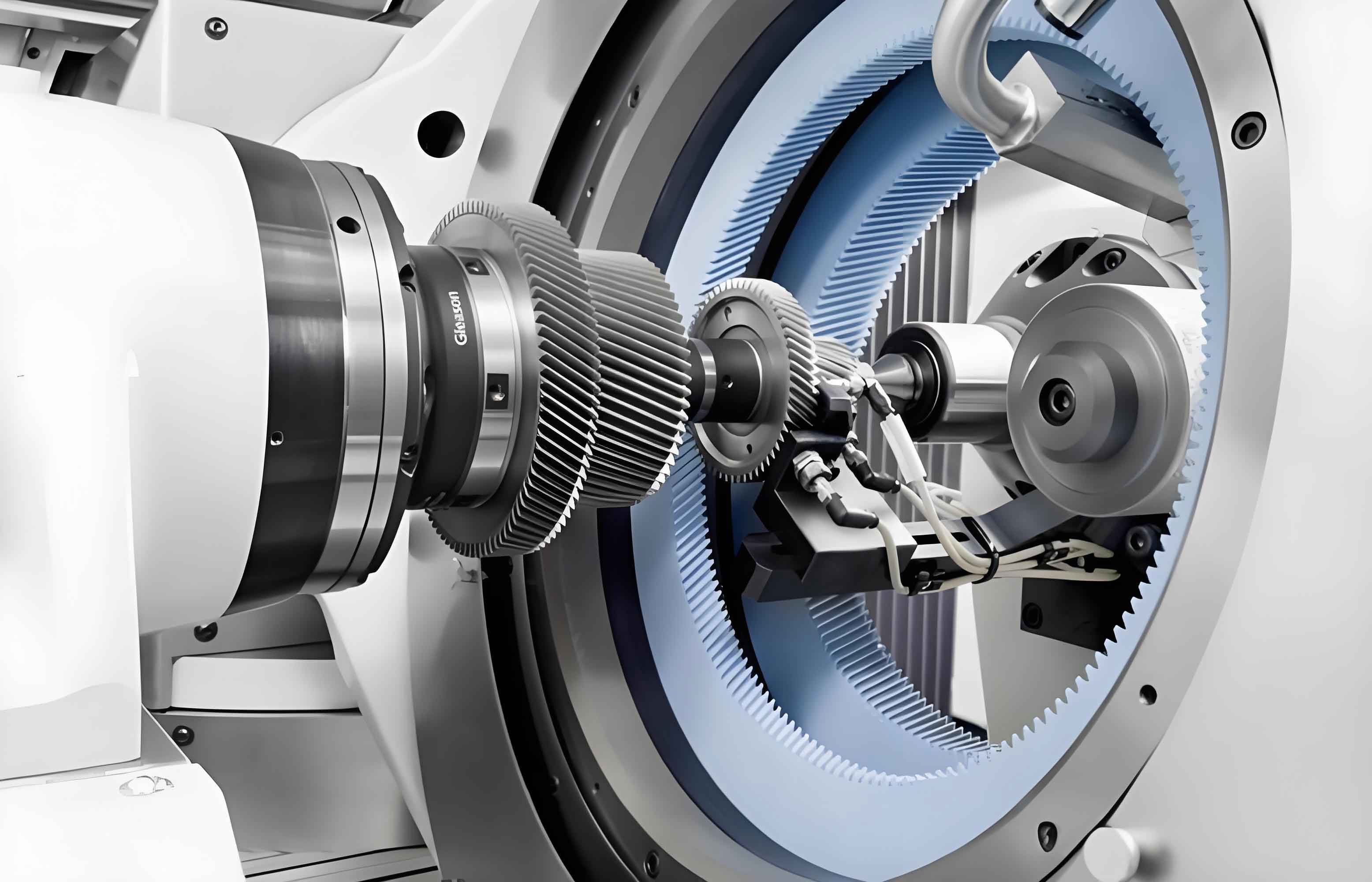
Numerical Modeling of the Internal Honing Wheel
The foundation of an accurate simulation is a precise geometric model. For the internal honing wheel, a parametric modeling approach was adopted. The tooth surface of a helical gear can be mathematically described as a helicoid based on the involute curve. In the workpiece coordinate system, the coordinates of any point on the workpiece gear surface can be expressed as:
$$
\begin{aligned}
x_1 &= r_{b1}\cos(\sigma_0 + \theta + \lambda) + r_{b1}\lambda\sin(\sigma_0 + \theta + \lambda), \\
y_1 &= r_{b1}\sin(\sigma_0 + \theta + \lambda) – r_{b1}\lambda\cos(\sigma_0 + \theta + \lambda), \\
z_1 &= \theta p,
\end{aligned}
$$
where $r_{b1}$ is the base radius of the workpiece, $\sigma_0$ is the starting angle of the tooth surface, $\theta$ is the increment angle along the helix, $\lambda$ is the involute roll angle, and $p$ is the lead of the helix. The parameters $\theta$ and $\lambda$ are bounded by the gear geometry (face width, root, and tip circles).
During the gear honing process, the conjugate contact between the honing wheel and the workpiece must satisfy the condition of orthogonality between the relative velocity vector and the common surface normal at the contact point ($\mathbf{v}_{12} \cdot \mathbf{n} = 0$). Applying spatial coordinate transformations based on gear meshing theory, the complete mathematical model for the internal honing wheel tooth surface is derived. For a given set of workpiece and honing wheel parameters (see Table 1), this model was implemented in computational software to generate discrete data points representing the honing wheel’s internal tooth flank.
| Component | Parameter | Value |
|---|---|---|
| Workpiece Gear | Module (mm) | 2.25 |
| Normal Pressure Angle (°) | 17.5 | |
| Number of Teeth | 73 | |
| Helix Angle (°) | 33 | |
| Face Width (mm) | 27 | |
| Internal Honing Wheel | Number of Teeth | 123 |
| Helix Angle (°) | 41.722 | |
| Face Width (mm) | 30 |
These discrete points were then imported into CAD software, where lofting operations between successive tooth profiles were used to construct a continuous, accurate 3D solid model of the internal honing wheel, essential for the subsequent finite element analysis.
Analysis of Honing Forces
In gear honing, the interaction force between the wheel and the workpiece is complex and distributed along the line of contact. From a macro-mechanical perspective, it is useful to resolve the resultant honing force into three orthogonal components relative to the workpiece: tangential ($F_s$), radial ($F_r$), and axial ($F_n$). The tangential force is primarily responsible for the material removal and is related to the cutting action of the abrasive grains. The radial force, often controlled in practice by adjusting the honing allowance, presses the gears together and influences contact pressure. The axial force arises due to the crossed-axes helical meshing.
The relationship between the overall honing force $F_a$ and its components can be approximated by:
$$
\begin{aligned}
F_r &= F_a \cos \beta \tan \alpha_t, \\
F_s &= F_a \sin \alpha_n, \\
F_n &= F_a \cos \beta,
\end{aligned}
$$
where $\beta$ is the workpiece helix angle, $\alpha_n$ is the normal pressure angle, and $\alpha_t$ is the transverse pressure angle. In the dynamic simulation, controlling the applied radial force serves as a proxy for controlling the honing intensity.
Dynamic Finite Element Simulation Setup
The dynamic simulation of the internal gear honing process was conducted using an explicit finite element solver. To ensure computational efficiency while capturing the essential meshing dynamics, a segment containing only a few teeth in contact was extracted from the full gear models.
The material properties assigned for the simulation are summarized in Table 2. The honing wheel was modeled with properties representative of a vitrified bonded microcrystalline alumina abrasive structure.
| Component | Density (kg/m³) | Elastic Modulus (GPa) | Poisson’s Ratio |
|---|---|---|---|
| Workpiece (20CrMnTi) | 7800 | 207 | 0.25 |
| Honing Wheel | 3120 | 70 | 0.07 |
A key aspect of the setup was the definition of contact. An automatic surface-to-surface contact algorithm was employed with static and dynamic friction coefficients of 0.35 and 0.40, respectively, to account for the sliding component inherent in gear honing. Boundary conditions were applied to replicate the actual kinematics: the honing wheel and workpiece were assigned rotational velocities about their respective axes according to their speed ratio. For the base case, the workpiece speed was set to 90.12 rad/s and the honing wheel speed to 151.67 rad/s, with a shaft crossing angle of 8.722°. A radial force of 150 N was applied to simulate the honing pressure. The simulation time was set to capture several meshing cycles.
Residual Stress Calculation Methodology
The calculation of residual stresses was performed in two sequential steps within the finite element framework:
- Honing Process Simulation: The dynamic meshing process was simulated with all applied loads (rotational velocities and radial force). From this simulation, the time-history of stress components $\sigma_{ij}$ at every integration point in the workpiece subsurface was extracted. The von Mises equivalent stress during engagement was computed as:
$$
\sigma_{vM} = \sqrt{ \sigma_{11}^2 + \sigma_{22}^2 + \sigma_{33}^2 – \sigma_{11}\sigma_{22} – \sigma_{22}\sigma_{33} – \sigma_{33}\sigma_{11} + 3\sigma_{12}^2 + 3\sigma_{23}^2 + 3\sigma_{31}^2 }.
$$ - Residual Stress Formation: All kinematic and force boundary conditions were removed from the model. The stress state at the end of the honing simulation was imported as an initial condition (pre-stress) into the unloaded model. A new static analysis was then performed to allow the workpiece to reach equilibrium under this initial stress field. The resulting stress field after this unloading step represents the final residual stress state induced by the gear honing process.
Results of Parameter Study on Residual Stress
The finite element model was used to systematically investigate the influence of key gear honing parameters on the magnitude of surface residual stress. Stresses were extracted from specific elements located at critical positions on the workpiece tooth flank: near the pitch line, the tooth tip (dedendum), and the tooth root (addendum).
Effect of Honing Speed (Workpiece Rotational Speed)
With a constant shaft angle (8.722°) and radial force (150 N), the workpiece speed was varied. The results, plotted in Figure 1, show a clear trend: the residual compressive stress decreases as the honing speed increases. Higher speeds reduce the effective contact time and the load duration on any given point on the tooth surface, leading to less plastic deformation and a smaller resultant residual stress field.
$$
\text{Residual Stress} \propto \frac{1}{\text{Honing Speed}}
$$
Effect of Honing Force (Radial Force)
Keeping the kinematics constant (speeds and shaft angle), the applied radial force was increased. As shown in Figure 2, the residual compressive stress exhibits a strong positive correlation with the honing force. A larger radial force increases the contact pressure and the depth of plastic deformation, resulting in higher magnitude residual stresses.
$$
\text{Residual Stress} \propto \text{Honing Force}
$$
Effect of Shaft Crossing Angle
The shaft angle was varied while maintaining constant rotational speeds and radial force. This required generating new honing wheel models with corresponding helix angles. The simulation results, summarized in Figure 3, indicate that the residual stress decreases with an increasing shaft angle within the studied range. A larger shaft angle increases the sliding velocity component and alters the contact conditions, effectively reducing the specific energy input and the resulting residual stress.
| Process Parameter | Trend in Residual Compressive Stress | Primary Mechanistic Reason |
|---|---|---|
| Increased Honing Speed | Decreases | Reduced contact time and thermal/mechanical load duration. |
| Increased Honing Force | Increases | Increased contact pressure and depth of plastic deformation. |
| Increased Shaft Angle (in range studied) | Decreases | Altered contact kinematics and increased sliding action. |
Furthermore, the analysis consistently showed that the convex side (drive side) of the tooth flank generally exhibited slightly higher compressive residual stresses compared to the concave side (coast side), due to differences in local contact conditions and force application during the internal gear honing process.
Experimental Validation
To validate the finite element model, an experimental gear honing test was conducted using parameters matching the base simulation case. The honed workpiece gear was sectioned to obtain a single tooth sample. Residual stresses on the tooth flank were measured using the X-ray diffraction (XRD) method with a Cu-Kα radiation source (λ = 0.15406 nm). Measurements were taken at locations corresponding to the finite element nodes analyzed in the simulation.
A comparison between the simulated residual stress values and the experimentally measured values is presented in Table 4. The agreement is good, with a maximum relative error of approximately 13.6%. Sources of discrepancy include inherent limitations of the XRD technique regarding penetration depth and subsurface averaging, as well as simplifications in the finite element model regarding abrasive grain geometry and constant friction assumptions. Nevertheless, the correlation confirms the validity and predictive capability of the developed finite element approach for analyzing residual stresses in gear honing.
| Measurement Location (Element) | Simulated Value (MPa) | Measured Value (MPa) | Relative Error (%) |
|---|---|---|---|
| Pitch Line 1 | -550 | -625 | 13.6 |
| Pitch Line 2 | -362 | -367 | 1.4 |
| Pitch Line 3 | -1200 | -1152 | 4.2 |
| Tooth Root Region | -950 | -1074 | 13.1 |
| Tooth Tip Region | -605 | -684 | 13.1 |
| Root Side | -510 | -572 | 12.2 |
Conclusion
This study successfully implemented a dynamic finite element modeling framework to analyze the generation of residual stresses during the internal gear honing process. The methodology involved the parametric generation of an accurate honing wheel model, dynamic simulation of the abrasive meshing process, and a two-step residual stress calculation. The simulation results consistently demonstrated that the gear honing process induces a state of compressive residual stress on the workpiece surface, which is generally beneficial for fatigue performance.
The parametric investigation revealed predictable trends: residual stress magnitude decreases with increasing honing speed, increases with increasing honing force, and decreases with an increasing shaft crossing angle within a practical range. The model’s predictions showed good agreement with experimental measurements obtained via X-ray diffraction, validating the finite element approach.
This integrated simulation-based methodology provides a powerful tool for predicting and optimizing the surface integrity outcomes of the gear honing process. It allows for the virtual exploration of parameter sets to achieve a desired residual stress profile, thereby reducing reliance on costly physical trials and contributing to the manufacture of high-performance, reliable gear components.