
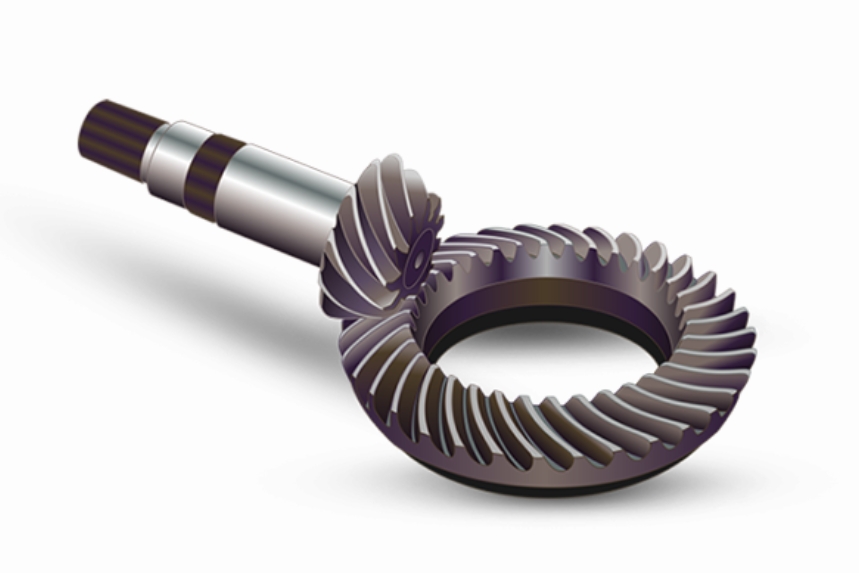
In my experience working with gear manufacturing, especially in small-scale or resource-constrained environments, the challenge of producing accurate spiral bevel gears often arises due to the high cost of dedicated machinery. Spiral bevel gears are critical components in various mechanical systems, such as automotive differentials and industrial gearboxes, due to their ability to transmit power smoothly at angles. The investment in specialized equipment for machining spiral bevel gears can be prohibitive. Therefore, I developed an innovative method using auxiliary tools on a standard shaper machine, which successfully addresses this难题. This article details the process, from the structural design to the mathematical underpinnings, emphasizing the repeated application of the term spiral bevel gear to highlight its centrality in this discussion.
The core of this method revolves around two main components: a specially designed milling head and a gear milling fixture. These tools transform a conventional shaper into a capable machine for producing spiral bevel gears. The shaper, typically used for planar cutting, is adapted to perform the complex motions required for spiral bevel gear generation. Below, I will elaborate on each component, the underlying principles, and the step-by-step procedures, supported by formulas and tables for clarity.
The specialized milling head is mounted on the ram of the shaper. It consists of a spindle, a sliding sleeve, a flywheel, speed change gears, and an electric motor. The milling cutter disc, which is essential for cutting the curved teeth of a spiral bevel gear, is installed in the tapered hole of the spindle. The spindle can move vertically with the sliding sleeve, allowing for adjustments in depth. By altering the gear ratio of the speed change gears, the required rotational speed for the cutter is achieved. This setup effectively converts the linear motion of the shaper’s ram into a rotary cutting action suitable for spiral bevel gear fabrication.
The gear milling fixture is installed on the worktable of the shaper. It comprises a base, two worm gears and worms, an arc-shaped slide plate, an arc-shaped bracket, and generating change gears. This fixture facilitates the generating motion necessary for cutting spiral bevel gears. The workpiece is mounted on a mandrel and engages with the worm gears. When the worms are rotated, the workpiece revolves around its own axis and simultaneously around a fixed axis, simulating the rolling action between the gear and a hypothetical flat-top gear. This dual motion is crucial for achieving the correct tooth profile of a spiral bevel gear.
The machining principle is based on the flat-top gear concept. In this approach, we imagine a flat-top gear in mesh with the spiral bevel gear being cut. The cutting edges of the milling cutter form the tooth surfaces of this imaginary flat-top gear. During adjustment, the pitch cone of the spiral bevel gear must be tangent to the pitch cone of the flat-top gear, ensuring pure rolling contact. The angle between their axes is given by $\Sigma = 90^\circ – \delta_f$, where $\delta_f$ is the root angle of the spiral bevel gear. This principle ensures that the generated tooth geometry matches the desired spiral bevel gear design.
The generating motion is achieved through the fixture. As the imaginary flat-top gear rotates by one tooth, the workpiece must also rotate by one tooth. This synchronization is controlled by the generating change gears. The transmission ratio for these gears can be derived as follows. Let $n_c$ and $Z_c$ be the rotational speed and number of teeth of the imaginary flat-top gear, and $n_w$ and $Z_w$ be those of the workpiece (the spiral bevel gear). The relationship is:
$$ \frac{n_c}{n_w} = \frac{Z_w}{Z_c} $$
However, in practice, this ratio is implemented through the worm gears in the fixture. Assuming single-start worms, the generating change gear ratio $i_g$ is calculated as:
$$ i_g = \frac{Z_{w1}}{Z_{w2}} \cdot \frac{\cos \delta}{\cos \delta_f} $$
Where $Z_{w1}$ and $Z_{w2}$ are the numbers of teeth on the two worm wheels, $\delta$ is the pitch cone angle of the spiral bevel gear, and $\delta_f$ is the root angle. For simplicity, $\delta_f$ can be approximated from the gear design parameters. This formula ensures precise tooth generation for the spiral bevel gear.
To organize the key variables and formulas, I present the following tables:
| Symbol | Description | Typical Range for Spiral Bevel Gears |
|---|---|---|
| $Z_w$ | Number of teeth on the spiral bevel gear | 10 to 50 |
| $\delta$ | Pitch cone angle (degrees) | 20° to 70° |
| $\delta_f$ | Root angle (degrees) | $\delta – \theta_f$ where $\theta_f$ is dedendum angle |
| $R_m$ | Mean cone distance (mm) | 50 to 200 mm |
| $\beta_m$ | Mean spiral angle (degrees) | 25° to 40° for spiral bevel gears |
Another critical aspect is the cutter location adjustment, which controls the spiral angle of the spiral bevel gear. Using a vertical-horizontal coordinate system, the position of the milling cutter disc relative to the workpiece is determined. The offset distances $X$ and $Y$ are calculated as:
$$ X = R_m \sin \beta_m $$
$$ Y = R_m \cos \beta_m – r_0 $$
Where $r_0$ is the nominal radius of the milling cutter disc. These adjustments ensure that the cutter engages at the correct point to form the curved teeth of the spiral bevel gear. The process involves aligning the spindle axis of the milling head with the generating axis of the fixture, then displacing the shaper ram and worktable by distances $X$ and $Y$, respectively.
The step-by-step adjustment procedure is as follows. First, calibrate the milling head so that its spindle axis coincides with the generating axis of the fixture. This is done using dial indicators and precision levels. Next, adjust the shaper ram horizontally by distance $X$ and the worktable vertically by distance $Y$ to set the cutter location. Then, mount the workpiece and set the generating change gears according to the calculated ratio. The indexing of the spiral bevel gear teeth is achieved through a dividing plate on the worm shaft, allowing for precise rotation between cuts. During machining, it is vital to ensure that the pitch cone apex of the spiral bevel gear lies on the generating axis. This is verified by measuring the cone distance and angle using gauges. The arc-shaped slide plate is rotated to orient the workpiece axis at an angle of $90^\circ – \delta_f$ relative to the generating axis.
To further elucidate the generating change gear calculation, consider an example. Suppose we are machining a spiral bevel gear with $Z_w = 30$, $\delta = 45^\circ$, and $\delta_f = 40^\circ$. The worm wheels have $Z_{w1} = 60$ and $Z_{w2} = 40$. The generating change gear ratio is:
$$ i_g = \frac{60}{40} \cdot \frac{\cos 45^\circ}{\cos 40^\circ} = 1.5 \cdot \frac{0.7071}{0.7660} \approx 1.5 \cdot 0.923 = 1.3845 $$
This ratio can be approximated using available gear sets, such as a combination of 35 and 25 teeth gears. The accuracy of this ratio directly impacts the tooth profile of the spiral bevel gear.
In addition to the formulas, the following table summarizes the key adjustments for machining spiral bevel gears:
| Adjustment Parameter | Purpose | Calculation Method |
|---|---|---|
| Generating Change Gear Ratio | Control tooth generation motion | $i_g = \frac{Z_{w1}}{Z_{w2}} \cdot \frac{\cos \delta}{\cos \delta_f}$ |
| Cutter Location (X offset) | Set spiral angle | $X = R_m \sin \beta_m$ |
| Cutter Location (Y offset) | Set depth of cut | $Y = R_m \cos \beta_m – r_0$ |
| Workpiece Orientation | Align pitch cone | Rotate arc slide to $90^\circ – \delta_f$ |
Several precautions must be observed to ensure the quality of the spiral bevel gear. The indexing must be precise to avoid accumulated error across teeth. The cutter must be sharp and properly balanced to prevent vibrations that could degrade the surface finish of the spiral bevel gear. During the cutting process, use coolant to manage heat and extend tool life. After roughing, a finishing pass may be necessary to achieve the desired tolerance for the spiral bevel gear. It is also advisable to perform a trial cut on a scrap piece to verify settings before machining the actual spiral bevel gear.
This method has proven effective in producing spiral bevel gears with satisfactory performance. In my applications, the contact area between paired spiral bevel gears exceeded 80%, and the gears operated smoothly with minimal noise. The adaptability of this setup is a significant advantage; the milling head and fixture can be removed, restoring the shaper to its original function. This flexibility makes it ideal for job shops or maintenance departments that occasionally need to produce spiral bevel gears without investing in dedicated machines.
Moreover, the underlying principle can be extended. The same fixture can be used for cutting straight bevel gears by replacing the milling head with a planing tool. This versatility further enhances the value of this approach. By leveraging fixtures to expand machine capabilities, we can address production needs in low-volume scenarios, utilize idle equipment, and reduce capital expenditure—all while maintaining the precision required for spiral bevel gears.
From a mathematical perspective, the geometry of spiral bevel gears involves complex trigonometrical relationships. The tooth curvature is defined by the spiral angle $\beta_m$, which varies along the tooth length. For accurate machining, we approximate using the mean spiral angle. The relationship between the gear parameters can be expressed using the Gleason system formulas, adapted for this setup. For instance, the pitch diameter $D$ of the spiral bevel gear is related to the cone distance $R$ and pitch angle $\delta$ by $D = 2R \sin \delta$. These formulas are integral to setting up the machine correctly for spiral bevel gear production.
To deepen the discussion, consider the forces involved in cutting spiral bevel gears. The milling cutter exerts tangential, radial, and axial forces on the workpiece. These forces must be accounted for in the fixture design to prevent deflection. The worm gears in the fixture provide high reduction ratios, ensuring that the generating motion is smooth and resistant to cutting forces. This robustness is essential for maintaining the accuracy of the spiral bevel gear teeth.
In terms of material selection, spiral bevel gears are often made from alloy steels such as AISI 8620 or 9310, which offer good hardness and wear resistance. The cutting parameters, including speed, feed, and depth of cut, should be optimized based on the material. For example, a typical cutting speed for milling steel spiral bevel gears might be 50-100 m/min, with a feed rate of 0.1-0.3 mm per tooth. These parameters influence the surface finish and tool life, directly affecting the quality of the spiral bevel gear.
The economic benefits of this method are substantial. Dedicated spiral bevel gear generators can cost hundreds of thousands of dollars, whereas adapting a shaper with these tools involves minimal expense. The shaper itself is a common machine in many workshops, often underutilized. By repurposing it for spiral bevel gear machining, we unlock new capabilities without significant investment. This is particularly valuable for custom or repair jobs where producing a spiral bevel gear quickly and cost-effectively is paramount.
Looking ahead, advancements in cutter technology, such as carbide inserts or coated tools, could further improve the efficiency of this method. Additionally, integrating digital readouts or CNC controls for the shaper could automate some adjustments, enhancing precision for spiral bevel gear manufacturing. However, the manual approach described here remains accessible and effective for many practitioners.
In conclusion, machining spiral bevel gears on a shaper using auxiliary tools is a viable and economical solution. The method relies on a well-designed milling head and generating fixture, underpinned by the flat-top gear principle and precise calculations. By following the outlined steps and precautions, one can produce high-quality spiral bevel gears suitable for various applications. This approach exemplifies innovation in manufacturing, demonstrating how traditional machines can be adapted for complex tasks like spiral bevel gear production. The repeated focus on spiral bevel gear throughout this article underscores its importance in mechanical power transmission and the practicality of this machining technique.