
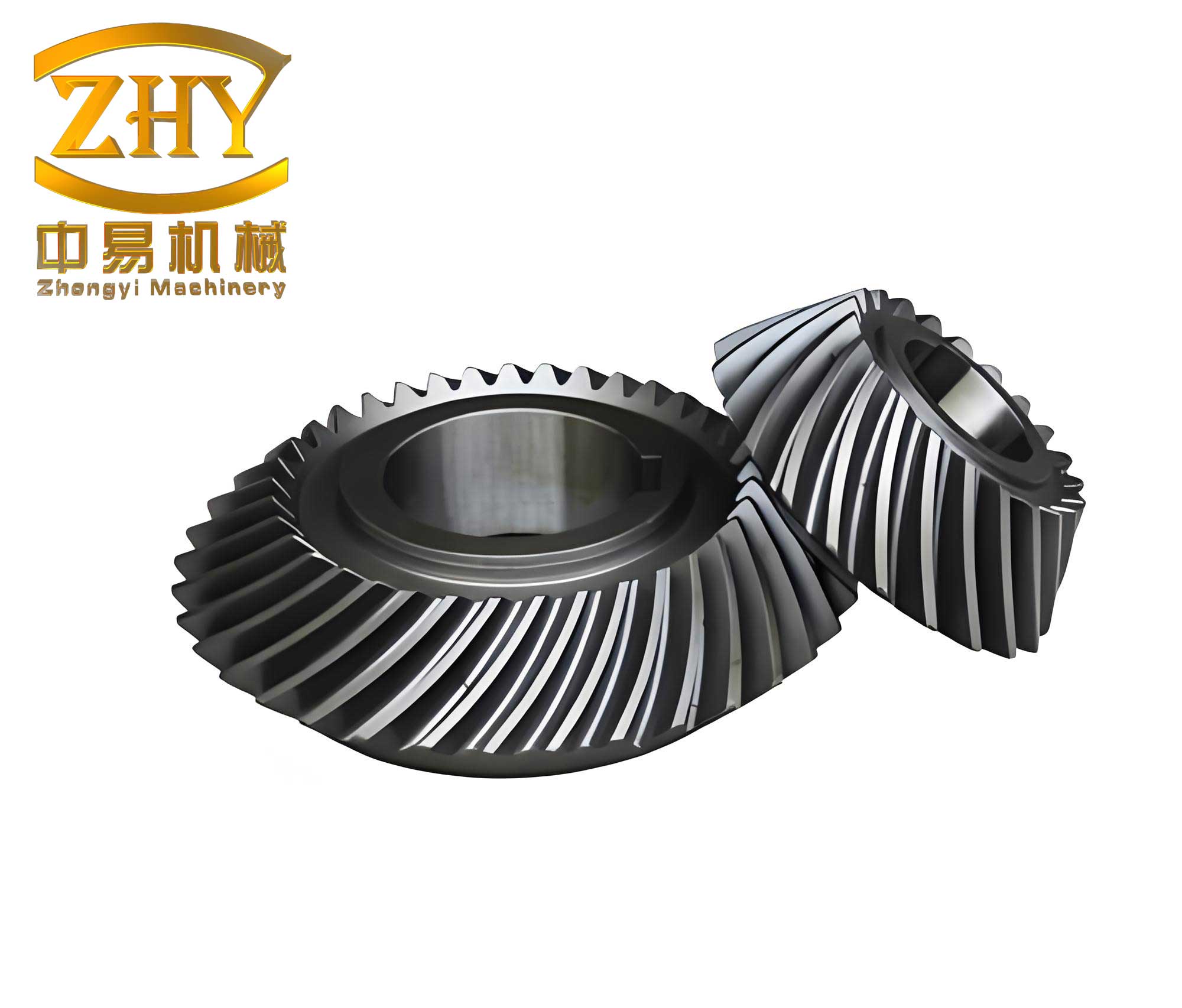
In our maintenance workshop, we frequently encounter the challenge of repairing and manufacturing spiral gears for coarse sanding machines. For a long time, our capabilities were severely limited; we could only handle spiral gears below a certain size, leaving larger or more complex spiral gear requirements unmet. This limitation hindered our productivity and forced us to seek external machining services, which were costly and time-consuming. Determined to overcome this obstacle, I spearheaded a project to design and fabricate a dedicated rotary tool holder attachment for our standard horizontal milling machine. This innovation, born out of necessity, has fundamentally transformed our approach to spiral gear production, extending our machining range and enabling us to tackle spiral gears with various specifications in-house.
The core problem with machining a spiral gear on a conventional horizontal mill lies in the need to impart a continuous rotary motion to the cutter relative to the workpiece’s linear feed, synchronized precisely to generate the helical tooth form. Standard setups lack this capability. Our solution was to create an auxiliary device that mounts onto the milling machine’s overarm, introducing a secondary rotational axis for the cutting tool. This rotary tool holder assembly effectively simulates the motion of a dedicated gear hobbing machine, allowing us to mill spiral gears accurately. The journey from concept to a functional prototype involved extensive calculations, mechanical design, and testing, all aimed at mastering the art of spiral gear fabrication.
The attachment is a self-contained unit comprising several key components that work in harmony. At its heart is the rotary tool holder itself, which houses the drive mechanism and provides the mounting interface for the cutter arbor. A sturdy base plate serves as the foundational element, ensuring rigidity and precise alignment when fixed to the machine’s overarm. The milling cutter shaft is the output element, holding the form cutter that profiles the spiral gear teeth. The power transmission chain is critical: it takes drive from the milling machine’s main spindle via a custom coupling, steps it through a series of gears including bevel gears to change the axis of rotation, and finally delivers it to the cutter shaft. This intricate gearing not only transmits power but also establishes the fixed rotational speed ratio essential for the process. The design incorporates a graduated scale on the rotary holder, allowing it to be swiveled and locked at any desired angle relative to the workpiece axis, which is crucial for setting the correct helix angle for the spiral gear being cut.
To provide a clear overview, the major components and their functions are summarized in the table below:
| Component Name | Primary Function | Key Features |
|---|---|---|
| Rotary Tool Holder (Main Body) | Houses the transmission system and provides rotational adjustment for helix angle setting. | Graduated scale for angle measurement, locking mechanism with T-bolts. |
| Base Plate | Provides a rigid mounting interface between the attachment and the milling machine overarm. | Precision-machined mating surfaces, drilled and tapped for secure fastening. |
| Milling Cutter Shaft & Arbor | Holds and drives the form-relieved gear cutter used to generate the spiral gear tooth profile. | Precision bearings for smooth rotation, keyway for positive drive. |
| Input Coupling / Adapter | Connects the attachment’s input shaft to the milling machine’s main spindle, transmitting power. | Designed for quick attachment and detachment, maintains alignment. |
| Gear Train (Spur & Bevel Gears) | Transmits and modifies power from the input to the cutter shaft, establishing speed ratio. | Includes an idler gear for direction and spacing, bevel gears for 90-degree power turn. |
| Angle Locking Mechanism | Secures the rotary holder at the selected swivel angle during the machining of the spiral gear. | Uses T-bolts and clamping pieces to prevent any movement under cutting forces. |
The fundamental theory behind machining a spiral gear revolves around the relationship between the gear’s geometry and the machine’s kinematics. The critical parameter is the helix angle $\beta$ of the spiral gear. When setting up the machine, the rotary tool holder is swiveled by this exact angle so that the path of the cutter is tangential to the intended helix on the gear blank. The calculation for the differential gearing (or in our case, the setup parameters) involves the lead $L$ of the spiral gear helix, which is related to the helix angle and the gear’s pitch diameter $d$. The lead is the axial distance for one complete turn of the helix. The formula connecting these is:
$$ L = \frac{\pi d}{\tan(\beta)} $$
For a standard milling machine without a true differential, we use change gears to link the table feed (workpiece rotation) to the cutter rotation. The ratio for these change gears is derived from the lead of the spiral gear and the lead of the machine screw. The basic formula for calculating the change gear ratio $i$ is:
$$ i = \frac{a}{b} \times \frac{c}{d} = \frac{S}{L} $$
where $S$ is the lead of the milling machine’s table feed screw (a constant for the machine), and $L$ is the lead of the desired spiral gear helix as calculated above. The gears $a$, $b$, $c$, and $d$ are the change gears selected from the available set. For a spiral gear, we must also account for the fact that the cutter is rotating, so the effective feed needs synchronization. In our attachment, the cutter gets its rotation directly from the main spindle, so the “feed” in this context is the rotation of the gear blank, which is achieved by the milling machine’s dividing head connected to the table feed via the change gears. Therefore, the complete setup requires calculating two interrelated elements: the swivel angle $\beta$ for the attachment and the change gear ratio $i$ for the dividing head/table feed chain to rotate the workpiece appropriately for each pass of the cutter.
The machining process for a spiral gear using this attachment is methodical. First, the gear blank is mounted on an arbor between the milling machine’s dividing head and footstock. The correct form cutter, matching the module and pressure angle of the desired spiral gear, is installed on the cutter shaft of our rotary attachment. The attachment is then mounted onto the machine’s overarm, and its input coupling is connected to the main spindle. Using the calculated helix angle $\beta$, the rotary tool holder is loosened, swiveled until the graduated scale indicates the angle, and then securely locked using the T-bolts. Next, the change gears are calculated and installed on the banjo of the milling machine to connect the table lead screw to the dividing head. The ratio ensures that as the table moves longitudinally to feed the workpiece past the cutter, the dividing head rotates the gear blank at precisely the right rate to generate the continuous helix of the spiral gear tooth. The depth of cut is set incrementally, and the process involves milling one tooth space, indexing the dividing head to the next tooth, and repeating until all teeth of the spiral gear are formed.
The performance of this setup has been rigorously evaluated. We have successfully machined spiral gears with modules ranging from fine to coarse pitches. The achieved precision, assessed via gear measurement tools, consistently reaches a level comparable to standard commercial grades for such custom-made gears. However, a notable observation is the comparative efficiency. When benchmarked against machining a standard spur gear of the same module on the same machine, the process for a spiral gear is inherently slower due to the continuous indexing and the need for lighter cuts to maintain accuracy and surface finish. We estimate the efficiency for spiral gear production is approximately 60-70% of that for spur gear production under similar conditions. Furthermore, we encountered a technical challenge: when using larger depths of cut to reduce machining time, the process tends to induce vibrations or chatter. This is attributed to the increased engagement of the cutter with the workpiece along the helical path and the less rigid setup compared to a fixed spindle machine. The table below contrasts key performance metrics between spur and spiral gear machining on our adapted setup:
| Performance Metric | Spur Gear Machining (Baseline) | Spiral Gear Machining with Attachment |
|---|---|---|
| Setup Complexity | Low (simple cutter alignment, no change gears for helix). | High (requires angle setting, precise change gear calculation and installation). |
| Machining Time per Gear | Relatively short, direct indexing. | Longer, due to continuous coordination of feed and rotation. |
| Achievable Precision (Tooth Profile & Lead) | High, easily achievable. | High but dependent on accurate setup calculations and component rigidity. |
| System Rigidity & Vibration Tendency | High rigidity, minimal chatter. | Reduced rigidity due to auxiliary attachment; chatter occurs with heavy cuts. |
| Process Efficiency (Relative Rate) | 100% (Defined as baseline). | 60-75%, varying with spiral gear size and helix angle. |
| Range of Producible Gears | Spur gears only. | Spiral gears with various helix angles and modules, significantly expanding capability. |
To delve deeper into the calculations, let’s formalize the mathematics for spiral gear machining parameters. The normal module $m_n$ is a fundamental design parameter for a spiral gear, related to the transverse module $m_t$ on the pitch cylinder by the helix angle:
$$ m_t = \frac{m_n}{\cos(\beta)} $$
The pitch diameter $d$ of the spiral gear is then $d = m_t \times Z$, where $Z$ is the number of teeth. As stated, the lead $L$ is $\pi d / \tan(\beta)$. Substituting $d$, we get an expression directly in terms of $Z$, $m_n$, and $\beta$:
$$ L = \frac{\pi \cdot Z \cdot m_n}{\sin(\beta)} $$
This form is often more convenient as $m_n$ and $Z$ are usually specified. The change gear ratio $i$ becomes:
$$ i = \frac{S}{L} = \frac{S \cdot \sin(\beta)}{\pi \cdot Z \cdot m_n} $$
where $S$ is the lead of the machine’s table screw (e.g., 6 mm for a metric machine). For practical selection, the ratio $i$ must be decomposed into a fraction that matches the teeth of available change gears. This often involves continued fractions or trial to find a suitable approximation with gears on hand. Additionally, the cutter selection is based on the equivalent number of teeth $Z_v$ in the normal section, which affects the tooth form curvature:
$$ Z_v = \frac{Z}{\cos^3(\beta)} $$
This virtual number of teeth is used to select the correct form cutter from a standard set, which are typically numbered for spur gears. This is a critical step to avoid undercutting and ensure proper tooth profile for the spiral gear.
The development and implementation of this rotary tool holder have been an enlightening exercise in applied mechanical engineering. It demonstrates how ingenuity and a deep understanding of machine tool principles can overcome equipment limitations. The ability to produce spiral gears in-house has reduced our dependency on external suppliers, shortened lead times for repairs, and given us greater control over quality. While the attachment has proven its worth, the experience also highlighted areas for potential refinement. The vibration issue suggests that dynamic stiffness could be improved—perhaps by using a more robust bearing arrangement for the cutter shaft or incorporating damping elements. Furthermore, future iterations could integrate a dedicated power feed for the swivel axis or even a digital readout for the angle setting to enhance precision and repeatability. The knowledge gained extends beyond just making a spiral gear; it encompasses gear geometry, machine kinematics, force analysis, and practical workshop problem-solving.
In conclusion, the project to enable spiral gear machining on a standard horizontal milling machine through a custom-designed rotary attachment has been a resounding success. It has unlocked new manufacturing capabilities for our workshop, allowing us to confidently produce and repair spiral gears that were previously beyond our scope. The process, while more involved than spur gear machining, is now a well-documented and repeatable part of our skill set. The key to success lies in meticulous setup, accurate calculation of helix angles and change gears, and careful operation to mitigate vibrations. This endeavor underscores the enduring relevance of spiral gears in mechanical power transmission and the continuous innovation possible in traditional machining domains. The spiral gear, with its smooth engagement and high load capacity, remains a vital component, and we are now fully equipped to manufacture it to required standards.