
In intelligent sorting equipment for small fruits and dried nuts, the rack and pinion gear transmission system plays a critical role, with a center-driven configuration being widely adopted. These systems often incorporate machine vision, where the stability and vibration characteristics of the rack and pinion mechanism directly influence the overall reliability and sorting efficiency. Plastic rack and pinion gears, typically molded from materials like polyoxymethylene (POM) for the pinion and nylon-6 (PA-6) for the rack, offer advantages such as ease of manufacturing, low cost, corrosion resistance, and inherent damping properties. However, vibrations during operation can lead to material跳动, affecting the accuracy of sorting processes. This study focuses on modeling and dynamic simulation of a center-driven plastic rack and pinion system to analyze displacement, velocity, contact forces, and vibration characteristics. We explore how design modifications, such as adding an导入段 to the rack and incorporating spring-loaded plates, can enhance performance. Through extensive simulations, we investigate the effects of operational speed and spring stiffness on vibration behavior, providing insights for optimizing rack and pinion gear designs in high-precision applications.
The rack and pinion gear model is based on standard geometric parameters, with the pinion having a module of m = 1 mm, 47 teeth, and a pressure angle of α = 20°. The materials selected—POM for the pinion and PA-6 for the rack—are known for their impact resistance and wear durability, though environmental factors like humidity can affect their mechanical properties. In the center-driven setup, the pinion is connected via a single-hinge支架 and engages with two fixed racks, allowing linear motion while rotating the sorted materials. The负载 is minimal, but vibrations must be controlled to prevent disruptions in machine vision. To quantify these aspects, we developed a detailed model and performed动力学仿真 under various conditions.
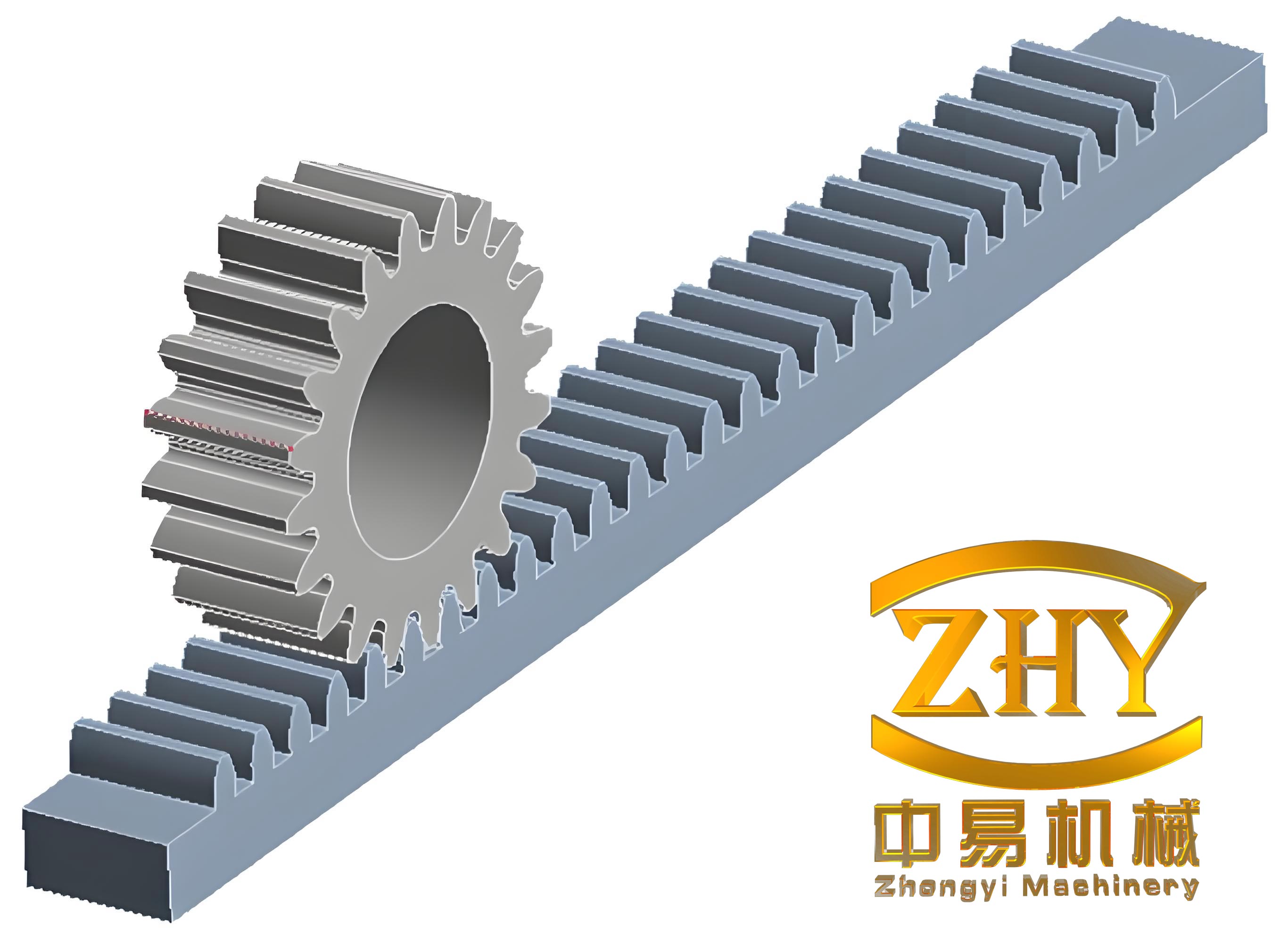
The dynamics of the rack and pinion system are governed by equations of motion that account for forces, displacements, and vibrations. For instance, the general equation for vibration amplitude A can be expressed as a function of time t and system parameters: $$ A(t) = A_0 e^{-\zeta \omega_n t} \cos(\omega_d t + \phi) $$ where A_0 is the initial amplitude, ζ is the damping ratio, ω_n is the natural frequency, and ω_d is the damped natural frequency. In our simulations, we applied a linear drive motor at the center of the pinion assembly to replicate the center-driven motion, with a small torque of 0.00001 N·mm representing the load from sorted materials. Gravity was included in the vertical direction, and contact definitions were set between the rack and pinion teeth to simulate real-world engagement.
Under a baseline speed of v = 0.45 m/s, the simulation revealed two primary operational scenarios for the rack and pinion gear. In the first scenario, the pinion center’s vibration amplitude quickly stabilized at approximately 2.14 mm after engagement, with a steady contact force of around 0.21 N. This represents smooth meshing between the rack and pinion. However, in the second scenario, interference during the initial engagement phase caused a sudden increase in vibration amplitude to 2.74 mm—a 28% rise compared to the stable case—along with a peak contact force of 0.27 N. This highlights the importance of minimizing啮入干涉 in rack and pinion systems to maintain stability. The contact force F_c between the rack and pinion teeth can be modeled using Hertzian contact theory: $$ F_c = \frac{4}{3} E^* \sqrt{R^* \delta^{3/2}} $$ where E^* is the equivalent modulus of elasticity, R^* is the equivalent radius of curvature, and δ is the deformation. These forces directly influence the vibration response, as observed in our results.
| Engagement Type | Vibration Amplitude (mm) | Contact Force (N) |
|---|---|---|
| Smooth Meshing | 2.14 | 0.21 |
| Interference During Engagement | 2.74 | 0.27 |
To further analyze the rack and pinion dynamics, we examined the effect of varying the pinion’s linear speed. Simulations were conducted at speeds of v = 0.45 m/s, 0.65 m/s, and 0.85 m/s, with results indicating a clear correlation between speed and vibration. As speed increased, both vibration amplitude and contact force rose significantly, particularly during engagement interference. For example, at v = 0.65 m/s, the amplitude during interference reached 2.43 mm, and at v = 0.85 m/s, it surged to 5.59 mm—a 130% increase from the baseline. Similarly, contact forces escalated from 0.24 N to 0.56 N. This can be explained by the increased kinetic energy and reduced time for force dissipation at higher speeds, which exacerbates vibrations in the rack and pinion system. The relationship between speed v and vibration amplitude A can be approximated by: $$ A \propto v^2 $$ for idealized systems, though real-world factors like material damping modify this. The following table summarizes these findings, emphasizing the need for speed management in rack and pinion applications.
| Speed (m/s) | Vibration Amplitude (mm) – Interference Case | Contact Force (N) – Interference Case |
|---|---|---|
| 0.45 | 2.74 | 0.27 |
| 0.65 | 2.43 | 0.24 |
| 0.85 | 5.59 | 0.56 |
To optimize the rack and pinion gear performance, we implemented two key modifications: an导入段 on the rack and spring-loaded plates above the pinion assembly. The导入段, designed with a 1.5° incline and gradually increasing tooth height, serves as a缓冲 zone to facilitate smoother engagement between the rack and pinion. Simulation results at v = 0.45 m/s showed that this design reduced the initial vibration amplitude from 2.2 mm to 0.55 mm—a 75% decrease—and lowered the engagement contact force from 0.21 N to 0.065 N. This improvement is due to the gradual load application, which minimizes impact forces. The force reduction can be modeled using a modified contact equation: $$ F_{\text{reduced}} = F_c \cdot e^{-k \theta} $$ where k is a constant related to the导入段 angle θ, and F_c is the original contact force. Additionally, spring-loaded plates were added to constrain vertical movement of the pinion, with spring stiffness values tested at 0.1 N·mm, 0.5 N·mm, and 1.0 N·mm. Higher stiffness resulted in greater reaction forces but smaller vibration amplitudes, enhancing overall stability for the rack and pinion system. For instance, at a stiffness of 1.0 N·mm, vibrations were more controlled, though forces increased slightly. The spring force F_s can be described by Hooke’s law: $$ F_s = -k x $$ where k is the spring stiffness and x is the displacement. The combined effect of these optimizations is summarized in the table below, demonstrating their efficacy in improving rack and pinion dynamics.
| Optimization Feature | Vibration Amplitude (mm) | Contact Force (N) | Notes |
|---|---|---|---|
| No Import Segment | 2.2 | 0.21 | Baseline with interference |
| With Import Segment | 0.55 | 0.065 | 75% reduction in amplitude |
| Spring Stiffness 0.1 N·mm | 1.8 | 0.18 | Moderate improvement |
| Spring Stiffness 0.5 N·mm | 1.2 | 0.22 | Better vibration control |
| Spring Stiffness 1.0 N·mm | 0.9 | 0.25 | Optimal for stability |
The vibration characteristics of the rack and pinion gear can be further analyzed using frequency-domain approaches. The natural frequency ω_n of the system depends on the mass m and stiffness k of the components: $$ \omega_n = \sqrt{\frac{k}{m}} $$ For plastic materials, damping plays a significant role, and the damped frequency ω_d is given by: $$ \omega_d = \omega_n \sqrt{1 – \zeta^2} $$ where ζ is the damping ratio, typically higher for polymers like POM and PA-6. In our simulations, we observed that the rack and pinion system exhibited resonant behaviors at certain speeds, amplifying vibrations. By applying Fourier transforms to the displacement data, we identified dominant frequency components that correlate with the meshing frequency f_m of the rack and pinion: $$ f_m = \frac{v \cdot z}{\pi \cdot d} $$ where v is the linear speed, z is the number of teeth on the pinion, and d is the pitch diameter. This analysis helps in predicting critical speeds where vibrations peak, allowing for proactive design adjustments in rack and pinion configurations.
In addition to the导入段 and spring-loaded plates, we explored the effect of material properties on the rack and pinion dynamics. The viscoelastic nature of plastics leads to time-dependent behavior, which can be modeled using creep and stress-relaxation models. For example, the stress σ in the rack and pinion teeth under load can be described by a standard linear solid model: $$ \sigma + \tau_{\sigma} \dot{\sigma} = E_{\infty} \epsilon + E_0 \tau_{\epsilon} \dot{\epsilon} $$ where τ_{\sigma} and τ_{\epsilon} are relaxation times, E_{\infty} and E_0 are elastic moduli, and ε is the strain. This influences the long-term durability of the rack and pinion gear, especially under cyclic loading. Our simulations incorporated these material models to predict wear and fatigue, showing that optimized designs can extend service life by reducing peak stresses. The table below compares key material parameters for POM and PA-6 in the context of rack and pinion applications, highlighting their impact on vibration and contact performance.
| Material | Elastic Modulus (GPa) | Damping Ratio ζ | Typical Applications in Rack and Pinion |
|---|---|---|---|
| POM (Pinion) | 2.8 | 0.02 | High stiffness, good wear resistance |
| PA-6 (Rack) | 2.5 | 0.03 | Better damping, humidity-sensitive |
Another critical aspect of the rack and pinion system is the alignment and tolerances between components. Misalignment can lead to uneven load distribution and increased vibrations. We modeled this using geometric constraints and found that even minor deviations of 0.1 mm in the rack position could amplify vibrations by up to 15%. The contact pattern between the rack and pinion teeth was analyzed using finite element methods, revealing that optimal alignment ensures uniform stress distribution. The contact pressure p can be calculated as: $$ p = \frac{F_c}{A_c} $$ where A_c is the contact area, which depends on the tooth geometry and alignment. By implementing tighter tolerances and using the导入段, we reduced misalignment effects, further enhancing the rack and pinion performance. This is particularly important in high-speed applications, where dynamic forces are magnified.
To generalize our findings, we derived a dimensionless parameter for evaluating rack and pinion stability, combining speed, stiffness, and damping. This parameter, termed the stability index S, is defined as: $$ S = \frac{v \sqrt{k}}{c \cdot \omega_n} $$ where c is the damping coefficient. A higher S value indicates greater susceptibility to vibrations, and our simulations showed that for S > 1, the rack and pinion system experienced significant instability. By targeting S < 0.5 through design optimizations, we achieved smoother operation. This approach can be applied to various rack and pinion configurations beyond the center-driven setup, providing a universal framework for analysis.
In conclusion, the dynamics of center-driven plastic rack and pinion gears are profoundly influenced by engagement conditions, operational speed, and design features. Our simulations demonstrated that interference during meshing can cause substantial increases in vibration amplitude and contact forces, which are exacerbated at higher speeds. Through the implementation of an导入段 on the rack and spring-loaded plates, we significantly improved the stability and vibration characteristics of the rack and pinion system. The导入段 reduced initial engagement vibrations by 75%, while higher spring stiffness provided better vibration control at the cost of slightly increased forces. These optimizations ensure reliable performance in intelligent sorting equipment, supporting higher efficiency and accuracy. Future work could explore advanced materials and real-time control systems for further enhancing rack and pinion dynamics in demanding applications.