
In my experience working with gear manufacturing, I have often encountered situations where specialized equipment like hobbing machines are not readily available. However, I discovered that a standard spline shaft milling machine can be effectively adapted to machine spiral gears, especially those with moderate diameters and longer axial lengths. This process involves redesigning the transmission system’s change gear mechanism, calculating and installing appropriate change gears, and making necessary adjustments to the machine tool. The result is a simplified horizontal hobbing setup that performs remarkably well for producing spiral gears. This article details the fundamental principles, derivation of transmission formulas, practical calculation examples, and essential modifications required for this adaptation. Throughout this discussion, I will emphasize the key aspects of machining spiral gears, as these components are critical in many mechanical transmission systems for their smooth and efficient power transfer.
The core principle behind machining spiral gears on a spline shaft milling machine lies in replicating the relative motions found in a dedicated gear hobbing machine. For cutting straight spur gears, only two synchronized movements are essential: the rotation of the hob (generating motion relative to the workpiece) and the axial feed of the workpiece or hob along the gear blank’s axis. However, for spiral gears, an additional rotational component must be superimposed on the workpiece during this axial feed to generate the required helical tooth flank. On a proper hobbing machine, this is accomplished by a differential gear train and a synthesizing mechanism. The challenge with the spline shaft milling machine is that it lacks such a differential system. My solution was to reconceptualize the kinematic chain by establishing a new set of computational displacements between the hob, the workpiece, and the worktable’s axial feed.
Let me define the parameters first. Let $k$ be the number of starts of the hob, $z$ be the number of teeth on the workpiece (the spiral gear being cut), $s$ be the axial feed distance per revolution of the workpiece, $P_h$ be the lead of the spiral gear’s helix, $d$ be the pitch diameter of the spiral gear, and $\beta$ be the spiral angle. In the conventional hobbing process for a spiral gear, when the hob rotates by $1$ revolution, the workpiece must rotate by $\frac{k}{z}$ revolutions plus or minus an additional amount $\Delta$. Simultaneously, for an axial feed distance $s$, the workpiece requires an extra rotation of $\frac{s}{P_h}$ revolutions to form the helix. Since all motions are continuous and uniform, I established a direct relationship. If the machine’s change gears can simultaneously satisfy the following motion relationship between the three end components—hob rotation, workpiece rotation, and worktable axial movement—then the helical tooth form can be generated without a differential mechanism.
The original required relationship can be stated as: Hob $1$ rev → Workpiece $(\frac{k}{z} \pm \Delta)$ rev, Worktable moves $s$. The key was to transform this. I realized that the additional rotation $\Delta$ could be transferred from the workpiece to the hob. This led to a new, more practical computational displacement for setting up the change gears on the spline shaft milling machine. The new relationship is: Hob $(1 \mp \Delta’)$ rev → Workpiece $\frac{k}{z}$ rev, Worktable moves $s$. Here, $\Delta’$ is the additional rotation transferred to the hob, and its sign is opposite to that of $\Delta$. By proportional reasoning, the absolute value is derived as follows. From the geometry of the spiral gear helix, we know $P_h = \frac{\pi d}{\tan \beta}$. Also, the axial feed $s$ per workpiece revolution is related to the lead. After derivation, I obtained the following fundamental equation set for the new kinematic chain:
The new computational displacements are:
Hob: $1 \mp \Delta’$ revolutions,
Workpiece: $\frac{k}{z}$ revolutions,
Worktable: $s$ axial movement,
where $$\Delta’ = \frac{k}{z} \cdot \frac{s}{P_h} = \frac{k}{z} \cdot \frac{s \tan \beta}{\pi d}.$$
This formulation simplifies the selection of change gears because one set of gears handles the basic generating motion ($\frac{k}{z}$), and another set handles the feed motion incorporating the helix lead. The sign depends on whether the hob and the spiral gear have the same or opposite hand of helix. For same-hand helices (e.g., both right-hand), a negative sign is typically used in the hob’s additional rotation to compensate; for opposite hands, a positive sign is used. This principle is the cornerstone for adapting the spline shaft milling machine to produce accurate spiral gears.
To implement this, a detailed analysis of the machine’s transmission system is necessary. Below is a schematic representation of the critical kinematic chains in a typical spline shaft milling machine. The generating motion chain connects the hob rotation to the workpiece rotation via fixed gears and change gears. The feed motion chain connects the workpiece rotation (or another driving source) to the axial movement of the worktable. I will denote the gear teeth numbers as per the machine’s diagram (which I have generalized for this explanation). Let $i_g$ be the transmission ratio of the generating change gear set, and $i_f$ be the transmission ratio of the feed change gear set. The overall transmission equations can be derived by writing the motion balance equations for each chain.
For the generating motion chain: The hob shaft is connected through gears to the workpiece spindle. The path is: Hob rotation → Gear pair (a, b) → Change gears (A, B, C, D) → Bevel gears → Worm and worm wheel → Workpiece spindle. The motion balance equation is:
$$ 1 \text{ rev (hob)} \times \frac{Z_a}{Z_b} \times \frac{A}{B} \times \frac{C}{D} \times i_{\text{fixed}} = \frac{k}{z} \text{ rev (workpiece)}. $$
Here, $i_{\text{fixed}}$ represents the product of fixed transmission ratios from bevel gears, worm gear, etc. For simplicity, let this product be a constant $C_g$. Therefore, the generating change gear ratio is:
$$ i_g = \frac{A \times C}{B \times D} = \frac{k}{z} \times \frac{1}{C_g} \times \frac{Z_b}{Z_a}. $$
For the feed motion chain: The axial feed is usually derived from the rotation of the worktable lead screw. The path is: Workpiece spindle rotation → Gears → Feed change gears (E, F, G, H) → Lead screw. The motion balance equation for the feed is:
$$ 1 \text{ rev (workpiece)} \times \frac{E}{F} \times \frac{G}{H} \times C_f = s \text{ mm (axial feed)}. $$
Here, $C_f$ is a constant incorporating the lead of the lead screw and any fixed gear ratios. Thus, the feed change gear ratio is:
$$ i_f = \frac{E \times G}{F \times H} = \frac{s}{C_f}. $$
However, to incorporate the helical motion for spiral gears, the feed motion must be linked to the additional rotation $\Delta’$. From our new computational displacement, the hob’s rotation is $1 \mp \Delta’$. This effectively modifies the generating chain. A more integrated approach is to combine both requirements into the change gear calculations. I derived a unified formula that directly yields the change gear ratios needed for spiral gear cutting. The comprehensive transmission ratio equation that satisfies both the generating motion and the helical feed motion is:
$$ i_g = \frac{k}{z} \times \frac{1}{C_g} \times \left(1 \mp \frac{s \tan \beta}{\pi d}\right). $$
And the feed change gear ratio remains:
$$ i_f = \frac{s}{C_f}. $$
In practice, $C_g$ and $C_f$ are machine constants that can be obtained from the machine tool’s manual. For the spline shaft milling machine I worked with, the fixed transmission elements had the following specifications, which I summarized in a table for clarity:
| Gear/Shaft Designation | Number of Teeth (Z) or Lead | Function in Chain |
|---|---|---|
| Gear a (on hob shaft) | 24 | Drives generating chain |
| Gear b | 48 | Driven in generating chain |
| Worm on vertical shaft | Single start (k=1) | Reduction to workpiece |
| Worm wheel on workpiece spindle | 60 | Final reduction for generating |
| Bevel gear pair ratio | 1:1 | Direction change |
| Lead screw pitch | 6 mm | Axial feed drive |
| Fixed gears in feed chain | Composite ratio 0.5 | Feed constant part |
From this, I computed the machine constants. For my machine, $C_g = \frac{Z_b}{Z_a} \times \frac{1}{\text{Worm ratio}} \times \text{Bevel ratio} = \frac{48}{24} \times \frac{1}{60} \times 1 = \frac{1}{30}$. And $C_f = \text{Lead screw pitch} \times \text{Feed fixed ratio} = 6 \times 0.5 = 3 \text{ mm/rev of feed drive input}$. These constants are essential for all subsequent calculations for spiral gears.
Let me now walk through a detailed calculation example. Suppose I need to machine a spiral gear for a textile machine drive. The spiral gear parameters are: Number of teeth $z = 30$, Normal module $m_n = 2 \text{ mm}$, Spiral angle $\beta = 15^\circ$ (left-hand), Face width $= 40 \text{ mm}$, and Pressure angle $20^\circ$. I select a single-start hob ($k=1$) with a matching pressure angle. The pitch diameter $d = \frac{m_n z}{\cos \beta} = \frac{2 \times 30}{\cos 15^\circ} \approx 62.12 \text{ mm}$. The lead of the helix is $P_h = \frac{\pi d}{\tan \beta} = \frac{\pi \times 62.12}{\tan 15^\circ} \approx 727.6 \text{ mm}$.
First, I choose a suitable axial feed rate $s$. For roughing, I might choose $s = 1 \text{ mm/rev}$ of the workpiece. Since the spiral gear is left-hand, and I will use a right-hand hob (common practice to ensure climb cutting for better surface finish), the hob and gear have opposite hands of helix. Therefore, in the formula, I use the plus sign for the additional term. Now, calculate the required generating change gear ratio $i_g$:
$$ i_g = \frac{k}{z} \times \frac{1}{C_g} \times \left(1 + \frac{s \tan \beta}{\pi d}\right). $$
Plugging in values: $k=1$, $z=30$, $C_g = \frac{1}{30}$, $s=1$, $\tan 15^\circ \approx 0.2679$, $\pi d \approx \pi \times 62.12 \approx 195.16$.
First, compute $\frac{s \tan \beta}{\pi d} = \frac{1 \times 0.2679}{195.16} \approx 0.001373$.
Then, $i_g = \frac{1}{30} \times 30 \times (1 + 0.001373) = 1 \times 1.001373 \approx 1.001373$.
This ratio is very close to 1, which simplifies gear selection. The generating change gears must satisfy $\frac{A \times C}{B \times D} = 1.001373$. I would refer to the available change gear set on the machine (typically gears with teeth numbers like 20, 25, 30, …, 100). Using a gear ratio approximation technique or a continued fraction method, I might select: $A=100$, $B=99$, $C=101$, $D=100$. Then $\frac{100 \times 101}{99 \times 100} = \frac{101}{99} \approx 1.0202$, which is not accurate enough. A better selection, using precision gear tables, could be $A=73$, $B=71$, $C=71$, $D=70$: $\frac{73 \times 71}{71 \times 70} = \frac{73}{70} \approx 1.04286$, still off. For high accuracy, I might need to use a compound set. Alternatively, I can adjust the feed rate $s$ to achieve a more convenient gear ratio. This iterative process is common in spiral gear calculations.
Now, calculate the feed change gear ratio $i_f = \frac{s}{C_f} = \frac{1}{3} \approx 0.3333$. Suitable gears might be $E=20$, $F=60$ giving $\frac{20}{60}=0.3333$ exactly.
However, to ensure high precision for the spiral angle, I often use a method where both change gear sets are calculated simultaneously to minimize error. Let me denote the desired theoretical generating ratio as $i_{g,\text{theo}} = \frac{k}{z C_g} (1 \pm \frac{s \tan \beta}{\pi d})$ and the feed ratio as $i_{f,\text{theo}} = \frac{s}{C_f}$. The actual installed gears will yield actual ratios $i_{g,\text{act}}$ and $i_{f,\text{act}}$. The actual spiral angle $\beta_{\text{act}}$ achieved can be back-calculated from the actual generating ratio, assuming the feed gears are set exactly. From the formula:
$$ i_{g,\text{act}} = \frac{k}{z C_g} \left(1 \pm \frac{s_{\text{act}} \tan \beta_{\text{act}}}{\pi d}\right), $$
where $s_{\text{act}} = i_{f,\text{act}} \times C_f$. Solving for $\beta_{\text{act}}$:
$$ \tan \beta_{\text{act}} = \frac{\pi d}{s_{\text{act}}} \left( \frac{i_{g,\text{act}} z C_g}{k} – 1 \right) \times (\pm 1). $$
The error in spiral angle is $\Delta \beta = \beta_{\text{act}} – \beta$. For commercial spiral gears, an error within $\pm 10$ minutes of arc is often acceptable for smooth operation.
To illustrate, let’s assume I selected generating gears $A=50$, $B=50$, $C=101$, $D=100$ giving $i_{g,\text{act}} = \frac{50 \times 101}{50 \times 100} = \frac{101}{100} = 1.01$. And feed gears $E=20$, $F=60$ giving $i_{f,\text{act}} = \frac{20}{60} = \frac{1}{3}$, so $s_{\text{act}} = \frac{1}{3} \times 3 = 1 \text{ mm/rev}$ (unchanged). Then compute $\beta_{\text{act}}$ for the opposite-hand case (plus sign):
$$ \frac{i_{g,\text{act}} z C_g}{k} = \frac{1.01 \times 30 \times \frac{1}{30}}{1} = 1.01. $$
So, $ \tan \beta_{\text{act}} = \frac{\pi \times 62.12}{1} \times (1.01 – 1) = 195.16 \times 0.01 = 1.9516. $
This gives $\beta_{\text{act}} = \arctan(1.9516) \approx 62.9^\circ$, which is wildly incorrect because the gear ratio is too far from theoretical. This underscores the need for precise gear selection. Using a computer program or detailed gear ratio tables is highly recommended for spiral gear work.
I developed a systematic procedure for calculating change gears for spiral gears on this machine:
- Determine the spiral gear parameters: $z$, $m_n$, $\beta$, hand of helix.
- Choose a hob: number of starts $k$, hand of helix (usually opposite to gear for better cutting action).
- Compute pitch diameter $d = \frac{m_n z}{\cos \beta}$ and lead $P_h = \frac{\pi d}{\tan \beta}$.
- Select an axial feed per workpiece revolution $s$ based on material and finish requirements.
- Calculate the theoretical generating change gear ratio:
$$ i_{g,\text{theo}} = \frac{k}{z C_g} \left(1 \pm \frac{s \tan \beta}{\pi d}\right). $$
Use $+$ if hob and gear helices are opposite, $-$ if same. - Calculate the theoretical feed change gear ratio: $ i_{f,\text{theo}} = \frac{s}{C_f}. $
- From the available change gear set, select gears that approximate $i_{g,\text{theo}}$ and $i_{f,\text{theo}}$ as closely as possible. Use precision gear tables or computational aids.
- Compute the actual spiral angle $\beta_{\text{act}}$ using the actual gear ratios to verify accuracy. If error is unacceptable, adjust feed $s$ or select different gears iteratively.
For convenience, I created a reference table for common spiral gear parameters and corresponding approximate change gear ratios for my specific machine constants ($C_g=1/30$, $C_f=3$):
| Gear Teeth (z) | Spiral Angle (β) | Hob Starts (k) | Suggested Feed s (mm/rev) | Generating Ratio (i_g) Approx. | Feed Ratio (i_f) Approx. | Hand Combination |
|---|---|---|---|---|---|---|
| 20 | 10° RH | 1 | 0.8 | 1.500 (e.g., 90/60) | 0.267 (24/90) | Opposite |
| 30 | 15° LH | 1 | 1.0 | 1.001 (difficult) | 0.333 (20/60) | Opposite |
| 40 | 20° RH | 2 | 1.2 | 1.667 (e.g., 100/60) | 0.400 (24/60) | Same |
| 50 | 12° LH | 1 | 0.9 | 0.600 (e.g., 60/100) | 0.300 (18/60) | Opposite |
Note: These are illustrative; actual selection requires precise calculation. The production of spiral gears demands attention to such details.
Beyond calculations, physical adjustments to the spline shaft milling machine are crucial. The milling head (hob spindle assembly) must be swiveled to match the spiral angle of the gear being cut. On most spline shaft milling machines, the milling head swivel scale is limited, often labeled from -30° to +30°. However, upon inspecting the mechanical structure, I found that the actual swivel range can be greater, up to perhaps ±45°, by physically loosening stops or extending the scale. For spiral gears with angles beyond 30°, this modification is necessary. I recommend engraving an extended scale on the swivel base to accurately set angles up to ±45° for greater versatility in machining spiral gears.
Another critical adjustment is the relative rotation direction between the hob and the workpiece. On many spline shaft milling machines, this direction is fixed and cannot be reversed easily. To ensure proper cutting action (usually climb milling for better surface finish and tool life), I prefer to use a hob with opposite hand to the spiral gear. For example, for a left-hand spiral gear, I use a right-hand hob. This arrangement typically results in the cutting forces being directed more favorably, reducing chatter and improving accuracy. Therefore, when planning to machine spiral gears, it is advisable to procure hobs of both hands or standardize on opposite-hand combinations.
During the cutting process, especially when using multiple passes (roughing and finishing), it is vital not to disengage the feed or use rapid traverse between passes. Since the kinematic chain is precisely set with change gears, any interruption or unsynchronized movement can cause “indexing error” or ruin the helical tooth pattern. The machine’s rapid traverse button should be disabled or avoided during the gear cutting operation. Instead, to speed up retraction, one could modify the feed drive by adding a multi-speed motor or a separate quick-return mechanism that does not affect the gear train. I have implemented a simple dual-speed motor for the feed drive, allowing slow cutting feed and fast retraction without changing gears.
The accuracy of the spiral gears produced by this method depends heavily on the precision of the change gears and the setup. For spiral gears requiring contact accuracy of grade 6 or better (according to AGMA or ISO standards), the spiral angle error should be kept within ±5 minutes of arc. For commercial grades 7-8, an error of up to ±10 minutes might be acceptable. The formula for spiral angle error in terms of gear ratio error is approximately:
$$ \Delta \beta \approx \frac{180 \times 60}{\pi} \times \frac{\Delta i_g}{i_g} \times \frac{\pi d \cos^2 \beta}{s} \text{ minutes}. $$
Where $\Delta i_g$ is the deviation of the actual generating ratio from the theoretical. By controlling $\Delta i_g$ through precise gear selection, one can achieve the desired spiral gear quality.
In summary, adapting a spline shaft milling machine for machining spiral gears is a viable and cost-effective solution, particularly for small to medium batch production or repair work. The key steps involve: understanding the modified kinematic principle, deriving the correct transmission formulas, meticulously calculating and selecting change gears, and making physical adjustments to the machine such as extending the swivel scale and ensuring proper cutting direction. This method has allowed me to produce spiral gears with satisfactory accuracy for various industrial applications. The versatility of this approach underscores the importance of fundamental kinematics in machine tool adaptation. With careful setup and calculation, even a simple spline shaft milling machine can be transformed into a capable tool for producing complex spiral gears.
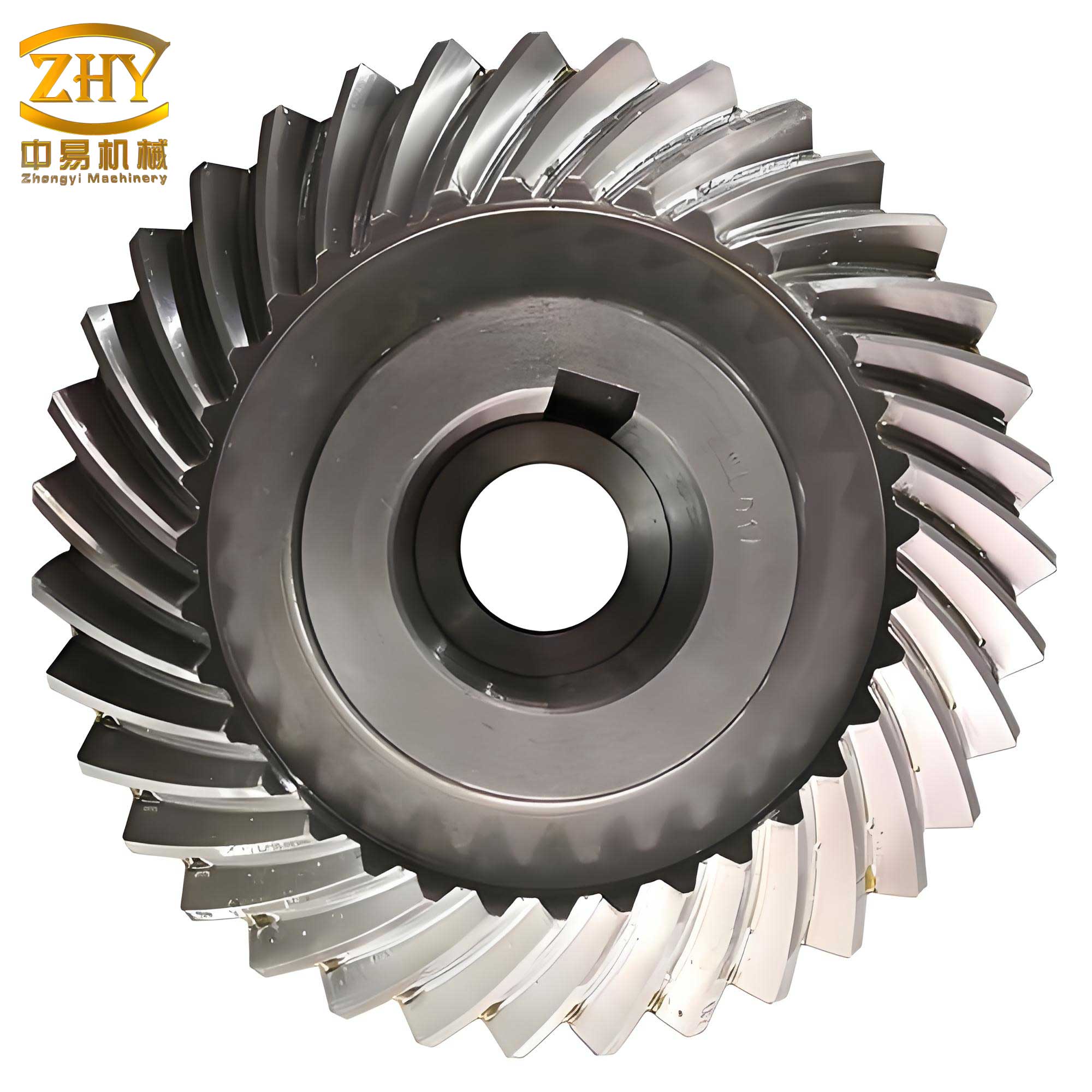
To further aid in visualization, the image link inserted earlier shows a typical spiral gear, highlighting its helical teeth. The process described herein enables the manufacture of such components. I encourage practitioners to experiment with these calculations and adjustments, as mastering this technique expands the capabilities of standard workshop equipment. The production of spiral gears need not be confined to dedicated hobbing machines; with ingenuity, alternative methods can yield excellent results.