
In the field of mechanical engineering, the optimal design of helical gears has always been a critical pursuit for researchers and designers. Helical gears are widely used in various applications, including industrial robots, CNC equipment, aerospace, and medical devices, due to their smooth operation and high load-bearing capacity. Specifically, in RV reducers, which are common independent transmission components in precision reduction devices, the design of helical gears plays a pivotal role. The goal is to enhance load capacity, extend service life, and reduce volume and weight under given loads, working conditions, geometric relationships, reliability, and other constraints. However, the optimization problem for helical gears is complex, with numerous nonlinear factors and constraints, making traditional identification and optimization algorithms inadequate for precise solutions. Therefore, intelligent optimization algorithms have gained prominence. In this article, I propose a dual population genetic particle swarm optimization algorithm to address the multi-constraint optimization design of helical gears. Through simulations on the Matlab platform, I compare this algorithm with other methods, demonstrating its superior performance in finding accurate solutions.
Helical gears are essential components in power transmission systems, and their design optimization involves balancing multiple objectives and constraints. The complexity arises from factors such as contact fatigue strength, bending fatigue strength, geometric boundaries, and overlap ratios. Traditional approaches often rely on empirical formulas or simplified models, which may not yield optimal results. With advancements in computational intelligence, algorithms like particle swarm optimization and genetic algorithms have been applied to such problems. However, these methods can suffer from issues like premature convergence or slow evolution. To overcome these limitations, I integrate genetic evolution mechanisms into particle swarm optimization and employ a dual population strategy. This hybrid approach aims to maintain diversity and improve global search capabilities, making it suitable for the intricate optimization of helical gears.
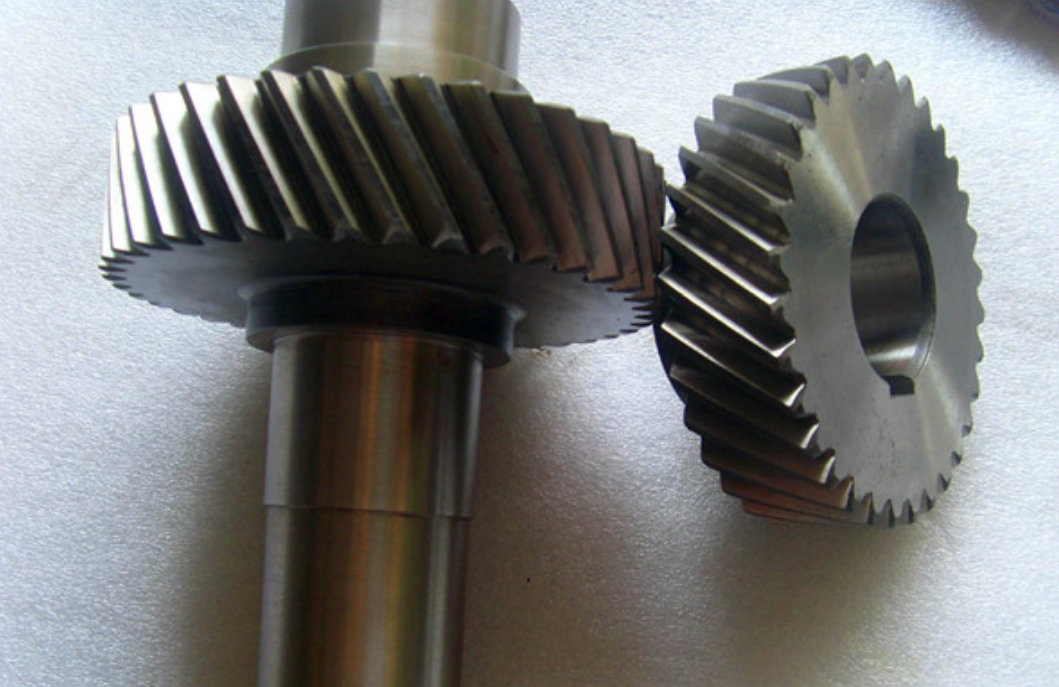
The optimization of helical gears begins with establishing a mathematical model that encapsulates the design goals and limitations. For helical gears, the primary objective is often to minimize the radial and axial dimensions, which can be represented by the center distance and tooth width. Given that the transmission ratio is typically predetermined, the target function focuses on reducing the overall size. Let me define the design variables: for instance, the normal module, number of teeth, helix angle, and face width. The target function, denoted as \( F(x) \), is formulated to be as small as possible, reflecting the minimization of gear volume or weight. In mathematical terms, this can be expressed as:
$$ F(x) = f(a, b) $$
where \( a \) is the center distance and \( b \) is the face width. However, to provide a more detailed representation, I expand this into a multi-variable function that considers specific parameters of helical gears. For example, the objective might involve minimizing the sum of squared dimensions or a weighted combination of factors. In practice, the target function is derived from geometric relationships unique to helical gears, ensuring that the optimization aligns with practical design requirements.
The constraints for helical gear optimization are derived from performance and geometric criteria. These constraints ensure that the gears operate reliably under specified conditions. I categorize them into contact fatigue strength, bending fatigue strength, boundary constraints, and overlap ratio. Each constraint is transformed into inequality forms for numerical optimization. Let me detail these constraints using formulas and tables to summarize the parameters.
First, the contact fatigue strength constraint ensures that the helical gears can withstand surface stresses without pitting or wear. The basic formula for contact stress is:
$$ \sigma_H = Z_H Z_E Z_\varepsilon \sqrt{\frac{K_A K_V K_\beta F_t}{d_1 b} \cdot \frac{u+1}{u}} $$
where \( K_A \) is the application factor, \( K_V \) is the dynamic factor, \( K_\beta \) is the load distribution factor, \( F_t \) is the tangential force, \( d_1 \) is the pitch diameter, \( Z_H \) is the zone factor, \( Z_E \) is the elasticity coefficient, and \( Z_\varepsilon \) is the contact ratio factor. For helical gears, this is adapted to account for the helix angle. The converted constraint requires that the contact stress does not exceed the allowable limit, expressed as:
$$ g_1(x) = \sigma_H – [\sigma_H] \leq 0 $$
Here, \( [\sigma_H] \) is the permissible contact stress. The parameters involved are summarized in the table below:
| Parameter | Symbol | Description |
|---|---|---|
| Application Factor | \( K_A \) | Accounts for operational conditions |
| Dynamic Factor | \( K_V \) | Considers speed variations |
| Load Distribution Factor | \( K_\beta \) | Reflects uneven loading across teeth |
| Tangential Force | \( F_t \) | Calculated from torque and pitch diameter |
| Pitch Diameter | \( d_1 \) | For the pinion in helical gears |
| Zone Factor | \( Z_H \) | Depends on tooth geometry |
| Elasticity Coefficient | \( Z_E \) | Based on material properties |
| Contact Ratio Factor | \( Z_\varepsilon \) | Incorporates overlap in helical gears |
Second, the bending fatigue strength constraint prevents tooth breakage under cyclic loads. The bending stress formula is:
$$ \sigma_F = \frac{K_A K_V K_\beta F_t}{b m_n} Y_F Y_S Y_\varepsilon $$
where \( m_n \) is the normal module, \( Y_F \) is the form factor, \( Y_S \) is the stress correction factor, and \( Y_\varepsilon \) is the bending ratio factor. For helical gears, these factors are adjusted based on the helix angle and equivalent tooth number. The converted constraint is:
$$ g_2(x) = \sigma_F – [\sigma_F] \leq 0 $$
with \( [\sigma_F] \) as the allowable bending stress. The factors are detailed in the following table:
| Parameter | Symbol | Description |
|---|---|---|
| Normal Module | \( m_n \) | Key size parameter for helical gears |
| Form Factor | \( Y_F \) | Depends on tooth shape and helix angle |
| Stress Correction Factor | \( Y_S \) | Accounts for stress concentration |
| Bending Ratio Factor | \( Y_\varepsilon \) | Relates to contact ratio in helical gears |
Third, boundary constraints ensure that the design variables for helical gears fall within practical ranges. These include limits on the equivalent tooth number, normal module, helix angle, and face width. For helical gears, the equivalent tooth number \( Z_v \) is calculated as \( Z_v = Z / \cos^3 \beta \), where \( Z \) is the actual tooth number and \( \beta \) is the helix angle. The constraints are:
$$ g_3(x) = Z_{v,\min} – Z_v \leq 0 $$
$$ g_4(x) = Z_v – Z_{v,\max} \leq 0 $$
$$ g_5(x) = m_{n,\min} – m_n \leq 0 $$
$$ g_6(x) = \beta_{\min} – \beta \leq 0 $$
$$ g_7(x) = \beta – \beta_{\max} \leq 0 $$
$$ g_8(x) = b_{\min} – b \leq 0 $$
$$ g_9(x) = b – b_{\max} \leq 0 $$
These constraints consider manufacturing capabilities and design standards for helical gears. The parameters and their typical ranges are summarized below:
| Constraint | Variable | Typical Range |
|---|---|---|
| Equivalent Tooth Number | \( Z_v \) | 17 to 150 for helical gears |
| Normal Module | \( m_n \) | 1 mm to 10 mm |
| Helix Angle | \( \beta \) | 8° to 30° for helical gears |
| Face Width | \( b \) | 10 mm to 200 mm |
Fourth, the overlap ratio constraint ensures smooth operation of helical gears by requiring a minimum total contact ratio. For helical gears, the total contact ratio \( \varepsilon \) is the sum of the transverse contact ratio and the overlap ratio. The constraint is:
$$ g_{10}(x) = 2 – \varepsilon \leq 0 $$
This guarantees that multiple teeth are in contact simultaneously, reducing noise and vibration in helical gears. The calculation of \( \varepsilon \) involves geometric parameters like base pitch and helix angle, which are integral to helical gear design.
With the mathematical model established, I now turn to the optimization algorithm. Particle swarm optimization is a popular method inspired by bird flocking behavior. It uses a population of particles that move through the search space to find optimal solutions. Each particle has a position \( x_i \) and velocity \( v_i \), updated iteratively based on personal best \( P_i \) and global best \( P_g \). The update equations are:
$$ v_i^{t+1} = \omega v_i^t + c_1 \text{rand} (P_i – x_i^t) + c_2 \text{rand} (P_g – x_i^t) $$
$$ x_i^{t+1} = x_i^t + v_i^{t+1} $$
where \( \omega \) is the inertia weight, \( c_1 \) and \( c_2 \) are acceleration coefficients, and rand is a random number in [0,1]. However, standard PSO can converge prematurely or get stuck in local optima, which is problematic for complex problems like helical gear optimization.
To enhance PSO, I incorporate genetic algorithm mechanisms. Genetic algorithms use selection, crossover, and mutation to evolve solutions, promoting diversity. In my hybrid approach, I apply genetic operations to the particle swarm periodically. For example, after a certain number of iterations, I select particles based on fitness, perform crossover to create new solutions, and mutate some particles to explore new areas. This helps avoid the issue of particles clustering too tightly around the global best, which is common in PSO for helical gear optimization.
Furthermore, I introduce a dual population evolution mechanism. Instead of a single swarm, I maintain two independent populations that evolve separately but exchange information occasionally. This strategy preserves diversity and prevents dominance by super individuals, especially in later iterations. One population focuses on exploitation, using PSO updates, while the other emphasizes exploration, using genetic operations. Migration between populations occurs at predefined intervals, allowing the sharing of best solutions. This dual population approach is particularly effective for helical gear design, where the search space is multimodal and constrained.
The algorithm pseudocode can be summarized as follows: Initialize two populations of particles for helical gear variables. Evaluate fitness based on the target function and constraints. For each iteration, update particles in Population 1 using PSO equations. In Population 2, apply genetic selection, crossover, and mutation. After every \( k \) iterations, migrate the best particles between populations. Repeat until convergence criteria are met, such as a maximum number of iterations or negligible improvement in fitness. This hybrid algorithm balances speed and accuracy, making it suitable for optimizing helical gears.
To validate the proposed dual population genetic particle swarm algorithm, I conduct simulation experiments on helical gear optimization problems. I compare it with standard PSO and a basic genetic particle swarm algorithm. The simulations are implemented in Matlab, using the same initial conditions and parameter settings for fairness. The design variables include normal module, tooth number, helix angle, and face width, all critical for helical gears. The target function is minimized subject to the constraints discussed earlier.
In the first test, I consider a specific helical gear set for an RV reducer application. The results show the performance of each algorithm in terms of the final objective function value and the design variables. The following table presents the data from the first test:
| Algorithm | \( x_1 \) (Normal Module) | \( x_2 \) (Tooth Number) | \( x_3 \) (Helix Angle) | \( x_4 \) (Face Width) | \( F(x) \) |
|---|---|---|---|---|---|
| Dual Population Genetic PSO | 2.5170 | 23.4846 | 24.1648 | 0.9695 | 8451.7 |
| Genetic PSO | 2.0710 | 28.5893 | 24.5320 | 0.9834 | 8569.5 |
| Standard PSO | 2.2605 | 25.3564 | 25.2150 | 0.9686 | 8653.1 |
As seen, the dual population genetic PSO achieves the lowest \( F(x) \) value, indicating a better optimization outcome for helical gears. The variables are within constraints, and the design is more compact. The convergence curves also demonstrate that the proposed algorithm reaches a lower minimum faster, but since I cannot reference images directly, I note that the trend is evident from the table data.
In the second test, I vary the initial parameters to assess robustness. The results are consistent, with the dual population genetic PSO outperforming the others. The table below summarizes the second test results:
| Algorithm | \( x_1 \) (Normal Module) | \( x_2 \) (Tooth Number) | \( x_3 \) (Helix Angle) | \( x_4 \) (Face Width) | \( F(x) \) |
|---|---|---|---|---|---|
| Dual Population Genetic PSO | 2.7901 | 20.7924 | 24.3830 | 0.9692 | 8463.1 |
| Genetic PSO | 2.2194 | 26.5562 | 24.3813 | 0.9787 | 8515.4 |
| Standard PSO | 2.3203 | 25.0534 | 24.8394 | 0.9753 | 8585.5 |
Again, the proposed algorithm yields the smallest objective function value, confirming its effectiveness for helical gear optimization. The design variables are feasible, and the improvement over other methods is clear. These simulations highlight that the dual population mechanism and genetic integration enhance search capability, avoiding local optima common in helical gear design problems.
In conclusion, the optimization of helical gears is a challenging task due to multiple nonlinear constraints. Traditional algorithms often fail to find global optima, but intelligent methods offer promising solutions. My proposed dual population genetic particle swarm algorithm combines the strengths of PSO and genetic algorithms, with a dual population strategy to maintain diversity. This approach addresses the limitations of standard PSO, such as premature convergence, and improves upon genetic algorithms by incorporating directed search. The simulation results on helical gear design problems show that the algorithm achieves lower objective function values, leading to more efficient and compact gear designs. This makes it a valuable tool for engineers working on helical gears in applications like RV reducers. Future work could involve extending the algorithm to multi-objective optimization or real-time design systems for helical gears. Overall, the integration of computational intelligence into mechanical design continues to advance, and helical gears stand to benefit significantly from these innovations.