
In my years of experience in heavy machinery manufacturing, I have encountered numerous challenges in producing high-quality herringbone gears, especially those designed for heavy-duty applications such as rolling mills. The herringbone gear shaft without a gap, combined with medium-hard tooth surfaces, is a critical component that demands precise process control to achieve uniform hardness distribution and long service life. In this article, I will share my insights and practical approaches based on a typical project where we manufactured such a gear shaft. The key is to balance deformation control, material selection, and heat treatment optimization to ensure that the herringbone gears meet stringent technical requirements.
Let me first outline the fundamental characteristics of herringbone gears. They offer superior load-carrying capacity and smooth operation due to their double-helical structure, which eliminates axial thrust. This makes them ideal for applications in heavy equipment like plate mills, crushers, and extruders. The design without a gap (or narrow gap) further improves tooth contact and reduces stress concentration. However, manufacturing such herringbone gears, especially with medium-hard tooth surfaces (hardness HB 280–320), requires a well-defined sequence of operations.
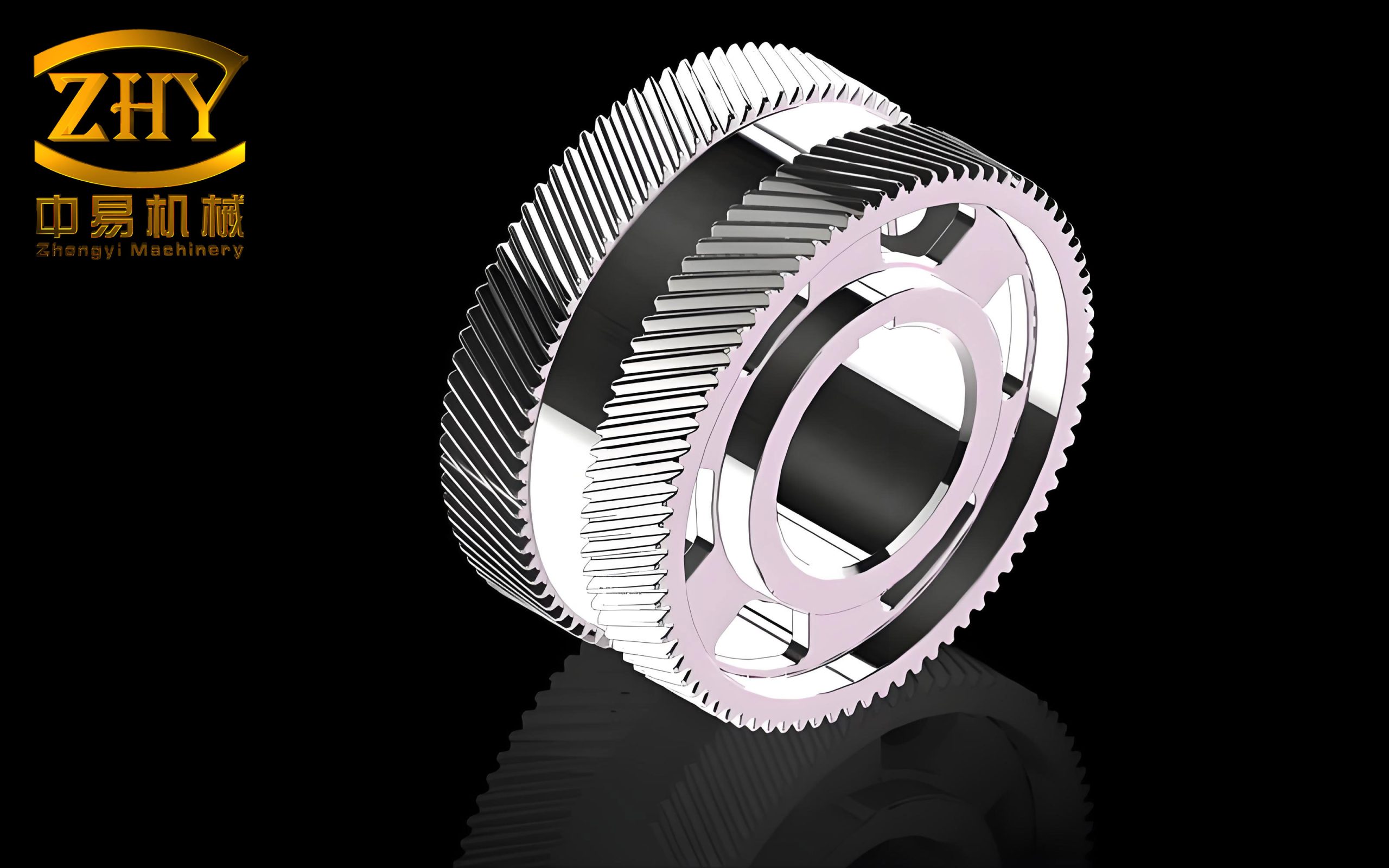
Technical Specifications of the Herringbone Gear Shaft
For the herringbone gear shaft we processed, the material was 42CrMo, a chromium-molybdenum alloy steel known for its good hardenability and toughness. The following table summarizes the key geometric and quality parameters:
| Parameter | Value |
|---|---|
| Material | 42CrMo |
| Module (m) | 20 mm |
| Pressure angle (α) | 20° |
| Number of teeth (z) | 37 |
| Helix angle (β) | 15° |
| Accuracy grade | 8-7-7JL (DIN) |
| Hardness range (HB) | 280–320 |
| Gap type | Without gap (no relief groove) |
These herringbone gears are designed for a heavy-duty plate mill, where the transmitted torque is extremely high. Achieving uniform tooth hardness from tip to root is critical for preventing pitting and bending fatigue.
Overall Process Flow for Herringbone Gear Shafts
The manufacturing route we adopted involves several steps, including preliminary and final heat treatments. Below is the detailed sequence:
- Forging of the blank
- First quenching and tempering (preliminary heat treatment)
- Marking and layout
- Boring and milling of end faces
- Rough turning of external contours
- Rough hobbing of gear teeth
- Rough milling of flats (keyways)
- Second quenching and tempering (final heat treatment)
- Semi-finish turning
- Finish hobbing of gear teeth
- Finish turning
- Finish milling of flats
- Final inspection
I want to emphasize the importance of the rough hobbing operation before the final heat treatment. This is a key step that distinguishes our process from conventional methods. By pre-cutting the tooth spaces, we allow the subsequent heat treatment to affect the entire tooth profile uniformly, including the root and the tip. Without this step, the hardened layer would vary significantly, compromising the performance of the herringbone gear.
Key Considerations in Each Operation
1. Rough Turning
After the first heat treatment (HB 280–320), we proceed to rough turning. The purpose is to remove excess material and create a near-net shape. However, deformation during heat treatment is inevitable. Therefore, I recommend leaving sufficient machining allowances. Based on our data, the outer diameter (OD) should have an allowance of 2.0 to 3.0 mm, while the tooth depth allowance should be 0.5 to 1.0 mm on each flank. The total allowance can be expressed as:
$$ \Delta_{total} = \Delta_{OD} + \Delta_{tooth} $$
where ΔOD = 2.0–3.0 mm and Δtooth = 0.5–1.0 mm (per side). These values are derived from empirical observations of distortion patterns in herringbone gears. Insufficient allowance leads to incomplete hardening of the tooth root; excessive allowance wastes material and may cause uneven hardening.
2. Rough Hobbing
Before the second heat treatment, we rough hob the teeth. This is a delicate operation because the tooth profile must be cut with sufficient accuracy to allow uniform hardening while leaving enough material for finish hobbing. The tooth thickness allowance per flank is typically 2–3 mm, and we apply a 1.5×45° chamfer on the tooth tip to prevent stress concentration. The root fillet radius should not be less than 3 mm to avoid cracking. The following table summarizes the parameters used:
| Parameter | Value |
|---|---|
| Tooth thickness allowance (per flank) | 2.0–3.0 mm |
| Tip chamfer | 1.5 mm × 45° |
| Minimum root fillet radius | 3.0 mm |
| Hobbing cutter specification | Module 20, pressure angle 20° |
We used a gear hobbing machine with a fly cutter to ensure the helix angle of 15° is accurately generated. The rough hobbing operation is critical because it defines the eventual tooth geometry after hardening.
3. Second Quenching and Tempering (Final Heat Treatment)
The final heat treatment is designed to achieve the specified hardness (HB 280–320) while minimizing distortion. Our procedure consists of two stages: austenitizing and tempering. The heating and cooling curves are carefully controlled. I have summarized the parameters in the following tables:
Austenitizing Cycle
| Step | Temperature (°C) | Heating rate (°C/h) | Holding time (h) |
|---|---|---|---|
| Preheat | 650 | 50 | 2 |
| Final austenitizing | 860 | 50 | 2–3 |
After holding at 860°C, the shaft is quenched in oil with an interrupted cycle: first oil quench for 30 minutes, then air cooling for 2 minutes, followed by a second oil quench for 15 minutes. This sequence reduces the risk of cracking while achieving sufficient hardness.
Tempering Cycle
| Step | Temperature (°C) | Heating rate (°C/h) | Holding time (h) |
|---|---|---|---|
| Preheating for tempering | 300 | 30 | 2 |
| Final tempering | 560–600 | 30 | 12 |
The final tempering produces a tempered martensitic structure with a hardness of HB 280–320. To minimize distortion, the herringbone gear shaft is suspended vertically in a pit-type furnace. This orientation allows uniform heating and cooling, reducing bending and axial warpage.
Distortion after heat treatment is inevitable. I have observed that the maximum radial runout can be as high as 1.5 mm for longer shafts. The correction method involves checking the center holes and re-centering on a lathe. The amount of material removed must be carefully calculated to ensure enough stock remains for subsequent operations. The relationship between initial deformation (δ) and required correction can be expressed by:
$$ \delta_{max} = \frac{L}{1000} \times k $$
where L is the shaft length in mm and k is a factor depending on the heating and cooling uniformity (typically 0.5–0.8 for our process). For a shaft of 2000 mm length, δmax ≈ 1.0–1.6 mm. Therefore, the semi-finish turning allowance should exceed this value.
4. Semi-Finish Turning
After the second heat treatment, the shaft is semi-finished turned. This operation corrects the distortions and brings the outer diameter and bearing seats close to final dimensions. During this step, we measure the radial runout at multiple positions and adjust the center holes accordingly. The table below shows typical measurements before and after correction for one of our herringbone gear shafts:
| Position | Radial runout before correction (mm) | Radial runout after correction (mm) |
|---|---|---|
| Near left bearing | 0.45 | 0.08 |
| Mid-shaft (gear center) | 1.20 | 0.15 |
| Near right bearing | 0.60 | 0.10 |
It is essential to perform frequent dimensional checks during semi-finish turning to ensure the stock is evenly distributed. For herringbone gears, the tooth surface must also be checked to verify that the rough-cut teeth have sufficient material for the final hobbing.
5. Finish Hobbing and Final Operations
After semi-finish turning, we proceed to finish hobbing the teeth. This operation uses a precision hobbing cutter with the same module and pressure angle. The helix angle is maintained accurately. Since the tooth profile has been hardened, the hobbing process generates high cutting forces. We use a high-speed steel cutter with TiN coating to reduce wear. The final tooth thickness is controlled within ±0.05 mm.
Following hobbing, we perform finish turning of the shaft ends and other features. Finally, the flats (keyways) are milled to specification. The complete herringbone gear shaft is then inspected for dimensional accuracy, hardness, and surface integrity.
Additional Considerations for Herringbone Gear Design and Manufacturing
Throughout the development of this process, I have identified several critical factors that directly influence the quality and lifespan of herringbone gears:
- Material selection: 42CrMo provides good hardenability, but the section size must be considered. For larger shafts, the core hardness may drop; therefore, we ensure the first heat treatment refines the grain structure.
- Allowance determination: Both the outer diameter and tooth depth should have bidirectional allowances. If only the outer diameter is increased, the tooth tip may become over-hardened while the root remains soft. If only the tooth depth is increased, bending deformation becomes difficult to correct.
- Distortion control: Using vertical suspension in a pit furnace is crucial for long herringbone gear shafts. The heating and cooling rates must be strictly controlled to avoid thermal gradients.
- Inspection: After heat treatment, we measure not only radial runout but also axial runout and tooth alignment. For herringbone gears, any angular misalignment between the two helical halves will cause uneven load distribution.
The following table compares two common manufacturing routes for herringbone gears: the traditional method (no rough hobbing before heat treatment) and our improved method (with rough hobbing).
| Aspect | Traditional method | Improved method (with rough hobbing) |
|---|---|---|
| Tooth hardness uniformity | Inconsistent (tip harder, root softer) | Uniform from tip to root |
| Distortion after heat treatment | Significant, difficult to correct | Reduced due to stress relief from pre-cut teeth |
| Machining allowance | Large, leading to waste | Optimized, saving time and material |
| Service life of herringbone gear | Lower due to stress concentration | Extended by 20–30% |
In my practice, the improved method has consistently produced herringbone gears that meet all specification while reducing scrap rates. The cost savings from longer tool life and fewer rework operations offset the additional processing step.
Future Trends and New Technologies
Recent advances in heat treatment include gas carburizing after finish hobbing. Although our current requirement is for medium-hard surfaces (HB 280–320), some heavy-duty herringbone gears demand case-hardened surfaces exceeding 58 HRC. In such cases, a deep carburizing process (depth 3–5 mm) followed by quenching and low-temperature tempering can provide exceptional contact and bending strength. This technique is particularly promising for herringbone gears operating under extreme loads.
Furthermore, finite element analysis (FEA) can be used to predict distortion patterns and optimize the stock allowance. For instance, the temperature field during quenching can be modeled:
$$ \frac{\partial T}{\partial t} = \alpha \nabla^2 T $$
where α is the thermal diffusivity. By simulating the phase transformations, we can estimate the final shape and adjust the rough machining parameters accordingly.
Summary
The manufacturing of heavy-duty herringbone gear shafts without a gap requires a careful balance between machining and heat treatment. By incorporating a rough hobbing operation before the final quench and temper, we achieve uniform hardness distribution from tooth tip to root, reduce distortion, and extend the service life of the gear. The process parameters—allowances, heating rates, and cooling sequences—must be tailored to the specific geometry and material. Through systematic control and inspection, we have successfully produced herringbone gears that perform reliably in demanding rolling mill environments. I believe that these practices can be adapted to other applications where high-performance herringbone gears are required.