
In the field of precision gear manufacturing, gear honing, particularly internal gear honing, stands as a critical finishing process for hardened gears. This method is essential for achieving high dimensional accuracy and superior surface quality in automotive transmission components. The core challenge in this process lies in the precise dressing of the internal honing wheel using a gear-shaped diamond dressing tool. In this extensive analysis, I will delve into the methodology for creating such diamond dressing tools, conduct a detailed spatial meshing theory analysis for both the dressing and honing processes, and present experimental validation. Throughout this discussion, the term ‘gear honing’ will be frequently emphasized to underscore its centrality. The integration of theoretical models, practical fabrication techniques, and experimental data aims to provide a holistic understanding of this sophisticated manufacturing process.
The principle of gear honing involves a two-step enveloping process. First, a diamond dressing wheel, conjugate to the desired workpiece, is used to generate the complex tooth surface of the internal honing wheel. Second, this honing wheel then machines the final workpiece gear through an internal spatial meshing arrangement. This secondary enveloping action, combined with a high degree of contact overlap, provides excellent error-averaging capabilities, making gear honing more than just a polishing operation but a true precision finishing method.
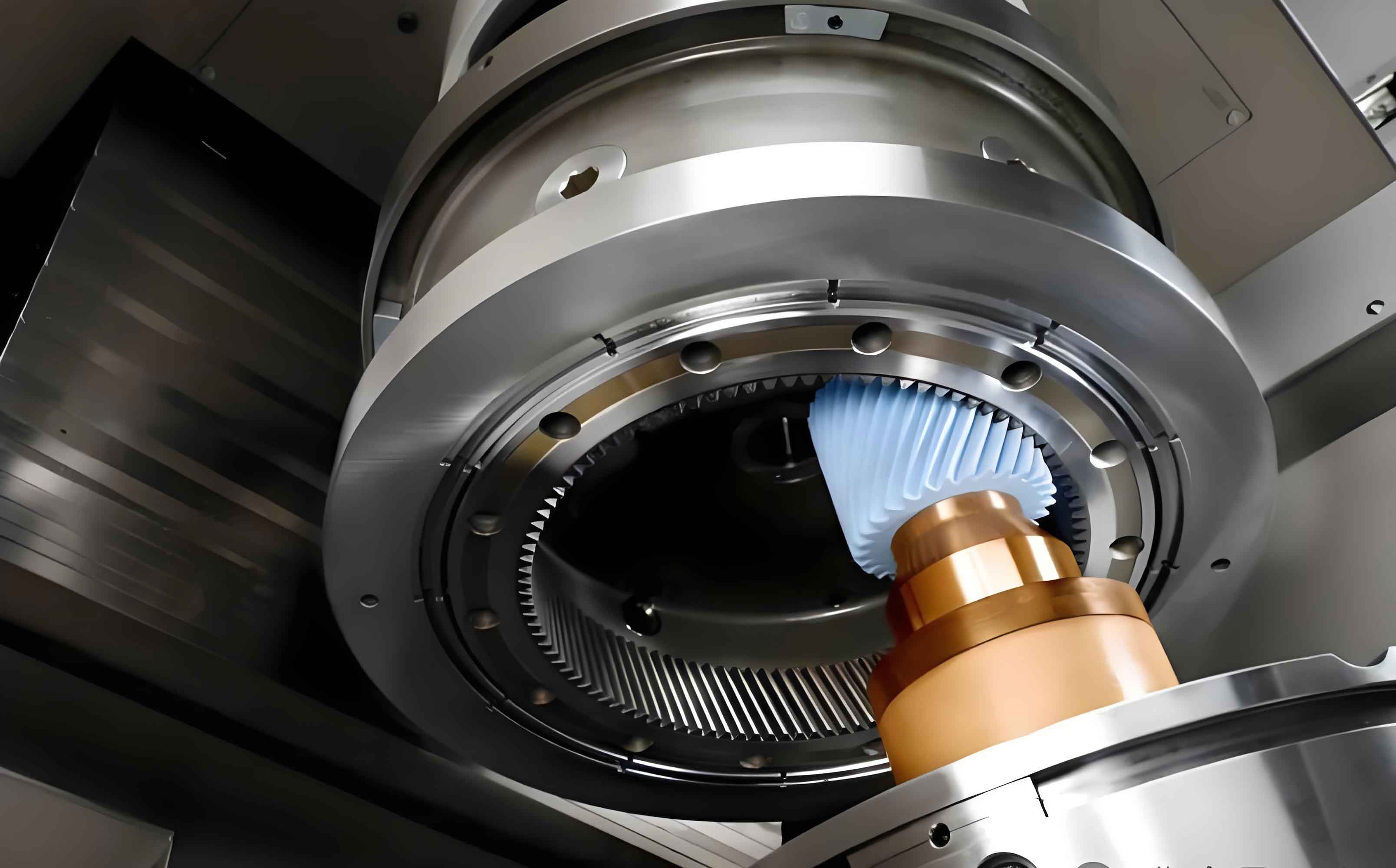
The successful application of gear honing is heavily dependent on the quality of the diamond dressing wheel. The wheel must exhibit exceptional dimensional and geometric accuracy, uniform distribution of abrasive grains with consistent protrusion height, and strong bonding between the coating, abrasives, and substrate. Two primary electroplating methods exist: external plating and internal plating. The external plating method directly deposits a layer of diamond grains onto the gear-shaped substrate. While simpler, it suffers from the “edge effect” of the electrical field during plating and variations in grit size, leading to inconsistent grain height and lower precision. The internal plating method involves creating a negative mold of the dressing wheel, plating diamonds onto this mold, transferring them to the substrate via electroforming, and finally removing the mold. This process is complex and demands high precision in equipment and technique but yields superior accuracy and durability, which is why high-end commercial dressing wheels often employ this method. In my practical work, I utilized the external plating method but implemented stringent controls to achieve the necessary precision for effective gear honing.
To quantify the process parameters and their impact on the final gear honing outcome, I have compiled key aspects of dressing wheel fabrication and honing process variables into the following table. This table summarizes critical factors influencing the quality and performance of the gear honing system.
| Process Stage | Key Parameter | Target Specification / Influence | Control Method |
|---|---|---|---|
| Dressing Wheel Fabrication | Abrasive Grit Size | Uniformity (e.g., 120# mesh) | Precision sieving using standard test sieves |
| Substrate Geometry | High-precision gear profile (Grade 3-5 per GB10095) | Grinding on precision gear grinding machines (e.g., MAAG) | |
| Electroplating Process | Uniform grain distribution and adhesion | Use of auxiliary anodes to homogenize electric field | |
| Gear Honing Process | Shaft Crossed-Angle (Σ) | Elimination of meshing boundary lines | Theoretical calculation and machine setup adjustment |
| Center Distance (a) | Proper meshing pressure and contact pattern | Controlled infeed on the honing machine |
The theoretical foundation for gear honing is rooted in spatial gearing theory. The process involves the meshing between the dressing wheel (gear 1), the internal honing wheel (gear 2), and finally the workpiece. To analyze this, I establish a fixed coordinate system S(O-i, j, k) where the Z-axis coincides with the dressing wheel’s axis. Another fixed system S_p(O_p-i_p, j_p, k_p) is set with its Z_p axis along the honing wheel’s axis. The two axes are crossed at an angle Σ (0 < Σ < π). The X and X_p axes coincide along the direction of the shortest distance between the two axes, with OO_p equal to the center distance ‘a’. Coordinate systems S_1 and S_2 are attached to the dressing wheel and honing wheel, respectively. When the dressing wheel rotates by an angle φ_1, the honing wheel rotates by φ_2. The tooth surface of the helical dressing wheel in its own coordinate system S_1 can be represented as a helicoid. For a standard involute helical gear, the surface equation is:
$$ \mathbf{r}_1 = R_b(\cos\theta – \nu\sin\theta) \mathbf{i}_1 + R_b(\sin\theta + \nu\cos\theta) \mathbf{j}_1 + p(\theta + \nu) \mathbf{k}_1 $$
Here, \(R_b\) is the base radius, \(\theta\) is the involute roll angle, \(\nu\) is a parameter along the tooth depth, and \(p\) is the helix parameter (\(p = R_b \tan\beta_b\), where \(\beta_b\) is the base helix angle). The fundamental equation of meshing, which defines the condition for contact between two conjugate surfaces, is given by \(\Phi = \mathbf{n} \cdot \mathbf{V}_{12} = 0\), where \(\mathbf{n}\) is the unit normal to the surface and \(\mathbf{V}_{12}\) is the relative velocity at the potential contact point. By calculating \(\mathbf{n}\) from the surface derivatives and \(\mathbf{V}_{12}\) from the spatial kinematics of the internal meshing pair, the meshing equation for the dressing process is derived. After thorough algebraic manipulation, I obtain the following relation:
$$ U \cos(\theta + \varphi_1) – V \sin(\theta + \varphi_1) = W $$
where the coefficients U, V, and W are defined as:
$$
\begin{aligned}
U &= -p a i_{21} \cos\Sigma + i_{21} \sin\Sigma \cdot R_b^2 \\
V &= p^2 i_{21} \sin\Sigma \cdot \theta + p^2 i_{21} \sin\Sigma \cdot \nu + i_{21} \sin\Sigma \cdot R_b^2 \nu \\
W &= p R_b – p R_b i_{21} \cos\Sigma + i_{21} \sin\Sigma \cdot R_b a
\end{aligned}
$$
In these equations, \(i_{21} = \omega_2 / \omega_1 = z_1 / z_2\) is the gear ratio (z being the number of teeth). This equation can be solved explicitly for the parameter \(\nu\) as a function of \(\theta\) and \(\varphi_1\):
$$ \nu = \nu(\theta, \varphi_1) = -\frac{p^2 \theta}{p^2 + R_b^2} – \frac{ p R_b – p \cos\Sigma \cdot i_{12}[-a \cos(\theta+\varphi_1) + R_b] – \sin(\theta+\varphi_1) i_{12} \sin\Sigma \times \left\{ -R_b \sin\Sigma \cdot i_{12}[R_b \cos(\theta+\varphi_1) – a] \right\} }{(p^2 + R_b^2)} $$
Here, \(i_{12} = 1/i_{21}\). Substituting this expression for \(\nu\) back into equation (1) yields the family of contact lines on the dressing wheel’s tooth surface for each instant (fixed φ1). This demonstrates that the meshing during dressing is a line contact process. The generated surface of the internal honing wheel is then the envelope of these contact lines. Transforming the coordinates of the dressing wheel surface point \(\mathbf{r}_1\) into the honing wheel’s coordinate system S_2 gives the mathematical description of the honed honing wheel tooth surface, which is no longer a pure involute helicoid but an enveloping surface derived from one. The transformation is given by:
$$
\begin{aligned}
\mathbf{r}_2 &= x_2 \mathbf{i}_2 + y_2 \mathbf{j}_2 + z_2 \mathbf{k}_2 \\
x_2 &= (x_1 \cos\varphi_1 – y_1 \sin\varphi_1 – a)\cos\varphi_2 + (x_1 \sin\varphi_1 \cos\Sigma + y_1 \cos\varphi_1 \cos\Sigma – z_1 \sin\Sigma)\sin\varphi_2 \\
y_2 &= -(x_1 \cos\varphi_1 – y_1 \sin\varphi_1 – a)\sin\varphi_2 + (x_1 \sin\varphi_1 \cos\Sigma + y_1 \cos\varphi_1 \cos\Sigma – z_1 \sin\Sigma)\cos\varphi_2 \\
z_2 &= x_1 \sin\varphi_1 \sin\Sigma + y_1 \cos\varphi_1 \sin\Sigma + z_1 \cos\Sigma
\end{aligned}
$$
where \(x_1, y_1, z_1\) are the components from equation (1). The honing wheel surface \(\mathbf{r}_2\) is thus defined parametrically by \(\theta\) and \(\varphi_1\), with \(\nu\) determined by the meshing condition.
The subsequent gear honing process, where this honing wheel machines the workpiece, constitutes a second envelope. Two distinct scenarios arise. In the first, the workpiece has identical basic geometric parameters (module, pressure angle, helix angle, and number of teeth) as the original dressing wheel. In this ideal replication case, the meshing between the honing wheel and the workpiece results in double-line contact. One line is the recurrence of the original contact line from the dressing stage, and a second, new contact line appears due to points on the dressing wheel surface entering the meshing zone a second time. These two families of contact lines intersect along the “meshing boundary line” from the first enveloping process. For high-fidelity gear honing, it is undesirable to have this new contact line, as it modifies the intended tooth form. Therefore, a key theoretical objective is to adjust the process parameters so that this meshing boundary line lies outside the active tooth surface of the dressing wheel. The condition for a point on the dressing wheel surface to be a meshing boundary point is given by simultaneously satisfying the meshing equation \(\Phi=0\) and its derivative with respect to the motion parameter \(\partial \Phi / \partial \varphi_1 = 0\). This leads to the condition:
$$ U^2 + V^2 = W^2 $$
Substituting the expressions for U, V, and W yields a quadratic equation in \(\nu\). The discriminant \(A\) of this equation determines the existence of boundary lines on the dressing wheel tooth surface:
$$ A = (p R_b – i_{21} p R_b \cos\Sigma + R_b i_{21} a \sin\Sigma)^2 – (-p a i_{21} \cos\Sigma + R_b^2 i_{21} \sin\Sigma)^2 $$
The analysis shows that by properly selecting the shaft crossed-angle Σ, the condition A < 0 can be achieved, thereby eliminating the meshing boundary line from the active tooth profile. This is a crucial finding for optimizing the gear honing setup.
In the more common and practical second scenario, the workpiece and the dressing wheel have different tooth numbers, though typically similar. This enhances the flexibility and economy of the gear honing process by allowing a single dressing wheel to prepare honing wheels for a range of workpiece gears. In this case, the center distance and gear ratio for the second enveloping (honing) differ slightly from those of the first (dressing). The mathematical analysis becomes significantly more complex. The tooth surface of the final workpiece is a secondary envelope of the honing wheel surface, which itself is an envelope. The resulting surface equation is highly intricate. To evaluate the accuracy of the gear honing process under these conditions, I performed a numerical error analysis. The theoretical tooth surface of the honed workpiece is compared point-by-point with the ideal involute helicoid surface of a standard gear with the same nominal parameters. The differences constitute the profile deviation (form error) and lead deviation (alignment error). The following table presents a sample of calculated surface error data for a honed workpiece at various evaluation points across the tooth flank, demonstrating the nanoscale-level deviations achievable with a well-controlled gear honing process.
| Evaluation Point Zone | Profile Error (μm) | Lead Error (μm) | Composite Error (μm) | Theoretical Prediction (μm) | Experimental Mean (μm) |
|---|---|---|---|---|---|
| Tip (I) | 0.450 | 0.157 | 0.064 | 0.451 | 0.440 |
| Upper Flank (II) | 0.451 | 0.154 | 0.067 | 0.150 | 0.442 |
| Pitch (III) | 0.402 | 0.121 | 0.000 | 0.101 | 0.390 |
| Lower Flank (IV) | 0.470 | 0.163 | 0.075 | 0.150 | 0.447 |
| Root (V) | 0.461 | 0.150 | 0.063 | 0.148 | 0.457 |
The experimental validation of this gear honing theory is paramount. I conducted honing trials using a commercially available internal gear honing machine. The honing wheel parameters were: module \(m_n = 3\) mm, number of teeth \(z_h = 105\), helix angle \(\beta = 15^\circ\), face width \(B = 40\) mm. The test workpiece was a spur gear with \(m = 3\) mm, \(z_w = 25\), \(\beta = 0^\circ\), \(B = 25\) mm, made from hardened 40Cr steel. The diamond dressing wheel was fabricated in-house using the controlled external plating method with 120-grit diamonds, having geometric parameters identical to the workpiece. The key steps of the gear honing experiment were as follows:
1. Dressing Wheel Setup and Honing Wheel Dressing: Based on the theoretical analysis, a shaft crossed-angle Σ of 15° was calculated to avoid meshing boundary lines. The honing machine’s wheel head was set to this angle. The diamond dressing wheel was mounted on the workpiece spindle. The honing wheel was then fed radially inward along the center distance direction until the prescribed contact pressure between the dressing wheel and the honing wheel teeth was established. The machine was activated, allowing the dressing wheel to profile the honing wheel’s internal teeth through the spatial meshing action described by the earlier equations.
2. Workpiece Honing: After dressing, the diamond wheel was replaced with the test workpiece gear. The same honing wheel was used to hone the workpiece to its final dimensions under similar machining conditions. The process parameters like rotational speed and feed were maintained consistently.
The honed workpiece was then measured on a precision gear measuring center. The resulting tooth profile trace exhibited excellent conformity to the theoretical involute, with deviations well within the tolerance for a DIN 7-8 grade gear. The profile chart showed a smooth, continuous curve with minimal waviness, confirming the effective error-averaging characteristic of the gear honing process. The success of this experiment hinged on the precision of the diamond dressing wheel. The self-made wheel performed comparably to expensive imported counterparts, successfully generating the required complex envelope on the honing wheel which in turn produced a high-quality workpiece. This demonstrates that with careful process control in fabrication—specifically, precision grinding of the substrate, meticulous grit sieving, and optimized electroplating with auxiliary anodes—the external plating method can yield dressing tools fully capable of supporting high-precision gear honing operations.
To further illustrate the kinematic and dynamic relationships in gear honing, let’s consider some fundamental formulas that govern the process. The effective gear honing action relies on the precise relative motion. The transmission relationship between the honing wheel and the workpiece is given by \(i_{hw} = \omega_h / \omega_w = z_w / z_h\), where the subscripts ‘h’ and ‘w’ denote honing wheel and workpiece, respectively. The theoretical contact path on the tooth flank can be analyzed using the derived equations. Furthermore, the material removal rate (MRR) in gear honing, while typically low as it is a finishing process, can be modeled considering the relative sliding velocity \(V_s\) and the normal force \(F_n\). A simplified expression for the volumetric removal rate per tooth contact might be approximated as:
$$ \dot{Q} \propto k \cdot V_s \cdot F_n \cdot t $$
where \(k\) is a process-dependent constant encompassing abrasive properties and lubrication, and \(t\) is the honing time. The relative sliding velocity is a function of the rotational speeds, base radii, and shaft angle:
$$ V_s = \sqrt{ (\omega_h R_{b,h} – \omega_w R_{b,w} \cos\Sigma)^2 + (\omega_w R_{b,w} \sin\Sigma)^2 } $$
These formulas, while simplified, highlight the parameters that can be optimized in a gear honing process to control efficiency and surface generation.
In conclusion, this comprehensive exploration of gear honing has covered the intricate journey from tool making to theoretical analysis and experimental verification. The self-manufactured diamond dressing wheel, produced via an enhanced external plating methodology, proved to be entirely satisfactory for the demanding task of profiling internal honing wheels. The spatial meshing theory analysis provided clear insights into the line-contact nature of the dressing process and the conditions necessary to avoid unwanted secondary contact lines during honing, primarily through the strategic selection of the shaft crossed-angle Σ. The experimental trials confirmed that the internal gear honing process is not only capable of improving surface finish but also of significantly enhancing geometric accuracy through its error-averaging effect, attributable to the large contact ratio and enveloping action. The viability of producing critical components like diamond dressing wheels domestically at high precision breaks a major technological bottleneck, potentially reducing costs and promoting the wider adoption of advanced gear honing technology in various manufacturing sectors. Future work could focus on dynamic modeling of the honing process, optimization of abrasive grain characteristics for different materials, and the development of adaptive control systems for in-process correction, further solidifying gear honing’s position as a premier hard gear finishing solution.