
The development of robust drivetrain components for heavy-duty mining equipment, such as shearers, presents significant material and manufacturing challenges. Traditional methods involving monolithic forging of gear shafts often lead to issues like cracking in the tooth root or end faces under cyclical impact loads. Furthermore, this approach is materially inefficient and poorly suited for batch production of multiple specifications. A promising alternative is the use of welded structures, combining a high-strength alloy steel gear ring with a shaft. However, this innovation introduces a critical metallurgical hurdle: managing the complex interplay of materials during post-weld heat treatment (PWHT) to prevent a spectrum of potential heat treatment defects. This article details a comprehensive study and the resulting holistic process strategy developed to manufacture reliable welded gear shafts, focusing specifically on mitigating the heat treatment defects of cracking, distortion, and microstructural inhomogeneity.
The gear shaft assembly in question consists of a gear ring made from 34CrNiMo steel welded to a shaft made from 42CrMo steel. The final assembly must achieve a uniform hardness in the range of 350-380 HBW to ensure the required combination of high strength and good toughness for its demanding service environment. The core challenge stems from joining two medium-carbon, low-alloy quenched and tempered steels with differing chemical compositions. This material dissimilarity is the root cause of amplified heat treatment defects during the essential quenching and tempering operation.
Fundamental Analysis of Potential Heat Treatment Defects
Before devising a solution, a thorough understanding of the failure mechanisms is necessary. The primary heat treatment defects anticipated in this welded assembly are:
- Quench Cracking: This is the most catastrophic defect. It arises from the superimposition of thermal stress and transformation (phase) stress exceeding the material’s fracture strength at a given temperature.
- Thermal Stress ($\sigma_{th}$): Generated due to differential thermal contraction/expansion during heating and cooling. The rate of heat transfer is governed by Fourier’s law and the thermal diffusivity ($\alpha$), which differs between 34CrNiMo and 42CrMo.
$$\alpha = \frac{k}{\rho C_p}$$
where \(k\) is thermal conductivity, \(\rho\) is density, and \(C_p\) is specific heat capacity. This difference in \(\alpha\) creates a temperature gradient and unequal dimensional changes, elevating thermal stress. - Transformation Stress ($\sigma_{tr}$): Generated when the austenite-to-martensite transformation occurs at different times in different regions. The martensite start temperature (\(M_s\)) is critical:
$$M_s (°C) \approx 539 – 423C – 30.4Mn – 17.7Ni – 12.1Cr – 7.5Mo$$
(Where element symbols represent weight percent). The differing \(M_s\) points of the base metals and the weld metal cause non-uniform volume expansion during transformation, creating significant internal stresses. The total stress driving crack initiation can be conceptualized as:
$$\sigma_{total} \approx \sigma_{th} + \sigma_{tr}$$
- Thermal Stress ($\sigma_{th}$): Generated due to differential thermal contraction/expansion during heating and cooling. The rate of heat transfer is governed by Fourier’s law and the thermal diffusivity ($\alpha$), which differs between 34CrNiMo and 42CrMo.
- Distortion and Warpage: A direct consequence of the same stresses that cause cracking. The asymmetric geometry of a gear ring welded to a slender shaft, with significant cross-sectional differences, exacerbates this issue. The gear teeth, acting as cantilevers, are prone to sagging under their own weight at elevated temperatures. The high tempering temperature (~500°C) required for good toughness further allows for stress-relief-driven distortion.
- Microstructural Defects in the Heat-Affected Zone (HAZ): The welding process itself creates a thermally altered region adjacent to the weld. During subsequent heat treatment, this can lead to:
- Embrittlement/Hardening: Formation of undesirable high-carbon martensite in regions that experienced a specific thermal cycle.
- Softening: Over-tempering of a region of the HAZ, creating a localized zone of lower strength and hardness, which can act as a failure initiation site.
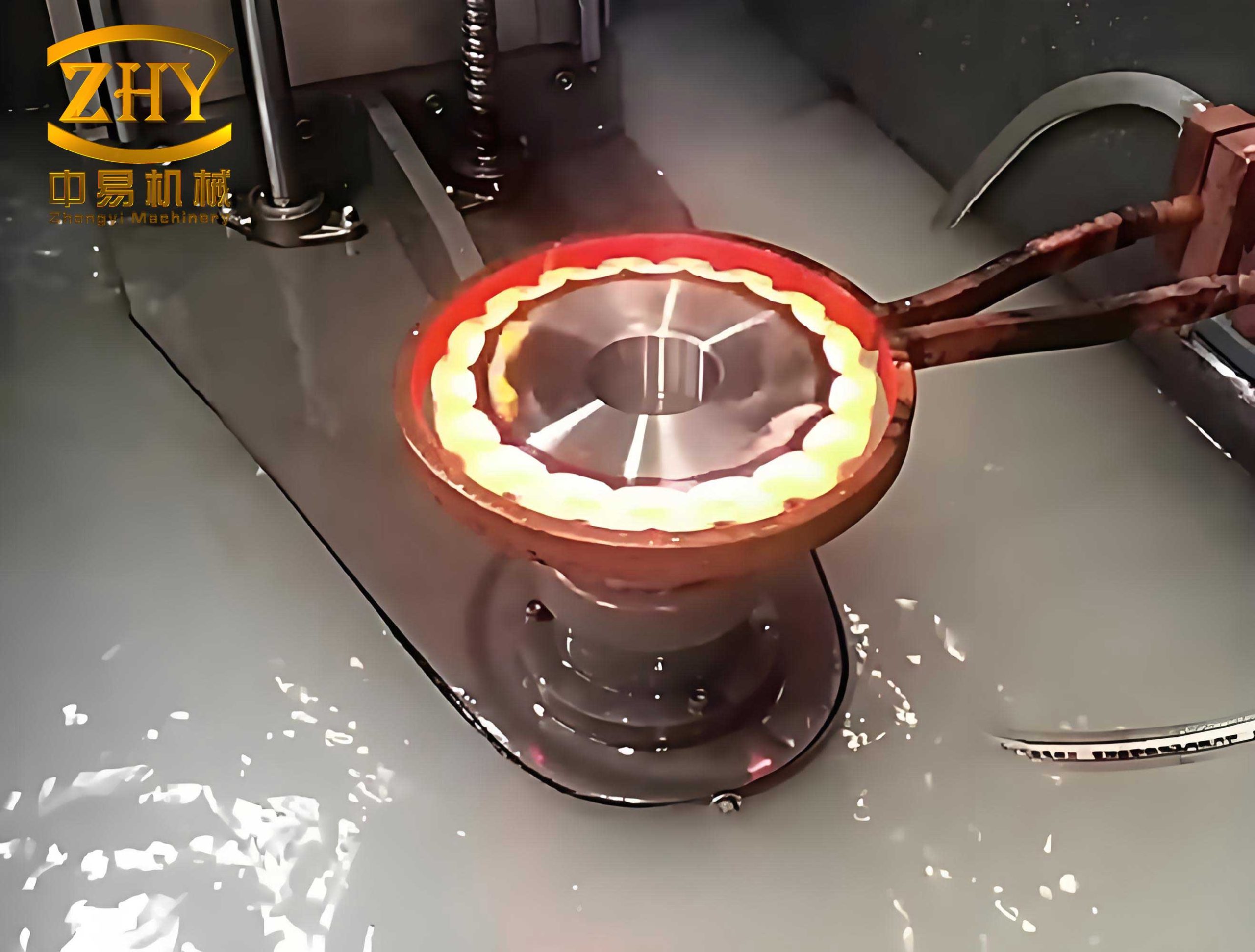
The following table summarizes these primary heat treatment defects, their root causes, and their potential impact on the gear shaft’s performance.
| Defect Category | Root Cause | Primary Contributing Factors | Potential Consequence |
|---|---|---|---|
| Quench Cracking | Excessive total internal stress ($\sigma_{total}$) | Material dissimilarity (different $\alpha$, $M_s$), rapid quenching, part geometry. | Catastrophic failure; scrap part. |
| Distortion | Non-uniform plastic yielding from $\sigma_{th}$ and $\sigma_{tr}$ | Asymmetric geometry, temperature gradients, self-weight sagging at high temperature. | Loss of dimensional accuracy; improper gear mesh. |
| HAZ Embrittlement | Formation of untempered, high-carbon martensite | Specific welding thermal cycle creating a carbon-enriched region. | Low toughness; crack initiation under impact. |
| HAZ Softening | Over-tempering of a sub-region of the HAZ | The welding cycle creating a region that experiences an effective high tempering temperature. | Reduced local strength; potential yielding under load. |
Holistic Process Development Strategy
To combat these intertwined heat treatment defects, a multi-stage, integrated process was developed. The strategy focuses on stress management, microstructure homogenization, and distortion control at every step.
1. Pre-Weld Heat Treatment: The Foundation
A critical initial step is the individual heat treatment of both the 34CrNiMo gear ring blank and the 42CrMo shaft before welding. They are quenched and tempered to a medium hardness of 230-270 HBW. This achieves several key objectives:
- Homogenizes Microstructure: Creates a uniform, fine-grained tempered martensite/sorbite structure, providing a consistent and predictable starting condition for the weld thermal cycle.
- Reduces Susceptibility to Welding Cracks: A lower carbon equivalent in a tempered structure reduces the risk of hydrogen-induced cold cracking during welding.
- Mitigates Final Distortion: By starting with a stress-relieved, stable structure, the dimensional changes during the final post-weld quench and temper are reduced.
2. Welding and Intermediate Stress Relief
Welding is performed using a carefully selected filler metal. To further address the risk of heat treatment defects related to the HAZ, a buttering layer technique was investigated. This involves depositing a layer of low-carbon steel weld metal on the mating surfaces of the pre-hardened components before the final weld. This buttering layer creates a more gradual transition in chemistry and hardenability between the two dissimilar steels.
Immediately after welding, the entire assembly undergoes a stress-relief anneal in a pit-type furnace. This step is crucial for:
– Reducing residual welding stresses that would add to the total stress during quenching.
– Tempering any untempered martensite formed in the HAZ during welding, preventing premature embrittlement.
3. The Core: Optimized Post-Weld Quench & Temper
This is the most critical phase where the majority of heat treatment defects can manifest. A detailed protocol was established:
- Fixture for Distortion Control: A custom support stand is used to hold the gear shaft vertically in the pit furnace. This minimizes gear tooth sag (self-weight distortion) during heating and soaking.
- Rapid Heating Regime: The furnace is pre-heated to 900°C. The fixtured part is then charged directly into this high temperature and soaked at 860°C. This “high-temperature charging” minimizes the time spent in the oxidation range, reducing decarburization, and also helps reduce thermal gradients.
- Controlled Quenching: The part is quenched vertically (along its axis, the direction of least resistance to fluid flow) into agitated oil. A key innovation is ceasing the oil agitation once the part’s surface temperature drops below the average \(M_s\) point of the assembly. This allows the core to cool through its transformation more slowly, reducing the temperature gradient between surface and core and thereby lowering the peak transformation stress ($\sigma_{tr}$).
- Immediate Tempering: The quenched part is transferred to the tempering furnace without delay. Tempering at 500°C is conducted to achieve the target hardness (350-380 HBW) and, most importantly, to relieve the substantial quenching stresses, converting the brittle as-quenched martensite to tough tempered martensite/sorbite.
Experimental Validation and Results
To validate the process strategy, test blocks simulating the welded joint were produced under different conditions and subjected to mechanical testing and microstructural analysis. The results conclusively demonstrate the control of heat treatment defects.
Microstructural Analysis
| Sample Condition | Weld Metal Region | Heat-Affected Zone (HAZ) | Implication |
|---|---|---|---|
| As-Welded (Air Cooled) | Bainite (B) + Martensite (M, trace) | B + Ferrite (F) + M (localized) | Undesirable mixed structure; prone to embrittlement. |
| Full PWHT (Quench & Temper) | Tempered Sorbit (S) | Tempered Sorbit (S) | Uniform, fine, and tough microstructure. |
| Full PWHT with Buttering Layer | Tempered S + F + Pearlite (P) | Tempered S + F + P (minor) | Softer, more ductile transition zone; excellent stress accommodation. |
Mechanical Performance
The tensile and impact properties were quantitatively assessed, as shown below. The dramatic improvement from the optimized PWHT is evident.
| Sample ID & Condition | Tensile Strength (MPa) | Elongation (%) | Impact Toughness (J) | Fracture Location |
|---|---|---|---|---|
| As-Welded (Air Cooled) | 969.1 | 7.8 | 33.4 | HAZ |
| Full PWHT (Standard) | 1178.8 | 4.5 | 17.1 | Weld Metal |
| Full PWHT with Buttering | 1066.7 | 6.6 | 60.2 | Weld Metal |
The as-welded sample shows lower strength and moderate toughness, with failure in the brittle HAZ. The standard PWHT sample achieves very high strength but at the expense of ductility and toughness (failure in the weld metal). The sample with the buttering layer and PWHT presents the optimal balance: high strength, good ductility, and outstanding impact toughness, demonstrating effective mitigation of HAZ-related heat treatment defects.
Hardness Traverse
Hardness mapping confirms the uniformity achieved. The as-welded condition shows a dangerous peak hardness over 50 HRC (~510 HV) in the HAZ, a clear sign of hardening heat treatment defects. Both PWHT conditions show a very flat hardness profile across the weld joint, with the buttered sample showing a slightly softer and more gradual transition, ideal for stress distribution.
Industrial Application and Final Quality
The integrated process—pre-hardening, welding with buttering, stress relief, fixtured quenching with controlled cooling, and immediate tempering—was implemented in production. To accommodate the inevitable minimal distortion from the final heat treatment, a grinding allowance of 0.4 mm was left on the gear teeth prior to PWHT. The successful control of distortion-related heat treatment defects is proven by the fact that all post-treatment distortion values fell well within this allowance.
| Inspection Parameter | Technical Requirement | Measured Result (Range) | Status |
|---|---|---|---|
| Gear Ring Radial Runout | < 0.40 mm | 0.30 – 0.40 mm | Pass |
| Gear Ring Face Runout | < 2.00 mm | 1.00 – 1.10 mm | Pass |
| Shaft Straightness | < 2.50 mm | 1.50 – 1.80 mm | Pass |
| Hardness (HBW) | 350 – 380 | 370 – 380 | Pass |
Conclusion
The successful production of high-integrity welded gear shafts for mining machinery hinges on a systemic approach to preempting heat treatment defects. By recognizing that defects like quench cracking, distortion, and HAZ instability are not isolated issues but are interconnected through the physics of thermal and transformation stresses, a cohesive multi-stage process was engineered. The key findings are:
- Material and Process Synergy: The adoption of a welded structure is not merely a fabrication choice but a metallurgical system that must be managed from pre-weld conditioning through to final tempering. Pre-hardening the components establishes a stable, uniform baseline that significantly dampens the drivers for final distortion and cracking.
- Stress is the Common Enemy: Every step of the process is designed to manage, relieve, or minimize both thermal and transformation stresses. The buttering layer, post-weld stress relief, fixtured heating, and controlled-quench interruption are all targeted interventions to keep the total stress ($\sigma_{total}$) below the critical threshold for heat treatment defects.
- Distortion is Controllable: By combining fixturing, optimized heating cycles, and allowing for a precise grinding stock, the geometrical heat treatment defects can be reduced to a manageable, predictable level compatible with final precision machining.
- Performance Optimization: The full post-weld quench and temper cycle transforms the entire assembly—base metals, HAZ, and weld metal—into a homogeneous structure of tempered sorbite. This erases the weak or brittle zones created by welding, resulting in superior and consistent mechanical properties that often exceed those of a traditionally forged and locally hardened component.
This holistic methodology effectively transforms the potential weaknesses of a dissimilar-material welded joint into a strength, enabling material savings, manufacturing flexibility for batch production, and most importantly, delivering a component with reliable performance in the extreme conditions of mining operations. It provides a proven framework for addressing the complex heat treatment defects inherent in the manufacture of advanced welded power transmission components.