
In the intricate world of mechanical power transmission, few components present a challenge as fascinating as a pair of **spiral gears**. Their elegance lies in their ability to connect two shafts that are neither parallel nor intersecting, transmitting motion through a point contact that rolls and slides simultaneously. As an engineer who has spent considerable time designing these gears, I have found that while numerous formulas exist for calculating their geometry—involving ratios, center distances, and shaft angles—the process can be laborious, often requiring multiple iterative calculations to arrive at a correct and efficient design. Today, I wish to share a powerful yet underutilized tool in our arsenal: the graphical method, or circle diagram approach. This technique provides a swift, intuitive path to determining the vital parameters of a **spiral gear** pair, offering clarity that pure calculation sometimes obscures.
The core challenge in designing a **spiral gear** set is to define the geometry that will allow two non-parallel, non-intersecting pitch cones to mesh correctly. The essential parameters we seek are the pitch cone radii (\(R_1\), \(R_2\)) and the spiral angles (\(\alpha_1\), \(\alpha_2\)) for both the driving and driven gears. These are governed by two fundamental relationships derived from the geometry of meshing:
1. The sum of the pitch radii must equal the given center distance (\(C\)):
$$ R_1 + R_2 = C $$
2. The relationship between the spiral angles depends on the hand of the helices. For gears with the same hand of spiral, the difference of the spiral angles equals the shaft angle (\(\Sigma\)). For gears with opposite hands, the sum equals the shaft angle:
$$ \alpha_1 – \alpha_2 = \Sigma \quad \text{(Same Hand)} $$
$$ \alpha_1 + \alpha_2 = \Sigma \quad \text{(Opposite Hand)} $$
Additionally, the velocity ratio (\(i\)) is inversely proportional to the ratio of the numbers of teeth (\(N\)) and directly proportional to the ratio of the pitch radii:
$$ i = \frac{\omega_1}{\omega_2} = \frac{N_2}{N_1} = \frac{R_2}{R_1} $$
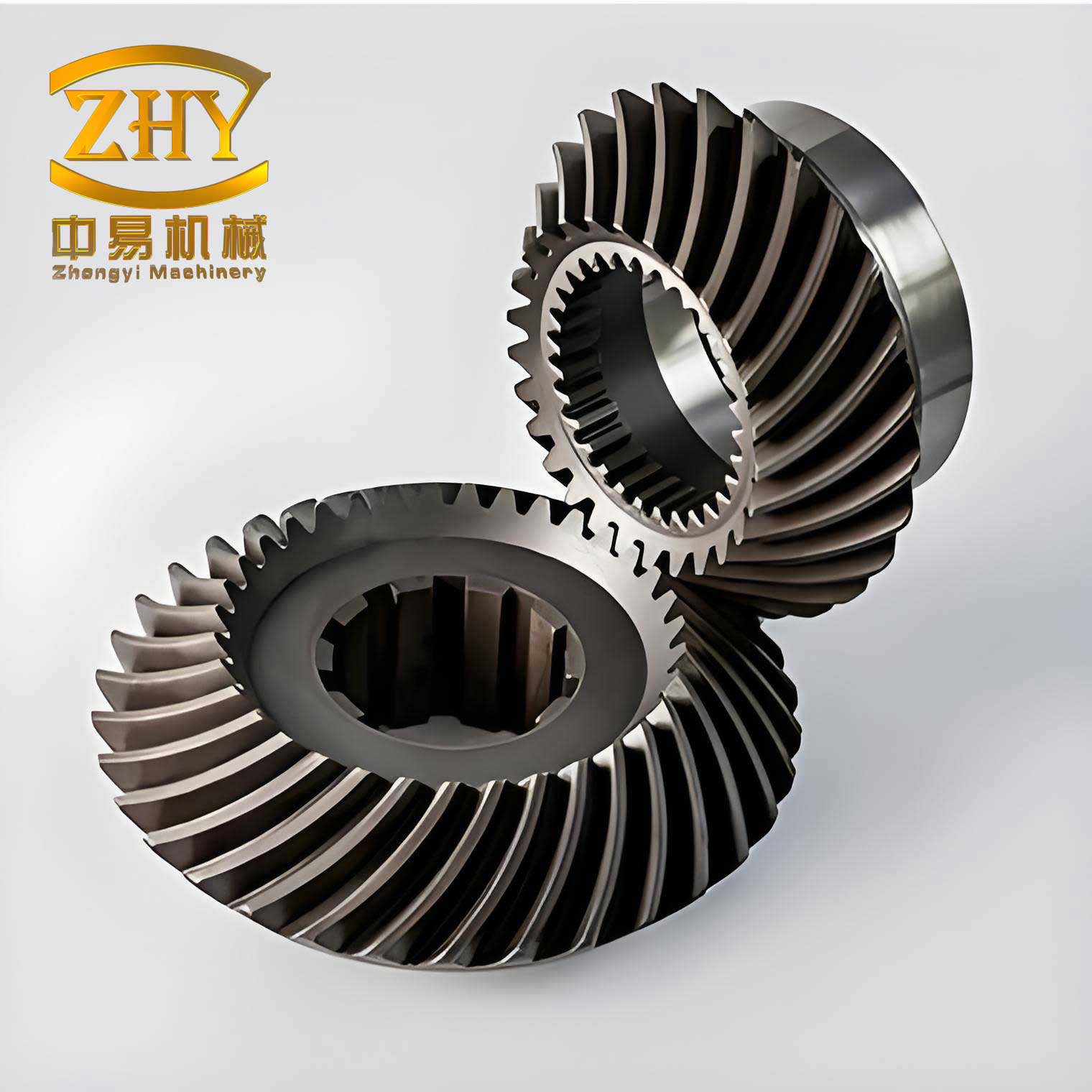
Before we can draw anything, we must make an initial, intelligent assumption. Based on the transmitted load, desired speed ratio, and overall size constraints, we must select a normal module (\(m_n\)) and tentative tooth numbers (\(N_1\), \(N_2\)) for our **spiral gear** pair. From these, we calculate the equivalent pitch diameters for straight bevel gears, which serve as our starting “representative circles.” The diameter of a representative circle is given by:
$$ d = m_n \cdot N $$
The pitch cone radius for a straight bevel gear equivalent is then \( R = d / (2 \sin \delta) \), where \(\delta\) is the pitch cone angle. For the initial graphical construction, we often start by approximating these radii directly from the tentative numbers.
The graphical procedure is elegantly simple. We begin by drawing the two representative circles to scale on a layout, with their centers separated by the given center distance, \(C\). Next, on a separate piece of transparent paper or film, we draw two intersecting lines that form an angle equal to the shaft angle, \(\Sigma\). This transparent overlay is the key.
We now place the transparent sheet over the circle layout. The objective is to maneuver the overlay so that the two intersecting lines are both tangent to the two representative circles *and* their intersection point lies exactly on the line connecting the two circle centers (the centerline). This is the crucial step. The point of tangency and the position of the intersection are highly sensitive to our initial assumptions of tooth numbers and module.
When the correct position is found, we can directly measure the results:
- The distance from the intersection point of the lines to the center of each circle is the actual pitch cone radius (\(R_1\), \(R_2\)) for that **spiral gear**.
- The angle between the tangent line at the point of contact and the perpendicular to the centerline is the spiral angle (\(\alpha_1\), \(\alpha_2\)) for that gear.
The hand of the spiral determines the side of tangency. For gears of the same hand, both lines will be tangent to their respective circles on the *same side* of the centerline. For opposite hands, the tangency points will lie on *opposite sides* of the centerline.
Once we have these measured values, we must verify them against our fundamental equations. We check that \(R_1 + R_2 = C\) and that \(\alpha_1 \pm \alpha_2 = \Sigma\). It is rare for the first graphical attempt to satisfy these perfectly due to scale and initial assumption inaccuracies. The diagram, however, immediately shows us the direction of correction needed. If the sum of radii is too large, our initial representative circles are too big, signaling we should reduce the tooth numbers or the normal module. If the spiral angle relationship is off, we adjust the measured angles proportionally and recalculate the corresponding pitch radii using the trigonometric relationships implied by the diagram.
To solidify this method, let’s walk through two detailed examples that highlight common scenarios. We will track the parameters in tables to clearly show the iterative process.
Example 1: Same-Hand Spiral Gears
Given: Velocity ratio \(i = 2\), Center Distance \(C = 200 \, \text{mm}\), Shaft Angle \(\Sigma = 75^\circ\), Same-hand spirals.
First Assumption: Let’s choose a normal module \(m_n = 4 \, \text{mm}\). For a ratio of 2:1, we try \(N_1 = 20\) and \(N_2 = 40\). The equivalent pitch diameters are \(d_1 = 80 \, \text{mm}\) and \(d_2 = 160 \, \text{mm}\). Assuming initial pitch cone angles, we estimate representative radii \(R_1 \approx 50 \, \text{mm}\) and \(R_2 \approx 100 \, \text{mm}\) (sum = 150mm, not 200mm). We immediately see our circles are too small. Let’s adjust tooth numbers to get closer to C.
Second Assumption: Try \(N_1 = 25\), \(N_2 = 50\), keeping \(m_n = 4\). \(d_1 = 100\, \text{mm}\), \(d_2 = 200\, \text{mm}\). Estimating radii, we get \(R_1′ \approx 62.5\, \text{mm}\), \(R_2′ \approx 125\, \text{mm}\) (sum = 187.5mm). Closer. We proceed to plot circles of these radii 62.5mm and 125mm, 200mm apart.
Applying the transparent sheet with a \(75^\circ\) angle, we maneuver it to find tangency. We find a position where the lines are tangent on the same side of the centerline. Measurements yield:
| Parameter | Driving Gear (1) | Driven Gear (2) | Check |
|---|---|---|---|
| Measured \(R\) (mm) | 68.0 | 132.0 | Sum = 200.0 ✓ |
| Measured \(\alpha\) (deg) | 52.5 | -22.5 | 52.5 – (-22.5) = 75.0 ✓ |
The negative angle for gear 2 simply indicates its spiral hand, while magnitude is what matters for the equation. This is a successful graphical solution. The final tooth numbers may need slight adjustment from our assumption to match these precise pitch radii, but the core geometry is solved.
Example 2: Opposite-Hand Spiral Gears
Given: Velocity ratio \(i = 1.5\), Center Distance \(C = 180 \, \text{mm}\), Shaft Angle \(\Sigma = 90^\circ\), Opposite-hand spirals.
First Assumption: Choose \(m_n = 5 \, \text{mm}\). For \(i=1.5\), try \(N_1 = 20\), \(N_2 = 30\). \(d_1 = 100\, \text{mm}\), \(d_2 = 150\, \text{mm}\). Estimate \(R_1 \approx 55\, \text{mm}\), \(R_2 \approx 83\, \text{mm}\) (sum=138mm). Too small.
Second Assumption: Increase size. Try \(N_1 = 24\), \(N_2 = 36\). \(d_1 = 120\, \text{mm}\), \(d_2 = 180\, \text{mm}\). Estimate \(R_1′ \approx 66\, \text{mm}\), \(R_2′ \approx 99\, \text{mm}\) (sum=165mm). Still under 180mm. The graphical process here helps visualize the need for larger circles.
Third Assumption (Graphically Guided): We plot circles for R1=70mm and R2=110mm (sum=180mm). Applying the \(90^\circ\) transparent sheet for opposite hands, we seek tangency on opposite sides of the centerline. We find a feasible position and measure:
| Parameter | Driving Gear (1) | Driven Gear (2) | Check |
|---|---|---|---|
| Measured \(R\) (mm) | 72.5 | 107.5 | Sum = 180.0 ✓ |
| Measured \(\alpha\) (deg) | 60.0 | 28.0 | 60.0 + 28.0 = 88.0 ✗ |
The sum of spiral angles is \(2^\circ\) less than the required \(90^\circ\) shaft angle. This is a typical minor discrepancy. We apply a correction, adding \(1^\circ\) to each angle. However, changing the spiral angles slightly affects the perpendicular distances and thus the pitch radii. We use the geometric relationship \(R = \frac{C \cdot \sin(\alpha_2)}{\sin(\alpha_1 + \alpha_2)}\) (for a derived configuration) to recalculate. Let’s correct to \(\alpha_1′ = 61.0^\circ\), \(\alpha_2′ = 29.0^\circ\). Recalculating:
$$ R_1′ = 180 \cdot \frac{\sin(29.0^\circ)}{\sin(90.0^\circ)} \approx 180 \cdot 0.4848 = 87.26 \, \text{mm} $$
$$ R_2′ = 180 – 87.26 = 92.74 \, \text{mm} $$
This is a significant change from our measured radii, indicating our initial graphical trial was not stable. We must return to the diagram with the new target angles and adjust the circle sizes iteratively until both conditions are satisfied simultaneously. This iterative tuning is where the graphical method shines, providing immediate visual feedback. Suppose after another adjustment of representative circles and overlay positioning, we converge to:
| Parameter | Driving Gear (1) | Driven Gear (2) | Check |
|---|---|---|---|
| Final \(R\) (mm) | 80.5 | 99.5 | Sum = 180.0 ✓ |
| Final \(\alpha\) (deg) | 61.5 | 28.5 | 61.5 + 28.5 = 90.0 ✓ |
This finalizes the geometry for this opposite-hand **spiral gear** set.
Beyond basic geometry, the design of a **spiral gear** pair must seriously consider efficiency. The sliding action inherent in their contact generates significant friction. The efficiency (\(\eta\)) can be estimated by a formula that accounts for the work done against friction:
$$ \eta = \frac{\cos(\alpha_2 – \phi) – \mu R_2 / R_1 \cos \phi}{\cos(\alpha_2 + \phi) + \mu R_2 / R_1 \cos \phi} $$
A more common and simplified approximation for same-hand spirals (where \(\alpha_1 > \alpha_2\)) is:
$$ \eta \approx \frac{\cos(\alpha_2 – \phi)}{\cos(\alpha_2 + \phi)} $$
where \(\phi = \arctan(\mu)\) is the friction angle and \(\mu\) is the coefficient of friction. This has profound implications for our graphical design. To maximize efficiency, the driving **spiral gear** should have the larger spiral angle (\(\alpha_1\)). The graphical method allows us to instantly see the relationship between the angles and radii. If our solution yields a smaller angle for the driver, we might deliberately seek an alternative tangency solution from the diagram that flips the angles, even if it results in a slightly different pitch radius ratio, ensuring the kinematic ratio is maintained through tooth number adjustment. This interplay between geometry, efficiency, and the visual tool is powerful.
The selection of the normal module and tooth numbers is critical for the graphical method to work smoothly. If the initial teeth numbers are too high, the representative circles become too large. On the drawing, the intersecting lines on the transparent sheet may fail to touch the circles at all, or their intersection point may fall far outside the centerline. This visually signals that the gears are over-sized, and we must reduce the tooth count or increase the module. Conversely, if the teeth numbers are too small, the circles become tiny. While a tangency solution might be easily found, it can lead to an impractical design where the faster **spiral gear** (with fewer teeth) has an absurdly large pitch radius compared to its slower mate, violating good design practice. The diagram makes this imbalance visually obvious.
Sometimes, for a given set of representative circles, the transparent sheet might find two different valid positions where the lines are tangent and intersect the centerline. One solution will typically give a larger pitch radius and spiral angle to one gear, the other solution assigning the larger geometry to the other gear. The convention and efficiency consideration dictate that we generally choose the solution that assigns the larger pitch radius and spiral angle to the *driving* **spiral gear**, as this tends to improve load capacity and efficiency.
In conclusion, the graphical circle method for designing **spiral gear** pairs is more than a mere shortcut; it is a conceptual bridge between abstract formulas and physical geometry. It empowers the designer to visualize the direct consequences of changing tooth numbers, modules, or shaft angles. One can instantly see why a particular set of assumptions fails and in which direction to adjust. While final detailed tooth profile generation requires precise calculation, the determination of the fundamental macro-geometry—the pitch cone radii and spiral angles—is greatly accelerated and illuminated by this technique. For any engineer venturing into the design of these fascinating, non-parallel axis gears, mastering this graphical approach provides an invaluable tool for rapid prototyping, feasibility assessment, and developing a deep, intuitive understanding of **spiral gear** meshing behavior. It transforms the design process from a sequence of blind calculations into an engaged, visual dialogue with the geometry of the machine.