
In the field of mechanical power transmission, the design of spiral gears for non-parallel, non-intersecting shafts presents a unique and fascinating challenge. When faced with the task of creating a pair of these gears given the velocity ratio, center distance, and the angle between the shafts, numerous calculation formulas are available. However, the process often involves several iterative trials to find the correct answer, and the computational journey can be quite cumbersome. From my experience, employing a graphical method—a circle diagram technique—proves to be significantly more expedient and intuitive. This guide details this practical approach, focusing on the core principles and calculations essential for successful spiral gear design.
The fundamental purpose of spiral gears, also known as crossed helical gears, is to transmit motion and power between shafts that are skew to each other. Unlike parallel helical gears, their axes do not lie in the same plane. This configuration offers flexibility in machine layout but introduces complexities in meshing. The point contact between the teeth, as opposed to line contact in parallel gears, inherently limits their load-carrying capacity. Therefore, spiral gears are typically employed for light to moderate loads, in instrumentation, or as a means to achieve specific, non-standard shaft angles.
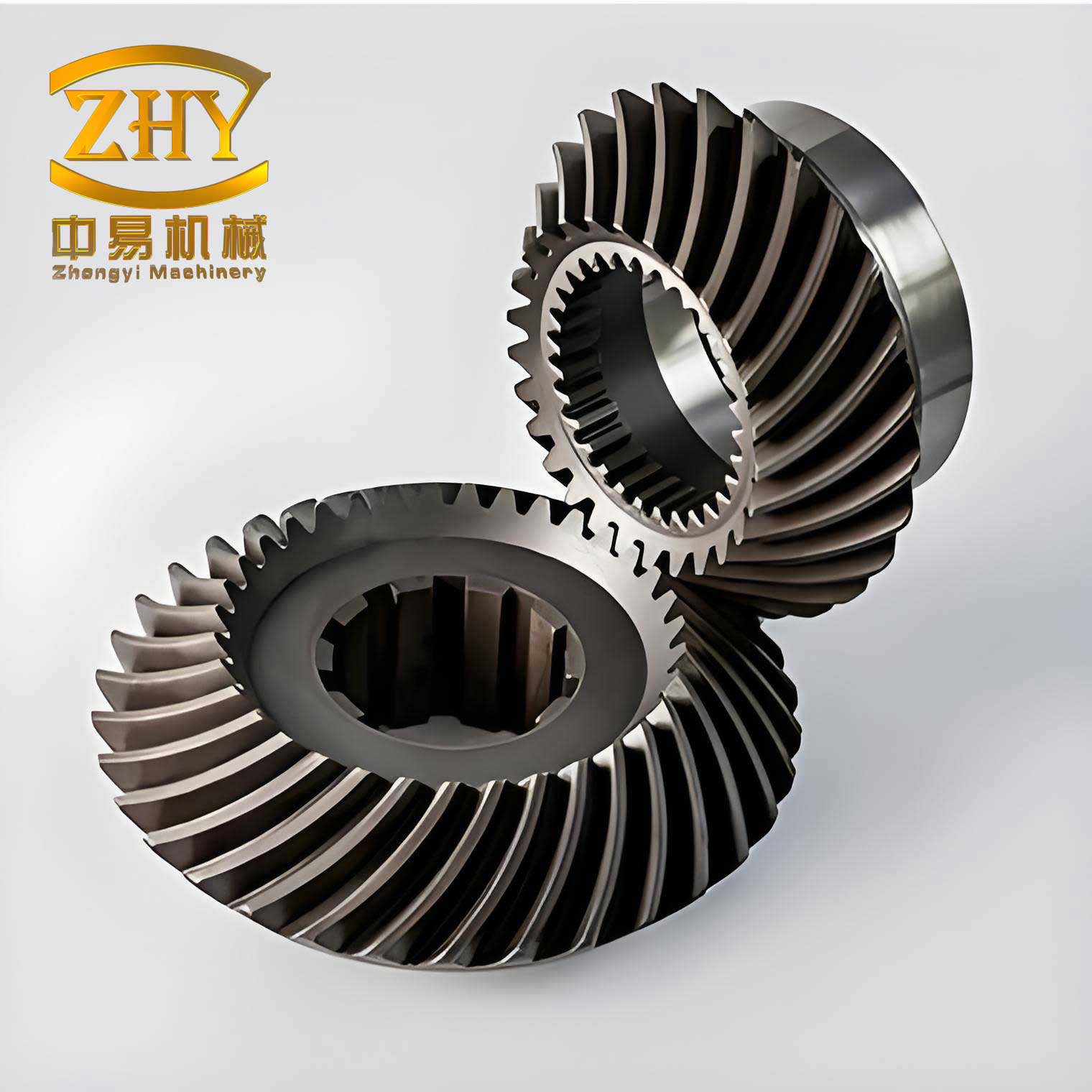
The successful operation of a pair of spiral gears hinges on several interdependent parameters. The design process begins by establishing the fundamental requirements: the velocity ratio (i), the center distance (C), and the shaft angle (Σ). With these fixed, the designer must determine the number of teeth (N1, N2), the normal diametral pitch (P_n), the pitch diameters (d1, d2), and the crucial spiral angles (ψ1, ψ2) for each gear. The relationship between the spiral angles and the shaft angle is paramount:
$$ \Sigma = \psi_1 \pm \psi_2 $$
Here, the plus sign (+) is used when the spiral gears have the same hand of helix (both right-handed or both left-handed), and the minus sign (-) is used when they have opposite hands. This relationship is the cornerstone of the graphical method, as it directly translates into the geometry of intersecting lines on our diagram.
The core idea of the circle diagram method is to bypass direct, complex trigonometric solving. Instead, we use scaled circles representing the pitch diameters of the proposed spiral gears and a transparent overlay with intersecting lines representing the spiral angles. By manipulating this overlay over the circles, we find a configuration that satisfies all geometric constraints simultaneously. Let’s break down the procedure step-by-step.
Step 1: Preliminary Assumptions and Calculations
We start by making intelligent initial guesses for the number of teeth and the normal diametral pitch. The choice influences the final size and proportions of the spiral gears. A good starting point is to consider the velocity ratio and desired size. For a velocity ratio i = ω1/ω2 = N2/N1, we assume N1 and N2. We also select a standard normal diametral pitch, P_n. The theoretical pitch diameter for a helical (or spiral) gear is given by:
$$ d = \frac{N}{P_n \cos\psi} $$
Since ψ is unknown at this stage, we initially assume it to be zero to get a reference “equivalent spur gear” diameter: d_ref = N / P_n. We use these reference diameters for the initial graphical plot. The assumed values for our two spiral gears are:
| Parameter | Gear 1 (Driver) | Gear 2 (Driven) |
|---|---|---|
| Number of Teeth (N) | N1 (Assumed) | N2 = i * N1 |
| Normal Diametral Pitch (P_n) | P_n (Assumed, common to both) | |
| Reference Pitch Diameter (d_ref) | d_ref1 = N1 / P_n | d_ref2 = N2 / P_n |
Step 2: Constructing the Representative Circles
On a drawing sheet, using a suitable scale, draw a horizontal line segment equal to the specified center distance, C. Mark the endpoints as O1 and O2, the centers of the two spiral gears. Using O1 and O2 as centers, draw two circles with radii equal to the calculated d_ref1/2 and d_ref2/2, respectively. These are our “representative circles.”
Step 3: Preparing the Transparent Overlay
On a separate transparent sheet, draw two straight lines intersecting at a point. The acute angle between these two lines should be made equal to the given shaft angle, Σ. This intersection point and these lines are key to finding the solution.
Step 4: The Graphical Solution – Manipulating the Overlay
This is the critical phase. Place the transparent sheet over the drawing containing the two representative circles. The goal is to position it such that:
- The intersection point of the two lines on the overlay lies on the line connecting the two circle centers (O1O2).
- Each of the two lines is tangent to one of the representative circles.
This process involves sliding and rotating the overlay until both conditions are met. There are two distinct cases based on the hand of the spiral gears:
| Hand of Helix | Tangency Condition |
|---|---|
| Same Hand (ψ1 + ψ2 = Σ) | Both lines are tangent to their respective circles on the same side of the center line O1O2. |
| Opposite Hand (ψ1 – ψ2 = Σ or ψ2 – ψ1 = Σ) | The lines are tangent to their respective circles on opposite sides of the center line O1O2. |
When a satisfactory position is found, carefully fix the overlay and mark the points of tangency (T1, T2) and the intersection point (I) on the center line.
Step 5: Extracting Parameters and Verification
From the final diagram, we can now measure the key design parameters for our spiral gears:
- Actual Pitch Radii: Measure the distances from the intersection point I on the center line to each circle center, O1 and O2. These distances, R1 = I-O1 and R2 = I-O2, are the actual pitch radii for the pair of spiral gears. Their sum must equal the center distance: R1 + R2 = C. This is our first check.
- Spiral Angles: For each gear, measure the angle between the line tangent to its circle (from the overlay) and the perpendicular dropped from the circle center (O1 or O2) to that tangent line. This measured angle is the spiral angle ψ for that gear. The algebraic sum (ψ1 ± ψ2) must equal the shaft angle Σ. This is our second check.
The mathematical relationships now solidify. The actual pitch diameters are:
$$ d_1 = 2R_1 $$
$$ d_2 = 2R_2 $$
The normal diametral pitch is recalculated based on the actual geometry:
$$ P_n = \frac{N_1}{d_1 \cos\psi_1} = \frac{N_2}{d_2 \cos\psi_2} $$
This calculated P_n should be close to a standard value. If it’s not, an adjustment in the assumed number of teeth may be needed, and the process is repeated.
Step 6: Iteration and Design Refinement
The first graphical attempt rarely yields a perfect, standardizable solution. The initial assumptions for N and P_n might lead to a diagram where the intersection point I cannot be placed on the center line while maintaining tangency, or where the resulting P_n is non-standard. This signals the need for iteration. For instance, if the intersection point falls outside the center line segment, it often indicates that the assumed number of teeth is too high for the given center distance, making the representative circles too large. The remedy is to reduce the number of teeth or increase the normal diametral pitch. Conversely, if the circles are too small, the intersection point might be found easily, but the resulting spiral angles could be impractically small or lead to an undesirable size relationship where the faster gear is larger than the slower one. This calls for increasing the number of teeth or reducing P_n.
Furthermore, for a given setup, there might be two possible graphical solutions where tangency and intersection conditions are met. The convention is to choose the solution that results in a larger pitch diameter for the driver gear, as this is often more favorable.
Let’s solidify this with a worked example using the circle diagram logic. Suppose we need spiral gears for a velocity ratio i = 2, center distance C = 4.5 inches, and shaft angle Σ = 75°. Let us assume we want spiral gears with the same hand of helix.
First attempt: Assume P_n = 10, N1 = 20, therefore N2 = 40.
Reference diameters: d_ref1 = 20/10 = 2.0″, d_ref2 = 40/10 = 4.0″.
Sum of reference radii = 1″ + 2″ = 3.0″, which is less than C (4.5″). This immediately indicates our circles are too small. When we try the graphical method, we may find the intersection point I, but the spiral angles will be very large, possibly exceeding practical limits.
Second attempt: Reduce P_n to increase size. Assume P_n = 6, N1 = 20, N2 = 40.
d_ref1 = 20/6 ≈ 3.333″, d_ref2 = 40/6 ≈ 6.667″.
Sum of reference radii ≈ 1.667″ + 3.333″ = 5.0″, which is greater than C (4.5″). Now the circles are too large. Graphically, the intersection point I will likely not be reachable on the center line segment O1O2.
Third attempt: Adjust tooth count. Assume P_n = 8, N1 = 24, N2 = 48.
d_ref1 = 24/8 = 3.0″, d_ref2 = 48/8 = 6.0″.
Sum of reference radii = 1.5″ + 3.0″ = 4.5″, which exactly equals C. This is promising. We construct circles of radius 1.5″ and 3.0″ spaced 4.5″ apart. Using the transparent overlay with a 75° angle, we position it for same-hand tangency. We find a position where I lies on O1O2. Measuring, we get R1 = 1.8″, R2 = 2.7″. Check: 1.8 + 2.7 = 4.5 (Correct). Measuring angles, we find ψ1 ≈ 35° and ψ2 ≈ 40°. Check: 35° + 40° = 75° (Correct). Now, back-calculate P_n: P_n = N1 / (2R1 cosψ1) = 24 / (3.6 * cos35°) ≈ 24 / (3.6 * 0.819) ≈ 8.14. This is very close to our assumed 8. We can standardize to P_n = 8 and accept slight adjustments, or tweak tooth counts slightly for a perfect fit.
Beyond the basic geometry, critical design considerations for spiral gears must be addressed to ensure functionality and performance.
Efficiency: The efficiency of a spiral gear pair is a major concern due to significant sliding friction between the teeth. It is not merely a function of the spiral angles themselves, but crucially of their relative size. For higher efficiency, the driving gear should have a larger spiral angle than the driven gear. The efficiency (η) can be estimated by:
$$ \eta = \frac{\cos(\psi_2 – \phi)}{\cos(\psi_1 + \phi)} \times \frac{d_2}{d_1} $$
where φ is the friction angle (φ = arctan μ, and μ is the coefficient of friction). This formula highlights why ψ1 > ψ2 is desirable—it increases the numerator and decreases the denominator of the cosine ratio. Using the earlier example numbers (ψ1=35°, ψ2=40°) with a friction coefficient μ=0.1 (φ≈5.7°), the efficiency would be relatively low. Swapping the angles so the driver has the 40° angle would improve it.
Tooth Action and Wear: As mentioned, spiral gears operate with point contact, leading to high contact stress. This makes them susceptible to wear and pitting. Proper material selection and lubrication are vital. Hardened steels are often used. The sliding action also means that for spiral gears with opposite hands, the contact point crosses the pitch line, which can affect the smoothness of motion transfer.
Thrust Loads: Like all helical-type gears, spiral gears generate axial thrust loads that must be accommodated by suitable bearings. The magnitude of this thrust depends on the tangential force and the spiral angle: Thrust Force = Tangential Force * tan ψ. This is an important consideration for the overall mechanical design of the shaft and bearing assemblies.
The following table summarizes common pitfalls and adjustments in the spiral gear design process using the graphical method:
| Observed Problem in Diagram | Likely Cause | Corrective Action |
|---|---|---|
| Intersection point (I) cannot be placed on center line while maintaining tangency. | Representative circles are too large. | Decrease number of teeth (N) or increase Normal Diametral Pitch (P_n). |
| Circles are small, I is easily found, but spiral angles are very small or driver gear is smaller than driven at high ratio. | Representative circles are too small. | Increase number of teeth (N) or decrease Normal Diametral Pitch (P_n). |
| Calculated P_n from final geometry is non-standard. | Assumed N or initial P_n not optimal. | Adjust N slightly to make P_n land on a standard value, and iterate diagram. |
| Efficiency calculated is unacceptably low. | Driver spiral angle (ψ1) is not sufficiently larger than ψ2. | Re-evaluate design choice; consider assigning the larger spiral angle to the driver gear, even if it requires re-working the diagram from different initial N. |
In conclusion, the circle diagram method is an elegant and practical tool for the initial synthesis of spiral gears. It transforms an abstract trigonometric problem into a visual, tactile one, providing clear insight into the relationship between center distance, shaft angle, and the resulting gear geometry. The process underscores that designing spiral gears is an iterative endeavor of assumption, graphical testing, verification, and refinement. Key parameters like the spiral angles, pitch diameters, and normal diametral pitch are all locked in a delicate balance defined by the fundamental equation Σ = ψ1 ± ψ2 and the center distance constraint. While modern software can perform these calculations instantly, mastering the graphical method deepens one’s understanding of the spatial relationships governing these interesting and useful mechanical components. Success with spiral gears depends on carefully considering not just the geometry, but also the implications for efficiency, thrust loading, and wear in the final application.
To aid in material selection, here is a brief reference:
| Application Load | Recommended Material Pair | Notes |
|---|---|---|
| Light Load / Instrumentation | Brass / Steel, or Plastics | Good wear resistance, lower cost, quieter operation. |
| Moderate Power Transmission | Case-Hardened Steel / Through-Hardened Steel | Good balance of surface hardness for wear and core toughness. |
| High Wear Resistance Priority | Hardened Steel / Hardened Steel (with excellent lubrication) | Maximizes surface durability against pitting. |
The journey from a set of requirements (i, C, Σ) to a functional pair of spiral gears is a rewarding exercise in mechanical design synthesis. By leveraging the circle diagram alongside a solid understanding of the governing principles and practical constraints, one can effectively design these gears for reliable performance in a wide array of mechanical systems.