
In my extensive experience as an automotive engineer, I have witnessed the evolution of steering systems, with the rack and pinion gear emerging as a cornerstone of modern vehicle design. Initially reserved for high-performance applications like racing cars due to its lightweight, direct response, compact size, and ease of installation, the rack and pinion gear has now become ubiquitous across a wide range of passenger vehicles. From compact city cars to mid-sized sedans, this mechanism is prized for its efficiency and simplicity. The fundamental principle of the rack and pinion gear is elegantly straightforward: it converts the rotational motion of the steering wheel into linear motion to turn the vehicle’s wheels. This direct mechanical linkage minimizes friction losses compared to systems with intermediate linkages like recirculating-ball steering, making it exceptionally responsive. The rack and pinion gear’s dominance is such that it has largely supplanted older designs in front-wheel-drive and many rear-wheel-drive platforms, often integrated with hydraulic or electric power assistance for enhanced driver comfort. In this detailed exploration, I will delve into the engineering nuances, correct installation protocols, common failure modes, and meticulous maintenance procedures essential for anyone working with or relying on a rack and pinion steering system.
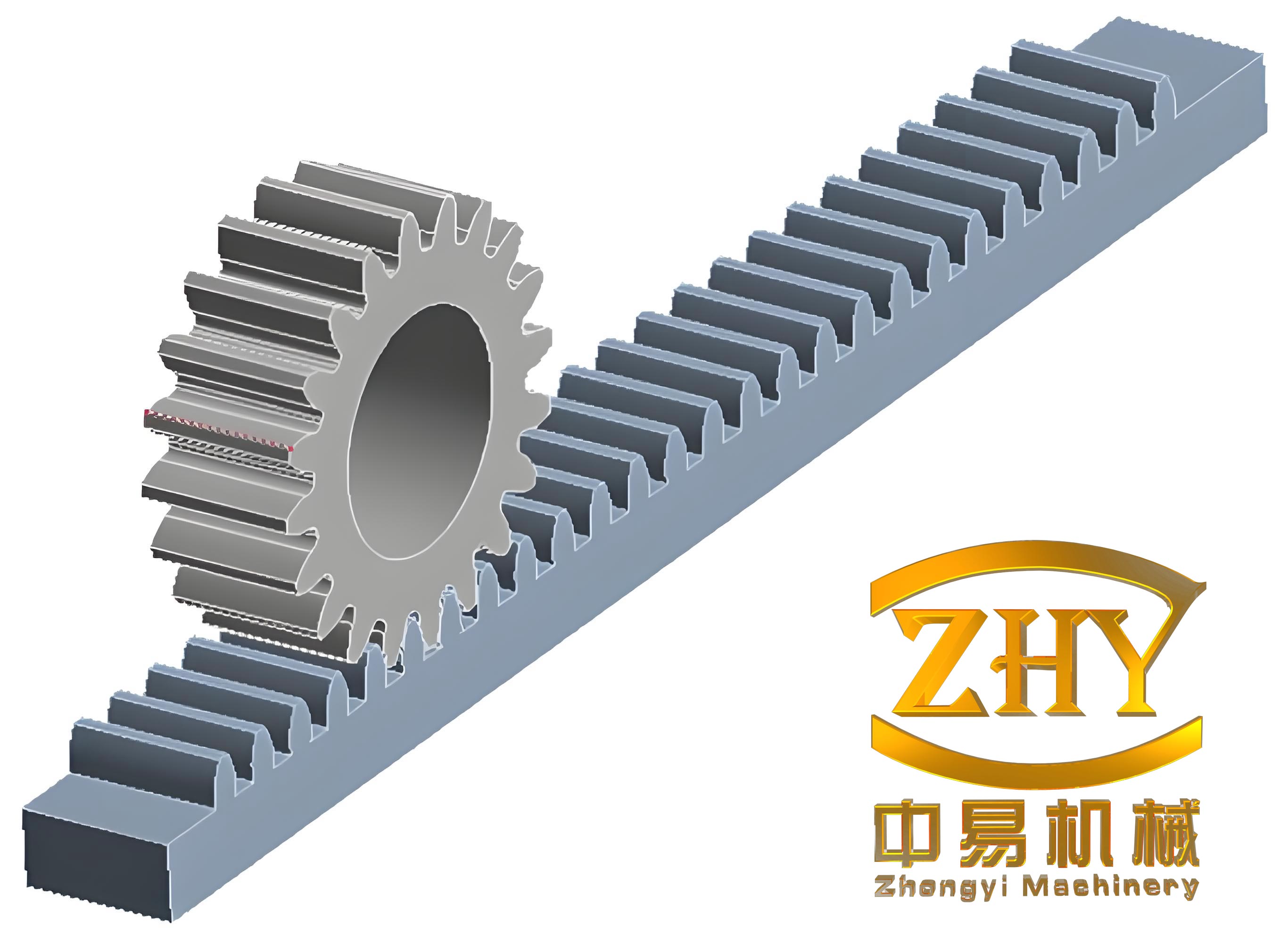
The core functionality of any rack and pinion gear system hinges on precise meshing between the pinion gear, attached to the lower end of the steering column, and the linear rack, which is essentially a flat steel bar with machined teeth. When the driver turns the steering wheel, the pinion rotates, engaging with the teeth on the rack and causing it to move laterally. This lateral movement is directly transmitted to the front wheels via tie rods connected to each end of the rack. The mechanical advantage is defined by the gear ratio, typically expressed as the number of degrees the steering wheel must turn to move the rack a certain distance. This ratio is a critical design parameter balancing steering effort and responsiveness. The force transmission can be modeled using fundamental principles of mechanics. The torque applied at the steering wheel, $T_{sw}$, is related to the tangential force at the pinion, $F_t$, by the pinion’s pitch radius, $r_p$:
$$T_{sw} = F_t \cdot r_p$$
This tangential force is the same force acting along the rack’s direction of motion. The resulting linear force on the rack, $F_r$, which must overcome tire scrub and other resistances to turn the wheels, is simply $F_t$ (assuming ideal efficiency). Therefore, the system’s output force is directly proportional to the input torque and inversely proportional to the pinion radius. For a given steering wheel torque, a smaller pinion radius yields a higher rack force, albeit with a slower steering response (higher ratio). The relationship between steering wheel angle $\theta_{sw}$ and rack displacement $x_r$ is given by:
$$x_r = r_p \cdot \theta_{sw}$$
where $\theta_{sw}$ is in radians. This linear relationship is a key benefit of the rack and pinion gear, providing predictable and direct feedback to the driver. To illustrate common design parameters across different vehicle classes, consider the following table:
| Vehicle Class | Typical Rack and Pinion Gear Ratio (mm/rev) | Pinion Teeth Count | Rack Travel (mm) | Common Application |
|---|---|---|---|---|
| Compact / Subcompact | 50-60 | 5-6 | ±70-80 | Manual Steering |
| Mid-size Sedan | 40-50 | 6-7 | ±75-85 | Power-Assisted Steering |
| Sports Car | 30-40 | 7-8 | ±65-75 | Quick Ratio, High Feedback |
| SUV / Crossover | 45-55 | 6-7 | ±80-90 | Electro-Hydraulic Power Steering |
Correct installation of the rack and pinion gear assembly is paramount to its longevity and performance. A critical aspect often overlooked, as I have encountered in numerous workshop scenarios, is the proper pre-loading of associated bearings. For instance, in configurations where the pinion shaft is supported by tapered roller bearings, the adjustment of the axial clearance is vital. The securing nut, often called a flange or pinion nut, must be torqued to a precise specification to ensure the designed axial play of the bearing is achieved. Insufficient torque can lead to excessive bearing play, causing premature wear, noise, and even loss of steering precision. The required tightening torque, such as the 51 kg·m mentioned in some contexts, is derived from the bearing’s preload requirement to eliminate internal clearance without inducing excessive drag. The torque $T_{tighten}$ required to achieve a specific clamp load $F_{preload}$ on the bearing can be estimated using the formula for torque-tension relationship:
$$T_{tighten} = K \cdot D \cdot F_{preload}$$
where $K$ is the nut factor (typically 0.2 for lubricated threads), $D$ is the nominal bolt diameter, and $F_{preload}$ is the desired preload force. Ignoring this during service, perhaps due to unfamiliarity with newer bearing types like the 97210 series in certain vehicle models, leads directly to avoidable failures. The entire rack and pinion gear assembly must be aligned correctly with the steering column. Misalignment can be accommodated using flexible couplers or universal joints, but these introduce additional compliance points that must be inspected for wear. The mounting brackets must secure the rack housing rigidly to the subframe to prevent unwanted movement that translates into steering vagueness.
Beyond the core rack and pinion gear, many systems incorporate hydraulic power assistance to reduce steering effort further, especially in heavier vehicles. In a hydraulic power rack and pinion gear system, the rack itself often acts as a piston within a cylindrical chamber integrated into the housing. Hydraulic fluid under pressure, supplied by an engine-driven pump, is ported to either side of this piston based on the direction of steering input. A rotary valve, typically coaxial with the pinion gear, directs this fluid. The valve senses the torque applied to the pinion shaft via a torsion bar. The governing equation for the assist force $F_{assist}$ generated by hydraulic pressure $P$ acting on the piston area $A_p$ is:
$$F_{assist} = P \cdot A_p$$
The net force on the rack becomes $F_r + F_{assist}$, dramatically reducing the driver’s required input torque $T_{sw}$ for the same wheel turning resistance. This integration makes the power rack and pinion gear unit a compact and efficient package. However, it introduces complexity in sealing. The rack piston has seals, and the pinion valve assembly has precise spool valve clearances. Any leakage in these areas diminishes assist performance and can lead to fluid loss. The table below categorizes common issues in hydraulic power rack and pinion gear systems:
| Symptom | Potential Cause Related to Rack and Pinion Gear | Diagnostic Check | Corrective Action |
|---|---|---|---|
| Hard Steering (Loss of Power Assist) | Low fluid level; Failed pump; Internal leakage in rack piston seals; Clogged valve. | Check fluid reservoir; Listen for pump whine; Check for external leaks at gear boots. | Top up fluid; Replace pump; Overhaul or replace rack and pinion gear assembly. |
| Steering Pulls to One Side | Uneven assist due to stuck valve spool or asymmetric seal leakage. | With engine running at idle, compare assist effort turning left vs. right. | Overhaul control valve or replace assembly. |
| Fluid Leak at Boots | Torn inner tie rod seal or rack piston seal failure. | Inspect rubber bellows boots for fluid accumulation. | Replace boots and internal seals; may require full unit service. |
| Excessive Play or Lash in Steering | Worn rack and pinion gear teeth; Loose mounting; Worn tie rod ends. | Check for lateral movement of tie rods at rack; Inspect mounting bolts. | Adjust preload (if adjustable); Replace worn rack and pinion gear; Tighten mounts. |
Diagnosing faults in a rack and pinion gear system requires a systematic approach. Instability or a tendency for the vehicle to wander can often be attributed to wear in the linkage rather than the gear mesh itself. The most common failure points are the inner and outer tie rod ends, which are ball-and-socket joints. In my practice, I always begin by checking for play. With the vehicle’s front wheels off the ground, I grasp each tie rod near the rack and attempt to move it up and down and in and out. Any perceptible free play, often accompanied by a dull metallic clunk, indicates wear. A mere 1 to 2 mm of play in a tie rod end can significantly compromise steering stability. The allowable free play after adjustment should not exceed specifications, often around 1 mm. The force required to move a tie rod end can be checked with a spring scale; a pull force between 0.45 kg and 2.3 kg is generally acceptable for smooth yet firm movement. The process of replacing these ends on a rack and pinion gear requires care, as they are often threaded onto the ends of the rack and secured with lock pins or crimped sections. Special tools are usually needed for removal without damaging the rack threads. Upon installation, a specific tightening torque, such as 6.9 to 8.2 kg·m, must be applied to the new joint to set its internal preload correctly.
The gear mesh between the rack and pinion gear teeth themselves is remarkably durable under normal conditions due to the low sliding velocities, favorable pressure angles, and constant lubrication within a sealed housing. However, misadjustment or contamination can lead to wear. Backlash in the mesh, felt as free play at the steering wheel before rack movement begins, is adjustable on some units via a preload spring or screw that pushes the pinion or a yoke against the rack. The adjustment must be precise: too loose causes play, too tight causes binding and accelerated wear. The optimal preload $F_{preload-mesh}$ creates a slight drag torque $T_{drag}$ measurable at the pinion input. A relationship can be approximated, considering the coefficient of friction $\mu$ and the normal force $N$ between teeth:
$$T_{drag} \propto \mu \cdot N \cdot r_p$$
where $N$ is increased by the adjustment mechanism. Manufacturers provide specific procedures, often involving measuring the rotational torque of the pinion shaft with a inch-pound torque wrench.
For hydraulic systems, integrity is paramount. The rack and pinion gear assembly in a power steering application is a long, relatively slender component. It is susceptible to bending or distortion from even minor impacts, such as striking a curb. A bent rack or housing can cause binding, uneven seal wear, and rapid fluid leakage. To diagnose this, I perform a full-lock steering test with the engine running: turning the wheel slowly to the left and right stops while observing for sudden fluid seepage from the boots or housing seals. If bending is minor, careful straightening in a press with proper alignment checks might be possible, but often, replacement of the rack, the housing, or the entire rack and pinion gear unit is the safest remedy. External leaks from hose fittings, the pump, or the reservoir are more common and should be addressed first. Persistent internal leakage necessitates a unit overhaul or replacement.
Preventive maintenance is crucial for the long-term health of any rack and pinion gear. This includes regular inspection of the protective rubber bellows boots at each end of the rack housing. These boots seal the internal mechanism from road dirt, water, and salt. A torn boot allows contaminants to enter, rapidly abrading the rack teeth and tie rod seals, leading to costly repairs. During oil changes or routine service, I always recommend a visual inspection of these boots for cracks, tears, or looseness. Furthermore, the power steering fluid should be checked for level and condition. Dark, burnt-smelling fluid indicates overheating and degradation, which can harm the sensitive valves and seals inside the power rack and pinion gear. Flushing the hydraulic system at intervals specified by the manufacturer removes abrasive particles and maintains optimal fluid properties. The following table outlines a suggested maintenance schedule for key components of a rack and pinion steering system:
| Component | Inspection Interval | Key Maintenance Action | Performance Metric / Specification |
|---|---|---|---|
| Tie Rod Ends (Inner & Outer) | Every 12 months or 15,000 km | Check for free play and boot integrity. | Free play < 1 mm; Boots intact, no tears. |
| Rack Mounting Bushings | Every 24 months or 30,000 km | Check for looseness, cracking, or deformation. | No visible movement under levering force; Bushings not collapsed. |
| Protective Bellows Boots | Every 6 months or 10,000 km | Visual inspection for damage. | Boots must be securely clamped and free of holes. |
| Power Steering Fluid | Every 6 months or 10,000 km | Check level and condition. | Fluid at “Full” mark; Color bright red/amber, not dark or black. |
| Gear Mesh Preload (if adjustable) | Every 50,000 km or if play is suspected | Measure input shaft rotational torque. | Typically 0.2 – 0.8 N·m (2 – 8 in-lb) drag torque. |
| Overall System Alignment | After any steering component repair or if vehicle pulls | Perform wheel alignment. | Toe, camber, caster within factory specifications. |
The mathematical modeling of a rack and pinion gear system can be extended to dynamic analysis. When considering vehicle speed and self-aligning torque from the tires, the equations become more complex. The steering feel is influenced by the friction within the system, which can be modeled as a combination of viscous and Coulomb friction. The equation of motion for the pinion, neglecting inertia of the steering wheel for low-frequency input, can be written as:
$$T_{driver} – T_{friction} – T_{align} / R = J_p \cdot \ddot{\theta}_p$$
where $T_{driver}$ is the driver-applied torque, $T_{friction}$ is the net friction torque in the rack and pinion gear and linkages, $T_{align}$ is the self-aligning torque from the tires, $R$ is the overall steering ratio, and $J_p$ is the pinion’s moment of inertia. The friction torque $T_{friction}$ itself can be a function of velocity, often modeled as:
$$T_{friction} = T_c \cdot \text{sgn}(\dot{\theta}_p) + B \cdot \dot{\theta}_p$$
where $T_c$ is the Coulomb friction torque and $B$ is the viscous damping coefficient. Optimizing these parameters is key to achieving the desired steering feel—a balance between on-center stability and off-center responsiveness. Modern electric power steering (EPS) systems, which are increasingly replacing hydraulic ones, use a motor to provide assist torque directly to the pinion shaft or the rack (a “dual-pinion” or “rack-concentric” design). In these systems, the control algorithms precisely modulate assist based on vehicle speed, steering angle, and torque sensor feedback, offering tunable characteristics that a purely hydraulic rack and pinion gear system cannot match easily.
In conclusion, the rack and pinion gear is a masterpiece of mechanical simplicity and effectiveness that forms the heart of modern automotive steering. Its successful implementation and longevity depend on a deep understanding of its principles, meticulous attention to installation details like bearing preload and torque specifications, and a proactive approach to maintenance focused on wear-prone linkage components. Whether in a basic manual configuration or an advanced electro-hydraulic power system, the fundamental interaction between the pinion and the rack remains the critical interface translating driver intent into vehicle direction. By adhering to precise service procedures, regularly inspecting for wear, and understanding the underlying mechanics, technicians and enthusiasts alike can ensure that this vital system delivers safe, precise, and reliable performance throughout the vehicle’s life. The journey from a racing curiosity to a universal automotive staple is a testament to the enduring engineering excellence of the rack and pinion gear.