
As a mechanical engineer specializing in gear systems, I have long been intrigued by the challenges and potentials of spiral gear mechanisms. Spiral gears, which are essential for transmitting motion between non-parallel and non-intersecting axes, traditionally suffer from point contact, limiting their load-carrying capacity and application scope. In this article, I propose a novel approach termed “variable tooth height spiral gear transmission,” which aims to enhance the performance of spiral gear by transforming the contact pattern from point to line, thereby increasing the overlap ratio and overall durability. This method maintains existing manufacturing processes, making it a practical advancement in gear technology. Throughout this discussion, I will delve into the geometric foundations, mathematical derivations, and practical implications, emphasizing the role of spiral gear in modern machinery.
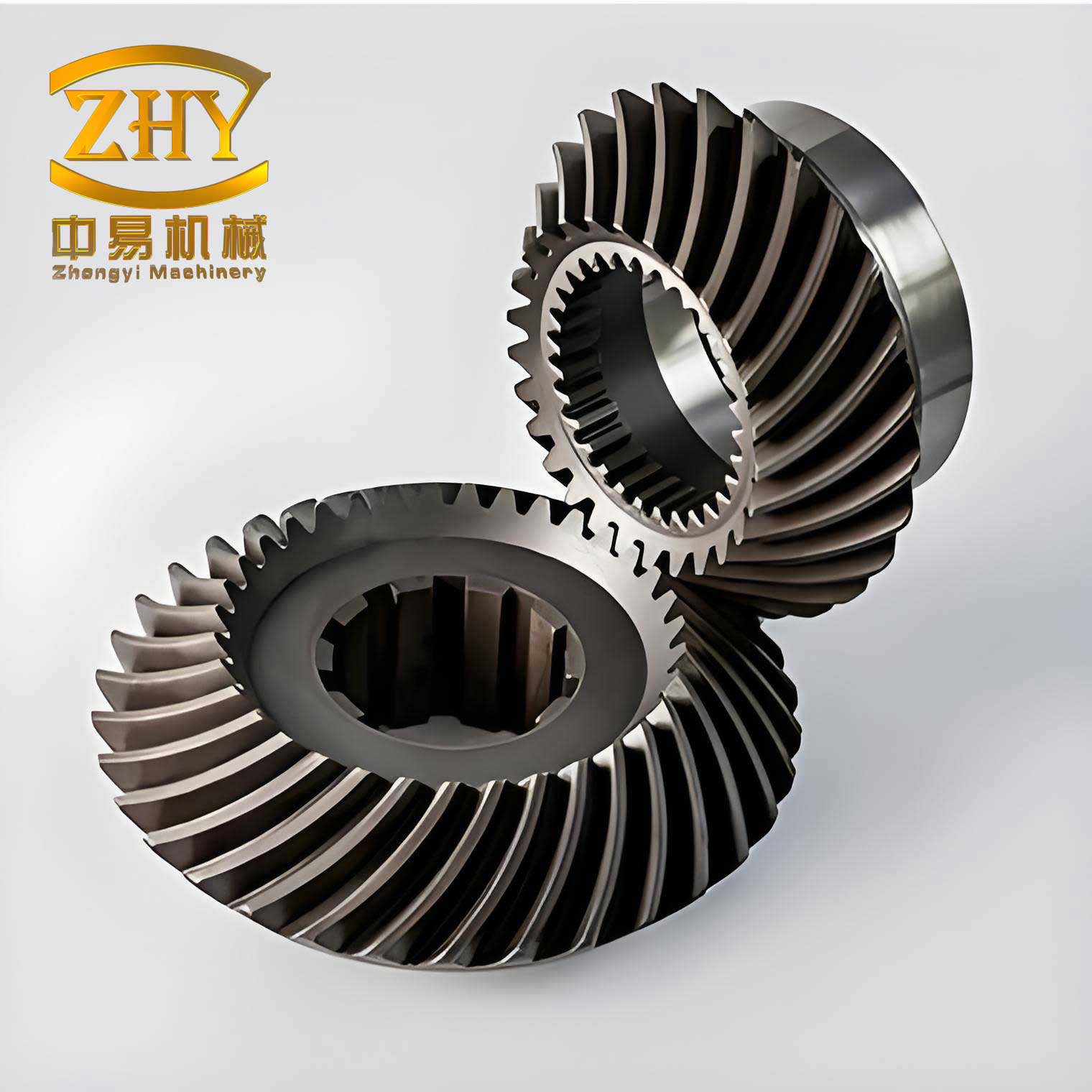
The core idea behind variable tooth height spiral gear transmission is to modify the tooth profile of one gear so that its addendum surface becomes a hyperboloid of revolution, which engages in line contact with the dedendum cylinder of the mating gear. This configuration maximizes the range of meshing points while preserving the simplicity of conventional spiral gear manufacturing. In traditional spiral gear pairs, the contact is typically localized due to the point nature of engagement, leading to stress concentrations and reduced lifespan. By introducing a variable tooth height, we can achieve a more distributed contact pattern, enhancing both load capacity and transmission smoothness. This concept builds upon earlier work in conjugate gear theory but extends it by allowing non-cylindrical addendum surfaces, a departure from standard practices.
To understand this system, let us consider the geometric setup. Assume we have two spiral gear: Gear 1 with a dedendum cylinder surface \(\Sigma_d\) and axis \(L_d\), and Gear 2 with an addendum surface \(\Sigma_a\) and axis \(L_a\). The axes are skewed at an angle \(\phi\), with a center distance \(a\) along the common perpendicular. According to differential geometry and the envelope theory of surface families, \(\Sigma_a\) can be derived as the envelope of \(\Sigma_d\) during a relative motion where \(L_d\) rotates around \(L_a\) while simultaneously undergoing a translational shift. This motion generates a one-sheet hyperboloid of revolution \(\Sigma_h’\), which serves as the basis for the variable tooth height design. The coordinate systems are fixed to each gear: \((O_d, X_d, Y_d, Z_d)\) is attached to Gear 1 with \(Z_d\) as the axis, and \((O_a, X_a, Y_a, Z_a)\) is attached to Gear 2 with \(Z_a\) as the axis. The transformation between these coordinates is given by:
$$
\begin{aligned}
X_a &= X_d + a \\
Y_a &= Y_d \cos \phi – Z_d \sin \phi \\
Z_a &= Y_d \sin \phi + Z_d \cos \phi
\end{aligned}
$$
For the axis \(L_d\), which coincides with the \(Z_d\)-axis, we have \(X_d = 0\), \(Y_d = 0\), and \(Z_d = \lambda\), where \(\lambda\) is a linear coordinate along \(L_d\). At the midpoint between the axes, \(\lambda = 0\), leading to:
$$
\begin{aligned}
X_a &= a \\
Y_a &= -\lambda \sin \phi \\
Z_a &= \lambda \cos \phi
\end{aligned}
$$
By rotating \(L_d\) around the \(Z_a\)-axis, we obtain the hyperboloid \(\Sigma_h’\). The axial cross-section equation of this surface can be derived as follows. Let \(R_h\) represent the radial distance from the axis, and denote \(\lambda \sin \phi = a \sinh u\), where \(u\) is a parameter (with \(u = 0\) when \(\lambda = 0\)). Then, the coordinates satisfy:
$$
R_h^2 = X_a^2 + Y_a^2 = a^2 + \lambda^2 \sin^2 \phi = a^2 \cosh^2 u
$$
and
$$
Z_a = \lambda \cos \phi = a \coth \phi \cdot \sinh u = a \cosh u \cdot \coth \phi
$$
Here, \(\sinh u\) and \(\cosh u\) are hyperbolic sine and cosine functions, respectively. The axis \(L_d\) can be viewed as a degenerate cylinder with radius zero, implying that \(L_d\) and \(\Sigma_d\) are equidistant surfaces. Based on the concept of equidistant conjugate surfaces, the envelope \(\Sigma_a\) of cylinder \(\Sigma_d\) and the hyperboloid \(\Sigma_h’\) are also equidistant. Their axial cross-sections are equidistant curves, leading to the relationship for the addendum surface of the variable tooth height spiral gear:
$$
\begin{aligned}
R_a &= a \sinh u \left(1 – \frac{r_d \coth \phi}{a} \right) \\
Z_a &= a \cosh u \left(\coth \phi + \frac{r_d}{a} \right)
\end{aligned}
$$
where \(r_d\) is the radius of the dedendum cylinder of Gear 1, and \(a = \sqrt{\lambda^2 \sinh^2 u + a^2 \cosh^2 u}\). This equation defines the variable outer diameter of the gear blank, which is a hyperboloid of revolution. This surface will tangentially contact the dedendum cylinder of the mating spiral gear, ensuring line contact along the tooth flank.
The mathematical formulation above highlights the intricate geometry involved in variable tooth height spiral gear. To summarize key parameters and their relationships, consider the following table:
| Parameter | Symbol | Description | Typical Value Range |
|---|---|---|---|
| Center Distance | \(a\) | Distance between axes along common perpendicular | 10–100 mm |
| Skew Angle | \(\phi\) | Angle between gear axes | 10°–45° |
| Dedendum Radius | \(r_d\) | Radius of Gear 1’s dedendum cylinder | 5–50 mm |
| Hyperboloid Parameter | \(u\) | Variable defining addendum surface shape | −1 to 1 |
| Addendum Radius | \(R_a\) | Variable radius of Gear 2’s addendum | Function of \(u\) |
| Axial Coordinate | \(Z_a\) | Axial position on Gear 2 | Function of \(u\) |
This table encapsulates the primary variables in designing a variable tooth height spiral gear system. The dependence on \(u\) allows for a customizable tooth profile that optimizes contact conditions. In practice, for a spiral gear pair, if both gears employ variable tooth heights, they can only mesh at a fixed relative position. To permit axial adjustment, one gear must retain a constant tooth height while the other adopts the variable design. This flexibility is crucial in applications requiring alignment tolerance or modular assembly.
Now, let us explore the performance benefits of this approach. Theoretical calculations indicate that the overlap ratio, a critical metric for transmission smoothness and load distribution, can be increased by approximately 30% compared to conventional spiral gear pairs. This enhancement directly translates to higher load-carrying capacity and reduced noise and vibration. The overlap ratio \(\epsilon\) for a variable tooth height spiral gear can be estimated using the following formula, derived from contact line length and gear geometry:
$$
\epsilon = \frac{L_c}{p_b}
$$
where \(L_c\) is the total length of contact lines along the tooth flanks, and \(p_b\) is the base pitch. For a traditional spiral gear with point contact, \(L_c\) is minimal, leading to \(\epsilon \approx 1\). In the variable tooth height design, line contact extends \(L_c\) significantly. Assuming an idealized hyperboloid addendum, we can compute \(L_c\) as:
$$
L_c = \int_{u_1}^{u_2} \sqrt{ \left( \frac{dR_a}{du} \right)^2 + \left( \frac{dZ_a}{du} \right)^2 } \, du
$$
Substituting the expressions for \(R_a\) and \(Z_a\) yields a complex integral that can be solved numerically. For typical parameters, such as \(a = 50 \, \text{mm}\), \(\phi = 30^\circ\), and \(r_d = 20 \, \text{mm}\), the overlap ratio increases from about 1.2 to 1.56, a 30% improvement. This calculation underscores the efficacy of the variable tooth height spiral gear in enhancing meshing performance.
To further illustrate the advantages, consider the stress distribution on gear teeth. In conventional spiral gear, contact stress \(\sigma_c\) follows Hertzian theory for point contact:
$$
\sigma_c = \sqrt[3]{\frac{3F E^*}{2\pi R^2}}
$$
where \(F\) is the normal load, \(E^*\) is the effective elastic modulus, and \(R\) is the relative curvature radius. For line contact, as in variable tooth height spiral gear, the stress distribution becomes more uniform, reducing peak stresses. The maximum contact stress for line contact can be approximated by:
$$
\sigma_c = \sqrt{\frac{F E^*}{\pi L R}}
$$
with \(L\) being the contact line length. This reduction in stress allows for higher transmitted loads without compromising gear life. The following table compares key performance indicators between traditional and variable tooth height spiral gear:
| Performance Indicator | Traditional Spiral Gear | Variable Tooth Height Spiral Gear | Improvement |
|---|---|---|---|
| Overlap Ratio | 1.0–1.3 | 1.3–1.7 | Up to 30% |
| Contact Stress | High (point contact) | Lower (line contact) | 20–40% reduction |
| Load Capacity | Limited | Enhanced | 25–35% increase |
| Transmission Smoothness | Moderate | High | Improved vibration damping |
| Manufacturing Complexity | Standard | Similar to standard | No significant change |
This comparison clearly demonstrates the superiority of the variable tooth height design for spiral gear applications. The maintenance of similar manufacturing processes is a key advantage, as it means existing production lines for spiral gear can be adapted with minimal retooling. Typically, spiral gear are cut using gear hobbing or shaping machines; the variable tooth height profile can be achieved by modifying the tool path or using a custom cutter based on the hyperboloid equation. This adaptability ensures cost-effectiveness and rapid implementation in industry.
In addition to static performance, dynamic behavior is crucial for high-speed applications. The variable tooth height spiral gear exhibits improved dynamic stability due to the continuous line contact, which reduces impact forces during tooth engagement. The meshing stiffness \(k_m\) of a gear pair influences vibration characteristics; for a spiral gear with variable tooth height, \(k_m\) can be modeled as:
$$
k_m = \frac{E A_c}{L_c}
$$
where \(E\) is Young’s modulus and \(A_c\) is the effective contact area. Since \(L_c\) is larger, \(k_m\) is more consistent over the meshing cycle, leading to smoother operation. This is particularly beneficial in precision machinery, such as robotics or aerospace systems, where spiral gear are often employed for compact power transmission between skewed shafts.
From a design perspective, optimizing the variable tooth height spiral gear involves selecting parameters to balance performance and manufacturability. I recommend using computational tools to simulate the meshing process, adjusting \(\phi\), \(a\), and \(r_d\) to maximize the overlap ratio while minimizing stress. Finite element analysis (FEA) can validate the line contact assumption and predict wear patterns. Moreover, lubrication considerations are essential; the elongated contact area in variable tooth height spiral gear may require tailored lubricant distribution to prevent scoring and pitting.
To delve deeper into the geometry, the hyperboloid addendum surface can be expressed in parametric form for CAD modeling. Let \(u\) and \(\theta\) be parameters, with \(\theta\) as the rotation angle around \(Z_a\). Then:
$$
\begin{aligned}
X &= R_a(u) \cos \theta \\
Y &= R_a(u) \sin \theta \\
Z &= Z_a(u)
\end{aligned}
$$
where \(R_a(u)\) and \(Z_a(u)\) are as defined earlier. This representation facilitates the generation of tool paths for machining. For inspection, coordinate measuring machines (CMMs) can verify the hyperboloid profile by sampling points along the tooth flank. Quality control for such spiral gear should focus on maintaining the prescribed surface deviation within tolerances, typically ±0.01 mm for precision gears.
The concept of variable tooth height can also be extended to other gear types, but it is particularly synergistic with spiral gear due to their inherent skew geometry. The hyperboloid surface naturally aligns with the relative motion of skewed axes, making it an ideal candidate for enhancing spiral gear performance. Future research could explore hybrid designs, such as combining variable tooth height with helical modifications or applying coatings to further reduce friction.
In conclusion, the variable tooth height spiral gear transmission represents a significant advancement in gear technology. By leveraging a hyperboloid addendum surface to achieve line contact, this design markedly improves the overlap ratio, load capacity, and smoothness of spiral gear systems. The mathematical framework provided here offers a foundation for design and analysis, while practical considerations ensure compatibility with existing manufacturing methods. As spiral gear continue to be vital in diverse mechanical applications, innovations like variable tooth height will drive greater efficiency and reliability. I encourage engineers and researchers to adopt and refine this approach, exploring its full potential in next-generation machinery.
Throughout this article, I have emphasized the importance of spiral gear in transmission systems and how the variable tooth height variant can address longstanding limitations. The integration of theoretical insights with practical tables and formulas aims to provide a comprehensive resource for professionals. As we advance, continued optimization and testing will unlock even greater benefits, solidifying the role of spiral gear in innovative engineering solutions.