
In the field of gear transmission, hyperboloid gears represent a complex yet highly valuable type of bevel gear. As a researcher focused on advanced manufacturing techniques, I have dedicated significant effort to developing precise methods for producing these gears. Hyperboloid gears are renowned for their high load-carrying capacity, efficient transmission, smooth operation, low noise, and substantial speed reduction ratios, making them critical components in automotive differential systems, particularly in drive axles. Compared to spiral bevel gears, hyperboloid gears feature an offset distance between the pinion and gear, which enhances vehicle stability and off-road performance. Additionally, the relative sliding along both the tooth length and height directions facilitates running-in, post-heat treatment grinding, and improves tooth contact patterns, surface finish, and noise reduction. Therefore, advancing the research on hyperboloid gears holds substantial practical significance. This study focuses on deriving a mathematical model for hobbing hyperboloid gears based on the Spiraloflex method, adapting it for modern six-axis CNC gear-cutting machines, and validating the model through simulation. The goal is to provide a reliable framework for accurate manufacturing of hyperboloid gears, leveraging mathematical transformations and computational tools.
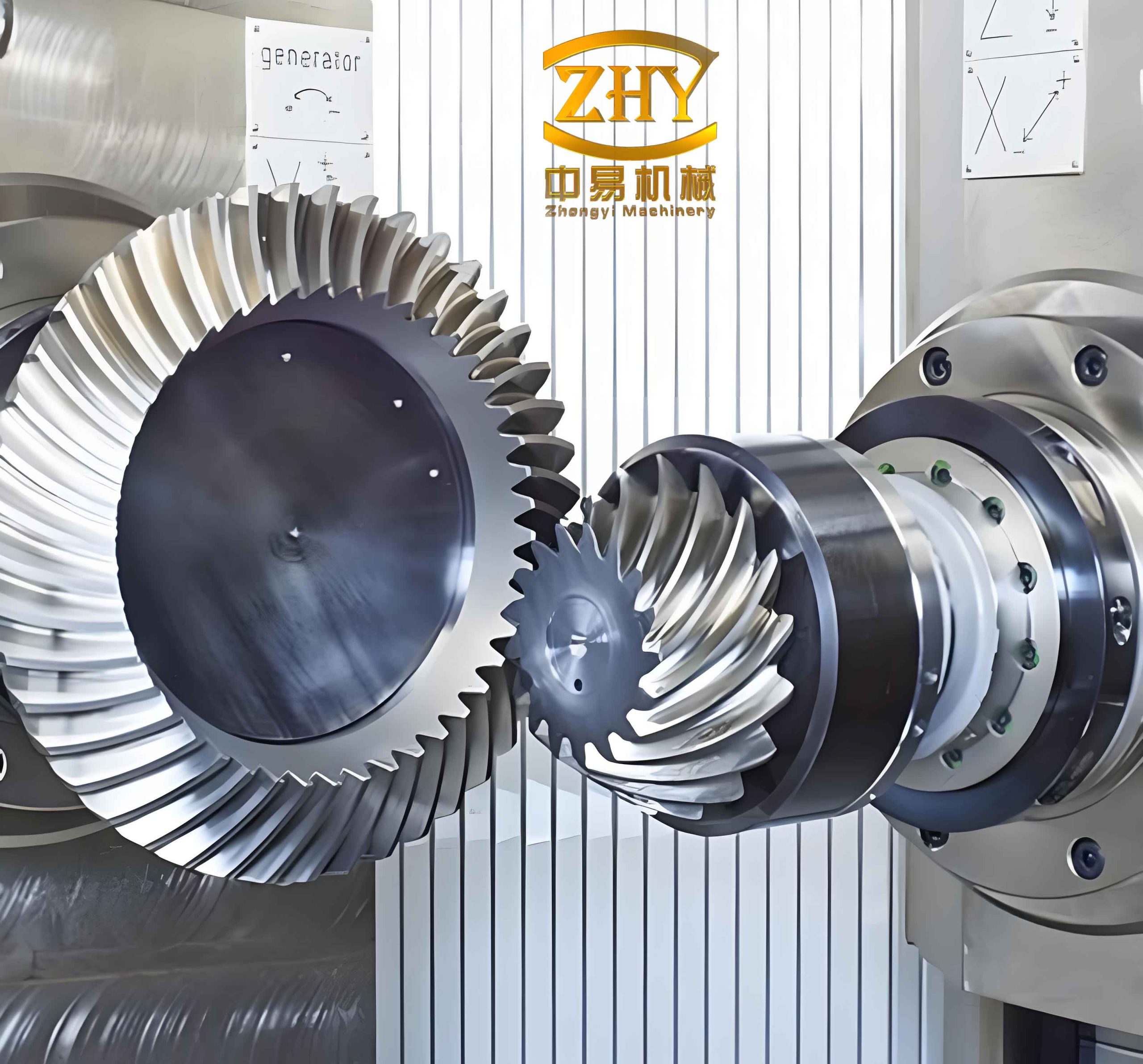
The Spiraloflex method, also known as the full generating method with tool tilt, is a sophisticated technique for cutting hyperboloid gears. It involves using a face-hobbing cutter with multiple blade groups to generate the tooth surfaces through a coordinated motion between the cutter and the workpiece. In this study, I begin by establishing the mathematical model based on a universal cradle-type gear-cutting machine, which serves as a virtual reference. The model encompasses the cutter geometry, coordinate transformations, and meshing equations to describe the tooth surface generation of hyperboloid gears. Subsequently, I transform the mechanical settings from the cradle-type machine to a Cartesian-type six-axis CNC gear-cutting machine, enabling practical implementation. Finally, I validate the model using simulation software to assess tooth surface errors, ensuring the accuracy of the proposed approach for manufacturing hyperboloid gears.
To derive the mathematical model for hobbing hyperboloid gears, I first define the cutter geometry. The face-hobbing cutter consists of multiple blade groups, typically including inner, middle, and outer blades, though middle blades are often omitted for finishing cuts. Inner blades cut the convex side of the hyperboloid gears, while outer blades cut the concave side. For left-handed hyperboloid gears, a left-handed cutter is used, and for right-handed ones, a right-handed cutter is employed. The blade edge comprises a straight segment and a rounded segment, as described in the following equations. In the blade coordinate system \( S_l \), the position vector of the blade edge is represented in homogeneous coordinates as:
$$ \mathbf{r}_l(u) = [x_l \quad 0 \quad z_l \quad 1]^T $$
where \( u \) is the blade edge parameter. The straight segment \( \mathbf{r}_l^{(l)}(u) \) and rounded segment \( \mathbf{r}_l^{(f)}(u) \) are given by:
$$ x_l^{(l)}(\alpha_F; u) = \pm u \sin \alpha_F $$
$$ z_l^{(l)}(\alpha_F; u) = u \cos \alpha_F $$
for the straight segment, and:
$$ x_l^{(f)}(\alpha_F; \rho_o; h_r; u) = \pm (x_{cf} – \rho_o \cos u) $$
$$ z_l^{(f)}(\alpha_F; \rho_o; h_r; u) = z_{cf} + \rho_o \sin u $$
for the rounded segment. Here, \( \alpha_F \) is the tool profile angle, \( h_r \) is the reference point height, \( \rho_o \) is the rounding radius, and \( (x_{cf}, z_{cf}) \) is the center of the rounding, calculated as:
$$ x_{cf} = h_r \tan \alpha_F + \rho_o \tan(0.4\pi – 0.5\alpha_F) $$
$$ z_{cf} = h_r – \rho_o $$
The ± sign corresponds to inner and outer blades, respectively. Next, I transform the blade edge equations to the cutter coordinate system \( S_t \) using rotation and translation matrices. The transformation is expressed as:
$$ \mathbf{r}_t(u) = \mathbf{M}_{tl} \mathbf{r}_l(u) $$
where \( \mathbf{M}_{tl} = \mathbf{M}_{tn} \mathbf{M}_{nm} \mathbf{M}_{ml} \), with matrices accounting for the initial setting angle \( \beta_0 \), tool reference point radius \( r_0 \), and tool direction angle \( \delta_0 \). This step is crucial for accurately representing the cutter geometry in the machine coordinate system, which is essential for generating hyperboloid gears.
With the cutter geometry defined, I proceed to model the tooth surface generation for hyperboloid gears. The process involves a virtual generating gear, which is a conceptual tool that engages with the workpiece to form the tooth surfaces. The coordinate systems include the cutter system \( S_t \), the generating gear system \( S_d \), and the workpiece system \( S_l \). The position vector of the blade edge in the generating gear system is obtained through a series of transformations involving tool tilt angles and machine motions. Specifically, the transformation from \( S_t \) to \( S_d \) is given by:
$$ \mathbf{r}_d(u, \beta, \phi_{c1}) = \mathbf{M}_{dt} \mathbf{r}_t(u) $$
where \( \mathbf{M}_{dt} = \mathbf{M}_{dc} \mathbf{M}_{cb} \mathbf{M}_{ba} \mathbf{M}_{at} \). Here, \( \beta \) is the cutter rotation angle, \( \phi_{c1} \) is the cycloidal motion rotation angle, \( \theta_c \) is the initial cradle setting angle, \( \phi_j \) is the tool tilt direction setting angle, and \( \phi_i \) is the tool tilt angle. The matrices incorporate these parameters to simulate the relative motion between the cutter and the generating gear. To obtain the tooth surface on the hyperboloid gears, I further transform to the workpiece system \( S_l \):
$$ \mathbf{r}_l(u, \beta, \phi_{c1}, \phi_{c2}, \phi_1) = \mathbf{M}_{ld} \mathbf{r}_d(u, \beta, \phi_{c1}) $$
where \( \mathbf{M}_{ld} = \mathbf{M}_{lg} \mathbf{M}_{gf} \mathbf{M}_{fe} \mathbf{M}_{ed} \). The parameters include the workpiece rotation angle \( \phi_1 \), cradle angle for generating motion \( \phi_{c2} \), machine root angle \( \gamma_m \), vertical wheel position \( E_m \), horizontal wheel position \( \Delta A \), and bed position \( \Delta B \). The relationships between angles are simplified as \( \phi_c = \phi_{c2} – \phi_{c1} \) and \( \phi_1 = R_c \beta + R_a \phi_c \), where \( R_c \) is the ratio of blade groups to tooth number, and \( R_a \) is the ratio of generating gear teeth to workpiece teeth. Thus, the tooth surface equation reduces to \( \mathbf{r}_l(u, \beta, \phi_c) \).
The meshing condition for hyperboloid gears is derived from the relative velocity between the cutter and workpiece. The normal vector \( \mathbf{n}_1 \) and relative velocity \( \mathbf{v}_1^{(lt)} \) are calculated as:
$$ \mathbf{n}_1(u, \beta, \phi_c) = \frac{\partial \mathbf{r}_1(u, \beta, \phi_c)}{\partial u} \times \frac{\partial \mathbf{r}_1(u, \beta, \phi_c)}{\partial \beta} $$
$$ \mathbf{v}_1^{(lt)}(u, \beta, \phi_c) = \frac{\partial \mathbf{r}_1(u, \beta, \phi_c)}{\partial \phi_c} \dot{\phi}_c $$
The meshing equation is then:
$$ f_1(u, \beta, \phi_c) = \mathbf{n}_1(u, \beta, \phi_c) \cdot \mathbf{v}_1^{(lt)}(u, \beta, \phi_c) = 0 $$
This equation, along with tooth blank constraints, allows solving for the parameters \( u \), \( \beta \), and \( \phi_c \) at each point on the tooth surface of hyperboloid gears. The tooth surface points and unit normal vectors are obtained, enabling the generation of a 3D model for hyperboloid gears. The mathematical model ensures precise tooth geometry, which is vital for the performance of hyperboloid gears in transmission systems.
To apply this model to modern manufacturing, I transform the mechanical settings from the universal cradle-type machine to a six-axis CNC gear-cutting machine. The six-axis machine features vertical axes for tool and workpiece movements, enhancing flexibility for producing hyperboloid gears. The coordinate system includes tool displacements \( c_x \), \( c_y \), \( c_z \), workpiece rotation axis tilt angle \( \Psi_b \), tool rotation angle \( \Psi_a \), workpiece tilt angle \( \Psi_c \), and angular increments \( \Delta \Psi_a \) and \( \Delta \Psi_b \). The transformation matrix from the tool to workpiece system on the six-axis machine is:
$$ \mathbf{M}_{lt} = \mathbf{M}_{ll’} \mathbf{M}_{l’d} \mathbf{M}_{dc} \mathbf{M}_{cb} \mathbf{M}_{ba} \mathbf{M}_{at’} \mathbf{M}_{t’t} $$
where the matrices account for workpiece rotation, angular increments, machine constants, tool displacements, and tool rotation. By equating this matrix to the cradle-type machine matrix \( \mathbf{M}_{ga} \), I solve for the six-axis machine settings. Let \( \mathbf{M}_{ga} \) be represented by elements \( a_{ij} \). The workpiece tilt angle \( \Psi_c \), tool rotation increment \( \Delta \Psi_a \), and workpiece rotation increment \( \Delta \Psi_b \) are calculated as:
$$ \Psi_c = \pm \arccos(a_{13}) $$
$$ \Delta \Psi_a = \arctan\left(\frac{\pm a_{12}}{\pm a_{11}}\right) $$
$$ \Delta \Psi_b = \arctan\left(\frac{\pm a_{23}}{\pm a_{33}}\right) $$
The tool displacements are derived from the displacement components:
$$ c_x = -a_{14} \cos \Psi_c – a_{24} \sin \Delta \Psi_b \sin \Psi_c – a_{34} \cos \Delta \Psi_b \sin \Psi_c – H_f + H_f \cos \Psi_c – k_x + k_x \cos \Psi_c – k_z \sin \Psi_c + M_d \cos \Psi_c $$
$$ c_y = \sin \Psi_c (-a_{14} + a_{24} \sin \Delta \Psi_b \cot \Psi_c + a_{34} \cos \Delta \Psi_b \cot \Psi_c + H_f + k_x + k_z \cot \Psi_c – k_z \csc \Psi_c + M_d) $$
$$ c_z = a_{24} \cos \Delta \Psi_b – a_{34} \sin \Delta \Psi_b $$
where \( H_f \) is the fixture height, \( k_x \) and \( k_z \) are machine constants, and \( M_d \) is the workpiece mounting distance. For hobbing hyperboloid gears on the six-axis machine, the tool rotation increment is compensated to the workpiece axis, resulting in the workpiece rotation axis tilt angle:
$$ \Psi_b = \phi_1 + \Delta \Psi_b – R_c \Delta \Psi_a $$
This transformation enables the use of the Spiraloflex method on contemporary CNC machines for manufacturing hyperboloid gears, ensuring compatibility with advanced manufacturing systems.
For experimental validation, I apply the mathematical model to a set of hyperboloid gears with specific parameters. The basic and blank parameters for the pinion and gear are summarized in the following tables. These parameters are essential for defining the geometry of hyperboloid gears and guiding the hobbing process.
| Parameter | Pinion (Convex) | Pinion (Concave) | Gear (Convex) | Gear (Concave) |
|---|---|---|---|---|
| Number of teeth \( z \) | 10 | 10 | 41 | 41 |
| Normal module at reference point \( m_n \) (mm) | 3.33 | 3.33 | 3.33 | 3.33 |
| Spiral angle at reference point \( \beta_m \) (°) | 50.01 | 50.01 | 37.13 | 37.13 |
| Pressure angle at reference point \( \alpha \) (°) | 22.13 | -17.87 | -22.13 | 17.87 |
| Shaft angle \( \Sigma \) (°) | 90 | |||
| Offset distance \( E \) (mm) | 20 | |||
| Pitch cone angle \( \delta \) (°) | 17.59 | 17.59 | 71.99 | 71.99 |
| Face width \( b \) (mm) | 32 | 32 | 30 | 30 |
| Pitch diameter \( d_e \) (mm) | 61.51 | 61.51 | 200.00 | 200.00 |
| Reference point pitch radius \( r_m \) (mm) | 25.94 | 25.94 | 85.74 | 85.74 |
| Addendum \( h_a \) (mm) | 4.63 | 4.63 | 2.03 | 2.03 |
| Dedendum \( h_f \) (mm) | 2.87 | 2.87 | 5.47 | 5.47 |
| Whole depth \( h_t \) (mm) | 7.50 | |||
| Mounting distance \( M_d \) (mm) | 99.47 | 99.47 | 42.03 | 42.03 |
| Parameter | Pinion (Convex) | Pinion (Concave) | Gear (Convex) | Gear (Concave) |
|---|---|---|---|---|
| Number of blade groups \( z_0 \) | 13 | |||
| Reference point height \( h_r \) (mm) | 3.99 | 3.88 | 4.05 | 3.92 |
| Tool profile angle \( \alpha_F \) (°) | 20.90 | 19.09 | 16.30 | 23.70 |
| Direction angle \( \delta_0 \) (°) | 14.36 | 14.12 | -14.13 | -14.35 |
| Tool reference point radius \( r_0 \) (mm) | 87.28 | 88.72 | 88.65 | 87.35 |
| Initial setting angle \( \beta_0 \) (°) | -34.51 | -23.71 | 20.57 | 2.88 |
| Parameter | Pinion (Convex) | Pinion (Concave) | Gear (Convex) | Gear (Concave) |
|---|---|---|---|---|
| Tool tilt angle \( \phi_i \) (°) | 2 | 2 | ||
| Tool tilt direction setting angle \( \phi_j \) (°) | 7.48 | 168.11 | ||
| Cutter radius \( S_R \) (mm) | 96.16 | 96.15 | ||
| Initial cradle setting angle \( \theta_c \) (°) | 67.85 | -55.26 | -55.26 | 67.85 |
| Vertical wheel position \( E_m \) (mm) | 17.75 | 17.75 | 2.16 | 2.16 |
| Horizontal wheel position \( \Delta A \) (mm) | 1.59 | 1.59 | -3.30 | -3.30 |
| Bed position \( \Delta B \) (mm) | -0.48 | -0.48 | -0.17 | -0.17 |
| Machine root angle \( \gamma_m \) (°) | 16.43 | 16.43 | 71.30 | 71.30 |
| Ratio \( R_a \) (\( z_p / z \)) | 4.18 | 4.18 | 1.02 | 1.02 |
Using these parameters, I derive the tooth surface mathematical model for hyperboloid gears and solve for tooth surface points and unit normal vectors. A 3D model of the hyperboloid gear pair is generated based on the tooth topologies and assembly parameters. Next, I transform the cradle-type machine settings to six-axis CNC machine settings, compute the workpiece coordinates, and plan NC programs for hobbing the hyperboloid gears. To validate the model, I simulate the hobbing process using VERICUT software and compare the simulated hyperboloid gears with the theoretical ones through tooth surface error analysis. The results show that for the pinion, the actual tooth thickness is 7.509 mm with an error of +3.8 μm, and for the gear, the actual tooth thickness is 6.701 mm with an error of -39.62 μm. The tooth surface error maps indicate that the maximum position error between theoretical and simulated tooth surfaces is approximately 30 μm for both hyperboloid gears. According to typical VERICUT simulation experience, tooth surface position errors and thickness errors are usually less than 50 μm. Since the errors in this study are within this range, the mathematical model demonstrates high accuracy for hobbing hyperboloid gears on six-axis CNC gear-cutting machines using the Spiraloflex method.
In conclusion, this study successfully establishes a mathematical model for hobbing hyperboloid gears based on the Spiraloflex method. The model incorporates detailed cutter geometry, coordinate transformations, and meshing equations to describe tooth surface generation. By transforming mechanical settings from a universal cradle-type machine to a six-axis CNC gear-cutting machine, the model becomes applicable to modern manufacturing systems for producing hyperboloid gears. Simulation validation using VERICUT software confirms that the tooth surface errors are within acceptable limits, typically under 50 μm, verifying the model’s accuracy. This work provides a robust framework for the precise manufacturing of hyperboloid gears, contributing to advancements in gear transmission technology. Future research could focus on optimizing tool paths or exploring real-time adjustments to further enhance the quality of hyperboloid gears in industrial applications.
The development of such mathematical models is essential for pushing the boundaries of gear manufacturing, especially for complex types like hyperboloid gears. As hyperboloid gears continue to be integral in automotive and machinery sectors, refining these methods will lead to improved performance and efficiency. I believe that the integration of computational tools with traditional gear theory, as demonstrated here, paves the way for more innovative approaches in the production of hyperboloid gears and other advanced gear systems.