
In the field of gear transmission, hyperboloidal gears represent one of the most complex types of bevel gears, offering significant advantages such as high load-bearing capacity, efficient transmission, smooth operation, low noise, and large reduction ratios. These gears are widely used in automotive differentials, making them critical components in drive axles. Compared to spiral bevel gears, hyperboloidal gears feature an offset distance between the pinion and gear, which enhances vehicle stability and off-road performance. Additionally, the relative sliding along both the tooth length and height directions facilitates running-in, allows for grinding after heat treatment, and improves the tooth contact pattern, surface finish, and noise reduction. Therefore, research on hyperboloidal gears holds substantial practical significance and value.
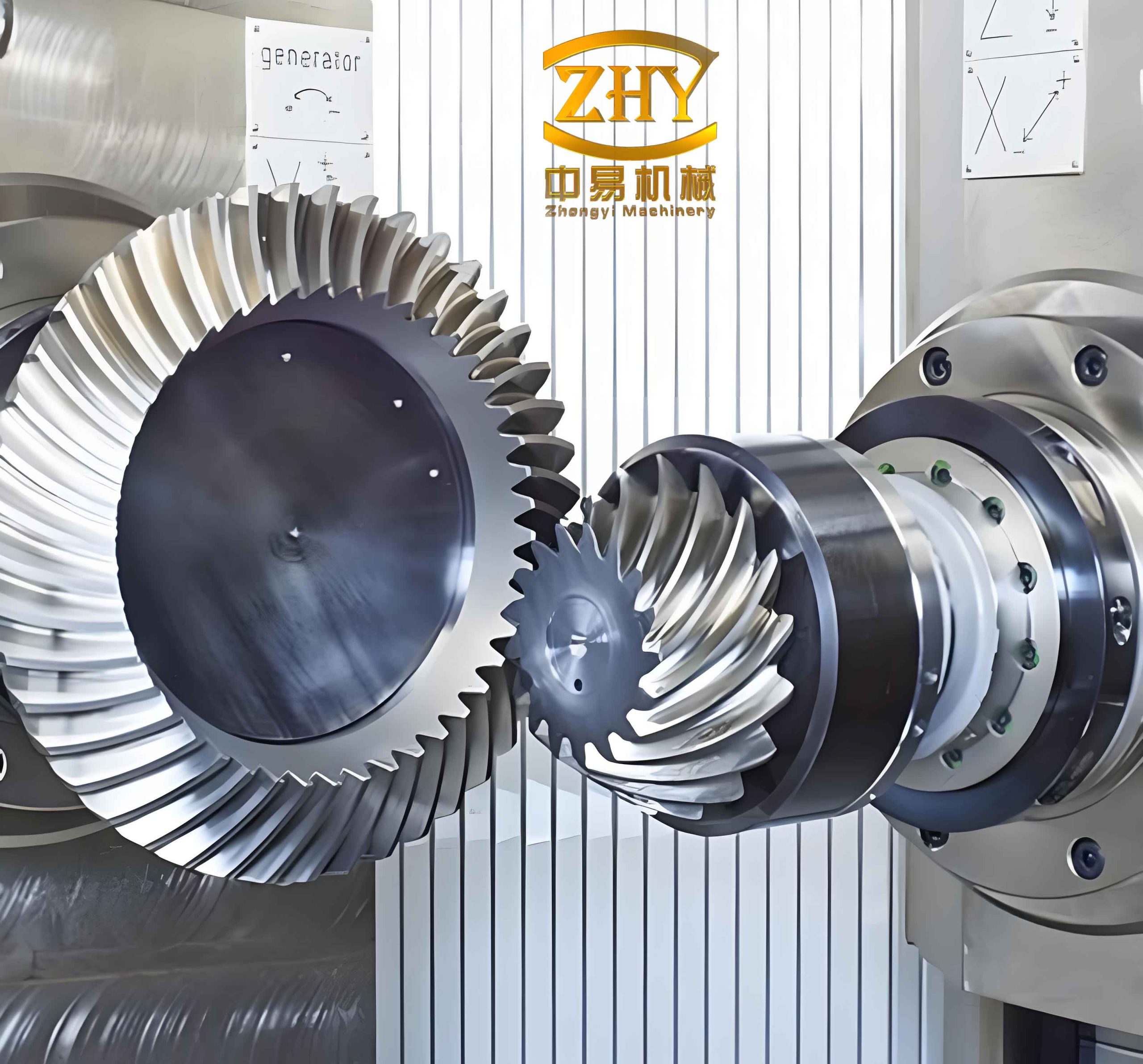
In this article, I will derive a mathematical model for hobbing hyperboloidal gears based on the Spiroflex method, starting from the coordinate system of a universal cradle-type gear-cutting machine. This model is then adapted for modern six-axis CNC gear-cutting machines. I will begin by transforming the mechanical settings of the universal cradle-type machine to suit the coordinate system of the new vertical six-axis machine. Next, I will calculate the mechanical coordinates for the six-axis machine and develop the machining program for hobbing hyperboloidal gears using the Spiroflex method. Finally, I will use VERICUT simulation software to simulate the hobbing process and analyze the tooth surface errors between the simulated gear and the theoretical gear. The results demonstrate that both the tooth surface position errors and tooth thickness errors are less than 50 μm, validating the high accuracy of this mathematical model for implementing the Spiroflex method on six-axis CNC gear-cutting machines for hyperboloidal gears production.
Introduction to Hyperboloidal Gears and the Spiroflex Method
Hyperboloidal gears, often referred to as hypoid gears, are essential in power transmission systems where non-intersecting shafts are required. Their unique geometry, characterized by an offset between the axes, allows for compact designs and improved performance in applications such as automotive rear axles. The manufacturing of hyperboloidal gears is challenging due to their complex tooth surfaces, which require precise machining methods. The Spiroflex method, also known as the face hobbing process with full generating motion, is a widely used technique for producing these gears. This method involves a face mill cutter that rotates and generates the tooth surface through a series of coordinated motions between the cutter and the workpiece. In this work, I focus on establishing a robust mathematical framework for the Spiroflex method to enable accurate machining of hyperboloidal gears on modern CNC platforms.
Mathematical Model for Face Hobbing Hyperboloidal Gears
The mathematical model for hyperboloidal gears using the Spiroflex method is built upon the kinematics of a universal cradle-type machine. This section details the derivation of the cutter equations, the generation of the tooth surface, and the coordinate transformations involved.
Face Hobbing Cutter Equations
The face hobbing cutter consists of multiple blade groups, each comprising inner, middle, and outer blades. For simplicity, I consider only the finishing process, excluding roughing. The blade edge profile includes a straight portion and a rounded tip, as shown in the following equations. Define the blade edge in coordinate system \(S_l\) using homogeneous coordinates. The position vector of the blade edge is given by:
$$ \mathbf{r}_l(u) = [x_l, 0, z_l, 1]^T $$
The blade edge comprises a rounded part \(\mathbf{r}_l^{(f)}(u)\) and a straight part \(\mathbf{r}_l^{(l)}(u)\). The equations are derived as:
For the straight portion:
$$ x_l^{(l)}(\alpha_F; u) = \pm u \sin \alpha_F $$
$$ z_l^{(l)}(\alpha_F; u) = u \cos \alpha_F $$
For the rounded portion:
$$ x_l^{(f)}(\alpha_F; \rho_o; h_r; u) = \pm (x_{cf} – \rho_o \cos u) $$
$$ z_l^{(f)}(\alpha_F; \rho_o; h_r; u) = z_{cf} + \rho_o \sin u $$
where \((x_{cf}, z_{cf})\) is the center of the rounding:
$$ x_{cf} = h_r \tan \alpha_F + \rho_o \tan(0.4\pi – 0.5\alpha_F) $$
$$ z_{cf} = h_r – \rho_o $$
Here, \(\pm\) corresponds to inner and outer blades, \(\alpha_F\) is the tool pressure angle, \(h_r\) is the reference point height, \(\rho_o\) is the rounding radius, and \(u\) is the blade edge parameter. These parameters are critical for defining the geometry of hyperboloidal gears during machining.
Next, transform the blade edge equations from coordinate system \(S_l\) to the cutter coordinate system \(S_t\). The transformation matrix \(M_{tl}\) accounts for the initial setup angle \(\beta_0\), tool reference radius \(r_0\), and tool direction angle \(\delta_0\):
$$ \mathbf{r}_t(u) = M_{tn} M_{nm} M_{ml} \mathbf{r}_l(u) = M_{tl} \mathbf{r}_l(u) $$
where:
$$ M_{tl} =
\begin{bmatrix}
\cos \beta_0 & \sin \beta_0 & 0 & 0 \\
-\sin \beta_0 & \cos \beta_0 & 0 & 0 \\
0 & 0 & 1 & 0 \\
0 & 0 & 0 & 1
\end{bmatrix}
\begin{bmatrix}
1 & 0 & 0 & r_0 \\
0 & 1 & 0 & 0 \\
0 & 0 & 1 & 0 \\
0 & 0 & 0 & 1
\end{bmatrix}
\begin{bmatrix}
\cos \delta_0 & -\sin \delta_0 & 0 & 0 \\
\sin \delta_0 & \cos \delta_0 & 0 & 0 \\
0 & 0 & 1 & 0 \\
0 & 0 & 0 & 1
\end{bmatrix} $$
This transformation ensures the blade edge is correctly oriented in the cutter frame, which is essential for accurate generation of hyperboloidal gears tooth surfaces.
Tooth Surface Generation for Hyperboloidal Gears
The tooth surface of hyperboloidal gears is generated through the relative motion between the cutter and the workpiece. I use a universal cradle-type machine model, where a imaginary generating gear (or crown gear) facilitates the process. The coordinate systems involve the cutter \(S_t\), the generating gear \(S_d\), and the workpiece \(S_l\). The transformation from \(S_t\) to \(S_d\) incorporates parameters such as the cutter rotation angle \(\beta\), tool tilt angle \(\phi_i\), tool tilt direction angle \(\phi_j\), cradle initial angle \(\theta_c\), and cycloidal motion angle \(\phi_{c1}\). The position vector in the generating gear system is:
$$ \mathbf{r}_d(u, \beta, \phi_{c1}) = M_{dc} M_{cb} M_{ba} M_{at} \mathbf{r}_t(u) = M_{dt} \mathbf{r}_t(u) $$
where the transformation matrices are defined as:
$$ M_{dt} =
\begin{bmatrix}
\cos(\theta_c – \phi_{c1}) & \sin(\theta_c – \phi_{c1}) & 0 & 0 \\
-\sin(\theta_c – \phi_{c1}) & \cos(\theta_c – \phi_{c1}) & 0 & 0 \\
0 & 0 & 1 & 0 \\
0 & 0 & 0 & 1
\end{bmatrix}
\begin{bmatrix}
-\sin \phi_j & 0 & \cos \phi_j & S_R \\
\cos \phi_j & 1 & -\sin \phi_j & 0 \\
0 & 0 & 1 & 0 \\
0 & 0 & 0 & 1
\end{bmatrix}
\begin{bmatrix}
\cos \phi_i & 0 & \sin \phi_i & 0 \\
0 & 1 & 0 & 0 \\
-\sin \phi_i & 0 & \cos \phi_i & 0 \\
0 & 1 & 0 & 0
\end{bmatrix}
\begin{bmatrix}
\cos \beta & -\sin \beta & 0 & 0 \\
\sin \beta & \cos \beta & 0 & 0 \\
0 & 0 & 1 & 0 \\
0 & 0 & 0 & 1
\end{bmatrix} $$
Here, \(S_R\) is the tool radial distance. To obtain the tooth surface as seen from the workpiece coordinate system \(S_l\), transform \(\mathbf{r}_d\) to \(S_l\) using additional parameters: generating motion cradle angle \(\phi_{c2}\), workpiece rotation angle \(\phi_1\), vertical wheel position \(E_m\), horizontal wheel position \(\Delta A\), bed position \(\Delta B\), machine root angle \(\gamma_m\), and machining allowance \(s\) (set to zero for theoretical derivation). The transformation is:
$$ \mathbf{r}_l(u, \beta, \phi_{c1}, \phi_{c2}, \phi_1) = M_{lg} M_{gf} M_{fe} M_{ed} \mathbf{r}_d(u, \beta, \phi_{c1}) = M_{ld} \mathbf{r}_d(u, \beta, \phi_{c1}) $$
with:
$$ M_{ld} =
\begin{bmatrix}
1 & 0 & 0 & 0 \\
0 & \cos \phi_1 & -\sin \phi_1 & 0 \\
0 & \sin \phi_1 & \cos \phi_1 & 0 \\
0 & 0 & 0 & 1
\end{bmatrix}
\begin{bmatrix}
\cos \gamma_m & 0 & \sin \gamma_m & -\Delta A \\
0 & 1 & 0 & 0 \\
-\sin \gamma_m & 0 & \cos \gamma_m & 0 \\
0 & 0 & 0 & 1
\end{bmatrix}
\begin{bmatrix}
1 & 0 & 0 & 0 \\
0 & 1 & 0 & E_m \\
0 & 0 & 1 & -(\Delta B + s) \\
0 & 0 & 0 & 1
\end{bmatrix}
\begin{bmatrix}
\cos \phi_{c2} & \sin \phi_{c2} & 0 & 0 \\
-\sin \phi_{c2} & \cos \phi_{c2} & 0 & 0 \\
0 & 0 & 1 & 0 \\
0 & 0 & 0 & 1
\end{bmatrix} $$
The relationships between angles simplify the model. The cradle angle \(\phi_c\) is:
$$ \phi_c = \phi_{c2} – \phi_{c1} $$
And the workpiece rotation angle relates to the cutter rotation and cradle angle via:
$$ \phi_1 = R_c \beta + R_a \phi_c $$
where \(R_c = z_0 / z\) is the ratio of blade groups to tooth number, and \(R_a = z_p / z\) is the ratio of generating gear teeth to workpiece teeth. Thus, the tooth surface equation reduces to \(\mathbf{r}_l(u, \beta, \phi_c)\).
The meshing equation ensures contact between the generating gear and workpiece tooth surface. The normal vector \(\mathbf{n}_1\) and relative velocity \(\mathbf{v}_1^{(lt)}\) are derived as:
$$ \mathbf{n}_1(u, \beta, \phi_c) = \frac{\partial \mathbf{r}_1(u, \beta, \phi_c)}{\partial u} \times \frac{\partial \mathbf{r}_1(u, \beta, \phi_c)}{\partial \beta} $$
$$ \mathbf{v}_1^{(lt)}(u, \beta, \phi_c) = \frac{\partial \mathbf{r}_1(u, \beta, \phi_c)}{\partial \phi_c} \dot{\phi}_c $$
The meshing condition is:
$$ f_1(u, \beta, \phi_c) = \mathbf{n}_1(u, \beta, \phi_c) \cdot \mathbf{v}_1^{(lt)}(u, \beta, \phi_c) = 0 $$
This system involves three parameters: \(u\), \(\beta\), and \(\phi_c\). By imposing two gear blank constraints from tooth surface topology points, I solve for these parameters to obtain the tooth surface points and unit normal vectors for hyperboloidal gears. The constraints are typically expressed as:
$$ x_1(u, \beta, \phi_c) = X_1^{(i,j)} $$
$$ y_1^2(u, \beta, \phi_c) + z_1^2(u, \beta, \phi_c) = Y_1^{(i,j)} $$
$$ f_1(u, \beta, \phi_c) = 0 $$
where \(X_1^{(i,j)}\) and \(Y_1^{(i,j)}\) are coordinates from the tooth topology grid. This mathematical formulation accurately describes the tooth surfaces of hyperboloidal gears produced via the Spiroflex method.
Mechanical Settings for Six-Axis CNC Gear-Cutting Machines
Modern manufacturing relies on CNC machines for precision and flexibility. The derived model for hyperboloidal gears must be adapted from the universal cradle-type machine to a six-axis CNC gear-cutting machine. This section details the coordinate transformation and mechanical settings for the six-axis machine.
Coordinate System of the Six-Axis Machine
The six-axis CNC machine features vertical configuration with axes for tool and workpiece movements. Define the coordinate systems: tool coordinate system \(S_t\), workpiece coordinate system \(S_l\), and intermediate systems for transformations. The transformation matrix from tool to workpiece is:
$$ M_{lt} = M_{ll’} M_{l’d} M_{dc} M_{cb} M_{ba} M_{at’} M_{t’t} $$
where the matrices account for workpiece rotation angle \(\phi_1\), workpiece rotation axis increment \(\Delta \Psi_b\), machine constants \(k_x\) and \(k_z\), workpiece tilt angle \(\Psi_c\), tool displacements \(c_x, c_y, c_z\), tool rotation axis increment \(\Delta \Psi_a\), and tool rotation angle \(\Psi_a\). The expanded form is:
$$ M_{lt} =
\begin{bmatrix}
1 & 0 & 0 & 0 \\
0 & \cos \Psi_b & \sin \Psi_b & 0 \\
0 & -\sin \Psi_b & \cos \Psi_b & 0 \\
0 & 0 & 0 & 1
\end{bmatrix}
\begin{bmatrix}
1 & 0 & 0 & 0 \\
0 & \cos \Delta \Psi_b & \sin \Delta \Psi_b & 0 \\
0 & -\sin \Delta \Psi_b & \cos \Delta \Psi_b & 0 \\
0 & 0 & 0 & 1
\end{bmatrix}
\begin{bmatrix}
1 & 0 & 0 & M_d + H_f + k_x \\
0 & 1 & 0 & 0 \\
0 & 0 & 1 & -k_z \\
0 & 0 & 0 & 1
\end{bmatrix}
\begin{bmatrix}
\sin \Psi_c & 0 & \cos \Psi_c & 0 \\
0 & 1 & 0 & 0 \\
-\cos \Psi_c & 0 & \sin \Psi_c & 0 \\
0 & 0 & 0 & 1
\end{bmatrix}
\begin{bmatrix}
1 & 0 & 0 & -(c_y + k_z) \\
0 & 1 & 0 & c_z \\
0 & 0 & 1 & -(c_x + H_f + k_x) \\
0 & 0 & 0 & 1
\end{bmatrix}
\begin{bmatrix}
\cos \Delta \Psi_a & \sin \Delta \Psi_a & 0 & 0 \\
-\sin \Delta \Psi_a & \cos \Delta \Psi_a & 0 & 0 \\
0 & 0 & 1 & 0 \\
0 & 0 & 0 & 1
\end{bmatrix}
\begin{bmatrix}
\cos \Psi_a & \sin \Psi_a & 0 & 0 \\
-\sin \Psi_a & \cos \Psi_a & 0 & 0 \\
0 & 0 & 1 & 0 \\
0 & 0 & 0 & 1
\end{bmatrix} $$
Here, \(M_d\) is the gear blank mounting distance, \(H_f\) is the fixture height, and other terms are machine-specific parameters.
Transformation from Cradle-Type to Six-Axis Machine
To ensure the tooth surface of hyperboloidal gears machined on the six-axis machine matches that from the cradle-type machine, the transformation matrices \(M_{ga}\) (from cradle model) and \(M_{l’t’}\) (from six-axis model) must be equal. Let \(M_{ga}\) be represented by elements \(a_{ij}\):
$$ M_{ga} =
\begin{bmatrix}
a_{11} & a_{12} & a_{13} & a_{14} \\
a_{21} & a_{22} & a_{23} & a_{24} \\
a_{31} & a_{32} & a_{33} & a_{34} \\
0 & 0 & 0 & 1
\end{bmatrix} $$
From the equality condition, I solve for key angles:
$$ \Psi_c = \pm \arccos(a_{13}) $$
$$ \Delta \Psi_a = \arctan\left( \frac{\pm a_{12}}{\pm a_{11}} \right) $$
$$ \Delta \Psi_b = \arctan\left( \frac{\pm a_{23}}{\pm a_{33}} \right) $$
The sign choices for \(\Psi_c\) depend on the gear hand to minimize machine travel. The tool and workpiece displacements are derived as:
$$ c_x = -a_{14} \cos \Psi_c – a_{24} \sin \Delta \Psi_b \sin \Psi_c – a_{34} \cos \Delta \Psi_b \sin \Psi_c – H_f + H_f \cos \Psi_c – k_x + k_x \cos \Psi_c – k_z \sin \Psi_c + M_d \cos \Psi_c $$
$$ c_y = \sin \Psi_c (-a_{14} + a_{24} \sin \Delta \Psi_b \cot \Psi_c + a_{34} \cos \Delta \Psi_b \cot \Psi_c + H_f + k_x + k_z \cot \Psi_c – k_z \csc \Psi_c + M_d) $$
$$ c_z = a_{24} \cos \Delta \Psi_b – a_{34} \sin \Delta \Psi_b $$
During face hobbing on the six-axis machine, the tool rotates at a constant speed. The angle increment \(\Delta \Psi_a\) is compensated negatively to the workpiece axis, resulting in the workpiece rotation axis tilt angle:
$$ \Psi_b = \phi_1 + \Delta \Psi_b – R_c \Delta \Psi_a $$
These equations provide the mechanical settings for the six-axis CNC machine to accurately produce hyperboloidal gears using the Spiroflex method.
Simulation and Error Analysis for Hyperboloidal Gears
To validate the mathematical model, I conduct a simulation using VERICUT software. This involves generating NC code based on the calculated mechanical coordinates and comparing the simulated gear tooth surfaces with theoretical ones. The hyperboloidal gears parameters used in this study are summarized in the following tables.
| Parameter | Pinion (Convex Side) | Pinion (Concave Side) | Gear (Convex Side) | Gear (Concave Side) |
|---|---|---|---|---|
| Number of teeth \(z\) | 10 | 41 | ||
| Normal module at reference point \(m_n\) (mm) | 3.33 | |||
| Spiral angle at reference point \(\beta_m\) (°) | 50.01 | 50.01 | 37.13 | 37.13 |
| Pressure angle at reference point \(\alpha\) (°) | 22.13 | -17.87 | -22.13 | 17.87 |
| Shaft angle \(\Sigma\) (°) | 90 | |||
| Offset distance \(E\) (mm) | 20 | |||
| Pitch angle \(\delta\) (°) | 17.59 | 17.59 | 71.99 | 71.99 |
| Face width \(b\) (mm) | 32 | 32 | 30 | 30 |
| Pitch diameter \(d_e\) (mm) | 61.51 | 61.51 | 200.00 | 200.00 |
| Reference point pitch radius \(r_m\) (mm) | 25.94 | 25.94 | 85.74 | 85.74 |
| Addendum \(h_a\) (mm) | 4.63 | 4.63 | 2.03 | 2.03 |
| Dedendum \(h_f\) (mm) | 2.87 | 2.87 | 5.47 | 5.47 |
| Whole depth \(h_t\) (mm) | 7.50 | |||
| Mounting distance \(M_d\) (mm) | 99.47 | 99.47 | 42.03 | 42.03 |
| Parameter | Pinion (Convex Side) | Pinion (Concave Side) | Gear (Convex Side) | Gear (Concave Side) |
|---|---|---|---|---|
| Number of blade groups \(z_0\) | 13 | |||
| Reference point height \(h_r\) (mm) | 3.99 | 3.88 | 4.05 | 3.92 |
| Tool pressure angle \(\alpha_F\) (°) | 20.90 | 19.09 | 16.30 | 23.70 |
| Tool direction angle \(\delta_0\) (°) | 14.36 | 14.12 | -14.13 | -14.35 |
| Tool reference radius \(r_0\) (mm) | 87.28 | 88.72 | 88.65 | 87.35 |
| Initial setup angle \(\beta_0\) (°) | -34.51 | -23.71 | 20.57 | 2.88 |
| Parameter | Pinion (Convex Side) | Pinion (Concave Side) | Gear (Convex Side) | Gear (Concave Side) |
|---|---|---|---|---|
| Tool tilt angle \(\phi_i\) (°) | 2 | 2 | ||
| Tool tilt direction angle \(\phi_j\) (°) | 7.48 | 168.11 | ||
| Tool radial distance \(S_R\) (mm) | 96.16 | 96.15 | ||
| Cradle initial angle \(\theta_c\) (°) | 67.85 | -55.26 | -55.26 | 67.85 |
| Vertical wheel position \(E_m\) (mm) | 17.75 | 17.75 | 2.16 | 2.16 |
| Horizontal wheel position \(\Delta A\) (mm) | 1.59 | 1.59 | -3.30 | -3.30 |
| Bed position \(\Delta B\) (mm) | -0.48 | -0.48 | -0.17 | -0.17 |
| Machine root angle \(\gamma_m\) (°) | 16.43 | 16.43 | 71.30 | 71.30 |
| Ratio \(R_a = z_p / z\) | 4.18 | 4.18 | 1.02 | 1.02 |
Using these parameters, I derive the tooth surface mathematical model for hyperboloidal gears and solve for tooth surface points and unit normal vectors. Based on the tooth surface points and assembly parameters, I generate a 3D model of the hyperboloidal gear pair in SolidWorks. Then, I convert the cradle-type machine settings to six-axis CNC machine settings, compute the workpiece machining coordinates, and plan the NC program. The VERICUT simulation mimics the face hobbing process, and the simulated gear is compared with the theoretical gear for error analysis.
The error analysis results show that for the pinion, the actual tooth thickness is 7.509 mm with an error of +3.8 μm, and for the gear, the actual tooth thickness is 6.701 mm with an error of -39.62 μm. The tooth surface error maps indicate that the maximum position error for both pinion and gear is approximately 30 μm. According to general experience with VERICUT simulations, the tooth surface position errors and tooth thickness errors between theoretical and simulated gears are typically less than 50 μm. These results confirm that the mathematical model achieves high accuracy for hobbing hyperboloidal gears on six-axis CNC gear-cutting machines using the Spiroflex method.
Discussion on Model Accuracy and Applications
The mathematical model presented here effectively bridges traditional cradle-type machining with modern CNC technology for hyperboloidal gears. The Spiroflex method, when implemented via this model, ensures precise tooth surface generation, which is crucial for the performance of hyperboloidal gears in demanding applications like automotive differentials. The error values below 50 μm demonstrate the model’s reliability, but further refinements could be explored, such as incorporating thermal effects or tool wear. Additionally, this model can be extended to other gear types or adapted for real-time correction during machining. The use of six-axis CNC machines offers flexibility in producing hyperboloidal gears with complex modifications, such as lengthwise crowning or bias corrections, without needing tool profile adjustments. This adaptability makes the Spiroflex method combined with CNC technology a powerful solution for advanced gear manufacturing.
Conclusion
In this article, I have developed a comprehensive mathematical model for hobbing hyperboloidal gears based on the Spiroflex method. Starting from the coordinate system of a universal cradle-type machine, I derived the cutter equations, tooth surface generation equations, and meshing conditions. I then transformed the mechanical settings to suit a six-axis CNC gear-cutting machine, calculating the necessary coordinates and displacements for accurate machining. The model was validated through VERICUT simulations, showing that tooth surface errors and tooth thickness errors are within 50 μm, confirming the model’s accuracy. This work provides a practical framework for manufacturing hyperboloidal gears on modern CNC platforms, enhancing precision and efficiency in gear production. Future work may focus on optimizing the model for different hyperboloidal gears designs or integrating it with adaptive control systems for improved manufacturing outcomes.