
In the field of precision motion control and robotics, harmonic drive gears are renowned for their high reduction ratios, compact design, and zero-backlash performance. As a researcher deeply involved in the mechanics of these systems, I find that the core of their performance lies in the intricate interaction between the flexspline and circular spline. Specifically, the tooth profile clearance—or the minimal gap between the conjugate tooth profiles—is critical for ensuring smooth operation, load capacity, and longevity. This article delves into a comprehensive mathematical model for analyzing the clearance between the involute tooth profiles of the flexspline and circular spline in a harmonic drive gear. By leveraging established involute geometry and coordinate transformations, I derive explicit equations for clearance, which serve as a foundation for optimizing design parameters like profile shift coefficients. The goal is to provide engineers with a robust framework to minimize interference and achieve near-conjugate action, thereby enhancing the efficiency and reliability of harmonic drive gear systems.
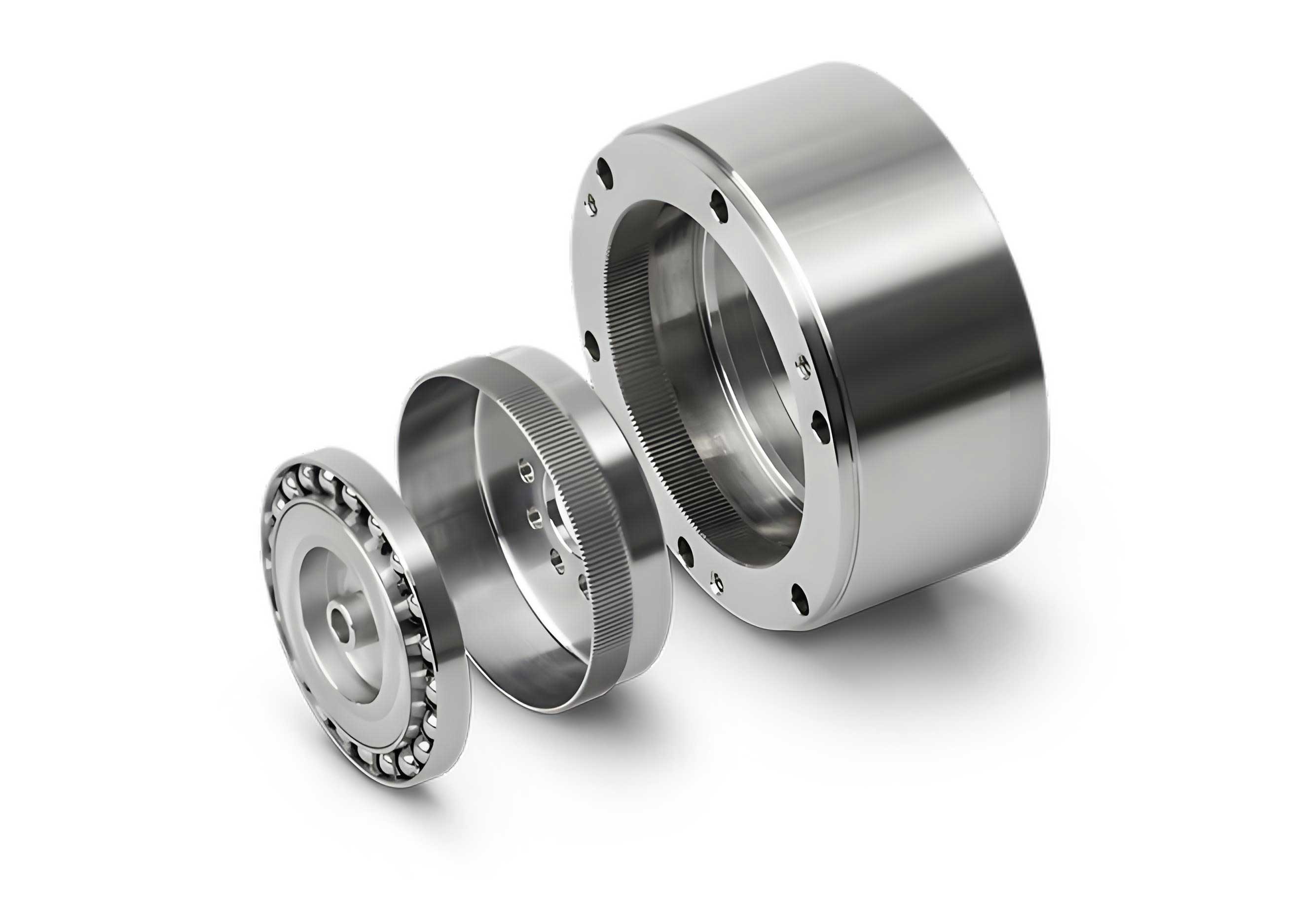
The harmonic drive gear operates on the principle of elastic deformation, where a wave generator induces a controlled elliptical shape in a thin-walled flexspline, causing its teeth to engage progressively with those of a rigid circular spline. This unique mechanism allows for significant speed reduction in a single stage. However, the non-rigid nature of the flexspline introduces complexities in tooth meshing. Unlike conventional gears, the teeth in a harmonic drive gear do not maintain constant contact; instead, they engage and disengage in a wave-like pattern. To prevent jamming, wear, and loss of precision, it is essential to model and control the clearance between the tooth profiles. In practice, the tooth profiles are often based on the involute curve due to its manufacturability and well-understood properties. Using a standard pressure angle of $$ \alpha = 20^\circ $$ facilitates high-precision machining with readily available equipment for small-module gears. This choice simplifies production while allowing for precise control over the meshing behavior through parametric adjustments. The focus of this study is to establish a mathematical model that quantifies the clearance between the flexspline and circular spline involute profiles, ultimately aiding in the design of harmonic drive gear systems that balance performance with practical manufacturing constraints.
To build an accurate model for tooth profile clearance in harmonic drive gears, one must first thoroughly understand the underlying geometry of the involute curve. The involute is a curve traced by a point on a straight line as it rolls without slipping on a base circle. This definition leads to several key properties that are fundamental to gear tooth design. Let the base circle have a radius $$ r_b $$. As the generating line rolls, the length of the arc unwound from the base circle equals the length of the generating line from the tangent point to the traced point. This relationship is central to deriving the involute equations. Furthermore, the generating line is always tangent to the base circle and normal to the involute at the point of contact. The radius of curvature at any point on the involute is equal to the length of the generating line from that point to the base circle, meaning curvature increases as one approaches the base circle. Importantly, the shape of an involute is uniquely determined by its base circle; a larger base circle yields a flatter curve. For gear applications, the involute profile typically starts from the base circle outward, as the region inside the base circle does not form a valid involute.
The mathematical representation of an involute can be expressed in both polar and Cartesian coordinates. In polar coordinates, let $$ r_x $$ be the radial distance from the center to a point on the involute, and $$ \theta_x $$ be the angle measured from the start of the involute. The pressure angle at that point, denoted $$ \alpha_x $$, is the angle between the radial line and the normal to the involute. The fundamental relation is given by the involute function:
$$ \theta_x = \text{inv} \alpha_x = \tan \alpha_x – \alpha_x $$
where $$ \text{inv} \alpha_x $$ is the involute function. The radial distance is:
$$ r_x = \frac{r_b}{\cos \alpha_x} $$
Thus, the polar coordinates of any point on the involute are $$ (r_x, \theta_x) $$. For harmonic drive gear analysis, it is often more convenient to work in Cartesian coordinates. Two common orientations are used: one where the y-axis aligns with the line connecting the origin to the start of the involute (the “generating line axis”), and another where the y-axis aligns with the tooth’s symmetry line. The latter is more practical for gear design. Let the base circle radius be $$ r_b $$. For a point with pressure angle $$ \alpha_x $$, define the parameter $$ \phi = \alpha_x + \theta_x = \alpha_x + \text{inv} \alpha_x = \tan \alpha_x $$. Then, the coordinates relative to the generating line axis are:
$$ X = r_b [ \sin \phi – \phi \cos \phi ] $$
$$ Y = r_b [ \cos \phi + \phi \sin \phi ] $$
To rotate the coordinate system so that the y-axis aligns with the tooth symmetry line, we introduce a rotation angle $$ \beta_b $$, which is half the base circle tooth thickness angle. The transformed coordinates (x, y) become:
$$ x = r_b [ \sin(\phi + \beta_b) – \phi \cos(\phi + \beta_b) ] $$
$$ y = r_b [ \cos(\phi + \beta_b) + \phi \sin(\phi + \beta_b) ] $$
Here, $$ \beta_b $$ depends on the gear parameters: the number of teeth Z, the profile shift coefficient ξ, and the standard pressure angle α. Specifically:
$$ \beta_b = \frac{\pi + 4\xi \tan \alpha}{2Z} + \text{inv} \alpha $$
This equation accounts for the tooth thickness modification due to profile shifting, a common technique in harmonic drive gear design to adjust clearance and strength.
In harmonic drive gears, the flexspline and circular spline have different numbers of teeth, typically differing by two (e.g., flexspline with Z_R teeth and circular spline with Z_G teeth, where Z_G = Z_R + 2). This difference enables the speed reduction. However, due to the deformation induced by the wave generator, the meshing is not conjugate in the traditional sense. Instead, designers aim to approximate conjugate action by carefully selecting profile shift coefficients ξ_R and ξ_G for the flexspline and circular spline, respectively. The critical aspect is to ensure that during operation, the tooth profiles do not interfere, and a minimal, controlled clearance exists to accommodate manufacturing tolerances and thermal expansion. Through theoretical analysis and experimental validation, it has been observed that the minimum clearance or potential interference in a harmonic drive gear occurs near the tooth tips. Specifically, when the wave generator rotates, the points of closest approach are often between the tip of one tooth and the flank of the mating tooth. Therefore, the clearance modeling focuses on two scenarios: the clearance from the flexspline tooth tip to the circular spline tooth flank, and the clearance from the circular spline tooth tip to the flexspline tooth flank.
To derive the clearance equations, we establish coordinate systems for both gears. Let C_R be the coordinate system fixed to the flexspline, with origin at its center O_R. Similarly, let C_G be the coordinate system fixed to the circular spline, with origin at its center O_G. The wave generator introduces a relative motion, which can be described by a transformation matrix that maps points from C_R to C_G. Assume the wave generator rotates clockwise and is the driving element, while the circular spline is fixed. The instantaneous position of the flexspline relative to the circular spline is characterized by a rotation angle ψ_G and a translation vector that depends on the wave generator’s profile, often represented by a radial displacement ρ and an angle γ_G. The transformation matrix is:
$$ M^G_{RG} = \begin{pmatrix}
\cos \psi_G & -\sin \psi_G & -\rho \sin \gamma_G \\
\sin \psi_G & \cos \psi_G & \rho \cos \gamma_G \\
0 & 0 & 1
\end{pmatrix} $$
Thus, a point in C_R with coordinates (x_R, y_R) transforms to C_G as:
$$ \begin{pmatrix} x^G_R \\ y^G_R \\ 1 \end{pmatrix} = M^G_{RG} \begin{pmatrix} x_R \\ y_R \\ 1 \end{pmatrix} $$
which gives:
$$ x^G_R = x_R \cos \psi_G – y_R \sin \psi_G – \rho \sin \gamma_G $$
$$ y^G_R = x_R \sin \psi_G + y_R \cos \psi_G + \rho \cos \gamma_G $$
This transformation is essential for expressing the flexspline tooth profile in the circular spline’s coordinate system during meshing.
Now, consider the clearance from the flexspline tooth tip to the circular spline tooth flank. Let the flexspline tooth tip point in C_R be denoted as (x_{aR}, y_{aR}). This point corresponds to the addendum circle of the flexspline. Using the involute equations in the tooth-symmetry-aligned coordinates, we have:
$$ x_{aR} = r_{bR} [ \sin(\tan \alpha_{aR} – \beta_{bR}) – \tan \alpha_{aR} \cdot \cos(\tan \alpha_{aR} – \beta_{bR}) ] $$
$$ y_{aR} = r_{bR} [ \cos(\tan \alpha_{aR} – \beta_{bR}) + \tan \alpha_{aR} \cdot \sin(\tan \alpha_{aR} – \beta_{bR}) ] – r_R $$
where:
- $$ r_{bR} = r_R \cos \alpha $$ is the base circle radius of the flexspline.
- $$ r_R = \frac{m Z_R}{2} $$ is the pitch radius of the flexspline.
- $$ \alpha_{aR} = \arccos\left( \frac{r_{bR}}{r_{aR}} \right) $$ is the pressure angle at the flexspline tooth tip.
- $$ r_{aR} = \frac{m}{2}(Z_R + 2\xi_R + 2h_{aR}^*) $$ is the addendum radius of the flexspline, with $$ h_{aR}^* $$ being the addendum coefficient.
- $$ \beta_{bR} = \frac{\pi + 4\xi_R \tan \alpha}{2Z_R} + \text{inv} \alpha $$ is the base circle half-tooth-thickness angle for the flexspline.
Similarly, the circular spline tooth tip point in C_G is (x_{aG}, y_{aG}), given by:
$$ x_{aG} = r_{bG} [ \sin(\tan \alpha_{aG} – \beta_{bG}) – \tan \alpha_{aG} \cdot \cos(\tan \alpha_{aG} – \beta_{bG}) ] $$
$$ y_{aG} = r_{bG} [ \cos(\tan \alpha_{aG} – \beta_{bG}) + \tan \alpha_{aG} \cdot \sin(\tan \alpha_{aG} – \beta_{bG}) ] $$
where:
- $$ r_{bG} = r_G \cos \alpha $$.
- $$ r_G = \frac{m Z_G}{2} $$.
- $$ \alpha_{aG} = \arccos\left( \frac{r_{bG}}{r_{aG}} \right) $$.
- $$ r_{aG} = \frac{m}{2}(Z_G + 2\xi_G – 2h_{aG}^*) $$ (note the subtraction for the circular spline addendum).
- $$ \beta_{bG} = \frac{\pi + 4\xi_G \tan \alpha}{2Z_G} + \text{inv} \alpha $$.
The flexspline tooth tip point transformed into C_G is:
$$ x^G_{aR} = x_{aR} \cos \psi_G – y_{aR} \sin \psi_G – \rho \sin \gamma_G $$
$$ y^G_{aR} = x_{aR} \sin \psi_G + y_{aR} \cos \psi_G + \rho \cos \gamma_G $$
Next, we find the point on the circular spline tooth flank that is closest to the flexspline tip. According to involute properties, the normal to the involute at any point passes through the base circle. Therefore, from the flexspline tip point (x^G_{aR}, y^G_{aR}), we draw a line normal to the circular spline involute. This line will intersect the circular spline involute at a point (x_{RG}, y_{RG}). The equation for this intersection point can be derived using geometric relations. Define:
$$ \theta_G = \arctan\left( \frac{x^G_{aR}}{y^G_{aR}} \right) $$
$$ \delta_G = \arcsin\left( \frac{r_{bG}}{\sqrt{(x^G_{aR})^2 + (y^G_{aR})^2}} \right) $$
$$ T^G_{aR} = \frac{\pi}{2} – (\delta_G – \theta_G) $$
$$ T_G = T^G_{aR} + \beta_{bG} $$
Then, the coordinates of the intersection point on the circular spline involute are:
$$ x_{RG} = r_{bG} ( T_G \cos T^G_{aR} + \sin T^G_{aR} ) $$
$$ y_{RG} = r_{bG} ( T_G \sin T^G_{aR} + \cos T^G_{aR} ) $$
The clearance $$ H_{RG} $$ is the distance between the flexspline tip and this intersection point:
$$ H_{RG} = \pm \sqrt{ (x^G_{aR} – x_{RG})^2 + (y^G_{aR} – y_{RG})^2 } $$
The sign is determined based on relative positions: if $$ |x^G_{aR}| – |x_{RG}| > 0 $$ or $$ y^G_{aR} – y_{RG} > 0 $$, use the negative sign; otherwise, use the positive sign. This sign convention accounts for whether the flexspline tip is outside or inside the circular spline flank.
Similarly, for the clearance from the circular spline tooth tip to the flexspline tooth flank, we follow an analogous procedure. The circular spline tip point (x_{aG}, y_{aG}) is known in C_G. We transform it into the flexspline coordinate system C_R, or directly work in a mixed system. Alternatively, we can consider the inverse scenario. Let the point on the flexspline flank closest to the circular spline tip be (x_{GR}, y_{GR}). Using geometry, define parameters relative to the flexspline:
$$ \theta_R = \arctan\left( \frac{x_{aG} – o_x}{y_{aG} – o_y} \right) $$
$$ \delta_R = \arcsin\left( \frac{r_{bR}}{\sqrt{(x_{aG} – o_x)^2 + (y_{aG} – o_y)^2}} \right) $$
$$ T^R_{aG} = \frac{\pi}{2} – (\delta_R – \theta_R) $$
$$ T_R = T^R_{aG} + \psi_G + \beta_{bR} $$
where (o_x, o_y) are the coordinates of the flexspline center in C_G, given by:
$$ o_x = r_R \sin \psi_G – \rho \sin \gamma_G $$
$$ o_y = -r_R \cos \psi_G + \rho \cos \gamma_G $$
Then, the intersection point on the flexspline involute is:
$$ x_{GR} = r_{bR} [ -T_R \cos T^R_{aG} + \sin T^R_{aG} ] + o_x $$
$$ y_{GR} = r_{bR} [ T_R \sin T^R_{aG} + \cos T^R_{aG} ] + o_y $$
The clearance $$ H_{GR} $$ is:
$$ H_{GR} = \pm \sqrt{ (x_{aG} – x_{GR})^2 + (y_{aG} – y_{GR})^2 } $$
with sign convention: if $$ x_{aG} – |x_{GR}| < 0 $$ or $$ y_{aG} – |y_{GR}| < 0 $$, use negative; otherwise, positive.
These clearance equations provide a quantitative means to assess the meshing conditions in a harmonic drive gear. By evaluating $$ H_{RG} $$ and $$ H_{GR} $$ over a range of wave generator rotation angles ψ_G, one can determine the minimum clearance and identify potential interferences. The model explicitly incorporates key design parameters: module m, tooth numbers Z_R and Z_G, profile shift coefficients ξ_R and ξ_G, addendum coefficients, and wave generator parameters (ρ, γ_G). This allows designers to iteratively adjust these parameters to achieve desired performance. For instance, increasing the profile shift coefficient of the flexspline ξ_R might increase clearance on one flank but decrease it on another, so a balanced approach is necessary.
To facilitate practical application, I summarize the key equations and parameters in tables below. These tables serve as a quick reference for engineers working on harmonic drive gear design.
| Symbol | Description | Typical Units |
|---|---|---|
| m | Module of the gear | mm |
| α | Standard pressure angle (usually 20°) | rad or deg |
| Z_R | Number of teeth on flexspline | – |
| Z_G | Number of teeth on circular spline | – |
| ξ_R | Profile shift coefficient for flexspline | – |
| ξ_G | Profile shift coefficient for circular spline | – |
| h_{aR}^* | Addendum coefficient for flexspline | – |
| h_{aG}^* | Addendum coefficient for circular spline | – |
| r_R | Pitch radius of flexspline | mm |
| r_G | Pitch radius of circular spline | mm |
| r_{bR} | Base circle radius of flexspline | mm |
| r_{bG} | Base circle radius of circular spline | mm |
| r_{aR} | Addendum radius of flexspline | mm |
| r_{aG} | Addendum radius of circular spline | mm |
| β_{bR} | Half base tooth thickness angle for flexspline | rad |
| β_{bG} | Half base tooth thickness angle for circular spline | rad |
| ψ_G | Rotation angle of wave generator (input) | rad |
| ρ | Radial displacement of wave generator | mm |
| γ_G | Angular position of wave generator | rad |
| H_{RG} | Clearance from flexspline tip to circular spline flank | mm |
| H_{GR} | Clearance from circular spline tip to flexspline flank | mm |
| Equation | Expression | Notes |
|---|---|---|
| Involute function | $$ \text{inv} \alpha_x = \tan \alpha_x – \alpha_x $$ | Fundamental relation |
| Polar coordinates | $$ r_x = \frac{r_b}{\cos \alpha_x}, \quad \theta_x = \text{inv} \alpha_x $$ | For any point on involute |
| Cartesian coordinates (tooth symmetry) | $$ x = r_b [ \sin(\phi + \beta_b) – \phi \cos(\phi + \beta_b) ] $$ $$ y = r_b [ \cos(\phi + \beta_b) + \phi \sin(\phi + \beta_b) ] $$ |
Where $$ \phi = \tan \alpha_x $$, $$ \beta_b $$ from gear parameters |
| Base half-tooth-thickness angle | $$ \beta_b = \frac{\pi + 4\xi \tan \alpha}{2Z} + \text{inv} \alpha $$ | Depends on profile shift |
| Pressure angle at addendum | $$ \alpha_a = \arccos\left( \frac{r_b}{r_a} \right) $$ | For tip point calculation |
| Step | Action | Equations Used |
|---|---|---|
| 1 | Compute flexspline tip coordinates in C_R | $$ x_{aR}, y_{aR} $$ from involute equations with $$ \alpha_{aR} $$ |
| 2 | Transform flexspline tip to C_G | $$ x^G_{aR} = x_{aR} \cos \psi_G – y_{aR} \sin \psi_G – \rho \sin \gamma_G $$ $$ y^G_{aR} = x_{aR} \sin \psi_G + y_{aR} \cos \psi_G + \rho \cos \gamma_G $$ |
| 3 | Find intersection on circular spline flank | Compute $$ \theta_G, \delta_G, T^G_{aR}, T_G $$, then $$ x_{RG}, y_{RG} $$ |
| 4 | Calculate clearance H_{RG} | $$ H_{RG} = \pm \sqrt{ (x^G_{aR} – x_{RG})^2 + (y^G_{aR} – y_{RG})^2 } $$ |
| 5 | Compute circular spline tip in C_G | $$ x_{aG}, y_{aG} $$ from involute equations with $$ \alpha_{aG} $$ |
| 6 | Find intersection on flexspline flank | Compute $$ \theta_R, \delta_R, T^R_{aG}, T_R $$, then $$ x_{GR}, y_{GR} $$ |
| 7 | Calculate clearance H_{GR} | $$ H_{GR} = \pm \sqrt{ (x_{aG} – x_{GR})^2 + (y_{aG} – y_{GR})^2 } $$ |
The mathematical model presented here is not merely theoretical; it has practical implications for the design and manufacturing of harmonic drive gears. By simulating the clearance over a full rotation of the wave generator, designers can identify critical positions where clearance is minimal. This allows for optimization of profile shift coefficients to ensure that clearance remains positive (i.e., no interference) while being as small as possible to maximize contact ratio and load capacity. In high-precision applications, such as aerospace or surgical robots, even micron-level clearances can impact performance. Therefore, the ability to predict and control these clearances through mathematical modeling is invaluable.
Moreover, the model can be extended to account for manufacturing tolerances, thermal effects, and load-induced deformations. For instance, the base circle radii $$ r_{bR} $$ and $$ r_{bG} $$ might have slight variations due to machining errors. By incorporating statistical distributions of these parameters, one can perform tolerance analysis to ensure robust performance. Additionally, under load, the flexspline deforms further, altering the effective tooth profiles. This can be modeled by adjusting the wave generator parameters (ρ, γ_G) to reflect the additional deflection. Such advanced analyses rely on the foundational clearance equations derived above.
In conclusion, the study of tooth profile clearance in harmonic drive gears is essential for achieving optimal performance. The involute profile, with its well-defined geometry, provides a tractable basis for modeling. Through coordinate transformations and geometric reasoning, I have derived explicit equations for the clearance between the flexspline and circular spline tooth profiles. These equations encapsulate the influence of key design parameters, enabling systematic optimization. The harmonic drive gear community can leverage this model to design systems that minimize backlash, reduce wear, and enhance efficiency. Future work may involve experimental validation using high-resolution imaging or computational simulations like finite element analysis to refine the model further. As harmonic drive gears continue to evolve for emerging technologies, such as collaborative robots and renewable energy systems, precise mathematical models will remain at the forefront of innovation.
To illustrate the interdependence of parameters, consider the following sensitivity analysis. The clearance values $$ H_{RG} $$ and $$ H_{GR} $$ are functions of multiple variables. Using partial derivatives, one can assess how changes in each parameter affect clearance. For example, the derivative with respect to the profile shift coefficient ξ_R for the flexspline can be computed numerically. This helps in understanding trade-offs. Below is a conceptual table showing typical trends (increase ↑, decrease ↓, or variable ~) for a standard harmonic drive gear configuration.
| Parameter | Effect on H_{RG} (flexspline tip to circular spline flank) | Effect on H_{GR} (circular spline tip to flexspline flank) |
|---|---|---|
| Increase in module m | ↑ (proportional increase) | ↑ (proportional increase) |
| Increase in ξ_R | ↓ (tip moves outward, potentially reducing clearance) | ↑ (flexspline tooth thicker, may increase clearance) |
| Increase in ξ_G | ↑ (circular spline tooth thinner, may increase clearance) | ↓ (tip moves inward, potentially reducing clearance) |
| Increase in addendum coefficients | ↓ (larger tip radius may lead to interference) | ↓ (similar effect) |
| Increase in wave generator radius ρ | ~ (complex, depends on phase) | ~ (complex, depends on phase) |
| Increase in tooth count difference (Z_G – Z_R) | ↑ (larger difference may increase clearance) | ↑ (similar effect) |
This sensitivity analysis underscores the need for a holistic approach when designing a harmonic drive gear. Adjusting one parameter in isolation may have opposing effects on the two clearances, potentially leading to suboptimal performance. Therefore, engineers should use the mathematical model to perform multi-variable optimization, often aided by computational tools.
In practice, the design process for a harmonic drive gear involves iterative steps: initial parameter selection based on load and speed requirements, clearance calculation using the model, adjustment of profile shifts or other parameters, and re-calculation until criteria are met. The model can be implemented in software such as MATLAB or Python, allowing for rapid iteration. Additionally, the equations can be coupled with stress analysis models to ensure that tooth strength is not compromised while achieving desired clearance.
Another important aspect is the impact of lubrication and surface finish on effective clearance. While the geometric clearance is a primary concern, actual performance may be influenced by tribological factors. However, the geometric model provides a baseline that can be modified with empirical factors based on testing. For instance, in high-speed harmonic drive gear applications, a slightly larger clearance might be recommended to accommodate oil film thickness.
The harmonic drive gear is a marvel of mechanical engineering, and its efficiency hinges on precise tooth interaction. By embracing mathematical modeling, designers can push the boundaries of what is possible, creating compact, high-ratio drives for tomorrow’s technologies. As I continue to explore this field, I am convinced that further refinements to the clearance model—such as incorporating non-standard involute modifications or accounting for dynamic effects—will yield even greater advancements. For now, the equations and tables presented here offer a solid foundation for anyone engaged in the design and analysis of harmonic drive gears.
Finally, it is worth noting that the model assumes perfect involute profiles and rigid body motion except for the prescribed flexspline deformation. In reality, teeth may have deviations due to manufacturing, and the flexspline’s elasticity may cause distributed strain. These complexities can be addressed by integrating the clearance model with finite element analysis, where the tooth profiles are discretized, and deformations are computed under load. Such hybrid approaches represent the cutting edge of harmonic drive gear research. Nonetheless, the analytical model remains invaluable for initial design and insight, providing a clear understanding of how geometric parameters influence performance. As harmonic drive gears become ubiquitous in precision machinery, the importance of such models will only grow, driving innovation and reliability in this critical component of modern mechanical systems.