
In my extensive work with mechanical design, I have always been fascinated by the power of parametric modeling to streamline the creation of complex components. Among these, straight spur gears are fundamental to countless transmission systems, prized for their simplicity, efficiency, and reliability. However, the geometric intricacies of involute tooth profiles and the variable nature of gear parameters have traditionally made the design process tedious and error-prone. Through my research and practical experience, I have leveraged Pro/E’s parametric design environment to develop a robust method for generating accurate, customizable straight spur gears. This approach not only simplifies the initial design but also enables rapid iteration for different modules, tooth counts, and face widths, making it an indispensable tool for engineers. In this article, I will share my methodology, supported by detailed formulas, tables, and step-by-step procedures, to demonstrate how parametric design can revolutionize the way we model standard involute straight spur gears.
1. Fundamentals of Parametric Design in Pro/E
Pro/E (now often referred to as Creo Parametric) is built upon a feature-based parametric architecture. Every feature created during modeling is recorded in a macro-like sequence, and by modifying the underlying parameters, the entire model can be regenerated automatically. This principle is perfectly suited for gear design, where the shape is governed by a small set of independent variables—namely the module \(m\), the number of teeth \(Z\), the pressure angle \(\alpha\), and the face width \(B\). By establishing mathematical relationships (relations) between these variables and the geometric dimensions of the gear, I can create a single “template” that produces any desired standard involute straight spur gear through simple parameter modification.
The key advantage of parametric design lies in its ability to preserve design intent. For straight spur gears, the involute profile is uniquely defined by the base circle diameter, which itself depends on the module, tooth count, and pressure angle. By encoding the involute equation directly into the modeling environment, I ensure that every generated tooth flank is mathematically precise—a critical factor for smooth meshing and load distribution. Moreover, by using relations to control features like the tooth root fillet, keyway, and hub dimensions, the entire gear can be treated as a family of parts. The following table summarizes the primary parameters I employed in my parametric gear model and their typical values or ranges.
| Symbol | Description | Typical Value / Range | Unit |
|---|---|---|---|
| \(m\) | Module (standard metric) | 1, 1.25, 1.5, 2, 2.5, 3, 4, 5, … | mm |
| \(Z\) | Number of teeth | 12 – 200 (or more) | — |
| \(\alpha\) | Pressure angle (standard) | 20° (also 14.5°, 25°) | deg |
| \(B\) | Face width | 10 – 100 (depends on load) | mm |
| \(h_a^*\) | Addendum coefficient (standard) | 1.0 | — |
| \(c^*\) | Clearance coefficient (standard) | 0.25 | — |
2. Geometric Relationships for Involute Spur Gears
The geometry of a standard involute straight spur gear is defined by a set of well-known equations. I have organized these into a coherent system of relations that Pro/E can evaluate during regeneration. The key diameters are:
- Pitch (reference) circle diameter: \(d = m \cdot Z\)
- Addendum circle (tip) diameter: \(d_a = m \cdot (Z + 2)\)
- Dedendum circle (root) diameter: \(d_f = m \cdot (Z – 2.5)\)
- Base circle diameter: \(d_b = d \cdot \cos\alpha = m Z \cos\alpha\)
These four circles are fundamental to building the gear blank and the tooth profile. The tooth thickness on the pitch circle is equal to the space width: \(s = e = \frac{\pi m}{2}\). The circular pitch is \(p = \pi m\). In parametric modeling, I often express angular equivalents: the pitch angle per tooth is \(\frac{360^\circ}{Z}\), and the half-tooth angle (for symmetry) is \(\frac{180^\circ}{Z}\). The involute curve needed for the tooth flank is generated in Cartesian coordinates using the following parametric equations, where \(R_b = d_b/2\) is the base radius and \(t\) is a parametric variable ranging from 0 to 1:
\[
\begin{aligned}
\rho &= R_b \\
\theta &= t \cdot 90^\circ \\
x &= \rho \cdot \cos\theta + \rho \cdot \sin\theta \cdot \theta \cdot \frac{\pi}{180} \\
y &= \rho \cdot \sin\theta – \rho \cdot \cos\theta \cdot \theta \cdot \frac{\pi}{180} \\
z &= 0
\end{aligned}
\]
These equations trace the involute from the base circle outward. By mirroring the curve about the tooth centerline, I obtain the two flanks of a single tooth space. The following table lists all the relationships I embedded in the Pro/E model for a standard straight spur gear with addendum coefficient \(h_a^*=1\) and clearance \(c^*=0.25\).
| Relation Name (Pro/E Dimension ID) | Formula | Description |
|---|---|---|
| d0 (root diameter) | \(d0 = m \times (Z – 2.5)\) | Dedendum circle diameter |
| d1 (base diameter) | \(d1 = m \times Z \times \cos(\alpha)\) | Base circle diameter |
| d2 (pitch diameter) | \(d2 = m \times Z\) | Pitch circle diameter |
| d3 (tip diameter) | \(d3 = m \times Z + 2 \times m\) | Addendum circle diameter |
| D5 (face width) | \(D5 = B\) | Extrusion depth of gear blank |
| D7 (half-tooth angle) | \(D7 = 360/(4 \times Z)\) | Angle from symmetry axis to tooth centerline |
| D8 (full tooth angle) | \(D8 = 2 \times D7\) | Total angular width of one tooth at pitch circle |
| d15 (rotation step) | \(d15 = 360/Z\) | Angular increment for copying teeth |
3. Step-by-Step Parametric Modeling Procedure
I will now describe the exact workflow I follow to create a parametric straight spur gear in Pro/E. The process is divided into stages, each leveraging the relations above to ensure full associativity. The initial parameter values I used for the prototype were: \(m = 1 \text{ mm}\), \(Z = 20\), \(\alpha = 20^\circ\), \(B = 5 \text{ mm}\).
3.1 Setting Up Parameters and Relations
I begin by creating a new part file and navigating to the Tools → Parameters menu. There, I define four real-number parameters: m, Z, B, and a (for pressure angle). I assign initial values as mentioned. Then, under Tools → Relations, I input the equations from Table 2 to link the geometric dimensions (d0, d1, d2, d3, D5, D7, D8) to these parameters. This ensures that any subsequent modification of \(m\), \(Z\), or \(\alpha\) will automatically update the circles and tooth geometry.
3.2 Creating the Four Reference Circles
Using the Sketch feature on a plane (e.g., FRONT), I draw four concentric circles of arbitrary diameters. After exiting the sketch, I open the Relations dialog for that sketch and assign the dimension ID of each circle to d0, d1, d2, and d3. Upon regeneration, the circles resize to the correct root, base, pitch, and tip diameters. This step is critical because the involute curve uses the base circle diameter, and the tooth profile must be trimmed by the root and tip circles.
3.3 Generating the Involute Curve
I insert a datum curve using Insert → Model Datum → Curve and choose the From Equation option. In the coordinate system dialog, I select a Cartesian CSYS and input the involute equations given above. The variable \(t\) ranges from 0 to 1, and the base radius is automatically computed from relation d1/2. The resulting curve is an exact involute starting at the base circle. I then create a datum point at the intersection of this involute with the pitch circle; this point represents the meshing point (pitch point) for the gear.
3.4 Constructing a Single Tooth Space
The next step is to create a symmetric tooth profile. I first create a datum axis through the center of the gear. Using the pitch point, I rotate a datum plane by the half-tooth angle (D7 = 360/(4*Z)) to define the symmetry plane for one tooth. I mirror the involute curve across this plane to obtain the other flank. Then, I extend both involute curves slightly beyond the root circle and trim all excess lines so that the closed contour consists of the two involute flanks, an arc of the root circle, and an arc of the tip circle. This single tooth space is now ready for extrusion.
3.5 Extruding the Gear Blank and the First Tooth
I first extrude the root circle (d0) along the Z-axis to a depth equal to B (using relation D5 = B). This creates a cylindrical blank. Then I extrude the single tooth profile (the closed contour from step 3.4) with the same depth, aligning it with the blank. To ensure the tooth is positioned correctly, I set the rotation angle of the profile relative to a reference plane using the relation D7. After regeneration, I have a gear with one tooth on a cylindrical blank.
3.6 Replicating Teeth via Pattern
To complete the gear, I pattern the single tooth feature. I create a rotational pattern around the central axis with an angular increment of 360/Z (relation d15) and a total number of instances equal to Z-1 (since the first tooth already exists, I need Z-1 copies). I use the Pattern tool with “Dimension” type, selecting the angle dimension of the tooth feature and entering the increment via the relation memb_i = 360/Z. The number of instances is set to Z-1. Upon regeneration, the full set of teeth appears. I must ensure that the first tooth itself is not duplicated; if the pattern includes the original, I use a “Reference” pattern or hide one instance. The final result is a parametric straight spur gear that fully regenerates when any of the four parameters change.
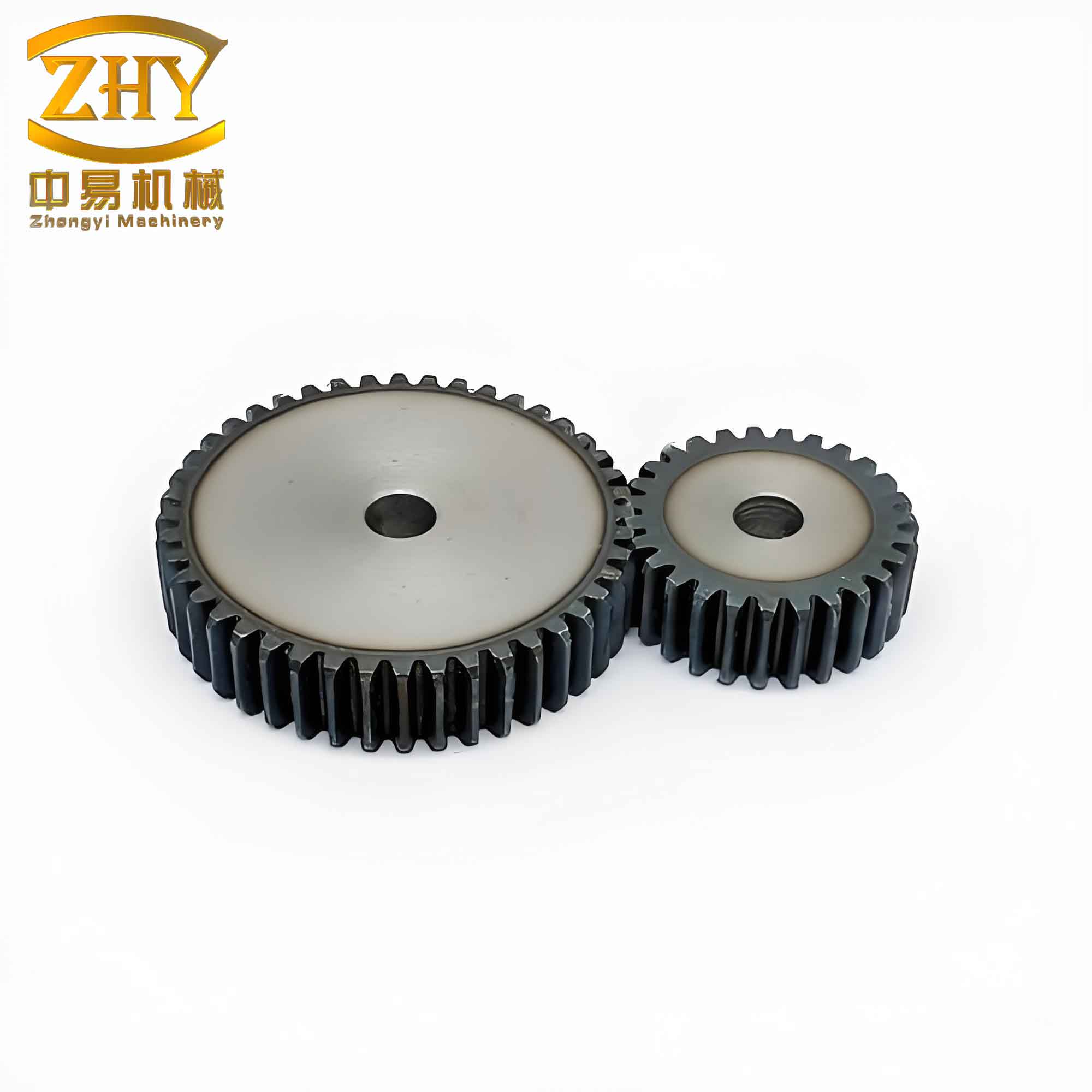
4. Validation and Application of the Parametric Model
Once the parametric gear model is complete, I can quickly generate different variants by modifying the parameters. For instance, to create a pinion with \(Z=12\) while keeping \(m=1\) mm and \(\alpha=20^\circ\), I simply change the value of \(Z\) in the parameter dialog to 12 and regenerate the model. The gear automatically updates: the pitch diameter becomes 12 mm, the root diameter becomes 9.5 mm, and the number of teeth is reduced to 12. This capability is invaluable when designing gear pairs for exact center distances and transmission ratios.
I have also extended the parametric model to include additional features such as the hub, keyway, and shaft hole. By adding more parameters—like the bore diameter \(d_{\text{bore}}\), key width, and key height—and writing relations that position these features relative to the gear center, I can create a fully detailed straight spur gear ready for manufacturing. The following table summarizes the extended parameters I often include for industrial applications.
| Parameter | Symbol | Relation Used | Typical Value |
|---|---|---|---|
| Shaft bore diameter | \(d_{\text{bore}}\) | Set manually or via relation with torque | 10 – 50 mm |
| Hub outer diameter | \(d_{\text{hub}}\) | \(d_{\text{hub}} = d_f + 2 \times \text{hub\_thickness}\) | 1.5× \(d_{\text{bore}}\) |
| Hub length | \(L_{\text{hub}}\) | \(L_{\text{hub}} = B\) or larger | Same as face width |
| Keyway width | \(w_k\) | Standard (e.g., 4 mm for 12 mm shaft) | Per ISO/R 773 |
| Keyway depth | \(t_k\) | \(t_k = 0.5 \times d_{\text{bore}}\) (approx.) | 2 – 4 mm |
The parametric model also allows for sensitivity studies. For example, I can examine how changing the pressure angle from 20° to 25° affects the root thickness and tooth strength. By setting the parameters as variables in a family table, I can generate multiple configurations of straight spur gears in seconds, each fully defined and ready for finite element analysis (FEA) or computer-aided manufacturing (CAM).
5. Summary of Key Formulas for Standard Straight Spur Gears
For convenience, I have consolidated all the essential formulas used in my parametric model into a single reference table. These equations are valid for standard involute straight spur gears with a module \(m\), tooth count \(Z\), and pressure angle \(\alpha\). The addendum and dedendum follow the standard: \(h_a = m\), \(h_f = 1.25 m\).
| Quantity | Formula | Remarks |
|---|---|---|
| Pitch diameter \(d\) | \(d = m Z\) | Reference circle |
| Addendum (tooth height above pitch circle) | \(h_a = m\) | |
| Dedendum (tooth depth below pitch circle) | \(h_f = 1.25 m\) | Includes clearance |
| Tip diameter \(d_a\) | \(d_a = d + 2 h_a = m(Z+2)\) | |
| Root diameter \(d_f\) | \(d_f = d – 2 h_f = m(Z-2.5)\) | |
| Base diameter \(d_b\) | \(d_b = d \cos\alpha = m Z \cos\alpha\) | |
| Circular pitch \(p\) | \(p = \pi m\) | Arc length on pitch circle per tooth |
| Tooth thickness (arc) on pitch circle | \(s = \frac{\pi m}{2}\) | Equal to space width for standard gears |
| Angular pitch (tooth spacing angle) | \(\theta_p = \frac{360^\circ}{Z}\) | |
| Base pitch | \(p_b = p \cos\alpha = \pi m \cos\alpha\) | Constant along line of action |
| Involute function (for tooth thickness at arbitrary radius) | \(\text{inv}\,\psi = \tan\psi – \psi\) | Where \(\psi\) is the pressure angle at that radius |
6. Advantages and Future Extensions
Through this parametric design methodology, I have achieved several significant improvements over conventional manual modeling of straight spur gears:
- Accuracy: The involute profile is mathematically exact, ensuring smooth meshing and reducing the need for post-processing adjustments.
- Speed: Once the template is built, generating a new gear takes only seconds—much faster than drawing each tooth individually.
- Consistency: All relations are hard-coded, eliminating human errors in dimensioning and allowing easy replication for design families.
- Flexibility: The same model can be adapted for non-standard modules, modified addendum/dedendum, or even helical gears by incorporating an additional helix angle parameter.
In the future, I plan to extend this parametric framework to include:
- Helical straight spur gears (i.e., helical gears, which are essentially straight spur gears with helix angle) by adding a helix angle parameter and generating a spiral tooth trace.
- Internal gears and rack-and-pinion sets.
- Automatic computation of gear pair center distance and backlash.
- Integration with FEA software for automated stress analysis.
The power of parametric design lies in its ability to capture engineering knowledge in a reusable form. By documenting every relation and step, I have created a digital twin for standard involute straight spur gears that can be shared, modified, and optimized across projects. This approach not only saves time but also elevates the quality of gear design from a manual drafting exercise to a sophisticated, data-driven engineering process.
7. Conclusion
My work on the parametric solid design of standard involute straight spur gears using Pro/E has demonstrated that even complex mechanical components can be efficiently modeled with a small set of controlling parameters. By encoding the involute equation and all geometric relationships into the modeling environment, I have produced a robust, accurate, and easily modifiable gear model. The methodology described here—from setting up parameters and relations to constructing the involute curve, extruding the tooth, and patterning—provides a clear roadmap for any engineer seeking to implement parametric design for straight spur gears. The extensive use of tables and formulas in this article serves as a reference guide for both beginners and experienced users. I believe that parametric modeling will continue to play a vital role in the future of mechanical design, enabling faster innovation and more reliable products.