
In modern mechanical transmission systems, miter gears, a type of spur bevel gears with a shaft angle of 90 degrees, are widely used in applications such as differentials in automobiles and agricultural machinery, machine tools, and various industrial equipment. These gears facilitate power transmission between intersecting shafts, offering simplicity and robustness for low-speed, heavy-load scenarios. However, due to their straight tooth lines, miter gears are sensitive to installation errors and load-induced contact variations, making precise design and analysis critical. With advancements in computer technology, accurate mathematical modeling and simulation have become indispensable tools in gear design and manufacturing, enabling the development of high-performance gear systems. In this article, I will detail a comprehensive approach to establishing a mathematical model for miter gears based on gear shaping principles, performing dynamic contact zone simulations, and validating the model through physical manufacturing and testing. This methodology emphasizes the use of computational tools and simulation techniques to enhance gear quality and reduce development cycles.
The foundation of accurate gear modeling lies in the precise calculation of tooth surface points. For miter gears, the tooth profile is typically approximated as a spherical involute, and the manufacturing process often involves gear shaping or planing based on the generating method. To derive the tooth surface geometry, I developed a software tool using Visual Basic that computes the coordinates of points on the tooth surface, accounting for modifications such as crown shaping or profile corrections. This software utilizes the principles of gear meshing and coordinate transformations to generate data points that define the entire tooth surface. The input parameters include basic gear dimensions, and the output is a set of spatial coordinates that can be imported into CAD software for 3D modeling. This approach ensures that the mathematical model reflects the true geometry of the miter gears, including any modifications applied to improve performance.
The mathematical basis for tooth surface point calculation involves several key equations. For a miter gear with shaft angle $\Sigma = 90^\circ$, the gear geometry is defined by parameters such as number of teeth $z$, module at the large end $m$, pressure angle $\alpha$, and pitch cone angle $\delta$. The spherical involute curve can be expressed in parametric form. Let $\theta$ be the parameter angle, then the coordinates on the tooth surface in a local coordinate system can be given by:
$$ x = R \sin(\delta) \cos(\theta) $$
$$ y = R \sin(\delta) \sin(\theta) $$
$$ z = R \cos(\delta) $$
where $R$ is the cone distance. However, for accurate generation, the coordinate transformations based on the gear shaping process must be considered. The generating motion involves the rotation of the gear blank and the tool, leading to a set of equations that describe the envelope surface. The general meshing equation for a gear pair can be written as:
$$ \mathbf{n} \cdot \mathbf{v} = 0 $$
where $\mathbf{n}$ is the normal vector at the contact point and $\mathbf{v}$ is the relative velocity between the gear and the tool. For miter gears, this equation is solved numerically to obtain the tooth surface points. The software implements these equations, allowing for the calculation of points across the tooth surface, including modifications to reduce sensitivity to installation errors. By optimizing parameters such as the contact ellipse, the software can generate tooth surfaces that exhibit improved contact patterns under load.
To illustrate the input parameters, Table 1 presents the main geometric data for a pair of miter gears used in a tractor differential. These parameters are typical for such applications and serve as the basis for the modeling process.
| Parameter | Gear 1 (Ring Gear) | Gear 2 (Pinion Gear) |
|---|---|---|
| Number of Teeth, $z$ | 19 | 11 |
| Module at Large End, $m$ (mm) | 6.17 | 6.17 |
| Pitch Cone Angle, $\delta$ (degrees) | 59.93 | 30.07 |
| Pressure Angle, $\alpha$ (degrees) | 22.5 | 22.5 |
| Cone Distance, $R$ (mm) | 67.73 | 67.73 |
| Face Width, $b$ (mm) | 23 | 26 |
| Normal Backlash, $j_n$ (mm) | 0.18 | 0.18 |
Using the software, the tooth surface points are computed for these miter gears. For example, a subset of the coordinate data for Gear 1 is shown in Table 2. These points represent the precise locations on the tooth surface that will be used to construct the 3D model.
| Point ID | X (mm) | Y (mm) | Z (mm) |
|---|---|---|---|
| 1 | 25.34 | 10.12 | 45.67 |
| 2 | 24.89 | 11.05 | 46.23 |
| 3 | 24.21 | 12.33 | 46.98 |
| 4 | 23.45 | 13.78 | 47.81 |
| 5 | 22.67 | 15.21 | 48.64 |
Once the tooth surface points are obtained, the next step is to build the 3D mathematical model in a CAD environment. I used UG software (now Siemens NX) for this purpose. The process involves importing the point data, creating surface patches from the points, and then constructing solid bodies. First, the points are imported as a .dat file, and the “Through Points” command is used to generate a surface patch for one side of the tooth. This patch represents the active tooth flank of the miter gear. Then, mirroring and other surface modeling tools are applied to create the complete tooth space, including the fillet and bottom surfaces. The tooth spaces are arrayed around the gear blank to form the full gear model. This method ensures that the model is accurate and can be used for further analysis and manufacturing.
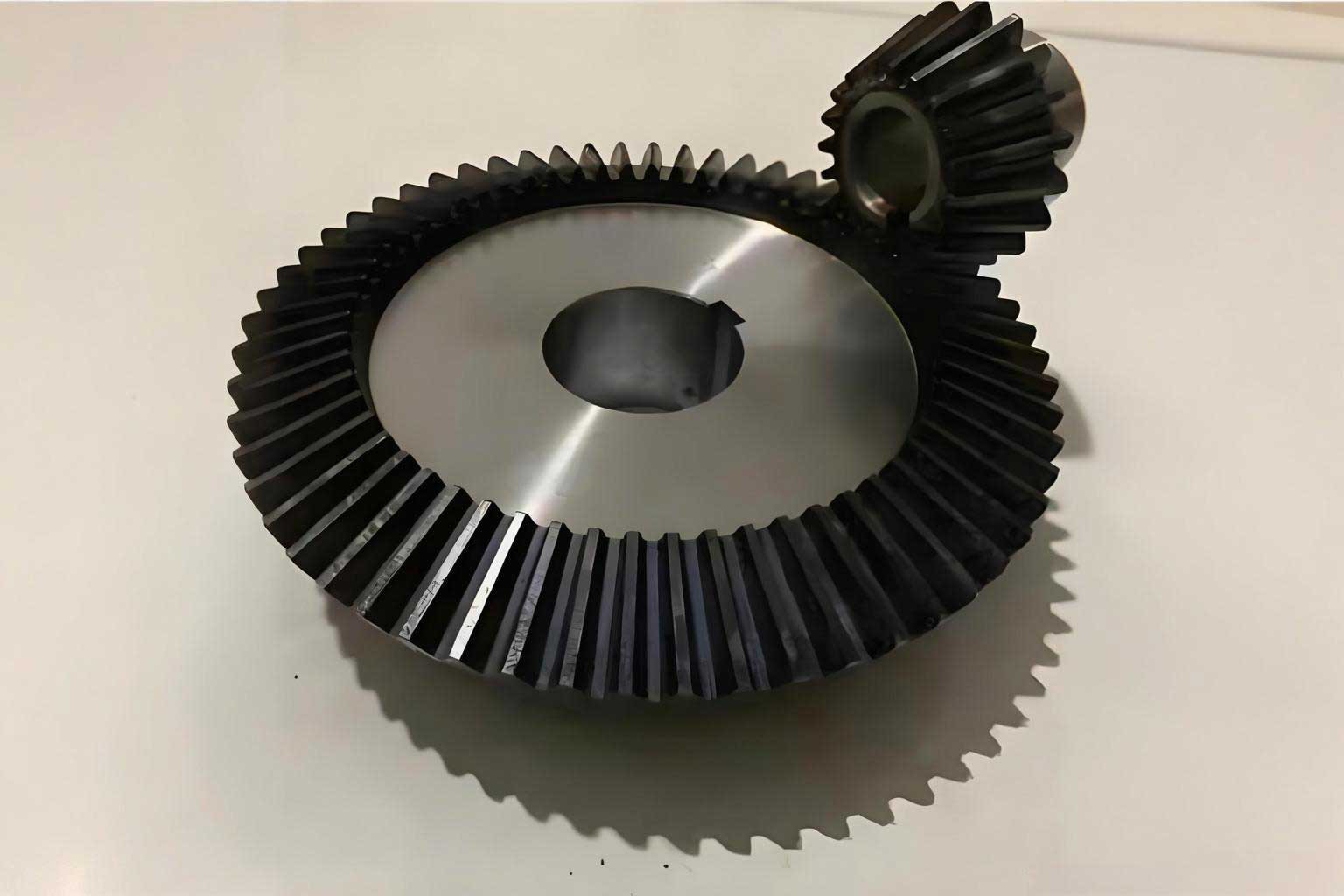
After developing the 3D models for both miter gears, I performed dynamic contact zone simulations to analyze the meshing behavior under no-load conditions. The simulation was conducted in the motion analysis module of UG software. The gear pair was assembled with their axes intersecting at 90 degrees, and a rotational motion was applied to one gear while the other was allowed to rotate freely. The contact analysis settings included an interference detection threshold of 0.005 mm to identify contact areas. The simulation run time was set to 30 seconds with a rotational speed of 50 rpm, allowing multiple meshing cycles to be observed. The contact zone at any given time instant was visualized, showing the pattern of contact between the teeth. This simulation helps in assessing the contact area size, location, and uniformity, which are critical for gear performance and noise reduction.
The contact zone analysis is based on Hertzian contact theory, which provides insights into the stress distribution and contact ellipse dimensions. For two elastic bodies in contact, the half-width of the contact area $a$ can be estimated by:
$$ a = \sqrt{\frac{4F R_e}{\pi E^*}} $$
where $F$ is the normal load, $R_e$ is the equivalent radius of curvature, and $E^*$ is the equivalent modulus of elasticity. However, in the simulation, the contact is evaluated geometrically by detecting intersections between the tooth surfaces. The results indicated that the contact zone for these miter gears was located near the toe (small end) of the tooth, covering approximately 50% of the face width and 60% of the tooth height. This pattern is desirable for miter gears as it avoids edge contact and ensures stable meshing. The simulation also allowed for iterative adjustments to the tooth modifications, optimizing the contact pattern for reduced sensitivity to misalignment.
To validate the mathematical model, I proceeded to manufacture physical standard gears based on the 3D models. The gears were machined on a DMG Mori five-axis machining center, which is capable of producing complex geometries with high precision. The CAM software associated with the machine imported the 3D models and generated NC programs automatically using a finger-type milling cutter. The material used was 45 steel, commonly employed for gear applications. The machining process ensured that the physical gears matched the digital models accurately, with tolerances within a few micrometers. This step is crucial for verifying the practicality of the modeling approach and for subsequent testing.
After manufacturing, the gears were inspected using a gear measuring machine and a roll tester. The gear measuring machine compared the physical gear teeth with the digital model by probing 45 points on the tooth surface near the pitch circle. The results showed that the gear accuracy met Grade 4 standards according to ISO norms, with a maximum deviation of 0.007 mm from the model. This confirms the high precision achievable with the proposed modeling method. Furthermore, roll testing was conducted to evaluate the contact zone under dynamic conditions. The gears were mounted on a roll tester, and the contact pattern was observed using marking compound. The actual contact pattern closely matched the simulation results, exhibiting a similar shape and location. Additionally, vibration and noise levels were measured and found to be within acceptable limits, indicating good meshing performance. These tests demonstrate that the mathematical model accurately predicts the behavior of miter gears in real applications.
The entire process from modeling to testing underscores the importance of digital tools in gear design. The use of custom software for tooth surface point calculation, combined with commercial CAD and CAE platforms, provides a robust framework for developing high-quality miter gears. This methodology is not limited to specific gear sizes or applications; it can be generalized to various types of bevel gears, including those with different shaft angles or tooth modifications. By integrating modeling, simulation, and manufacturing, designers can reduce prototyping costs, shorten development time, and improve product reliability. Moreover, the insights gained from contact zone simulations can guide design improvements, such as optimizing tooth flank corrections to enhance load distribution and noise characteristics.
In conclusion, the mathematical modeling and contact zone simulation analysis of miter gears presented here offer a comprehensive approach to gear design. The development of a Visual Basic-based software for tooth surface point calculation enables precise geometry generation, which is essential for accurate 3D modeling in UG. The dynamic simulations provide valuable insights into meshing behavior, allowing for the optimization of contact patterns before physical production. The successful manufacturing and testing of standard gears validate the model’s accuracy and practical utility. This method is universally applicable to miter gears and other bevel gear types, making it a valuable tool in the gear industry. Future work could explore advanced modifications, such as asymmetric tooth profiles or multi-axis machining strategies, to further enhance performance. Overall, the integration of computational techniques with traditional gear engineering principles paves the way for more efficient and reliable gear systems.