
As an engineer specializing in gear transmission systems, I have long been fascinated by the unique capabilities of hypoid gears. These gears are crucial for transmitting motion and power between non-intersecting, perpendicular axes, commonly found in automotive differentials and industrial machinery. The offset of the pinion axis relative to the gear axis provides significant advantages, such as increased overlap ratio, higher transmission efficiency, smoother operation, and enhanced design flexibility for vehicle layouts. However, the complex tooth surface geometry of hypoid gears has historically made their design and manufacturing challenging, often requiring sophisticated machinery and intricate calculations. This complexity has persistently troubled researchers and engineers in the field.
In this article, I present a completely new theoretical approach to the tooth surface formation, meshing transmission, and design-manufacturing process for ruled-surface hypoid gears. This method deviates from traditional, convoluted theories and offers a simplified yet effective solution. The core idea is to design the gear member (the larger gear) with tooth surfaces composed of two planes that are neither perpendicular nor parallel to the gear axis. The tooth slot cross-section forms a “V” shape, and an array of these V-slots around the gear axis creates the complete gear. This allows the gear member to be manufactured in a single pass using a forming method. Conversely, the pinion (the smaller gear) tooth surface is a ruled surface generated by conjugately enveloping the corresponding gear tooth surface according to a constant transmission ratio. Therefore, the pinion can be produced using an enveloping method with two interrelated rotational motions (the fixed-ratio drive between the gear and pinion). I will explore, explain, and demonstrate the machining methods for both sides of the gear and pinion, deriving the machine adjustment parameters and coordinate equations for the cutter’s motion trajectory. Using a specific ruled-surface hypoid gear as an example, I will conduct simulation studies of gear transmission and machining processes using CATIA and ADAMS software. These simulations aim to verify the feasibility of the proposed new transmission and tooth surface formation principles. Finally, based on this new machining theory, I will propose a preliminary design for a machine tool compatible with the ruled-surface hypoid gear processing principle, building upon existing machine tool foundations. The machining process utilizes a slab milling cutter moving along a specific cutting direction line, coordinated with two-axis linkage, to produce the required tooth surface in one pass. Through this research, the designed gear transmission achieves smooth operation and correct meshing, requiring only simple tools and straightforward processes to manufacture hypoid gears that meet design specifications.
This work, based on the new tooth surface formation principle and machining methods for ruled-surface hypoid gears, represents an innovative breakthrough in addressing the longstanding problems in hypoid gear design and manufacturing. It advances the study of ruled-surface hypoid gears and holds significant importance for improving current hypoid gear processing levels.
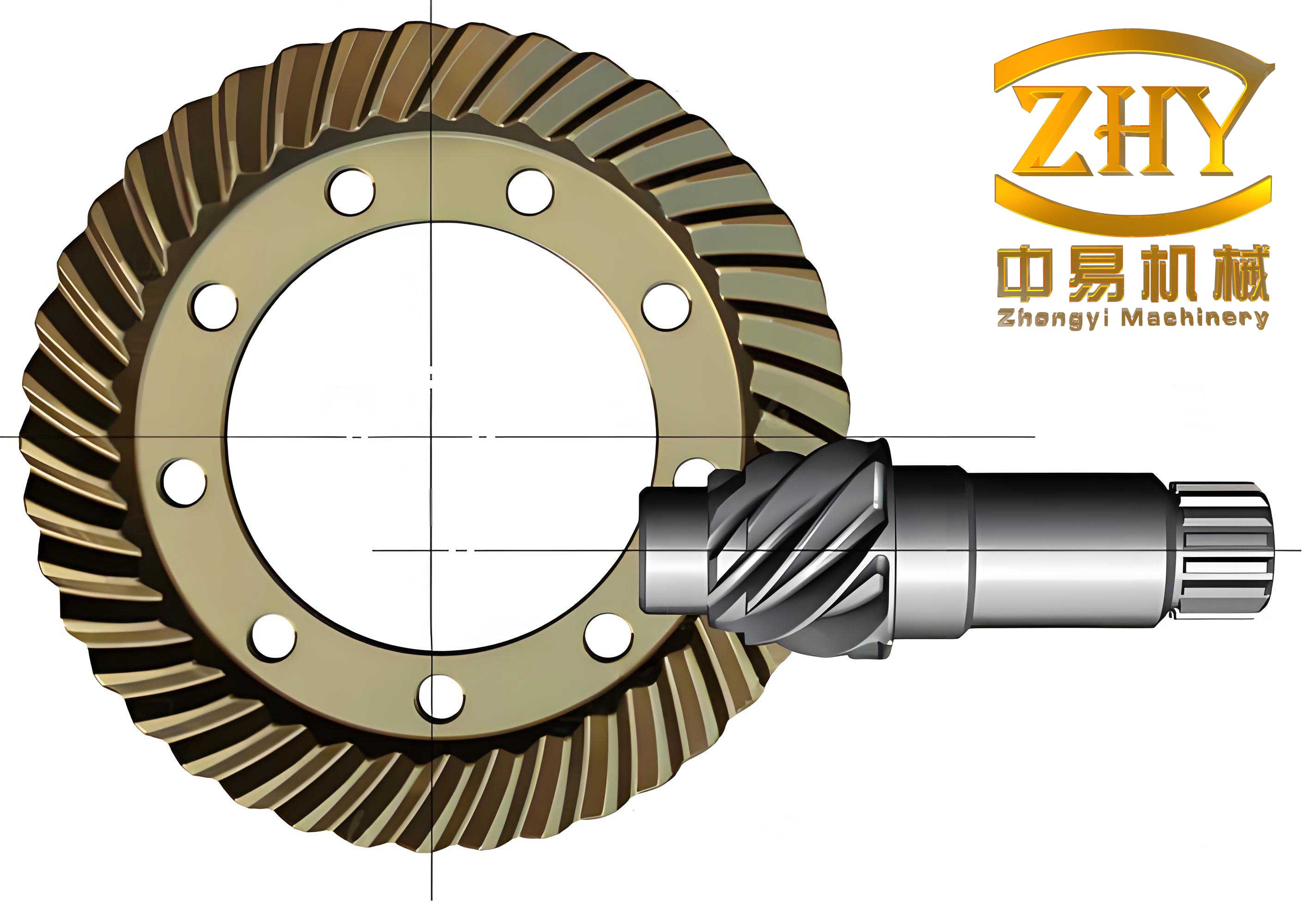
Meshing Principles of Ruled-Surface Hypoid Gears
The transmission of hypoid gears involves spatial meshing between non-parallel, non-intersecting axes. Unlike cylindrical gears, hypoid gears require spatial offset-axis transmission theory. Conventionally, conical surfaces approximate the hyperboloidal pitch surfaces for cutting teeth. For ruled-surface hypoid gears, any surface satisfying spatial offset-axis meshing conditions can serve as the tooth surface. To simplify design and machining, I propose that the gear member’s tooth surface be a plane. This plane then acts as the generating surface to envelope the pinion tooth surface. This approach allows the use of simple cutters and machine motions for cost-effective manufacturing of high-performance hypoid gears. Therefore, it’s essential to discuss this new planar-envelope ruled-surface hypoid gear meshing principle and establish the theoretical equations for tooth surface formation and meshing.
Tooth Surface Formation Principle
Imagine two non-parallel planes on the root cone surface of the gear member, neither perpendicular to the gear axis. These planes extend to intersect along a line, forming a V-slot. The cross-section of a tooth slot perpendicular to certain lines is V-shaped. By arraying these planes around the gear axis (Z-axis), a complete gear member is formed. According to the generating principle, using the gear tooth surface (the plane) as the generating surface, the pinion tooth surface can be enveloped, forming a conjugate pair. Since the generating surface is the actual gear tooth surface, instantaneous contact during meshing is line contact.
Consider a spatial 90° offset-axis drive system with an offset distance \(E\). A fixed coordinate system \(O_p – x_p y_p z_p\) is established, with the pinion axis coinciding with \(z_p\), and \(x_p\) intersecting the gear axis. The gear coordinate system \(O – xyz\) has its Z-axis aligned with the gear axis, origin \(O\) at the intersection of the gear axis and \(x_p\), and Y-axis offset by \(E\) from \(z_p\). The gear rotates about Z with angular velocity \(\omega_1\), and the pinion rotates about \(z_p\) with angular velocity \(\omega_2\), with a transmission ratio \(i = \omega_2 / \omega_1\). The plane \(\Sigma_1\) is the gear tooth surface, rotating at \(\omega_1\). Surface \(\Sigma_2\) is the pinion tooth surface, rotating at \(\omega_2\) and meshing with \(\Sigma_1\). Thus, plane \(\Sigma_1\) envelopes the pinion tooth surface \(\Sigma_2\).
For the gear member, if the tooth slot bottom width is uniform, a cutter with a V-shaped profile matching the slot can machine both tooth faces simultaneously by feeding along the intersection line vector of the two planes at the slot bottom. If widths differ, each tooth face must be machined separately with a cutter having an inclination angle equal to the respective tooth profile angle.
Meshing Equation and Contact Conditions
For spatial meshing where gears only rotate about their axes, the necessary condition for correct meshing (no separation or interference) is that the relative velocity at the point of contact must be perpendicular to the common normal vector. This leads to the meshing equation.
Establish coordinate systems as described. Let the gear tooth surface \(\Sigma\) be a plane. A point \(M\) on this plane can be defined by parameters \(t\) and \(u\) in the gear coordinate system:
$$ x_1 = r_0 + t \cdot \sin\beta, \quad y_1 = u, \quad z_1 = t \cdot \cos\beta $$
where \(\beta\) is the angle between the plane and the Z-axis, and \(r_0\) is a distance parameter. The unit normal vector \(\mathbf{n}’\) to the plane is:
$$ \mathbf{n}’ = (-\cos\beta, 0, \sin\beta) $$
Thus, the plane equation is:
$$ -\cos\beta (x_1 – r_0 – t\sin\beta) + \sin\beta (z_1 – t\cos\beta) = 0 $$
Simplifying:
$$ -\cos\beta \cdot x_1 + \sin\beta \cdot z_1 + \cos\beta \cdot r_0 = 0 $$
The meshing equation for offset axes with a 90° shaft angle is:
$$ U \cos\phi_1 – V \sin\phi_1 = W $$
where \(\phi_1\) and \(\phi_2\) are rotation angles of gear and pinion, with \(\phi_2 / \phi_1 = i_{21} = i\). The terms \(U, V, W\) are derived from the coordinates and normal vector:
$$ U = i_{21} (x_1 n_z’ – z_1 n_x’) = i_{21} (x_1 \sin\beta + z_1 \cos\beta) $$
$$ V = i_{21} (z_1 n_y’ – y_1 n_z’) = -i_{21} y_1 \sin\beta $$
$$ W = y_1 n_x’ – x_1 n_y’ – n_z’ E = -y_1 \cos\beta – E \sin\beta $$
Substituting and solving for \(t\):
$$ t = \frac{u \cos\beta – E \sin\beta – r_0 \sin\phi_1 + i_{21} u \sin\beta \cos\phi_1}{i_{21} \cos\phi_1} $$
This shows \(t\) is a linear function of \(u\), meaning the contact points form a line on the tooth surface at any instant—line contact occurs.
Limit of Meshing
To avoid undercutting or interference, the meshing limit must be determined. The condition for a point to participate in meshing is \(U^2 + V^2 \geq W^2\). Substituting expressions:
$$ (i_{21}(r_0 + t\sin\beta))^2 + (-i_{21} u \sin\beta)^2 \geq (-u \cos\beta – E \sin\beta)^2 $$
This inequality defines the region on the tooth surface that actually participates in meshing. Solving it provides the range of rotation angle \(\phi_1\) for valid meshing, establishing the meshing boundary.
Geometric Parameter Design for Ruled-Surface Hypoid Gears
Designing hypoid gears involves determining geometric parameters that satisfy meshing conditions while enabling simplified manufacturing. For the ruled-surface hypoid gear, the gear member’s tooth surfaces are planes, characterized by specific angles relative to the gear axis and pitch cone.
Gear Member Tooth Surface Parameter Design
Establish a coordinate system \(O-XYZ\) with Z as the gear axis. Point \(M\) is on the pitch cone at the mid-face width. Two planes \(\Sigma_1\) and \(\Sigma_2\) intersect along line \(AB\), with \(M\) on this line. The pitch cone angle is \(\delta\), and the spiral angle at point \(M\) is \(\beta\). A plane \(U\) is tangent to the pitch cone along the generatrix through \(M\). Its unit normal is \(\mathbf{n}_0\). In the cross-section normal to the tooth slot, define profile vectors. The left profile vector \(\mathbf{c}_0\) makes an angle \(\alpha_2\) (left profile angle) with \(\mathbf{n}_0\). The right profile vector \(\mathbf{b}_0\) makes an angle \(\alpha_1\) (right profile angle) with \(\mathbf{n}_0\). To ensure proper tooth thickness, plane \(\Sigma_1\) is rotated by an angle \(\theta\) around the Z-axis to become \(\Sigma_{1\theta}\). Thus, \(\Sigma_{1\theta}\) and \(\Sigma_2\) form the two sides of a tooth, arrayed around the axis to form the complete gear.
Key parameters include pitch cone angle \(\delta\), root cone angle \(\delta_f\), face cone angle \(\delta_a\), spiral angle \(\beta\), left and right profile angles \(\alpha_2, \alpha_1\), number of teeth \(z\), and tooth surface rotation angle \(\theta\).
To derive the plane equations, we need coordinates of point \(M\) and the normal vectors to planes \(\Sigma_2\) and \(\Sigma_{1\theta}\). Let the midpoint pitch cone generatrix length be \(L_m\). Then:
$$ M: (L_m \sin\delta, 0, 0) $$
The unit vector \(\mathbf{a}_0\) along the spiral direction on plane \(U\) is:
$$ \mathbf{a}_0 = (-\cos\beta \sin\delta, \sin\beta, \cos\beta \cos\delta) $$
The unit normal to plane \(U\) is:
$$ \mathbf{n}_0 = (\cos\delta, 0, \sin\delta) $$
Through vector operations, the profile vectors are:
$$ \mathbf{c}_0 = (\cos\delta \cos\alpha_2 – \sin\beta \sin\delta \sin\alpha_2, -\cos\beta \sin\alpha_2, \sin\delta \cos\alpha_2 + \sin\beta \cos\delta \sin\alpha_2) $$
$$ \mathbf{b}_0 = (\cos\delta \cos\alpha_1 + \sin\beta \sin\delta \sin\alpha_1, \cos\beta \sin\alpha_1, \sin\delta \cos\alpha_1 – \sin\beta \cos\delta \sin\alpha_1) $$
The normal to plane \(\Sigma_2\) is found via cross product \(\mathbf{a}_0 \times \mathbf{c}_0\):
$$ \mathbf{n}_{02} = (\sin\beta \sin\delta \cos\alpha_2 + \cos\delta \sin\alpha_2, \cos\beta \cos\alpha_2, \sin\delta \sin\alpha_2 – \sin\beta \cos\delta \cos\alpha_2) $$
Thus, plane \(\Sigma_2\) equation with point \(M\) is:
$$ n_{02x} (x – L_m \sin\delta) + n_{02y} y + n_{02z} z = 0 $$
Similarly, the normal to plane \(\Sigma_1\) is \(\mathbf{n}_{01} = \mathbf{a}_0 \times \mathbf{b}_0\):
$$ \mathbf{n}_{01} = (-\sin\beta \sin\delta \cos\alpha_1, -\cos\beta \cos\alpha_1, \sin\delta \sin\alpha_1 + \sin\beta \cos\delta \cos\alpha_1) $$
After rotating \(\Sigma_1\) by \(\theta\) around Z-axis to get \(\Sigma_{1\theta}\), its normal \(\mathbf{n}_{01\theta}\) is obtained by rotation matrix \(A_z(\theta)\):
$$ A_z(\theta) = \begin{bmatrix} \cos\theta & -\sin\theta & 0 \\ \sin\theta & \cos\theta & 0 \\ 0 & 0 & 1 \end{bmatrix} $$
$$ \mathbf{n}_{01\theta} = A_z(\theta) \cdot \mathbf{n}_{01} $$
Point \(M\) rotates to \(M_1\):
$$ M_1: (L_m \sin\delta \cos\theta, L_m \sin\delta \sin\theta, 0) $$
Then plane \(\Sigma_{1\theta}\) equation is:
$$ n_{01\theta x} (x – L_m \sin\delta \cos\theta) + n_{01\theta y} (y – L_m \sin\delta \sin\theta) + n_{01\theta z} z = 0 $$
Comprehensive Geometric Parameter Design
Based on standard design practices (e.g., Gleason system), a set of geometric parameters for a hypoid gear pair can be calculated. Below is a table summarizing key parameters for both gear and pinion.
| Parameter | Symbol | Gear (Large Wheel) | Pinion (Small Wheel) |
|---|---|---|---|
| Number of Teeth | \(z\) | 39 | 8 |
| Transmission Ratio | \(i\) | 4.875 | |
| Module (at large end) | \(m\) | 11.723 mm | – |
| Face Width | \(b\) | 70 mm | 76.38 mm |
| Pitch Cone Angle | \(\delta\) | 74.6147° | – |
| Spiral Angle | \(\beta\) | 37.1344° | 50.0106° |
| Offset Distance | \(E\) | 44.45 mm | |
| Midpoint Pitch Cone Generatrix Length | \(L_m\) | 202.1 mm | – |
| Midpoint Tooth Dedendum | \(a_G\) | 14.747 mm | – |
| Midpoint Tooth Addendum | \(b_G\) | 2.21 mm | – |
| Face Cone Angle | \(\delta_a\) | 75.8352° | 21.7866° |
| Root Cone Angle | \(\delta_f\) | 67.6886° | 13.8188° |
| Midpoint Pitch Circle Radius | \(r_m\) | 194.857 mm | 39.97 mm |
These parameters serve as the foundation for subsequent machining process calculations and simulations.
Cutting Methods for Ruled-Surface Hypoid Gear Tooth Surfaces
The proposed machining method leverages the simplicity of the planar tooth surfaces. For the gear member, forming cutting is used; for the pinion, enveloping generation is applied.
Gear Member Tooth Surface Cutting
Since each tooth face is a plane, machining involves moving a cutter along a straight line—the cutting direction line—that lies on that plane and within the tooth slot boundaries (root cone to face cone). For non-uniform tooth slot bottom width, left and right faces are cut separately.
Right Tooth Face Cutting: The cutting direction line is the intersection of plane \(\Sigma_2\) with the root cone’s large-end circle \(c_1\) and small-end circle \(c_2\). The root cone equation is:
$$ z = L_m \cos\delta – S_f – \sqrt{x^2 + y^2} \cot\delta_f $$
where \(S_f\) is the distance along axis from pitch cone apex to root cone apex. The circles \(c_1\) and \(c_2\) at large and small ends have radii \(L_{f1} \sin\delta_f\) and \(L_{f2} \sin\delta_f\), and Z-coordinates \(Z_1 = L_m \cos\delta – S_f – L_{f1} \cos\delta_f\) and \(Z_2 = L_m \cos\delta – S_f – L_{f2} \cos\delta_f\). Intersection points \(F\) (on \(c_1\)) and \(G\) (on \(c_2\)) with plane \(\Sigma_2\) are found by solving simultaneously the circle equations and plane equation. The vector \(\overrightarrow{FG}\) defines the cutting direction. Its distance \(d\) to the Z-axis and its angle \(\kappa\) to the XOY plane are calculated. The cutter profile angle \(\chi_5\) should match the tooth profile angle, which is the angle between the plane’s normal \(\mathbf{n}_{02}\) and the vector perpendicular to both \(\overrightarrow{FG}\) and Z-axis.
Left Tooth Face Cutting: Similarly, for plane \(\Sigma_{1\theta}\), find intersections \(H\) and \(I\) with root cone circles. The cutting direction line \(\overrightarrow{HI}\) is determined. Its distance to Z-axis and angle to XOY plane are computed, along with the corresponding cutter profile angle \(\chi_6\).
The tooth slot width at the root can be calculated by projecting points onto a plane containing the intersection line of both tooth faces.
Pinion Tooth Surface Cutting
The pinion tooth surface is generated by enveloping the gear tooth surface. In machining, a cutter representing the gear tooth plane moves relative to the pinion blank along a specific cutting direction line while both rotate with a fixed ratio. The cutting direction line for the pinion is defined on the gear’s face cone (since generation occurs theoretically at the pitch or outer surface).
Pinion Left Side Cutting: Use the gear’s right tooth plane \(\Sigma_2\). Its intersections with the face cone’s large-end circle \(c_3\) and small-end circle \(c_4\) yield points \(C’\) and \(D’\). The cutting direction line \(\overrightarrow{C’D’}\) is derived. Its spatial orientation relative to the gear axis is determined by distance to Z-axis and angle to XOY plane. The cutter profile angle \(\chi_7\) corresponds to the gear tooth profile angle for that side.
Pinion Right Side Cutting: Use the gear’s left tooth plane \(\Sigma_{1\theta’}\), where \(\theta’ = \theta + \pi/z\) (for tooth thickness). Find intersections \(C\) and \(D\) with face cone circles. The cutting direction line \(\overrightarrow{CD}\) is calculated, along with its orientation parameters and cutter profile angle \(\chi_8\).
The mathematical derivations involve solving systems of equations combining plane equations and cone circle equations. For brevity, the general forms are:
For intersection of plane \(n_x x + n_y y + n_z z = D\) and circle \(x^2 + y^2 = R^2, z = Z_0\), substitute parametric circle coordinates \(x = R \cos t, y = R \sin t\):
$$ n_x R \cos t + n_y R \sin t + n_z Z_0 = D $$
This simplifies to:
$$ R \sqrt{n_x^2 + n_y^2} \sin(t + \psi) = D – n_z Z_0 $$
where \(\psi = \arctan(n_x / n_y)\). Solving for \(t\) gives the intersection points.
These cutting direction lines and angles provide the necessary machine tool setup parameters for accurate machining.
Simulation and Experimental Validation
To validate the proposed design and machining principles, I conducted virtual simulations using CATIA for 3D modeling and ADAMS for dynamic analysis.
3D Modeling of Hypoid Gears
Using the geometric parameters from the design table, I created 3D models in CATIA. For the gear member, the process involved sketching the pitch, root, and face cones, then creating the planar tooth surfaces by intersecting these cones with the defined planes. The tooth surfaces were trimmed, and a circular pattern generated the full gear. The pinion model was built based on the enveloping principle: generating lines on the pinion tooth surface were derived from instantaneous contact lines during meshing, then swept to form the ruled surface.
Meshing Simulation and Analysis
The gear pair was imported into ADAMS. Constraints included revolute joints for both gears and a contact force defined between tooth surfaces. A constant angular velocity of 30°/s was applied to the pinion. The simulation results showed that the gear rotated at an average angular velocity of approximately 6.15°/s, yielding a transmission ratio of \(30 / 6.15 \approx 4.878\), closely matching the designed ratio of 4.875. The angular velocity profiles remained steady with minor fluctuations, indicating smooth transmission. Contact force analysis under no-load and loaded conditions (e.g., 1000 N resisting torque on the gear) showed initial transients followed by stable forces, confirming proper meshing without severe impacts or separations.
Machining Process Simulation
I simulated the machining process conceptually within CATIA. For the gear member, positioning the workpiece so that the cutting direction line lies in the cutter’s plane and is parallel to the machine’s feed direction allows a simple linear feed to produce the plane. For the pinion, simulating the relative motion—linear feed along the cutting direction line combined with coordinated rotations of workpiece (simulating gear rotation) and cutter head (simulating pinion rotation)—validates that the enveloping process generates the correct ruled surface. These simulations demonstrated the feasibility of using a simple slab mill cutter and basic machine motions (linear feed and two rotary axes) to manufacture both gear and pinion.
Machine Tool Design Concept
Based on the machining method, a preliminary machine tool design was proposed. It builds upon a standard CNC milling machine with X, Y, Z linear axes. Additional components include a rotary table mounted on the Y-axis slide to provide rotation about a vertical axis (simulating gear rotation), and a tilting worktable on the rotary table to orient the workpiece axis at the required offset and angle. The milling spindle (cutter head) can swivel in the XOZ plane to set the cutter profile angle. For gear cutting, the workpiece is fixed, and the cutter moves linearly. For pinion cutting, the workpiece undergoes two coordinated rotations (from rotary table and its own spindle) while the cutter feeds linearly. This design minimizes complexity compared to traditional hypoid gear generators.
Although physical cutting experiments are planned, time constraints currently limit the work to virtual validation. The simulations, however, strongly support the practicality of the new method.
Conclusion and Future Work
In this research, I have developed a novel approach to the design and manufacturing of hypoid gears, specifically focusing on ruled-surface hypoid gears with planar tooth surfaces on the gear member. The key contributions include:
- Establishing a simplified spatial meshing theory for hypoid gears, deriving the meshing equation and identifying the meshing limit to ensure correct tooth engagement.
- Proposing a new tooth surface formation principle where the gear tooth surfaces are planes arranged in V-slots, and the pinion tooth surface is a ruled surface enveloped by these planes.
- Deriving comprehensive geometric parameter design formulas and providing a detailed example calculation.
- Developing practical cutting methods for both gear and pinion, including determination of cutting direction lines, cutter orientation angles, and machine setup parameters.
- Validating the concepts through 3D modeling and dynamic simulation, confirming proper meshing and feasible machining processes.
- Outlining a machine tool design that implements the new machining method with relatively simple kinematics.
This work offers an innovative breakthrough that can potentially simplify hypoid gear production, reduce costs, and make high-performance hypoid gears more accessible. The use of planar surfaces and ruled surfaces reduces the need for complex cutter geometry and multi-axis simultaneous machining, which is common in traditional methods like those of Gleason or Klingelnberg.
Future work should focus on several areas to advance this technology:
- Refinement of Meshing Limit Theory: Further analysis to optimize tooth surface boundaries and prevent edge contact or undercutting in practical applications.
- Contact Pattern Design and Load Capacity Analysis: Studying the contact ellipse under load, lubrication requirements, fatigue life, and methods for contact pattern adjustment. Tooth surface modification (e.g., crowning) should be investigated to account for deflections and ensure stable meshing under varying loads.
- Physical Cutting Experiments: Building a prototype machine or adapting an existing machine to perform actual cutting tests. This is crucial to identify practical challenges, such as cutter wear, surface finish, and accuracy of the setup parameters.
- Comprehensive Machine Tool Development: Detailed mechanical design, CNC programming, cutter design optimization, and process planning for the proposed machine tool.
- Extension to Other Gear Types: Exploring the applicability of similar principles to other types of bevel gears or spatial gears.
In conclusion, the ruled-surface hypoid gear concept presents a promising alternative to conventional hypoid gears. By rethinking the tooth surface geometry and leveraging simple manufacturing processes, it is possible to achieve high-performance gear transmission without the traditional complexities. This research lays a solid theoretical and simulation-based foundation for future practical implementation, contributing to the ongoing advancement of gear technology.