
Spur gears are fundamental components in mechanical power transmission systems, prized for their high efficiency, compact design, and reliable operation. During service, gear teeth are subjected to cyclic meshing loads, which can initiate fatigue cracks at the tooth root—a region of high-stress concentration. The propagation of these cracks not only degrades transmission accuracy and generates noise but can also lead to catastrophic gear failure, resulting in significant safety hazards and economic losses. Consequently, a profound understanding of the crack propagation behavior in spur gear teeth is critical for predictive maintenance, structural integrity assessment, and the design of more durable gear systems. This article delves into the theoretical framework for analyzing crack-tip stress fields, presents a refined numerical simulation methodology, and comprehensively investigates key factors influencing the crack propagation path in spur gears.
The study of fatigue crack propagation in spur gears necessitates a solid foundation in fracture mechanics. Cracks are typically categorized based on the loading mode relative to the crack plane: Mode-I (opening), Mode-II (sliding), and Mode-III (tearing). For spur gears, the stress state at the tooth root under meshing loads often results in a mixed-mode condition, primarily combining Mode-I and Mode-II. Analyzing the complex stress field near the crack tip is the first step in predicting propagation behavior. The Westergaard stress function approach, employing complex variable theory, provides an elegant solution for the singular stress field surrounding a crack tip in a linear elastic, isotropic material. For a mixed-mode (I/II) crack, the stress components ($\sigma_{ij}$) in the vicinity of the tip can be expressed in polar coordinates ($r$, $\theta$) with the origin at the tip:
$$
\begin{align*}
\sigma_x &= \frac{K_I}{\sqrt{2\pi r}} \cos\frac{\theta}{2}\left(1 – \sin\frac{\theta}{2}\sin\frac{3\theta}{2}\right) – \frac{K_{II}}{\sqrt{2\pi r}} \sin\frac{\theta}{2}\left(2 + \cos\frac{\theta}{2}\cos\frac{3\theta}{2}\right) \\
\sigma_y &= \frac{K_I}{\sqrt{2\pi r}} \cos\frac{\theta}{2}\left(1 + \sin\frac{\theta}{2}\sin\frac{3\theta}{2}\right) + \frac{K_{II}}{\sqrt{2\pi r}} \sin\frac{\theta}{2} \cos\frac{\theta}{2} \cos\frac{3\theta}{2} \\
\tau_{xy} &= \frac{K_I}{\sqrt{2\pi r}} \cos\frac{\theta}{2}\sin\frac{\theta}{2}\cos\frac{3\theta}{2} + \frac{K_{II}}{\sqrt{2\pi r}} \cos\frac{\theta}{2}\left(1 – \sin\frac{\theta}{2}\sin\frac{3\theta}{2}\right)
\end{align*}
$$
Here, $K_I$ and $K_{II}$ are the stress intensity factors (SIFs) for Mode I and Mode II, respectively. They quantify the magnitude of the stress singularity and are functions of the applied load, crack geometry, and component geometry. The accurate calculation of these SIFs is paramount for fatigue life prediction. The circumferential stress $\sigma_{\theta\theta}$ is particularly important for predicting the crack growth direction. According to the Maximum Circumferential Tensile Stress (MCTS) criterion, the crack will extend in the direction $\theta_0$ where $\sigma_{\theta\theta}$ is maximum. The associated SIF for this direction, $K_{\theta}$, and the critical angle $\theta_0$ are given by:
$$
K_{\theta} = \lim_{r \to 0} \sqrt{2\pi r} \, \sigma_{\theta\theta} = \cos\frac{\theta}{2} \left[ K_I \cos^2\frac{\theta}{2} – \frac{3}{2} K_{II} \sin\theta \right]
$$
$$
\frac{\partial K_{\theta}}{\partial \theta} = 0 \quad \Rightarrow \quad K_I \sin\theta_0 + K_{II}(3\cos\theta_0 – 1) = 0
$$
Crack propagation is assumed to occur when $K_{\theta}$ reaches a critical value, the material’s fracture toughness $K_{IC}$. These equations form the theoretical basis for determining both the initiation angle and the critical condition for crack growth in spur gears.
| Criterion | Governing Principle | Critical Condition | Primary Application |
|---|---|---|---|
| Maximum Circumferential Stress (MCTS) | Crack grows in direction of max $\sigma_{\theta\theta}$ | $K_{\theta} = K_{IC}$ | Brittle & quasi-brittle materials |
| Maximum Energy Release Rate (MERR) | Crack grows in direction of max $G$ | $G(\theta_0) = G_c$ | Widely used for mixed-mode |
| Strain Energy Density (SED) | Crack grows in direction of min $S$ | $S_{min} r_c = \text{const.}$ | Complex stress states |
Numerically simulating the propagation of cracks in complex geometries like spur gears presents significant challenges. The traditional Finite Element Method (FEM) requires continuous re-meshing to conform to the evolving crack geometry, which is computationally expensive and can introduce inaccuracies. The eXtended Finite Element Method (XFEM) overcomes this limitation by enriching the standard FEM approximation with discontinuous functions, allowing the crack to propagate through elements without the need for remeshing. The displacement field $\mathbf{u}(\mathbf{x})$ in XFEM is approximated as:
$$
\mathbf{u}(\mathbf{x}) = \sum_{i \in \mathcal{N}} N_i(\mathbf{x}) \mathbf{u}_i + \sum_{j \in \mathcal{N}_{H}} N_j(\mathbf{x}) H(\mathbf{x}) \mathbf{a}_j + \sum_{k \in \mathcal{N}_{F}} N_k(\mathbf{x}) \left( \sum_{\alpha=1}^{4} F_{\alpha}(\mathbf{x}) \mathbf{b}_k^{\alpha} \right)
$$
where $\mathcal{N}$ is the set of all nodes, $N_i$ are standard shape functions, and $\mathbf{u}_i$ are standard degrees of freedom (DOFs). The second term handles the strong discontinuity across the crack faces, where $\mathcal{N}_{H}$ is the set of nodes whose support is cut by the crack, $H(\mathbf{x})$ is the Heaviside jump function, and $\mathbf{a}_j$ are enriched DOFs. The third term models the crack-tip singularity, where $\mathcal{N}_{F}$ is the set of nodes around the tip, $F_{\alpha}(\mathbf{x})$ are asymptotic crack-tip functions, and $\mathbf{b}_k^{\alpha}$ are corresponding enriched DOFs.
A known issue with the standard XFEM formulation arises in “blending elements”—elements that contain both enriched and standard nodes. Here, the partition of unity property is lost, potentially degrading solution accuracy. A common and effective remedy is the use of a corrected or modified XFEM formulation. This involves applying a ramp function or a modified enrichment strategy to ensure a smooth transition between enriched and standard regions, preserving the method’s convergence properties. For instance, the Heaviside enrichment can be modified to a shifted form: $H(\mathbf{x}) – H(\mathbf{x}_i)$, which vanishes at the standard nodes. This corrected approach is crucial for obtaining reliable and accurate crack path predictions in the intricate stress fields found in spur gears.
| Aspect | Traditional FEM (with remeshing) | XFEM |
|---|---|---|
| Mesh Requirement | Must conform to crack geometry; requires frequent remeshing. | Independent of crack geometry; fixed mesh. |
| Computational Cost | High due to repeated meshing and mapping of solution fields. | Lower; no remeshing overhead. |
| Accuracy at Crack Tip | Depends heavily on mesh refinement and quality near the tip. | High accuracy through asymptotic enrichment functions. |
| Implementation Complexity | Moderate (standard FEM + remeshing logic). | High (requires enrichment management and integration strategies). |
| Application to Complex Paths | Cumbersome for curved or branching cracks. | Well-suited for arbitrary, curved crack paths. |
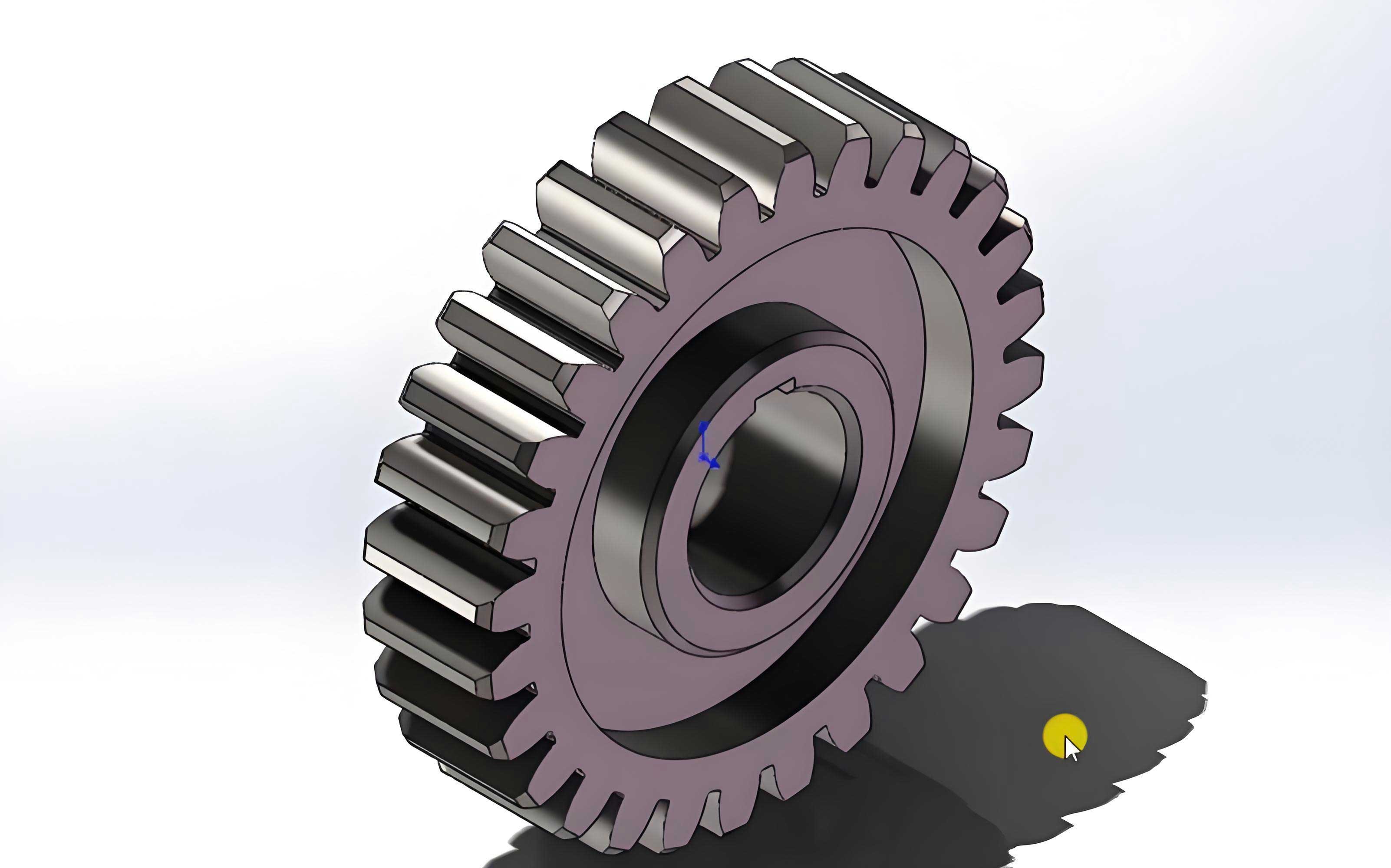
Building upon the corrected XFEM framework, a finite element model for a spur gear pair is constructed. The model focuses on the driving gear, incorporating realistic features such as a web and web holes. The material is typically a high-strength alloy steel with properties: Elastic Modulus $E = 210$ GPa, Poisson’s ratio $\nu = 0.28$, and density $\rho = 7830$ kg/m³. A critical aspect of the simulation is defining the initial crack. Fatigue cracks in spur gears often nucleate at the tooth root fillet due to maximum bending stress. Multiple potential nucleation sites along the fillet curve are considered to study path dependency. A static equivalent load, derived from the transmitted torque and gear geometry, is applied to the tooth flank or tip. The boundary conditions constrain the gear bore. The simulation then incrementally calculates the stress intensity factors, determines the crack growth direction based on the MCTS criterion, and updates the crack geometry using the level-set method within the XFEM framework.
The primary factors influencing the crack propagation path in spur gears can be systematically investigated using this model. The first major factor is the initial crack nucleation location along the tooth root fillet. Simulations reveal a distinct pattern: cracks initiating closer to the loaded side of the tooth (i.e., where the meshing contact occurs) tend to propagate more directly across the tooth, leading to tooth fracture. In contrast, cracks nucleating farther from the immediate load application point exhibit a more curved trajectory, initially growing towards the gear’s rim before turning. This behavior is governed by the local mixed-mode stress ratio ($K_{II}/K_I$) at the crack tip, which varies significantly with the nucleation point relative to the load.
| Nucleation Point (Relative to Load) | Initial $K_{II}/K_I$ Ratio | Initial Growth Direction | Final Failure Mode | Crack Path Length |
|---|---|---|---|---|
| At point of max bending stress (near load) | Low to Moderate | Relatively straight into tooth | Tooth Breakoff | Shorter |
| Mid-fillet | Moderate | Curved, towards rim then turning | Tooth Breakoff or Rim Crack | Medium |
| Far from loaded flank | Higher | Sharply curved towards gear center/rim | Rim Failure or Web Involvement | Longer |
The second critical factor is the web geometry, specifically the outer diameter of the web ($r_{wo}$). The web connects the gear rim (where teeth are located) to the hub (mounted on the shaft). Its size significantly alters the global stiffness distribution of the gear body. Analysis shows that as the web’s outer diameter increases—meaning the web is thicker and extends closer to the tooth root—the overall stiffness of the gear body increases. This stiffness change modifies the compliance felt by the crack. In stiffer configurations (larger $r_{wo}$), the crack path is “attracted” towards the stiffer region, i.e., the gear rim. Consequently, cracks are more likely to propagate into the rim rather than across the tooth, potentially changing the failure mode from a single tooth breakoff to a more catastrophic rim fracture. The relationship can be conceptualized as the crack seeking a path through a region of lower strain energy density, which is influenced by the global stiffness field shaped by the web.
The third influential factor involves stress concentrators like web holes. Lightweight design often necessitates holes in the gear web. These holes act as potent stress concentrators and create local disturbances in the stress field. When a propagating crack approaches the vicinity of a web hole, its path can be significantly deflected. The crack tends to be “attracted” towards the hole, as propagating towards this free surface reduces the system’s strain energy. The degree of attraction depends on the relative position between the crack tip and the hole. A parameter like a “deflection influence coefficient” $C_d$ can be defined, relating the crack tip coordinates at a reference point to its deviation. The influence is most pronounced when the hole is positioned directly in the projected path of the crack or slightly offset from it. This phenomenon underscores the critical importance of considering the placement of manufacturing features like web holes in the design of high-integrity spur gears, as they can inadvertently guide a crack towards critical structural areas.
| Influencing Factor | Mechanism of Influence | Effect on Crack Path | Implication for Gear Design |
|---|---|---|---|
| Nucleation Location | Alters local mixed-mode stress ratio ($K_{II}/K_I$) at the crack tip. | Determines initial curvature; paths from different points diverge. | Highlights critical zones for inspection; informs fillet optimization. |
| Web Outer Diameter | Changes global stiffness distribution and compliance of the gear body. | Attracts path towards stiffer regions (e.g., rim) as diameter increases. | Suggests optimal web sizing to guide cracks towards less critical areas or increase tooth breakoff likelihood for safer failure. |
| Web Holes & Discontinuities | Act as strong stress concentrators and local strain energy minimizers. | Strongly attracts and deflects the crack path towards the hole. | Demands careful placement of lightening holes; avoid aligning holes with likely crack trajectories from critical root locations. |
| Load Magnitude & Point | Directly affects SIFs ($K_I$, $K_{II}$) and their ratio. | Higher loads accelerate growth; load point shifts stress field, altering path. | Underlines importance of accurate load history for life prediction and path analysis. |
In conclusion, the propagation of fatigue cracks in spur gear teeth is a complex process governed by fracture mechanics principles and highly sensitive to several design and operational factors. The use of a corrected eXtended Finite Element Method provides a powerful and accurate tool for simulating this process without the computational burdens of traditional remeshing techniques. The investigation into influencing factors reveals that the initial crack location dictates the fundamental trajectory, while the gear body’s structural design—particularly the web geometry and the presence of holes—plays a decisive role in steering the crack path, potentially altering the final failure mode. These insights are invaluable for the design of more robust and failure-tolerant spur gears. Designers can leverage this knowledge to optimize tooth fillet geometry, strategically size webs, and judiciously place web holes to either arrest cracks or guide them towards benign failure modes, ultimately enhancing the safety, reliability, and lifespan of geared transmission systems.