
In modern mechanical engineering, the design and manufacturing of spiral bevel gears are critical due to their widespread application in high-speed and heavy-load intersecting shaft transmissions. These gears offer advantages such as smooth operation, low noise, and high load-carrying capacity. However, achieving high-quality and efficient processing of spiral bevel gears remains a challenge. The emergence of virtual manufacturing technology provides a promising solution, with product and process modeling and simulation at its core. In this article, I present a comprehensive method for constructing three-dimensional solid models of spiral bevel gears, which facilitates the application of virtual manufacturing in gear processing, allowing for the visualization of meshing contacts and cutting conditions on computer screens.
The foundation of this modeling approach lies in the spatial meshing theory. I begin by establishing the tooth surface equations for spiral bevel gears through a detailed analysis of the gear-cutting process. Consider the cutting process示意图, where a cutter head simulates the generation of the tooth surface. I introduce several coordinate systems to describe the geometry and kinematics: Σd (fixed to the cutter head, with Od as the cutter center and xd as the cutter rotation axis), Σy (fixed to the machine tool cradle, with Oy as the cradle center and xy as the cradle rotation axis), and Σg (a fixed coordinate system attached to the machine bed, initially coincident with Σy, representing the position of the generating gear rotation denoted by ψ).
During cutting, the cutter head rotates around its axis, and its cutting edges form a conical surface known as the generating surface. In Σd, the vector equation of this surface is given by:
$$\vec{r}_d = (r_H \cot \alpha – u \cos \alpha) \vec{i}_d + u \sin \alpha \sin \theta \vec{j}_d + u \sin \alpha \cos \theta \vec{k}_d$$
Here, rH is the nominal cutter radius, α is the blade pressure angle, and u and θ are parameters defining a point on the conical surface. The unit normal vector to the generating surface is:
$$\vec{e}_d = \sin \alpha \vec{i}_d + \cos \alpha \sin \theta \vec{j}_d + \cos \alpha \cos \theta \vec{k}_d$$
通过坐标变换, I transform these equations into other coordinate systems. The transformation matrix from Σd to Σy is denoted as Myd, and the vector transformation matrix as Lyd. Thus, in Σy, the position vector $\vec{r}_y$ and unit normal vector $\vec{e}_y$ are:
$$\vec{r}_y = M_{yd} \cdot \vec{r}_d, \quad \vec{e}_y = L_{yd} \cdot \vec{e}_d$$
Similarly, transforming to Σg using matrices Mgy and Lgy yields the generating surface equations in the fixed coordinate system:
$$\vec{e}_g = \sin \alpha \vec{i}_g + \cos \alpha [\sin(\theta – q + \psi) \vec{j}_g + \cos(\theta – q + \psi) \vec{k}_g] \tag{1}$$
$$\vec{r}_g = (r_H \cot \alpha – u \cos \alpha) \vec{i}_g + [u \sin \alpha \sin(\theta – q + \psi) – b_H \sin(q – \psi)] \vec{j}_g + [u \sin \alpha \cos(\theta – q + \psi) + b_H \cos(q – \psi)] \vec{k}_g \tag{2}$$
In Cartesian coordinates, this becomes:
$$
\begin{aligned}
x_g &= r_H \cot \alpha – u \cos \alpha \\
y_g &= u \sin \alpha \sin(\theta – q + \psi) – b_H \sin(q – \psi) \\
z_g &= u \sin \alpha \cos(\theta – q + \psi) + b_H \cos(q – \psi)
\end{aligned} \tag{3}
$$
To model spiral bevel gears, I apply the principle of the imaginary crown gear. Assuming the generating surface F is used to cut pinion 1, I introduce additional coordinate systems: Σm (equivalent to Σg), Σa (fixed, with za as the gear rotation axis), and Σ1 (attached to the gear, initially coincident with Σa, rotating with the gear by φ1). By modifying equations (1) and (3) with subscript g replaced by m and adding superscript F for the generating gear, I obtain the generating surface equations for cutting pinion 1 in Σm:
$$
\begin{aligned}
x^{(F)}_m &= r_F \cot \alpha_F – u_F \cos \alpha_F \\
y^{(F)}_m &= u_F \sin \alpha_F \sin(\theta_F – q_F + \psi_F) – b_F \sin(q_F – \psi_F) \\
z^{(F)}_m &= u_F \sin \alpha_F \cos(\theta_F – q_F + \psi_F) – b_F \cos(q_F – \psi_F)
\end{aligned} \tag{4}
$$
$$\vec{e}^{(F)}_m = \sin \alpha_F \vec{i}_m + \cos \alpha_F [\sin(\theta_F – q_F + \psi_F) \vec{j}_m + \cos(\theta_F – q_F + \psi_F) \vec{k}_m] \tag{5}$$
The relative motion between the generating surface F and pinion 1 is described by the velocity vector $\vec{v}^{(F1)}_m$. With the generating gear rotating at angular velocity $\vec{\Omega}^{(F)}$ and the pinion at $\vec{\Omega}^{(1)}$, the velocity vector is:
$$\vec{v}^{(F1)}_m = (\vec{\Omega}^{(F)} – \vec{\Omega}^{(1)}) \times \vec{r}^{(1)}_m – \vec{R}^{(1)}_m \times \vec{\Omega}^{(1)}$$
where $\vec{r}^{(1)}_m$ is the position vector of the contact point, and $\vec{R}^{(1)}_m$ is the vector from the origin to an arbitrary point on the line of action. Substituting the expressions for angular velocities, the components of $\vec{v}^{(F1)}_m$ are:
$$
\begin{aligned}
v^{(F1)}_{mx} &= -\Omega^{(1)} (y_m + \Delta E_1) \cos \delta_{b1} \\
v^{(F1)}_{my} &= \Omega^{(F)} z_m + \Omega^{(1)} [(x_m – L \sin \Delta_1) \cos \delta_{b1} – (z_m + \Delta L_1) \sin \delta_{b1}] \\
v^{(F1)}_{mz} &= -\Omega^{(F)} y_m + \Omega^{(1)} (y_m + \Delta E_1) \sin \delta_{b1}
\end{aligned} \tag{6}
$$
Here, δb1 is the root angle, and ΔE1, ΔL1 are machine tool adjustment parameters. The meshing condition in Σm is given by $\vec{e}^{(F)}_m \cdot \vec{v}^{(F1)}_m = 0$. Substituting equations (5) and (6) yields the meshing equation for pinion 1. A similar process derives the meshing equation for gear 2.
The tooth surface of the cut gear is the locus of contact lines transformed into the gear-attached coordinate system Σ1. By applying coordinate transformations and combining with the meshing equation, I obtain the tooth surface equations for both pinion and gear. For generality, the tooth surface can be expressed as a parametric surface with parameters θP and ψP:
$$
\begin{aligned}
x &= x(\theta_P, \psi_P) \\
y &= y(\theta_P, \psi_P) \\
z &= z(\theta_P, \psi_P)
\end{aligned}
$$
To construct the three-dimensional model, I focus on the tooth geometry. A single tooth of spiral bevel gears can be represented as a mesh of points. If points like P00, P01, …, P1520 on the tooth轮廓 are determined, I can use commands like 3Dmesh in AutoCAD to connect these points and create a wireframe model. The tooth surface is a double-parameter surface, so by fixing one parameter and varying the other, I can generate curves that form a网格 representation. However, boundary determination is crucial, requiring surface-surface and surface-line intersections.
I define additional conical surfaces to bound the tooth: the back cone, root cone, front cone, and face cone. For each cone, I establish a coordinate system with the cone apex as origin and the axis as the z-axis. The transformations between these systems and the gear-attached system Σ1 are computed using transformation matrices. The conical surface equations in their local coordinates are:
$$
\begin{aligned}
x &= u \sin \alpha \cos \theta \\
y &= \pm u \sin \alpha \sin \theta \\
z &= u \cos \alpha
\end{aligned} \tag{8}
$$
where α is the semi-cone angle (back, root, front, or face angle), and the sign of y is chosen based on the cone orientation. After transformation to Σ1, these equations become:
$$\vec{r}_i = M_{1ai} \cdot \vec{r}, \quad i=1,2,3,4$$
corresponding to back, root, front, and face cones, respectively.
The intersection lines between the tooth surface and these cones define the tooth boundaries. By solving the system of equations from the tooth surface and each cone surface, I obtain four boundary lines l1, l2, l3, l4. The parameters ui for these intersections are determined iteratively, with initial and final values approximated from geometric relationships. For example, for the front cone, u30 ≈ Lb tan δ1 + Δl and u31 ≈ Lb tan δ1 – Δl, where Δl is a small offset. Through double loops and solving simultaneous equations, precise values for ui at points like c and d (intersections of multiple surfaces) are found.
Once the boundaries are established, I discretize the tooth surface into a grid of points. For instance, along the root cone boundary l2, points P10 to P140 are obtained by varying u2 from u20 to u21. Similarly, other boundaries yield points like P150 to P157 for l1, P00 to P07 for l3, and P17 to P147 for l4. To complete the tooth, points on the face cone (e.g., Pi8, Pi9 between Pi7 and Pi10) and root cone (e.g., Pi18, Pi19 between Pi17 and Pi0) are calculated. All these points are summarized in the table below for clarity.
| Parameter | Description | Typical Value or Expression |
|---|---|---|
| rH | Cutter nominal radius | Design-specific |
| α | Blade pressure angle | Often 20° |
| u, θ | Surface parameters | Varies per point |
| δb1 | Root angle of pinion | Based on gear design |
| ΔE1, ΔL1 | Machine adjustment parameters | From setup calculations |
| u10 | Initial u for back cone intersection | d12 cos δ1 – hb1 |
| u11 | Final u for back cone intersection | d12 cos δ1 + ha1 |
| u20 | Initial u for root cone intersection | Approx. db12 sin δb1 – b |
| u21 | Final u for root cone intersection | db12 sin δb1 |
After obtaining all points Pij for both concave and convex tooth surfaces, I use the 3Dmesh command to generate the wireframe model. To visualize the complete gear, I apply rotational transformations to replicate the tooth around the gear axis. This allows for the construction of the entire spiral bevel gear model. Finally, by invoking rendering commands in AutoCAD, I create a three-dimensional solid model that accurately represents the spiral bevel gears.
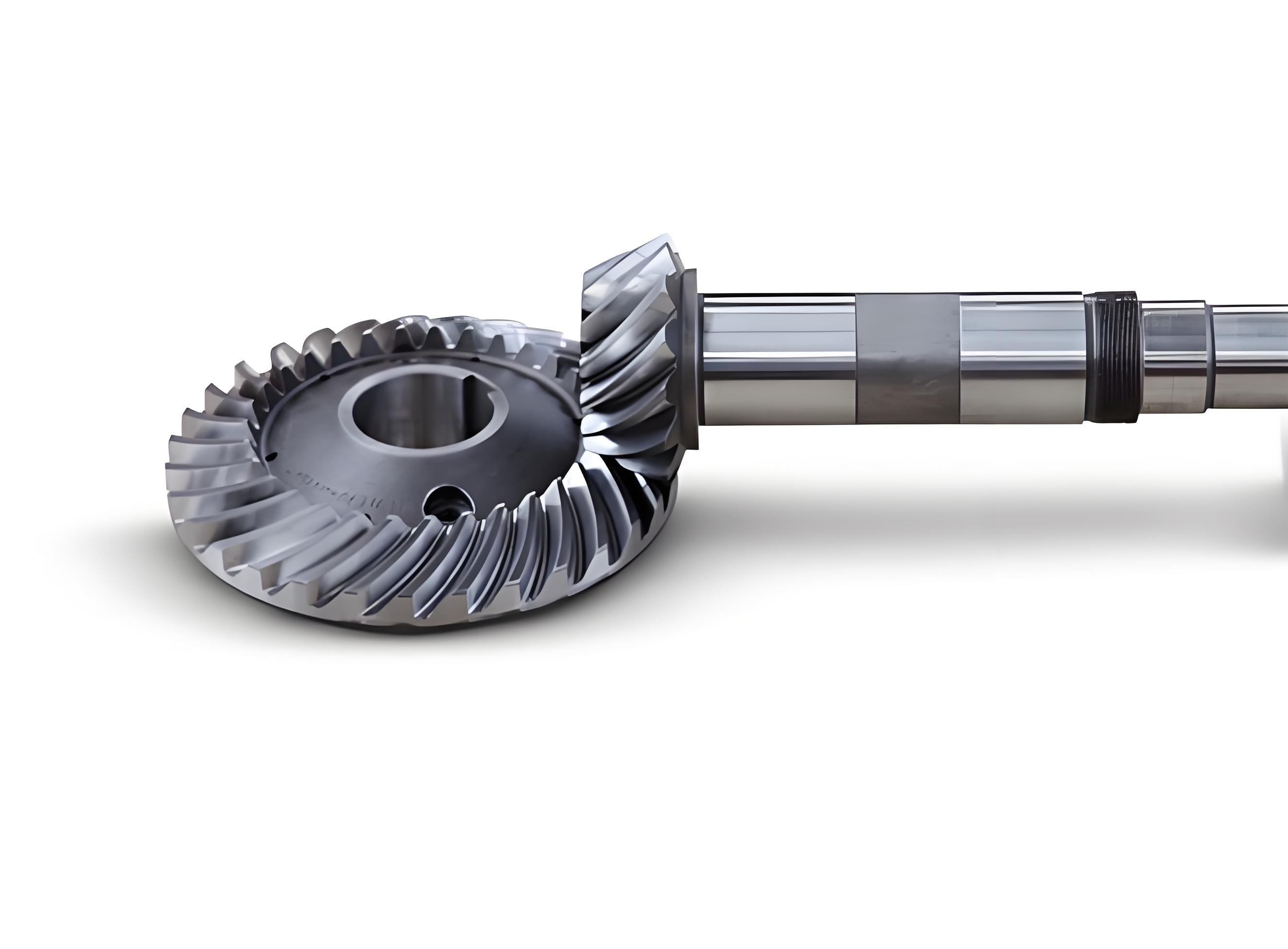
The modeling process highlights the importance of precise mathematical formulations for spiral bevel gears. The tooth surface equations are derived from meshing theory, ensuring accuracy in virtual simulations. For instance, the meshing condition can be expressed in a generalized form. Let $\vec{r}(u, \theta)$ be the position vector of the generating surface, and $\vec{v}$ be the relative velocity. The meshing equation is:
$$\vec{n} \cdot \vec{v} = 0$$
where $\vec{n}$ is the normal vector. In matrix form, the coordinate transformations involve rotation and translation matrices. For example, the transformation from Σd to Σy can be represented as:
$$M_{yd} = \begin{bmatrix}
\cos \phi & -\sin \phi & 0 & a \\
\sin \phi & \cos \phi & 0 & b \\
0 & 0 & 1 & c \\
0 & 0 & 0 & 1
\end{bmatrix}$$
where φ, a, b, c are parameters based on machine geometry.
In practice, the design of spiral bevel gears involves numerous parameters. Below is a table summarizing key design variables used in the modeling process.
| Parameter | Symbol | Role in Modeling |
|---|---|---|
| Number of teeth | N | Determines gear ratio and spacing |
| Module | m | Scales tooth size |
| Pressure angle | α | Affects tooth strength and meshing |
| Spiral angle | β | Influences smoothness and load capacity |
| Pitch diameter | d | Base for geometry calculations |
| Face width | b | Tooth engagement length |
| Cutter radius | rH | Defines generating surface |
| Machine settings | ΔE, ΔL | Adjust tooth surface topology |
The virtual modeling of spiral bevel gears enables extensive analysis, such as contact pattern simulation and stress distribution. By iterating the parameters, I can optimize gear performance. For example, the contact condition between mating gears can be evaluated using the equation of meshing. If $\vec{r}_1$ and $\vec{r}_2$ are the tooth surfaces of pinion and gear, and $\vec{n}_1$, $\vec{n}_2$ are their normals, the contact requires:
$$\vec{r}_1 = \vec{r}_2, \quad \vec{n}_1 \parallel \vec{n}_2$$
In parametric form, this leads to systems of equations that can be solved numerically.
Furthermore, the construction of spiral bevel gears in CAD software allows for integration with finite element analysis (FEA). The solid model can be exported for simulation of manufacturing processes or operational loads. This holistic approach bridges design and manufacturing, reducing prototyping costs and time. The mathematical rigor ensures that the models are suitable for high-precision applications, such as aerospace or automotive transmissions.
To elaborate on the coordinate transformations, consider the detailed steps. The transformation from Σa to Σ1 involves a rotation about the z-axis by angle φ1. The matrix is:
$$M_{1a} = \begin{bmatrix}
\cos \varphi_1 & -\sin \varphi_1 & 0 & 0 \\
\sin \varphi_1 & \cos \varphi_1 & 0 & 0 \\
0 & 0 & 1 & 0 \\
0 & 0 & 0 & 1
\end{bmatrix}$$
Similarly, for cone surfaces, the transformation from local cone coordinates to Σa includes translations along the axis. For the back cone, with distance L1 = OaOa1 = La / cos δ1, the matrix Maa1 is:
$$M_{aa1} = \begin{bmatrix}
1 & 0 & 0 & 0 \\
0 & 1 & 0 & 0 \\
0 & 0 & 1 & L_1 \\
0 & 0 & 0 & 1
\end{bmatrix}$$
Then, M1a1 = M1a · Maa1. This systematic approach allows for consistent modeling of all surfaces.
In terms of computational implementation, I use algorithms to solve for intersection points. For each boundary line, I set up loops over the parameter u. For example, for the root cone intersection l2, I solve the system:
$$
\begin{aligned}
x(\theta_P, \psi_P) &= x_{\text{cone}}(u_2, \theta_2) \\
y(\theta_P, \psi_P) &= y_{\text{cone}}(u_2, \theta_2) \\
z(\theta_P, \psi_P) &= z_{\text{cone}}(u_2, \theta_2)
\end{aligned}
$$
with the meshing equation included. This yields θP, ψP, and θ2 as functions of u2. By varying u2 from u20 to u21, I generate discrete points on l2.
The modeling of spiral bevel gears is not just theoretical; it has practical implications in virtual manufacturing. By creating accurate 3D models, I can simulate cutting processes, predict tool paths, and optimize machine settings. This reduces trial-and-error in physical加工, saving resources. Moreover, the models can be used for educational purposes, demonstrating the complex geometry of spiral bevel gears to students and engineers.
In conclusion, the method I present here for building three-dimensional solid models of spiral bevel gears is grounded in spatial meshing theory and coordinate geometry. Through derived tooth surface equations and careful boundary determination, I construct wireframe models that are then transformed into solid representations. This process leverages CAD capabilities and enhances virtual manufacturing applications. The repeated emphasis on spiral bevel gears throughout this discussion underscores their significance in mechanical systems. Future work could integrate this modeling with real-time simulation platforms for even more advanced virtual prototyping.
To further illustrate the mathematical details, I provide additional formulas. The tooth surface for pinion 1, after transformation to Σ1, can be written as:
$$\vec{r}_1(\theta_F, \psi_F) = M_{1m} \cdot \vec{r}^{(F)}_m(\theta_F, \psi_F)$$
subject to the meshing equation f(θF, ψF) = 0. Similarly, for gear 2, the surface is:
$$\vec{r}_2(\theta_G, \psi_G) = M_{2m} \cdot \vec{r}^{(G)}_m(\theta_G, \psi_G)$$
with its own meshing condition. The transformation matrices M1m and M2m account for the relative positions and orientations of the gears.
Finally, the entire gear assembly can be modeled by布尔 operations in CAD, combining multiple teeth into a single solid. This comprehensive approach ensures that the spiral bevel gears are represented accurately for analysis and manufacturing preparation. The integration of such models into digital twins of machinery will further advance the field of mechanical engineering, making the design and production of spiral bevel gears more efficient and reliable.