
The relentless pursuit of high-performance mechanical systems demands components with exceptional surface integrity, characterized by superior fatigue resistance and long-term reliability. Cylindrical gears, as fundamental power transmission elements, are no exception. Among various finishing technologies, spindle barrel finishing stands out for its ability to enhance surface integrity of complex-shaped parts like cylindrical gears. This process effectively reduces surface roughness, refines surface texture, improves residual stress states, and can impart isotropic surface properties, all while being cost-effective. The core mechanism involves the controlled interaction between a turbulent mass of abrasive media (particles) and the workpiece surface under simultaneous rotation of a containing drum and the workpiece fixture. However, the precise behavior of particles at the intricate contact interface with gear tooth flanks remains obscured, making the prediction of optimal process parameters and final surface outcomes largely empirical. This study employs the Discrete Element Method (DEM) to simulate the spindle finishing process for straight cylindrical gears, aiming to elucidate the particle action behavior on the tooth surface, analyze the influence of key parameters, and validate the findings through experimental measurements.
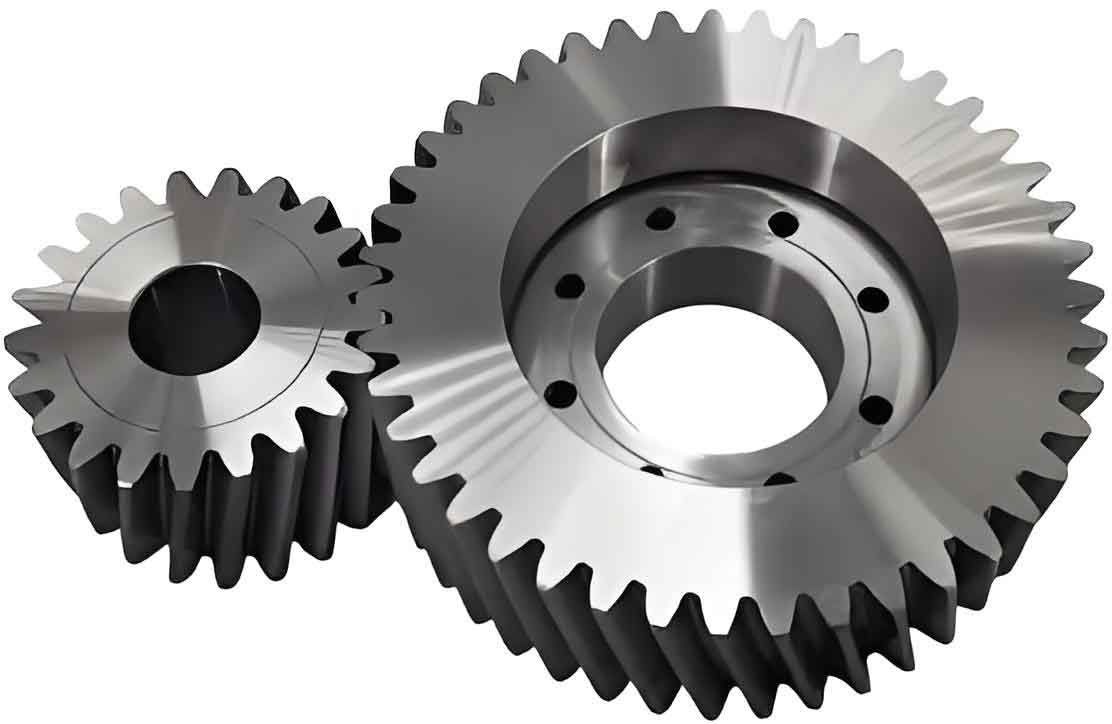
The efficacy of spindle finishing for cylindrical gears is governed by the interaction dynamics at the particle-tooth interface, primarily characterized by contact forces and relative sliding velocities. According to the Archard wear model, which is often adapted for abrasive processes, the wear depth $\Delta h$ is proportional to the normal pressure $P$ and the relative sliding velocity $v$ at the contact interface:
$$
\Delta h = K \frac{P v}{H} \Delta t
$$
where $K$ is a dimensionless wear coefficient, $H$ is the workpiece hardness, and $\Delta t$ is the wear time. Therefore, to understand and control the finishing outcome on cylindrical gears, it is imperative to analyze how process parameters influence these two fundamental quantities on the complex topography of a gear tooth.
Traditional experimental methods, such as high-speed imaging or embedded force sensors, offer valuable insights but face limitations in probing the confined and dynamic particle-gear contact zone. Computational simulation via DEM provides a powerful alternative, allowing for the tracking of individual particles and the computation of interaction forces and velocities. In this study, a DEM model of a spindle finishing system was constructed. The setup includes a rotating drum, a large population of spherical brown alumina abrasive particles (3 mm diameter), and a straight cylindrical gear workpiece. The material properties and interaction parameters used in the simulation are summarized in the following tables.
| Material | Density $\rho$ (kg/m³) | Poisson’s Ratio | Shear Modulus (MPa) |
|---|---|---|---|
| Drum (Steel) | 7850 | 0.300 | 7940 |
| Particle (Alumina) | 2675 | 0.360 | 1260 |
| Cylindrical Gear (40Cr) | 7870 | 0.277 | 8080 |
| Contact Pair | Coefficient of Restitution | Static Friction Coefficient | Rolling Friction Coefficient |
|---|---|---|---|
| Particle-Drum | 0.50 | 0.35 | 0.10 |
| Particle-Cylindrical Gear | 0.43 | 0.36 | 0.10 |
| Particle-Particle | 0.46 | 0.39 | 0.10 |
The simulation investigates the effects of two critical parameters: the workpiece submersion depth ($h_1$), defined as the distance from the gear’s top face to the static media level, and the rotational speeds. The drum speed ($n_1$) and gear speed ($n_2$) were varied while maintaining a fixed ratio ($n_1:n_2 = 5:4$) to systematically alter the relative motion. The parametric design is shown below.
| Workpiece Submersion Depth $h_1$ (mm) | Drum Rotational Speed $n_1$ (rpm) |
|---|---|
| 80, 110, 140 | 12, 21, 30 |
The analysis of the particle flow field reveals significant alterations caused by the presence of the cylindrical gear. The gear obstructs the natural parabolic flow, leading to media accumulation upstream (in front relative to the drum rotation) and the creation of a void or wake region downstream. This results in a substantial height difference between the media pile upstream and downstream of the cylindrical gear. Velocity vector analysis on different cross-sectional planes shows that upon impacting the gear, the particle swarm splits. One stream is deflected upwards, climbing along the upstream tooth flank of the cylindrical gear, another flows around the gear’s sides at higher velocities, and a portion passes beneath it. This complex flow pattern directly influences the particle action on the tooth surfaces of the cylindrical gears.
A crucial finding is the periodic nature of particle action within an individual tooth space of the cylindrical gear during one gear revolution. This cycle can be delineated into three distinct phases:
- Particle Infilling Phase: As the cylindrical gear rotates, the tooth space exits the wake region. Particles from the overhead bulk media cascade down into the cavity, primarily with a vertically downward velocity.
- Stable Filling & Processing Phase: The tooth space becomes fully packed and enters the main media impact zone. Particles within the space are subjected to compressive forces from the overlying media mass and exhibit upward sliding motion along the tooth flank due to the gear’s rotation and the global flow. This phase is characterized by a high and stable number of contacting particles and significant normal contact forces.
- Particle Evacuation Phase: The tooth space leaves the high-impact zone. Assisted by centrifugal force and gravity, particles flow out towards the gear tip and bottom, emptying the space as it re-enters the wake region.
The stable filling phase is identified as the dominant period for material modification on cylindrical gears, as it sustains both high contact forces and sustained sliding action.
The influence of process parameters on the average normal contact force ($F$) and the average particle-to-tooth relative sliding velocity ($V$) during the stable processing phase was quantified. The data clearly shows a decoupled effect:
Effect of Submersion Depth ($h_1$): Increasing the submersion depth of the cylindrical gear predominantly amplifies the contact force. A 75% increase in $h_1$ (from 80 mm to 140 mm) resulted in an approximately 76% increase in the average normal contact force on the tooth flank. This is attributed to the increased hydrostatic-like pressure from a taller column of media above the workpiece. In contrast, the relative sliding velocity increased only marginally (about 4%) with depth.
$$
F \propto h_1, \quad \text{while} \quad V \approx \text{constant w.r.t. } h_1
$$
Effect of Rotational Speeds ($n_1, n_2$): Increasing the rotational speeds (while keeping their ratio constant) primarily enhances the relative sliding velocity. A 150% increase in speed (from 12 rpm to 30 rpm) led to an approximately 148% increase in the average relative velocity on the tooth flank of the cylindrical gear. The contact force saw a much smaller increase of about 18%. This relationship aligns with the theoretical relative velocity in an idealized model:
$$
V \propto n_1 \sqrt{ R^2 + r^2 \left(1 – \frac{n_2}{n_1}\right)^2 + 2Rr\left(1 – \frac{n_2}{n_1}\right)\cos\theta }
$$
where $R$ is the center distance, $r$ is the distance from a point on the cylindrical gear to its axis, and $\theta$ is the angular position.
$$
V \propto n_1, \quad \text{while} \quad F \text{ shows weak dependence on } n_1
$$
The simulation also revealed inherent processing non-uniformities across the tooth surface of the cylindrical gear. The contact force and sliding velocity are not uniformly distributed from the root to the tip of the tooth, nor between the upstream (drive side) and downstream (coast side) flanks of the cylindrical gear. Specifically, the upstream flank experiences significantly higher contact force (1.5 to 1.8 times) and higher sliding velocity (1.35 to 1.45 times) compared to the downstream flank. This asymmetry stems from the direction of the global media flow relative to the gear rotation. Furthermore, along the gear axis, the lower section of the tooth typically experiences slightly higher forces than the upper section when submersion is shallow. Critically, increasing the submersion depth was found to effectively mitigate this axial non-uniformity for cylindrical gears, promoting more consistent finishing along the tooth width.
To validate the DEM findings, experimental stress testing was conducted on a spindle finishing platform. Strain gauges were mounted at strategic locations on a cylindrical gear specimen: on the tooth flank, and on the top and bottom faces of the gear body. The measured stress signals, which correlate with the interaction forces, exhibited clear周期性 patterns corresponding to gear rotation, corroborating the simulated periodic action. The experimental trends confirmed the parametric influences: stress (force) increased substantially with greater submersion depth but only modestly with increased rotational speed, aligning perfectly with the simulation predictions for cylindrical gears.
Finally, surface roughness measurements were performed on cylindrical gears processed under different parameters. The results confirmed the practical implications. The surface roughness reduction rate increased with both higher rotational speed (increased sliding velocity) and greater submersion depth (increased contact force). Most notably, the experimental roughness data validated the key finding regarding axial uniformity. For a shallow submersion (80 mm), the roughness reduction varied significantly from the top to the bottom section of the tooth flank on the cylindrical gear. When the submersion depth was increased to 140 mm, the roughness improvement became highly uniform across the entire tooth width, demonstrating that deeper submersion can homogenize the finishing effect along the axis of cylindrical gears.
In conclusion, this integrated DEM simulation and experimental study elucidates the complex particle action behavior during the spindle finishing of straight cylindrical gears. The process is characterized by a cyclical interaction within the tooth space, with a distinct stable processing phase responsible for the majority of surface modification. The effects of key parameters are decoupled: submersion depth primarily governs the contact force magnitude, while rotational speeds dictate the relative sliding velocity. Furthermore, the process inherently creates non-uniform effects on different flanks of the cylindrical gear, but increasing the submersion depth presents an effective strategy to minimize axial non-uniformity and achieve a more consistent finish across the tooth width. These insights provide a foundational understanding for optimizing the spindle finishing process for enhanced surface integrity of cylindrical gears.