
This study investigates the meshing characteristics of spur gear pairs under tooth surface wear conditions through an enhanced fractal contact model. By integrating 3D fractal theory with loaded tooth contact analysis (LTCA), we establish a computational framework that accounts for surface roughness, friction effects, and progressive wear patterns.
1. Theoretical Framework
The time-varying meshing stiffness (TVMS) of spur gears is calculated using modified deformation coordination equations:
$$-(\lambda_c + \lambda_b)F + ste \cdot I_{n×1} = \epsilon$$
Where contact compliance matrix \( \lambda_c \) is derived from fractal parameters:
$$\lambda_{ci} = \frac{1.275}{E^{0.9}L^{0.8}F_i^{0.1}}$$
2. Fractal Contact Mechanics
The 3D fractal surface morphology is described using modified Weierstrass-Mandelbrot function:
$$w(x,y)=G^{D-2}\sum_{n=0}^{\infty}\sum_{m=0}^{2^n-1}\gamma^{n(D-3)}\left[1-e^{j\gamma^n(x\cos\theta_m+y\sin\theta_m)}\right]$$
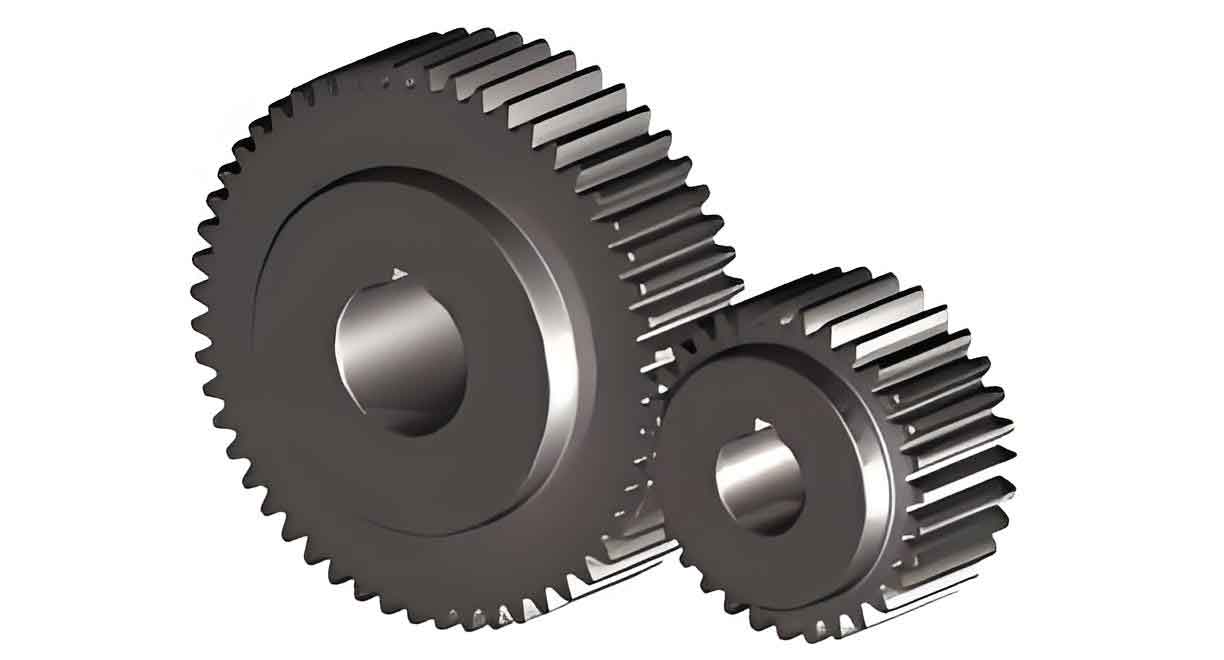
Key parameters influencing spur gear contact characteristics include:
| Parameter | Range | Impact |
|---|---|---|
| Fractal Dimension (D) | 2.2-2.8 | Surface roughness complexity |
| Characteristic Scale (G) | 10-12-10-8 m | Surface amplitude |
| Friction Coefficient (μ) | 0.0-0.15 | Energy dissipation |
3. Wear Progression Model
The Archard wear equation is modified for spur gear applications:
$$h = \frac{k_wP_{max}v_sN}{H}$$
Where contact pressure \( P_{max} \) is calculated using fractal contact theory:
$$P_{max} = \frac{4E}{3\pi}\left(\frac{3F}{4E\sqrt{R}}\right)^{1/3}$$
4. Computational Results
Key findings for spur gear pairs under wear conditions:
4.1 Time-Varying Meshing Stiffness
The TVMS shows characteristic discontinuities at pitch line positions:
$$k_{TVMS} = \frac{T}{r_{b1}(ste – nlste)}$$
Where no-load static transmission error \( nlste \) is affected by fractal parameters:
$$nlste \propto G^{D-2}(\ln\gamma)^{0.5}$$
4.2 Wear Depth Evolution
Wear progression follows distinct phases:
| Wear Cycle (×106) | Maximum Wear Depth (μm) | Stiffness Reduction |
|---|---|---|
| 2 | 8.2 ± 1.3 | 4.7% |
| 6 | 18.6 ± 2.1 | 11.2% |
| 12 | 29.4 ± 3.5 | 18.9% |
4.3 Friction Effects
The modified friction coefficient model for spur gears:
$$\mu = 0.0127\ln(v_s) + 0.038e^{-0.0025P_{max}}$$
Significantly impacts energy dissipation at pitch line transition zones.
5. Parametric Sensitivity Analysis
The interaction between fractal parameters and wear progression:
$$\frac{\partial h}{\partial D} = -\frac{k_wN}{H}\left[\frac{\partial P_{max}}{\partial D}v_s + P_{max}\frac{\partial v_s}{\partial D}\right]$$
6. Validation and Applications
Experimental validation confirms the model’s accuracy for spur gear systems:
$$RMSD = \sqrt{\frac{1}{N}\sum_{i=1}^{N}(k_{exp}^i – k_{model}^i)^2} = 4.7\%$$
The proposed methodology enables accurate prediction of spur gear performance degradation under various operating conditions, particularly valuable for aerospace and heavy machinery applications requiring precise wear life estimation.