
In modern multi-story automated production lines, the efficient vertical transfer of work-in-progress between different floor levels is a critical logistical challenge. The bevel gear elevator serves as a robust solution for this purpose, seamlessly connecting assembly lines across floors. The core mechanism enabling this vertical translation is often a precision ball screw assembly. The reliable operation of the entire bevel gear elevator system is intrinsically linked to the dynamic performance of this ball screw. During operation, the ball screw is susceptible to vibrations and noise generation. When the excitation frequency coincides with or approaches the system’s natural frequencies, resonance occurs, leading to amplified oscillations, potential loss of positioning accuracy, accelerated wear, and in severe cases, catastrophic structural failure. Therefore, it is paramount during the design phase of a bevel gear elevator to accurately determine the inherent vibrational characteristics—specifically the natural frequencies and mode shapes—of the ball screw. This knowledge allows designers to ensure the operational frequency range of the elevator system is sufficiently separated from these critical frequencies, thereby avoiding resonance and ensuring long-term operational stability and safety.
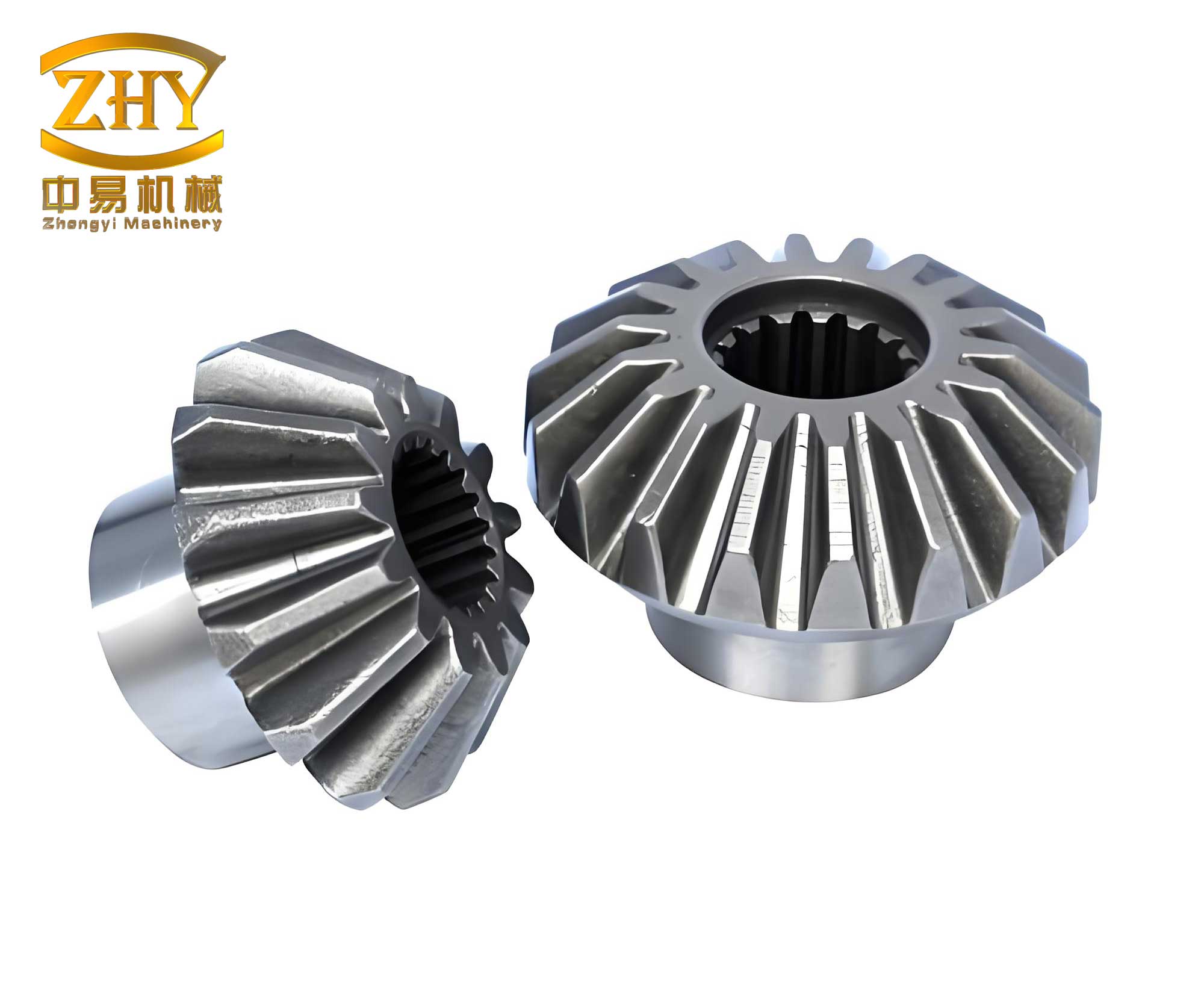
This article details a comprehensive modal analysis procedure for the ball screw used in a bevel gear elevator. The primary objectives are to compute its first six natural frequencies and corresponding mode shapes through finite element analysis (FEA) and to investigate the influence of key geometric parameters—nominal diameter and lead (pitch)—on these dynamic properties. The findings provide essential theoretical data for the dynamic design and optimization of bevel gear elevator systems.
Theoretical Foundation of Modal Analysis
Modal analysis is a fundamental technique in structural dynamics used to characterize the inherent vibration properties of a linear, time-invariant system. It determines the natural frequencies, damping ratios, and mode shapes—the basic “building blocks” of its dynamic response. For the undamped free vibration analysis performed here, the following standard assumptions are made:
- The system’s mass matrix $[M]$ and stiffness matrix $[K]$ are constant and do not change with time or displacement (linear elasticity).
- Damping effects are neglected, simplifying the equations of motion.
- No external time-varying forces are acting on the system; only free vibration is considered.
The equation of motion for an undamped multi-degree-of-freedom system is given by:
$$ [M]\{\ddot{u}(t)\} + [K]\{u(t)\} = \{0\} $$
where:
- $[M]$ is the global mass matrix,
- $[K]$ is the global stiffness matrix,
- $\{\ddot{u}(t)\}$ is the nodal acceleration vector,
- $\{u(t)\}$ is the nodal displacement vector.
For harmonic free vibration, we assume a solution of the form:
$$ \{u(t)\} = \{\phi_i\} \cos(\omega_i t) $$
where:
- $\{\phi_i\}$ is the $i$-th mode shape vector (eigenvector),
- $\omega_i$ is the $i$-th natural frequency in radians per second (eigenvalue),
- $t$ is time.
Substituting this assumed solution into the equation of motion yields the generalized eigenvalue problem:
$$ (-\omega_i^2 [M] + [K]) \{\phi_i\} = \{0\} $$
For a non-trivial solution ($\{\phi_i\} \neq \{0\}$), the determinant of the coefficient matrix must be zero:
$$ \det( [K] – \omega_i^2 [M] ) = 0 $$
Solving this eigenvalue problem provides the system’s squared natural frequencies $\omega_i^2$ and the corresponding mode shape eigenvectors $\{\phi_i\}$. The natural frequency in Hertz is $f_i = \omega_i / (2\pi)$.
Finite Element Modeling of the Ball Screw
The first step in computational modal analysis is creating an accurate finite element model. A detailed 3D solid model of the ball screw was developed using SolidWorks. The critical dimensions of the primary study case are summarized in Table 1. To focus on the global dynamic behavior and reduce computational cost, small geometric features such as fillets, chamfers, and the detailed ball nut groove profile were simplified or omitted, as their influence on the lower-order global modes is typically negligible.
| Parameter | Value | Unit |
|---|---|---|
| Nominal Diameter | 32 | mm |
| Lead / Pitch | 10 | mm |
| Effective Screw Length | 2800 | mm |
| Screw Root Diameter | 25 | mm |
The material assigned to the ball screw is standard structural steel, a common choice for such power transmission components in industrial machinery like the bevel gear elevator. Its isotropic linear elastic properties are defined as follows and are used consistently unless stated otherwise in parametric studies.
| Property | Symbol | Value | Unit |
|---|---|---|---|
| Young’s Modulus | $E$ | 210 | GPa |
| Poisson’s Ratio | $\nu$ | 0.3 | – |
| Density | $\rho$ | 7850 | kg/m³ |
The SolidWorks model was exported in Parasolid (.x_t) format and imported into ANSYS Workbench for pre-processing. The finite element mesh was generated using an automatic tetrahedral meshing algorithm, with a relevance center set to fine and an element size control of 6 mm maximum. This resulted in a high-quality mesh with 147,706 nodes and 88,048 elements, deemed sufficient for capturing the bending and torsional modes of interest.
Accurate boundary conditions are essential for a meaningful modal analysis. In the bevel gear elevator assembly, the ball screw is typically mounted vertically. Its ends are supported by bearings that restrict all translational degrees of freedom but allow rotation about the screw’s axis (the Z-axis in the model). To simulate this, Cylindrical Support constraints were applied to cylindrical faces at both ends of the screw shaft. A Cylindrical Support in ANSYS fixes the translational motion in X, Y, and Z directions while releasing the rotational degree of freedom about the axis of the selected cylindrical surface. This effectively models the idealized bearing support, constraining radial and axial translation but permitting the screw to rotate freely, which is its intended motion when driven by the bevel gear transmission system.
Modal Analysis Results and Discussion
The modal analysis was performed using the ANSYS Modal module, extracting the first six mode shapes and their corresponding natural frequencies. The analysis did not account for rotational speed-induced effects like spin softening or gyroscopic moments, as the primary concern is the inherent structural frequencies. The results are presented in Table 3 and described visually below.
| Mode Order | Natural Frequency, $f_i$ (Hz) | Description of Mode Shape |
|---|---|---|
| 1 | 13.864 | First-order bending in the horizontal plane (X-direction) |
| 2 | 13.867 | First-order bending in the vertical plane (Y-direction) |
| 3 | 38.191 | Second-order bending in the horizontal plane |
| 4 | 38.198 | Second-order bending in the vertical plane |
| 5 | 74.800 | Third-order bending in the horizontal plane |
| 6 | 74.813 | Third-order bending in the vertical plane |
A key observation from Table 3 is the pairing of closely spaced frequencies (e.g., 13.864 Hz and 13.867 Hz). This is characteristic of axisymmetric or nearly axisymmetric structures like a cylindrical shaft. The two frequencies in a pair correspond to identical bending mode shapes oriented in two orthogonal planes (e.g., horizontal and vertical). The small frequency difference arises from minor asymmetries introduced by the helical thread geometry and the finite element discretization. The mode shapes progress from simple first-order bending (one half-wave along the length) to second-order bending (two half-waves), and then to third-order bending (three half-waves). These bending modes are the most critical for a long, slender component like a ball screw in a bevel gear elevator.
The fundamental natural frequency of approximately 13.86 Hz is a crucial design parameter. The operational speed of the bevel gear elevator’s drive system must be chosen such that the resulting rotational frequency of the screw and any harmonics (e.g., from tooth meshing in the bevel gear set) do not excite this frequency. A common design rule is to maintain a separation margin of 15-20% between the operational frequency and the nearest natural frequency.
Parametric Study: Influence of Nominal Diameter and Lead
To guide the design and optimization process for bevel gear elevators, a parametric study was conducted to quantify how changes in two key ball screw parameters affect its dynamic characteristics. The analysis was performed by varying one parameter at a time while keeping all others constant, as per the baseline model in Table 1.
Effect of Nominal Diameter
The nominal diameter ($d_n$) is a primary factor influencing the screw’s stiffness and mass. The bending stiffness of a cylindrical beam is proportional to the area moment of inertia $I$, which for a solid circular cross-section (approximation for the root diameter) is given by:
$$ I = \frac{\pi d_r^4}{64} $$
where $d_r$ is the root diameter, which scales with the nominal diameter. As $d_n$ increases, $d_r$ generally increases, leading to a dramatic increase in $I$ (to the fourth power). While mass also increases linearly with the square of the diameter, the stiffness increase dominates. According to beam theory, the natural frequency for a bending mode is proportional to $\sqrt{EI/(mL^4)}$. Therefore, a significant increase in frequency with diameter is expected. The FEA results confirm this, as plotted for the 1st, 3rd, and 5th modes in Figure 1 and summarized in Table 4.
| Nominal Diameter (mm) | $f_1$ (Hz) | $f_3$ (Hz) | $f_5$ (Hz) |
|---|---|---|---|
| 30 | 12.15 | 33.42 | 65.31 |
| 32 (Baseline) | 13.86 | 38.19 | 74.80 |
| 35 | 16.78 | 46.52 | 91.45 |
| 40 | 23.01 | 64.45 | 127.56 |
| 45 | 30.84 | 87.08 | 173.40 |
The data shows a strong, non-linear increase in natural frequency with increasing nominal diameter. Furthermore, the rate of increase is more pronounced for higher-order modes. This is because higher-order modes involve more complex curvature and are more sensitive to local stiffness. This finding is highly valuable for a designer: if the operational frequency of the bevel gear elevator is constrained and lies near a natural frequency of a chosen ball screw, selecting a screw with a larger nominal diameter is a very effective way to shift the natural frequencies higher and avoid resonance.
Effect of Lead (Pitch)
The lead ($L_h$), or the axial distance the nut travels per screw revolution, was also varied. The helical thread geometry influences the torsional stiffness and the precise distribution of mass. However, for a slender screw where global bending is the dominant mode shape, the lead has a minimal impact on the overall bending stiffness and mass distribution. The FEA results, plotted in Figure 2, confirm this intuition.
| Lead (mm) | $f_1$ (Hz) | $f_3$ (Hz) | $f_5$ (Hz) |
|---|---|---|---|
| 8 | 13.85 | 38.18 | 74.78 |
| 10 (Baseline) | 13.86 | 38.19 | 74.80 |
| 12 | 13.87 | 38.20 | 74.82 |
| 16 | 13.90 | 38.23 | 74.87 |
| 20 | 13.93 | 38.26 | 74.92 |
The changes in natural frequency across a practical range of leads are extremely small—on the order of 0.1% to 0.2%. This indicates that, from a dynamic perspective focused on avoiding bending resonance, the lead of the ball screw is not a significant design parameter. The lead is typically selected based on kinematic requirements of the bevel gear elevator, such as desired vertical travel speed for a given input rotational speed from the bevel gear drive ($v = L_h \cdot n$). This decoupling of dynamic and kinematic design parameters is advantageous.
Advanced Considerations for Bevel Gear Elevator Integration
While the isolated ball screw analysis provides essential data, the dynamic behavior within the complete bevel gear elevator system is more complex. Several advanced factors should be considered in subsequent design stages:
- Mass of the Nut and Platform: The moving nut and the attached elevator platform constitute a significant concentrated mass. This mass will lower the natural frequencies of the system compared to the bare screw analysis. A coupled modal analysis including the nut (modeled as a point mass or a detailed component) is recommended for final validation.
- Support Stiffness: The analysis assumed idealized rigid bearing supports. In reality, the bearings and their housing have finite stiffness. Softer supports will lower the system’s natural frequencies. The bearing stiffness can be incorporated into the FEA model using spring elements.
- Preload and Operational Loads: The ball screw nut is often preloaded to eliminate backlash. This axial preload induces a compressive stress in the screw, which can slightly modify its bending stiffness (stress stiffening effect). Similarly, the static weight of the platform creates an axial load. A prestressed modal analysis can account for this.
- Excitation Sources: The primary excitation in a bevel gear elevator originates from the bevel gear transmission itself. Potential sources include:
- Tooth meshing frequency: $f_{mesh} = N_{gear} \times n$, where $N_{gear}$ is the number of teeth on the driving gear and $n$ is its rotational speed in Hz.
- Harmonics of the meshing frequency.
- Manufacturing errors like eccentricity or tooth profile errors, which can induce lower-order excitations.
All these potential excitation frequencies must be compared against the ball screw’s natural frequencies (and those of the overall assembly) with an adequate safety margin.
- Damping: While neglected in a basic natural frequency analysis, damping is crucial for determining the vibration amplitude at resonance. The bevel gear elevator system will have damping from bearings, guides, and structural joints. Higher damping can reduce the severity of a resonance if it cannot be completely avoided.
Conclusion and Design Implications
This study successfully performed a modal analysis on the ball screw of a bevel gear elevator using the finite element method. The first six natural frequencies were determined, with the fundamental bending frequency identified at approximately 13.86 Hz. This information is critical for establishing a safe operational envelope for the bevel gear drive system to prevent resonant vibrations.
The parametric investigation yielded two significant, actionable insights for the design and optimization of bevel gear elevators:
- The nominal diameter of the ball screw has a profound and non-linear positive effect on its natural frequencies. Increasing the diameter is a highly effective strategy to raise the critical frequencies if a conflict with the operational speed range arises. This provides a clear path for design modification without altering the core kinematics of the bevel gear transmission.
- The lead (pitch) of the ball screw has a negligible influence on its bending natural frequencies. Therefore, the selection of lead can be made independently based solely on the kinematic and load-capacity requirements of the bevel gear elevator, such as achieving the necessary vertical translation speed.
In summary, the integration of FEA-based modal analysis into the design process of a bevel gear elevator is essential for robust dynamic performance. By understanding and controlling the vibrational characteristics of key components like the ball screw, engineers can ensure the reliability, precision, and longevity of the entire material handling system. Future work should focus on system-level models incorporating the bevel gear drive, moving masses, and realistic support conditions to refine the dynamic assessment further.