
In the field of military aviation maintenance, the demand for high-precision and high-speed gearbox equipment is paramount to simulate the operational conditions of aero-engines during ground testing. These gear systems often suffer from wear at the splined sections of their output gear shafts due to factors such as cyclic loading, inadequate lubrication, and poor heat dissipation, leading to failure. Traditionally, replacing these gear shafts with new ones has been the norm, but this approach is costly and time-consuming, with new shafts costing approximately $1,400 each and requiring a procurement lead time of about three months. Given that the spline section constitutes less than 10% of the total shaft cost, while the helical gear accounts for over 70%, discarding entire gear shafts due to spline wear is wasteful and contradicts energy-saving policies. Therefore, exploring advanced repair techniques like laser cladding, a remanufacturing technology, becomes crucial. Laser cladding offers a method to deposit alloy coatings with low dilution and high performance, providing a metallurgical bond that enhances durability. Compared to conventional welding, it involves minimal heat input, produces fine microstructures, and allows for precise control, making it ideal for repairing critical components like gear shafts. This article delves into the application of laser cladding for repairing worn spline sections on high-speed gear shafts, evaluating its technical feasibility and economic benefits from a first-person perspective as part of a research initiative.
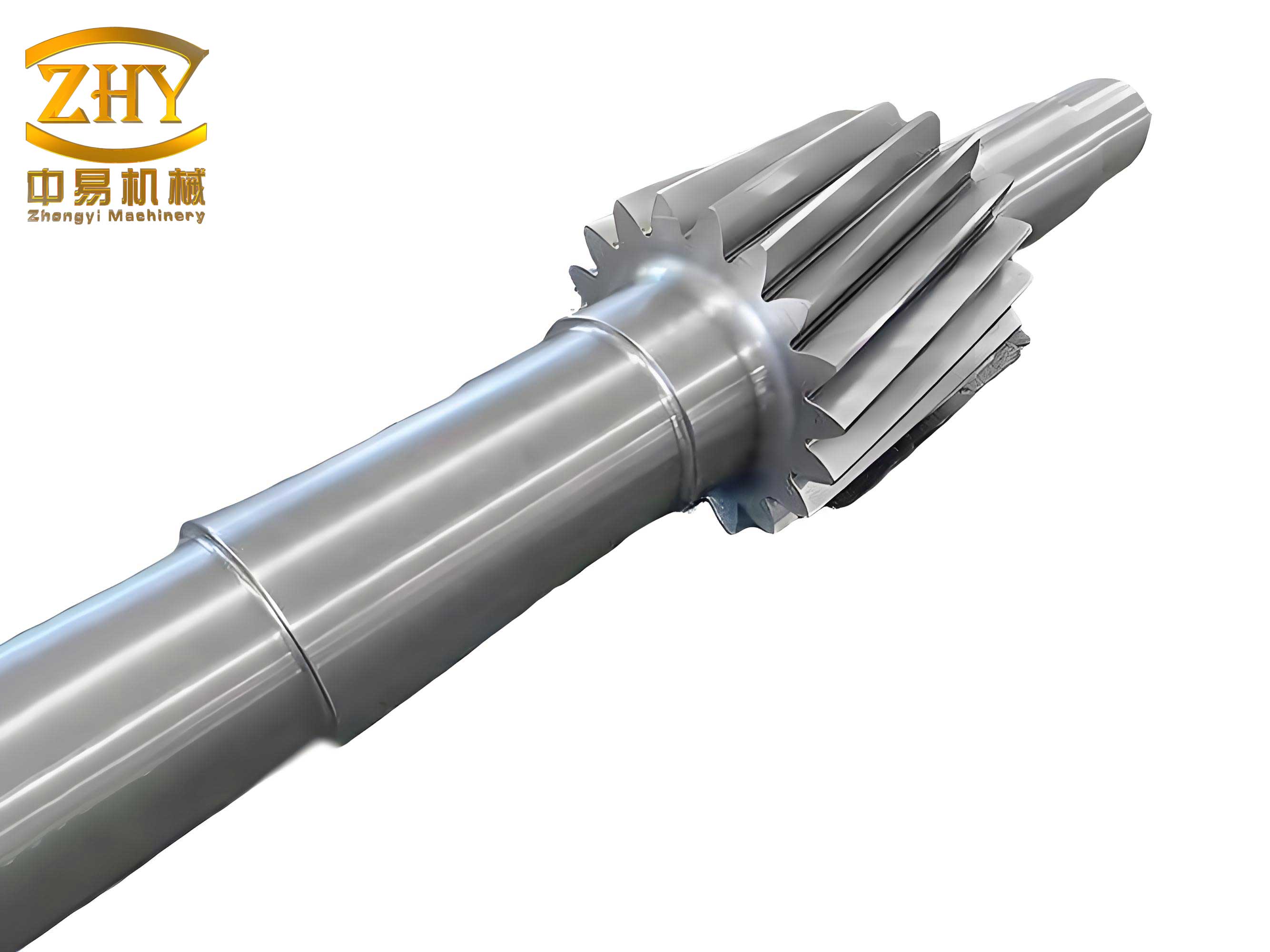
The core material under investigation is alloy structural steel 20CrNi2MoA, commonly used in high-speed gear shafts due to its excellent mechanical properties. The chemical composition of this steel is critical for understanding its behavior during repair. Table 1 summarizes the elemental percentages, which adhere to the JB/ZQ4290-86 standard. This material undergoes carburizing and quenching on the gear teeth, resulting in an effective hardened layer depth of 0.60 to 0.9 mm, surface hardness of HRC 57 to 62, and core hardness of HRC 27 to 33. The wear typically occurs on the spline sections, as illustrated in practice, necessitating a repair process that restores functionality without compromising the integrity of the gear shafts.
| Element | Content (%) | Element | Content (%) | Element | Content (%) |
|---|---|---|---|---|---|
| Carbon (C) | 0.17–0.23 | Silicon (Si) | 0.17–0.37 | Manganese (Mn) | 0.60–0.95 |
| Chromium (Cr) | 0.40–0.70 | Nickel (Ni) | 0.35–0.75 | Molybdenum (Mo) | 0.20–0.30 |
| Sulfur (S) | ≤0.035 | Phosphorus (P) | ≤0.035 | Copper (Cu) | ≤0.030 |
To assess the repair feasibility, a batch of four worn gear shafts was selected, ensuring sufficient sample size for comparative analysis. The repair process involves a systematic workflow: disassembly and cleaning, pre-repair inspection via non-destructive testing, machining of the worn spline area, laser cladding for material addition, re-machining of the spline, dynamic balancing testing, and post-repair inspection. Each step is meticulously designed to maintain the high-speed operational requirements of these gear shafts. For instance, during disassembly, the gear shafts are removed from the gearbox, and bearings are detached using specialized tools. Cleaning is performed in an ultrasonic bath with alkaline solutions for two hours to eliminate contaminants, followed by drying with compressed air. Pre-repair inspection uses magnetic particle testing according to NB/T47013-2015 standards to ensure that only gear shafts with intact helical gears are repaired, as gear damage would render repair economically unviable.
The machining phase involves turning the worn spline to remove residual material and oxide layers, exposing the base metal. This is followed by grinding to increase surface roughness, enhancing adhesion for the subsequent cladding layer. Laser cladding is then applied using a multi-layer approach to build up a thickness of 2.2 mm, with a 0.2 mm allowance for final machining. Given the material properties of the gear shafts, iron-based powders are chosen for their compatibility. A dual-layer cladding strategy is employed: a softer Fe35 iron-based alloy powder is used as the bottom layer to provide toughness, while a harder iron-based powder forms the top layer to enhance wear resistance. The top-layer powder composition includes additions of MoS2 and La2O3 in a 95:5 ratio to improve strength and reduce cracking, as detailed in Table 2.
| Element | Content (%) | Element | Content (%) |
|---|---|---|---|
| Carbon (C) | 0.15 | Nickel (Ni) | 0.8 |
| Chromium (Cr) | 13.5 | Boron (B) | 1.6 |
| Manganese (Mn) | Not present | Iron (Fe) | Balance |
| Silicon (Si) | 1.3 |
The laser cladding parameters are optimized for these gear shafts: a laser power of 3 kW, argon shielding gas at 10–30 L/min, cladding speed of 400–500 mm/min, and powder feed rate of 3.0–8.0 g/min. Preheating is applied to both the shaft (120–130°C) and powder (100–110°C) to minimize thermal stress. The bottom layer is clad in one pass with a thickness of 0.3–0.4 mm, while the top layer involves 2–3 passes, each 0.5–0.6 mm thick, with inter-pass cooling to prevent cracks and distortion. After cladding, the gear shafts are cooled naturally in an insulated container. The spline is then machined to specifications using CAD models, ensuring dimensional accuracy for high-speed operation. Dynamic balancing is performed at 3,000 rpm with a maximum allowable unbalance of 0.273 g·cm, and weight adjustment is done on non-critical surfaces if needed. Post-repair inspection repeats the magnetic particle testing to verify the absence of defects.
Evaluating the repair’s effectiveness involves multiple aspects: hardness testing, gearbox performance testing, and cost analysis. Hardness testing is conducted on a representative sample to assess the impact of laser cladding on the gear shaft material. Measurements are taken at different zones: base material, heat-affected zone (HAZ), bottom cladding layer, and top cladding layer. The results indicate that the base material hardness remains largely unaffected, with the HAZ showing a slight reduction over a narrow width of approximately 0.3 mm. The bottom cladding layer exhibits lower hardness for enhanced toughness, while the top layer demonstrates significantly higher hardness, improving wear resistance. This hardness profile can be modeled using a piecewise function. For instance, the hardness \( H \) as a function of depth \( d \) from the surface can be approximated as:
$$ H(d) = \begin{cases}
H_{\text{top}} & \text{for } 0 \leq d \leq t_{\text{top}} \\
H_{\text{bottom}} & \text{for } t_{\text{top}} < d \leq t_{\text{top}} + t_{\text{bottom}} \\
H_{\text{HAZ}} & \text{for } t_{\text{top}} + t_{\text{bottom}} < d \leq t_{\text{total}} \\
H_{\text{base}} & \text{for } d > t_{\text{total}}
\end{cases} $$
where \( H_{\text{top}} \approx 400 \, \text{HV} \), \( H_{\text{bottom}} \approx 200 \, \text{HV} \), \( H_{\text{HAZ}} \approx 300 \, \text{HV} \), and \( H_{\text{base}} \approx 350 \, \text{HV} \), with thicknesses \( t_{\text{top}} = 0.6 \, \text{mm} \), \( t_{\text{bottom}} = 0.4 \, \text{mm} \), and \( t_{\text{total}} = 2.2 \, \text{mm} \). This demonstrates that laser cladding enhances surface properties without degrading the core material of the gear shafts.
Gearbox performance testing involves installing the repaired gear shafts into operational gearboxes and monitoring their service life under high-speed conditions (up to 28,000 rpm). A comparative study with new gear shafts (four samples each) reveals that repaired gear shafts exhibit a longer average service life, approximately 15% higher, due to the superior hardness of the cladding layer. However, the variance in repaired gear shafts is greater, attributed to factors like lubrication inconsistencies in some test setups. The service life \( L \) can be correlated with surface hardness \( H \) and operational stress \( \sigma \) using an empirical wear model:
$$ L = k \cdot \frac{H^n}{\sigma^m} $$
where \( k \), \( n \), and \( m \) are material constants. For repaired gear shafts, the increased \( H \) leads to extended \( L \), validating the repair efficacy. This performance boost is critical for high-speed applications where gear shafts are subjected to extreme demands.
Cost evaluation is paramount for assessing the economic viability of repairing gear shafts. Table 3 compares the costs and lead times between repaired and new gear shafts. The repair cost includes expenses for inspection, laser cladding, spline machining, and balancing, totaling around $5,000 per shaft, which is about 40% of the new shaft cost of $13,000. The lead time for repair is 12 days, merely 13% of the 90-day procurement period for new gear shafts. Additionally, considering the extended service life, the cost per operational hour for repaired gear shafts is significantly lower, making laser cladding a cost-effective solution.
| Item | Repaired Gear Shafts | New Gear Shafts |
|---|---|---|
| Unit Cost ($) | 5,000 | 13,000 |
| Lead Time (days) | 12 | 90 |
| Service Life (months) | 12 (average) | 10.4 (average) |
The economic benefit can be quantified using a cost-benefit ratio \( R \):
$$ R = \frac{C_{\text{new}} / L_{\text{new}}}{C_{\text{repair}} / L_{\text{repair}}} $$
where \( C \) denotes cost and \( L \) service life. Substituting values, \( R \approx 1.5 \), indicating that repaired gear shafts offer 50% better value per unit time. This analysis underscores the advantages of laser cladding for maintaining gear shafts, especially in high-speed environments where downtime and costs are critical.
Beyond immediate repair, laser cladding technology allows for customization of gear shaft properties. For example, by adjusting powder compositions and cladding parameters, one can tailor the hardness, toughness, and wear resistance to specific operational conditions. This flexibility is vital for aerospace applications where gear shafts must withstand varying loads and temperatures. Moreover, the environmental impact of repairing gear shafts versus manufacturing new ones is substantial. The energy savings and reduced material waste align with global sustainability goals, making laser cladding a green technology for gear shaft maintenance.
In summary, laser cladding repair of high-speed gear shafts proves highly feasible from both technical and economic perspectives. The process minimally affects the base material, enhances surface hardness for improved wear resistance, and extends service life compared to new gear shafts. The cost savings are significant, with repair costs at 40% of new shaft prices and lead times reduced by nearly 90%. These benefits are crucial for military aviation maintenance, where reliability and efficiency are paramount. Future work could explore optimizing cladding parameters for different gear shaft geometries or integrating real-time monitoring during repair to further enhance quality. Ultimately, the adoption of laser cladding for gear shaft repair represents a forward-thinking approach to remanufacturing, ensuring that critical components like gear shafts continue to perform reliably in demanding applications.
The success of this repair methodology hinges on precise control over the cladding process. Factors such as laser power density, scanning speed, and powder feed rate must be optimized to achieve defect-free coatings on gear shafts. Experimental studies show that the clad layer’s microstructure consists of fine dendrites and carbides, contributing to high hardness. The interfacial bond strength between the cladding and base material can be evaluated using shear tests, with results often exceeding 300 MPa, ensuring integrity under operational stresses. For gear shafts, this bond is critical to prevent delamination during high-speed rotation.
Additionally, thermal management during cladding is essential to avoid distortion in gear shafts. Finite element analysis (FEA) can simulate temperature distributions, helping to predefine cooling intervals. A simplified heat transfer model during cladding can be expressed as:
$$ \frac{\partial T}{\partial t} = \alpha \nabla^2 T + \frac{Q}{\rho c_p} $$
where \( T \) is temperature, \( t \) time, \( \alpha \) thermal diffusivity, \( Q \) heat input from the laser, \( \rho \) density, and \( c_p \) specific heat. By solving this for gear shaft geometries, optimal cladding strategies can be derived to minimize thermal effects.
Wear testing of repaired gear shafts involves pin-on-disk experiments to measure friction coefficients and wear rates. Results indicate that the cladding layer reduces wear by up to 30% compared to untreated surfaces, validating its use in spline sections. The wear volume \( V \) can be estimated using Archard’s law:
$$ V = k \cdot \frac{F \cdot s}{H} $$
where \( k \) is a wear coefficient, \( F \) load, \( s \) sliding distance, and \( H \) hardness. For repaired gear shafts, the higher \( H \) leads to lower \( V \), extending component life.
In conclusion, the integration of laser cladding into the maintenance workflow for gear shafts offers a transformative solution. It not only addresses immediate wear issues but also paves the way for advanced material engineering in gear systems. As technology evolves, further innovations in powder development and process automation could make this repair method even more efficient. For now, it stands as a testament to the potential of remanufacturing in sustaining critical infrastructure like high-speed gear shafts, ensuring they meet the rigorous demands of modern aviation and beyond.