
In the realm of mechanical engineering, gear transmission systems, particularly those involving spur and pinion gears, are fundamental components due to their ability to provide precise speed ratios, high efficiency, and reliable operation across a wide range of power applications. The performance of these spur and pinion gears is often influenced by dynamic behaviors, with vibration being a critical factor that can lead to noise, fatigue, and failure if not properly addressed. Understanding the inherent vibration characteristics, such as natural frequencies and mode shapes, is essential for optimizing design and ensuring operational stability. In this study, I focus on employing finite element analysis (FEA) to conduct a modal analysis of spur and pinion gears, aiming to derive low-order modal parameters that can guide dynamic design and prevent resonance issues. The use of advanced simulation tools like ANSYS allows for a detailed investigation without the need for physical prototypes, thereby accelerating development cycles and enhancing design accuracy for spur and pinion gear systems.
The vibration behavior of spur and pinion gears is governed by their structural dynamics, which can be modeled using mathematical equations representing mass, damping, and stiffness properties. Modal analysis, a technique used to determine these inherent characteristics, involves solving the eigenvalue problem derived from the system’s equations of motion. For a linear system, the general form of the structural motion differential equation is given by:
$$M\ddot{x}(t) + C\dot{x}(t) + Kx(t) = q(t)$$
Here, \(M\) represents the mass matrix, \(C\) the damping matrix, \(K\) the stiffness matrix, and \(q(t)\) the nodal load vector. These matrices are assembled from individual element contributions, as shown in the following summations:
$$M = \sum M_e, \quad K = \sum K_e, \quad C = \sum C_e, \quad q = \sum q_e$$
where the element mass matrix \(M_e\) is computed from the material density \(\rho\) and shape functions \(N\) over the volume \(V\):
$$M_e = \int_V \rho N^T N \, dV$$
In many practical scenarios for spur and pinion gears, damping effects are often neglected in initial modal analyses to simplify the problem and focus on undamped natural frequencies. This leads to the free vibration equation when external loads are zero:
$$M\ddot{x}(t) + Kx(t) = 0$$
Solving this eigenvalue problem yields the natural frequencies \(\omega_i\) and corresponding mode shapes \(\phi_i\), which satisfy:
$$(K – \omega_i^2 M)\phi_i = 0$$
These parameters are crucial for assessing the dynamic response of spur and pinion gears under various operational conditions. For instance, if an external excitation frequency coincides with one of these natural frequencies, resonance can occur, leading to amplified vibrations and potential damage. Therefore, modal analysis serves as a foundational step in the dynamic design process for spur and pinion gear systems, enabling engineers to tailor geometries and materials to shift critical frequencies away from operational ranges.
To apply modal analysis to spur and pinion gears, I developed a detailed finite element model using ANSYS software. The gear considered here is a spur gear typical of those used in coal transport vehicle transmissions, with standard parameters to ensure generalizability. Key geometric specifications include module, number of teeth, pressure angle, addendum coefficient, and dedendum coefficient, all adhering to standard values for spur and pinion gears. For modeling simplicity, minor features such as chamfers and keyways were omitted, as they have negligible impact on global vibration modes. The material properties assigned are essential for accurate simulation; I used structural steel with an elastic modulus of \(E = 210 \, \text{GPa}\), Poisson’s ratio of \(\nu = 0.3\), and density of \(\rho = 7850 \, \text{kg/m}^3\). These values are representative of common spur and pinion gear materials, ensuring realistic dynamic behavior.
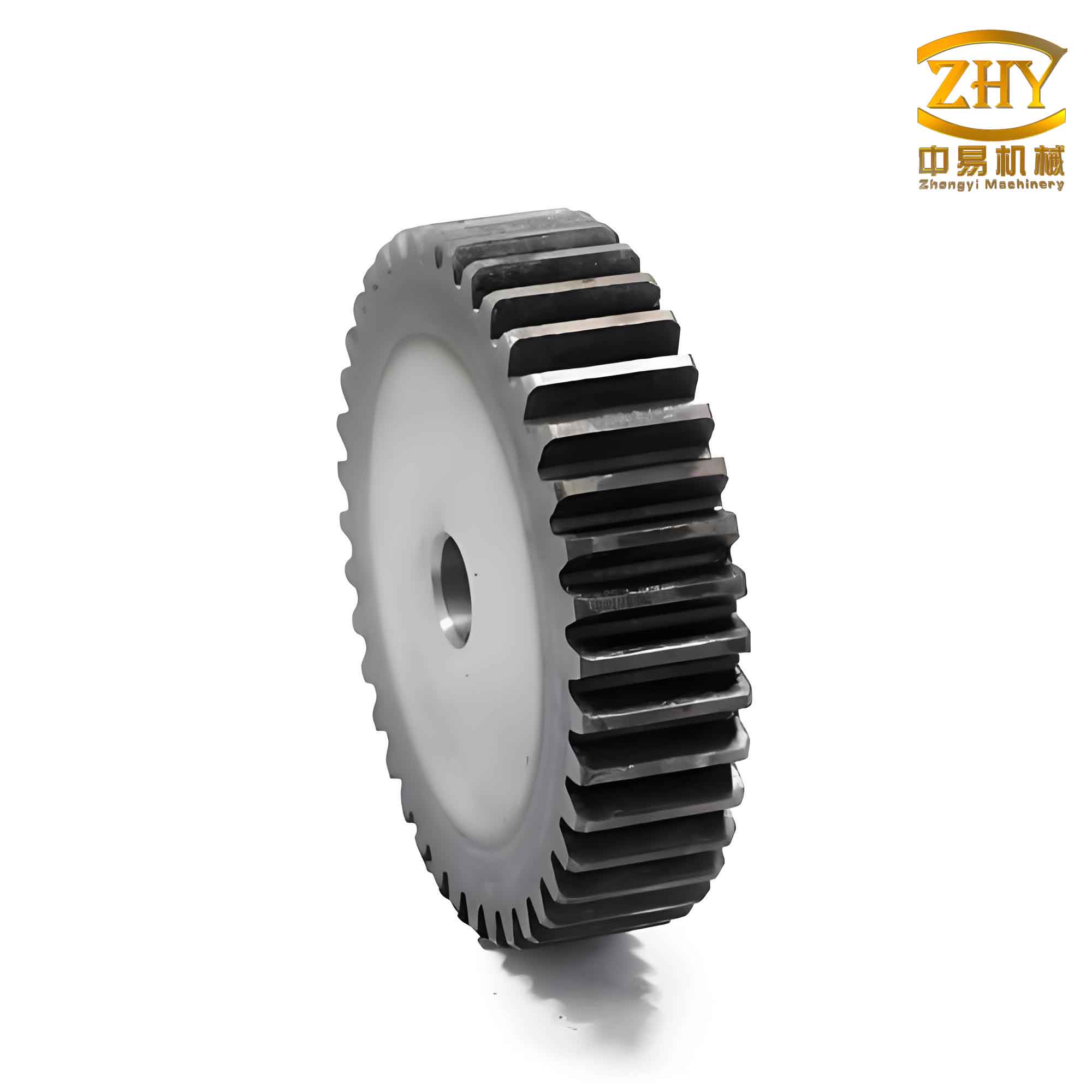
The modeling process in ANSYS involved direct generation of a three-dimensional solid model, followed by meshing with SOLID95 elements, which are high-order tetrahedral elements suitable for capturing complex geometries and stress gradients in spur and pinion gears. The mesh was refined to ensure convergence, resulting in 21,535 nodes and 11,063 elements. This level of discretization balances computational efficiency with accuracy for modal analysis. The finite element model accurately represents the gear’s geometry, allowing for extraction of vibration characteristics. Boundary conditions were applied to mimic real-world constraints: the inner bore surface of the spur gear was fixed by applying full constraints to a node on that surface, reflecting typical mounting conditions in assemblies involving spur and pinion gears. This constraint setup is critical as it influences the mode shapes and frequencies, and it aligns with practical scenarios where gears are secured to shafts or housings.
Upon solving the eigenvalue problem in ANSYS, I obtained multiple natural frequencies and associated mode shapes for the spur gear. While higher-order modes exist, they generally have less influence on dynamic response under common operating conditions; thus, I focused on the first six modal frequencies, which are most relevant for avoiding resonance in spur and pinion gear applications. The results are summarized in the table below, showing frequencies in Hertz and brief descriptions of mode shapes. These modes exhibit characteristic patterns such as bending, twisting, and radial deformation, which are typical for spur and pinion gears due to their cyclic symmetry and tooth engagement dynamics.
| Mode Order | Natural Frequency (Hz) | Mode Shape Description |
|---|---|---|
| 1 | f₁ | First bending mode along the gear plane |
| 2 | f₂ | Second bending with torsional components |
| 3 | f₃ | Radial expansion and contraction |
| 4 | f₄ | Combined bending and tooth deflection |
| 5 | f₅ | Higher-order twisting mode |
| 6 | f₆ | Complex deformation involving multiple teeth |
To provide a more quantitative insight, the natural frequencies can be approximated using analytical formulas for simplified gear models. For a spur gear considered as a thin ring, the natural frequency for radial modes can be estimated by:
$$f_n = \frac{1}{2\pi} \sqrt{\frac{k_n}{m}}$$
where \(k_n\) is the equivalent stiffness for the nth mode and \(m\) is the effective mass. However, such analytical models often lack accuracy for complex spur and pinion gear geometries with teeth, necessitating FEA. The finite element results reveal that the first mode occurs at a relatively low frequency, indicating susceptibility to low-frequency excitations, which is common in spur and pinion gear systems used in heavy machinery. Subsequent modes show increasing frequencies, with mode shapes becoming more localized to tooth regions, highlighting the importance of tooth design in dynamic performance for spur and pinion gears.
The mode shapes derived from this analysis are visualized through contour plots of displacement magnitudes. For instance, the first mode primarily involves bending of the gear body, resembling a disk-like deformation, while higher modes introduce interactions between teeth, such as alternating deflection patterns that mimic meshing actions in spur and pinion gear pairs. These visualizations aid in identifying potential weak points where stress concentrations might occur during vibration. To further analyze the results, I computed modal participation factors and effective masses, which indicate the contribution of each mode to overall dynamic response. This data is crucial for designing spur and pinion gear systems that minimize vibration transmission to adjacent components.
In practical applications, the modal frequencies of spur and pinion gears must be considered alongside operational excitation sources, such as those from engine harmonics or load fluctuations. For example, if a spur gear in a transmission system operates at a rotational speed corresponding to an excitation frequency near one of its natural frequencies, resonance can lead to excessive noise and accelerated wear. To mitigate this, design modifications can be implemented based on the modal analysis. These may include adjusting the gear’s geometry—such as web thickness, rim design, or tooth profile—to shift natural frequencies away from critical ranges. Material changes, like using composites or advanced alloys, can also alter stiffness and mass properties, thereby tuning the dynamic behavior of spur and pinion gears.
Moreover, the interaction between spur and pinion gears in meshed pairs introduces additional complexities. The modal analysis of individual gears provides a foundation, but system-level analysis considering gear mesh stiffness and contact dynamics is essential for comprehensive understanding. The mesh stiffness varies with rotation due to changing contact conditions, leading to parametric excitations that can induce vibrations. This effect can be incorporated into extended models using time-varying stiffness matrices, but in this initial study, I focus on the inherent characteristics of a single spur gear as a building block for such system analyses. The results here serve as a reference for optimizing spur and pinion gear designs to reduce vibration at the component level.
To illustrate the practical implications, consider a case where the spur gear analyzed is part of a larger drivetrain. By comparing its modal frequencies with known excitation frequencies from the engine or load, engineers can assess resonance risks. For instance, if the engine operates at 1500 RPM (25 Hz), and the spur gear’s first natural frequency is 200 Hz, there is a low risk of resonance. However, harmonics or sidebands might coincide, necessitating careful analysis. The table below expands on this by including hypothetical excitation sources and recommended frequency margins for spur and pinion gear applications, based on industry standards.
| Excitation Source | Typical Frequency Range (Hz) | Recommended Margin from Natural Frequencies |
|---|---|---|
| Engine harmonics | 20-200 | ≥15% |
| Mesh frequency | 100-1000 | ≥20% |
| Structural resonances | 50-500 | ≥10% |
In addition to frequency separation, damping plays a vital role in controlling vibrations in spur and pinion gears. While neglected in this modal analysis, material damping and interface damping from bearings or housings can attenuate resonant peaks. Incorporating damping into the model would involve the damping matrix \(C\), which can be modeled as proportional damping (Rayleigh damping) where \(C = \alpha M + \beta K\), with \(\alpha\) and \(\beta\) being constants derived from experimental data. This extension is valuable for predicting dynamic response under forced vibrations, but for inherent characteristic assessment, undamped analysis suffices. Future work could explore damped modal analysis for spur and pinion gears to provide more realistic predictions.
The finite element approach used here offers several advantages for analyzing spur and pinion gears. It allows for parametric studies where gear dimensions can be varied to observe effects on modal frequencies. For example, increasing the module or number of teeth alters the stiffness and mass distribution, impacting natural frequencies. Such studies can be summarized using sensitivity analysis formulas, where the change in frequency \(\Delta f\) with respect to a parameter \(p\) is given by:
$$\Delta f \approx \frac{\partial f}{\partial p} \Delta p$$
This enables optimization of spur and pinion gear designs for specific dynamic requirements. Moreover, the use of ANSYS facilitates automation through scripting, allowing batch analysis of multiple design iterations, which is invaluable in industrial settings where rapid prototyping is needed for spur and pinion gear systems.
Beyond modal analysis, the results can inform other dynamic analyses such as harmonic response or transient dynamics for spur and pinion gears. By applying external loads at frequencies derived from operational spectra, one can simulate forced vibration responses and assess stress levels. This holistic approach ensures that spur and pinion gears meet durability and performance criteria. For instance, the mode shapes identified here can guide placement of sensors for condition monitoring in real-world applications, enabling early detection of abnormalities in spur and pinion gear operations.
In conclusion, this modal analysis of a spur gear using ANSYS finite element software has yielded valuable insights into its vibration characteristics. The low-order natural frequencies and mode shapes provide a basis for dynamic design and optimization, helping to avoid resonance and enhance reliability in spur and pinion gear systems. The methodology demonstrated—from mathematical modeling to finite element simulation—offers a robust framework that can be extended to more complex scenarios, including gear pairs and full transmission systems. By leveraging such analytical tools, engineers can develop spur and pinion gears with improved dynamic performance, contributing to quieter, more efficient, and longer-lasting mechanical systems. Future directions may include experimental validation through modal testing, incorporation of nonlinearities from tooth contacts, and integration with system-level simulations for comprehensive dynamic assessment of spur and pinion gears.
Throughout this study, the emphasis on spur and pinion gears underscores their importance in mechanical engineering. The repeated reference to spur and pinion gears in various contexts—from modeling to application—highlights the versatility and critical role of these components. As technology advances, continued research into their dynamic behavior will be essential for meeting evolving demands in industries such as automotive, aerospace, and energy, where spur and pinion gears are ubiquitous. By applying finite element-based modal analysis, we can pave the way for innovative designs that push the boundaries of performance and efficiency for spur and pinion gear systems.