
In the realm of precision mechanical transmissions, the harmonic drive gear stands out due to its exceptional performance characteristics, including high accuracy, minimal backlash, large transmission ratios, compact size, and low noise. As a key component, the flexspline—a thin-walled cylindrical shell with a toothed rim—is often the critical element whose failure, typically through fatigue fracture, dictates the lifespan of the harmonic drive gear system. Accurate three-dimensional modeling of the flexspline is therefore paramount, as it directly influences subsequent stress analysis, deformation studies, and fatigue life predictions via finite element methods. In this article, I will detail my comprehensive approach to constructing a precise parametric model of a cylindrical flexspline for a harmonic drive gear using Pro/ENGINEER (Pro/E). This process emphasizes parametric design for flexibility, incorporates essential gear geometry formulas, and prepares the model for advanced engineering analysis. The goal is to provide a reliable digital prototype that can withstand rigorous mechanical evaluation.
The harmonic drive gear operates on the principle of elastic deformation. It consists of three primary components: the circular spline (a rigid internal gear), the flexspline (a flexible external gear), and the wave generator (an elliptical bearing). When the wave generator rotates, it deforms the flexspline, causing its teeth to engage with those of the circular spline at two diametrically opposite regions. This controlled meshing enables high reduction ratios in a single stage. The flexspline, being the component that undergoes cyclic elastic deformation, is subjected to complex stress states, making its design and analysis crucial. The cylindrical flexspline, commonly used for its simplicity and effectiveness, features a toothed section at one end and a smooth cylindrical barrel, often connected to an output flange. Its geometry must balance flexibility for deformation and strength to withstand operational loads.
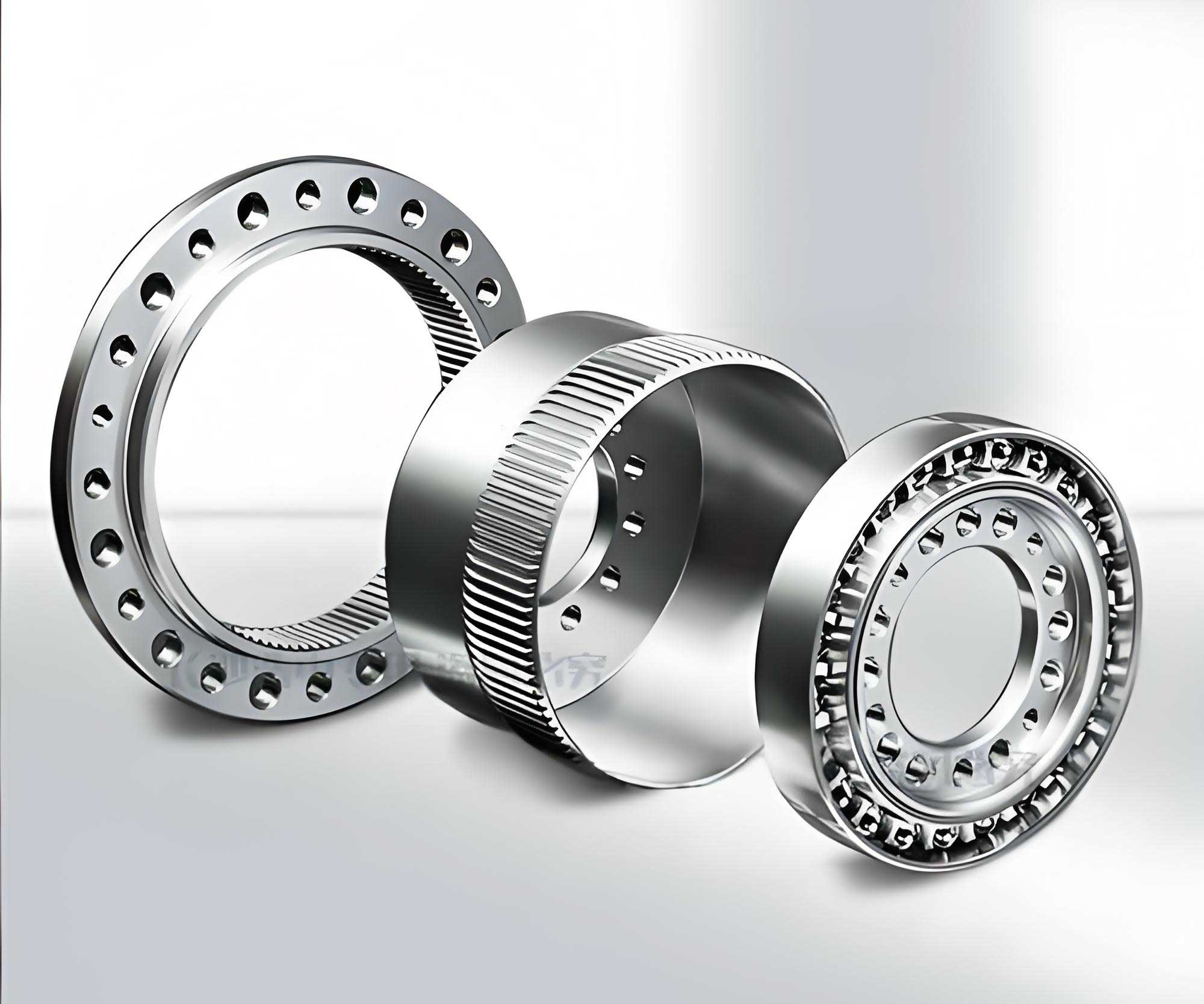
To begin the modeling process, I first define the fundamental geometric parameters of the flexspline. A parametric approach in Pro/E allows for easy modification and optimization of the design. The following table summarizes the key parameters for the cylindrical flexspline model, which are based on standard gear design principles tailored for harmonic drive gear applications.
| Parameter Name | Symbol | Value | Unit |
|---|---|---|---|
| Module | m | 0.5 | mm |
| Number of Teeth | z | 427 | – |
| Pressure Angle | α | 20 | ° |
| Addendum Coefficient | ha* | 1 | – |
| Dedendum Clearance Coefficient | c* | 0.25 | – |
| Profile Shift Coefficient | x | 0 | – |
| Tooth Width (Face Width) | b | 40 | mm |
| Cylinder Body Length | L | 180 | mm |
| Cylinder Wall Thickness (smooth section) | δ1 | 3.6 | mm |
| Tooth Rim Wall Thickness | δ | 6 | mm |
From these basic parameters, I derive the essential gear diameters. The calculations follow standard involute spur gear geometry, which is fundamental for the tooth profile of the harmonic drive gear flexspline. The formulas are implemented directly within Pro/E’s parameter and relation tools.
$$ \text{Pitch Diameter: } d = m \cdot z = 0.5 \times 427 = 213.5 \text{ mm} $$
$$ \text{Base Circle Diameter: } d_b = d \cdot \cos(\alpha) = 213.5 \times \cos(20^\circ) \approx 200.38 \text{ mm} $$
$$ \text{Addendum Diameter (Tip Diameter): } d_a = d + 2 \cdot m \cdot h_a^* = 213.5 + 2 \times 0.5 \times 1 = 214.5 \text{ mm} $$
$$ \text{Dedendum Diameter (Root Diameter): } d_f = d – 2 \cdot m \cdot (h_a^* + c^*) = 213.5 – 2 \times 0.5 \times (1 + 0.25) = 212.0 \text{ mm} $$
With the parameters defined, I initiate the modeling in Pro/E. The process starts by creating the smooth cylindrical body of the flexspline. I use the Blend feature (specifically, Insert > Blend > Protrusion) to generate a cylindrical solid. I select the FRONT plane as the sketching plane and create a circular sketch. The depth of the extrusion is set to the body length, L = 180 mm. The initial diameter is chosen to be slightly larger than the root diameter to allow for subsequent tooth generation. This results in a basic cylindrical shape representing the main barrel of the harmonic drive gear flexspline.
The next, and most intricate, step is generating the involute tooth profile on one end of this cylinder. The accuracy of the tooth geometry is vital for simulating proper meshing behavior in the harmonic drive gear. Pro/E does not have a built-in equation-driven curve for involutes in the sketcher, but it allows the creation of such curves via Equation from the Curve tool. I begin by sketching a circle on the cylindrical surface corresponding to the base circle diameter ($d_b$). This circle serves as the foundation for the involute development.
To create the first involute curve, I access Insert > Model Datum > Curve > From Equation. I select the default coordinate system (PRT_CSYS_DEF) and define the parametric equations in the relation editor. For an involute of a circle, the Cartesian coordinates (x, y, z) are expressed in terms of a parameter t (which varies from 0 to 1) and the base circle radius $r_b = d_b / 2$.
The general form of the involute equations is:
$$ x = r_b (\cos(\theta) + \theta \cdot \sin(\theta)) $$
$$ y = r_b (\sin(\theta) – \theta \cdot \cos(\theta)) $$
$$ z = 0 $$
where $\theta$ is the roll angle in radians. For Pro/E, I define $\theta$ as a function of the parameter t. To ensure the curve spans a sufficient arc for the tooth flank, I set $\theta = 60 \cdot t \cdot (\pi/180)$, which converts 60 degrees of roll angle into radians as t goes from 0 to 1. Therefore, the specific equations entered into Pro/E are:
“`
theta = 60 * t * (pi/180)
rb = 200.38 / 2
x = rb * cos(theta) + rb * theta * sin(theta)
y = rb * sin(theta) – rb * theta * cos(theta)
z = 0
“`
This generates the first involute curve originating from the base circle. Since a tooth is symmetric about its centerline, I need a second involute curve for the opposite flank. I create this by mirroring the first curve. First, I establish a datum plane passing through the cylinder’s central axis and positioned at an angular offset corresponding to half the tooth thickness angle. The angular pitch for the gear is $360^\circ / z$. The tooth thickness at the pitch circle is theoretically $\pi m / 2$ for a standard tooth. However, for precise control, I often create a reference axis or plane. In practice, I mirror the first involute curve about a plane that passes through the cylinder axis and is offset by a specific angle. The exact angular offset for the mirror plane is calculated based on the desired tooth space. For simplicity in this model, I mirror the curve about a plane defined through the axis and a point, ensuring symmetry.
After mirroring, I have two involute curves defining the flanks of a single tooth space. To complete the 2D profile for extrusion, I need to connect these curves with the root and tip circles. I use the Sketch tool on the end face of the cylinder. Within the sketch, I project the existing involute curves and the cylindrical surface edges. Then, I draw the root circle with diameter $d_f$ and the tip circle with diameter $d_a$. Using trimming and line drawing tools, I create a closed loop comprising segments of the two involute curves, an arc of the root circle, and an arc of the tip circle. This closed profile defines the cross-section of one tooth gap.
With the sketch complete, I use the Extrude feature to remove material, thereby cutting out the first tooth gap from the cylindrical blank. The extrusion depth is set equal to the tooth width, b = 40 mm. This creates a precise, negative space for one tooth in the harmonic drive gear flexspline.
The power of parametric modeling shines in the next step: patterning the single tooth gap to create all teeth around the circumference. I select the extruded cut feature and apply the Pattern tool. I choose an Axis Pattern, select the central axis of the cylinder as the reference, specify the total number of instances as the tooth count z = 427, and set the angular increment to $360^\circ / 427$. Pro/E then replicates the tooth gap feature around the entire perimeter, generating the complete internal spline of the flexspline. This automated patterning ensures perfect circumferential distribution and allows for instant updates if the tooth count parameter changes.
Following the tooth generation, I refine the model to represent the actual flexspline geometry more accurately. The harmonic drive gear flexspline typically has a thicker wall in the toothed region compared to the smooth cylindrical barrel to enhance strength where meshing occurs. To achieve this, I add another extrusion feature. I sketch a concentric circle on the open end of the toothed section with a diameter corresponding to the inner diameter of the smooth barrel. I then extrude this sketch back along the cylinder’s length for a distance, effectively creating the thinner-walled barrel section. The transition between the thick tooth rim and the thin barrel is often filleted to reduce stress concentration, but for finite element analysis simplification, sharp corners are sometimes retained initially. The key dimensions—barrel length L, barrel wall thickness δ1, and tooth rim thickness δ—are controlled by parameters for easy modification.
To solidify the model’s readiness for analysis, I define additional parameters related to material properties and operational conditions. While Pro/E is primarily for geometry, these parameters can be linked to downstream analysis tools. I create a new parameter set within the model.
| Parameter Group | Parameter Name | Symbol | Typical Value | Unit |
|---|---|---|---|---|
| Material Properties | Young’s Modulus | E | 2.1e5 | MPa |
| Poisson’s Ratio | ν | 0.3 | – | |
| Yield Strength | σ_y | ≥ 800 | MPa | |
| Density | ρ | 7.85e-9 | tonne/mm³ | |
| Operational Parameters | Wave Generator Rotation | θ_w | Variable | ° |
| Input Torque | T_in | Design-dependent | N·mm | |
| Meshing Force per Tooth | F_m | Calculated | N |
The meshing force in a harmonic drive gear can be estimated from the input torque and the gear geometry. Assuming torque is transmitted primarily at the major axis of the wave generator engagement, the tangential force $F_t$ at the pitch circle of the flexspline is related to the transmitted torque $T$ and the pitch radius $r = d/2$:
$$ F_t = \frac{T}{r} $$
This force is distributed over the teeth in contact. For a simplified static analysis, one might assume the load is shared by a certain number of teeth simultaneously in mesh, often estimated as a percentage of the total teeth (e.g., 20-30% for harmonic drives). The force per tooth $F_m$ is then:
$$ F_m = \frac{F_t}{n_{teeth, in, contact}} $$
These formulas, while simplified, provide initial loading conditions for finite element analysis.
With the geometric model complete, I proceed to validate its dimensions using Pro/E’s measurement tools. I verify critical distances such as the root diameter, tip diameter, and wall thicknesses against the calculated values. Ensuring geometric accuracy is a critical step before exporting the model for finite element analysis (FEA) in software like ANSYS. The model can be exported in neutral formats such as STEP (Standard for the Exchange of Product model data) or IGES, which preserve the solid geometry without parametric history. However, for a more integrated workflow, one can use direct interfaces if available.
In preparing for FEA, I often simplify the model further to reduce computational cost without sacrificing result accuracy. Common simplifications for harmonic drive gear flexspline analysis include:
- Suppressing small fillets and chamfers at non-critical stress regions.
- Using a sector model with appropriate cyclic symmetry boundary conditions instead of the full 427-tooth model, given the high tooth count and expected periodic deformation.
- Simplifying the tooth profile to a parabolic or trapezoidal approximation if a full involute is not critical for stress concentration studies at the root.
However, for the purpose of this modeling exercise, I maintain the full involute profile to preserve fidelity. The parametric nature of the Pro/E model allows me to quickly regenerate a simplified version if needed by adjusting feature suppression or creating a new configuration.
The final cylindrical flexspline model for the harmonic drive gear is a complex assembly of features: a thin-walled cylinder, a thickened toothed rim with precisely spaced involute teeth, and potentially a mounting flange (not detailed here for brevity). The entire model is driven by a set of primary parameters (m, z, α, etc.), making it highly adaptable for different harmonic drive gear specifications. This adaptability is crucial for design optimization studies, where one might vary the wall thickness, tooth count, or pressure angle to achieve optimal stress distribution and weight.
In conclusion, the process of modeling a cylindrical flexspline for a harmonic drive gear in Pro/ENGINEER involves a systematic blend of parametric design, precise application of gear theory, and strategic use of modeling features like equations, patterns, and extrusions. The resulting digital model serves as a robust foundation for subsequent finite element analysis to predict stress, strain, and fatigue life under the unique deformation conditions imposed by the wave generator. This integrated approach from design to analysis is essential for developing reliable and efficient harmonic drive gear systems. The repeated focus on the harmonic drive gear throughout this process underscores its centrality in advanced motion control applications, from robotics to aerospace. By mastering such parametric modeling techniques, engineers can significantly accelerate the development cycle and enhance the performance of these sophisticated mechanical components.
To further elaborate on the harmonic drive gear flexspline modeling, I can discuss the mathematical foundation of the involute curve in more depth. The involute function, often denoted as inv(α), is defined as:
$$ \text{inv}(\alpha) = \tan(\alpha) – \alpha $$
where α is the pressure angle in radians. This function is key in calculating tooth thickness at any radius. For a gear with no profile shift, the tooth thickness $s$ on the pitch circle is:
$$ s = \frac{\pi m}{2} $$
The tooth thickness at an arbitrary circle of radius $r_y$ can be calculated using the involute function:
$$ s_y = r_y \left( \frac{s}{r} + 2 \cdot \text{inv}(\alpha) – 2 \cdot \text{inv}(\alpha_y) \right) $$
where $r$ is the pitch radius, α is the standard pressure angle, and $\alpha_y$ is the pressure angle at the circle of radius $r_y$, given by $\alpha_y = \arccos(r_b / r_y)$. These relations are invaluable for verifying the tooth profile geometry in the model or for creating custom tooth forms if a standard involute is not used.
Another important aspect is the deformation kinematics of the harmonic drive gear. When the wave generator deforms the flexspline, its neutral surface adopts an approximately elliptical shape. The major axis of this ellipse increases relative to the minor axis. The radial deformation $w$ as a function of angular position $\phi$ can be approximated by:
$$ w(\phi) = w_0 \cdot \cos(2\phi) $$
where $w_0$ is the maximum radial deformation at the major axis (typically a small fraction of the module, e.g., $w_0 \approx m$). This deformation pattern is what causes the teeth to engage and disengage. In finite element analysis, this deformation can be applied as a displacement boundary condition to simulate the action of the wave generator, allowing for stress analysis of the flexspline under operational conditions.
Finally, I present a consolidated table of all major formulas used throughout the harmonic drive gear flexspline modeling and analysis process. This serves as a quick reference for engineers undertaking similar projects.
| Aspect | Formula | Description |
|---|---|---|
| Basic Gear Geometry | $d = m \cdot z$ | Pitch diameter |
| $d_b = d \cdot \cos(\alpha)$ | Base circle diameter | |
| $d_a = d + 2m h_a^*$ | Addendum (tip) diameter | |
| $d_f = d – 2m (h_a^* + c^*)$ | Dedendum (root) diameter | |
| Involute Curve (Parametric) | $x = r_b (\cos\theta + \theta \sin\theta)$ $y = r_b (\sin\theta – \theta \cos\theta)$ |
Cartesian coordinates, $\theta$ in radians |
| Tooth Thickness | $s_y = r_y \left( \frac{s}{r} + 2 \cdot \text{inv}(\alpha) – 2 \cdot \text{inv}(\alpha_y) \right)$ $\text{inv}(\alpha) = \tan\alpha – \alpha$ |
Thickness at radius $r_y$ |
| Deformation Kinematics | $w(\phi) = w_0 \cos(2\phi)$ | Radial deformation of flexspline |
| Load Estimation | $F_t = \frac{T}{r}$ $F_m = \frac{F_t}{n_c}$ |
Tangential force; force per tooth |
This comprehensive modeling journey underscores the intricate relationship between geometric design, mathematical principles, and engineering analysis in the development of high-performance harmonic drive gear components. The parametric model created in Pro/E is not just a static representation but a dynamic tool that facilitates exploration, optimization, and validation, ultimately contributing to more reliable and efficient harmonic drive gear systems.