
In the field of mechanical transmission systems, hypoid bevel gears play a critical role due to their ability to transmit motion between non-intersecting shafts with high efficiency and compact design. Among various types, the extension epicycloid tooth form of hypoid bevel gears has garnered attention for its superior meshing performance and manufacturing advantages, such as higher production efficiency and suitability for dry cutting. However, the dynamic contact behavior under different operating conditions remains a complex nonlinear problem that significantly impacts gear life, noise, and reliability. In this study, I aim to explore the contact characteristics of extension epicycloid hypoid bevel gears through advanced finite element analysis (FEA), focusing on variations in contact area and contact force across multiple vehicle operational scenarios. By leveraging detailed three-dimensional geometric modeling and nonlinear dynamic simulation techniques, I seek to provide insights into optimal gear design and operational guidelines, thereby enhancing the durability and performance of hypoid bevel gear systems in practical applications like automotive rear axles.
The contact mechanics of hypoid bevel gears involve three primary nonlinearities: material nonlinearity from large deformations, geometric nonlinearity from shape changes, and contact surface nonlinearity from intermittent interactions. To accurately model this, I adopt a dynamic contact formulation based on the principle of virtual work and Coulomb friction. Consider two bodies, A (the contactor, often the more flexible gear) and B (the target, often the stiffer gear), with their respective configurations \( V_A \) and \( V_B \). The normal contact condition enforces a non-penetration constraint, meaning that during motion, no point from body A can penetrate body B. For a point P on the surface of body A at time t, denoted as \( ^tS_A \), and a corresponding point Q on body B’s surface \( ^tS_B \), the gap function is defined as:
$$ ^tg_N = g(^t\mathbf{x}_A^P, t) = (^t\mathbf{x}_A^P – ^t\mathbf{x}_B^Q) \cdot ^t\mathbf{n}_B^Q \geq 0 $$
Here, \( ^t\mathbf{x}_A^P \) and \( ^t\mathbf{x}_B^Q \) are the position vectors of points P and Q, respectively, and \( ^t\mathbf{n}_B^Q \) is the outward normal vector at Q. This ensures that the distance \( ^tg_N \) remains non-negative, preventing overlap. For tangential contact, I use the Coulomb friction model, which relates the frictional force \( ^t\mathbf{F}_A^P \) to the normal contact force \( ^tF_A^N \) through a friction coefficient \( \mu \). The condition is expressed as:
$$ ^tF_A^P = \sqrt{(^tF_{A1})^2 + (^tF_{A2})^2} \leq \mu \, ^tF_A^N $$
where \( ^tF_{A1} \) and \( ^tF_{A2} \) are the tangential contact force components. The contact problem is solved incrementally using a finite element approach. The virtual work principle for the equilibrium configuration at time \( t + \Delta t \) is given by:
$$ \sum_{r=A,B} \left[ \int_{^{t+\Delta t}V} ^{t+\Delta t}\tau_{ij}^r \, \delta^{t+\Delta t} e_{ij}^r \, dV – ^{t+\Delta t}W_L^r – ^{t+\Delta t}W_I^r – ^{t+\Delta t}W_C^r \right] = 0 $$
In this equation, \( ^{t+\Delta t}\tau_{ij}^r \) represents the Cauchy stress tensor, \( \delta^{t+\Delta t} e_{ij}^r \) is the variation of the infinitesimal strain tensor, \( ^{t+\Delta t}W_L^r \) is the virtual work of external loads, \( ^{t+\Delta t}W_I^r \) accounts for inertial forces, and \( ^{t+\Delta t}W_C^r \) denotes the virtual work due to contact forces. This formulation allows for the tracking of contact evolution over time, incorporating both normal and frictional effects in hypoid bevel gear simulations.
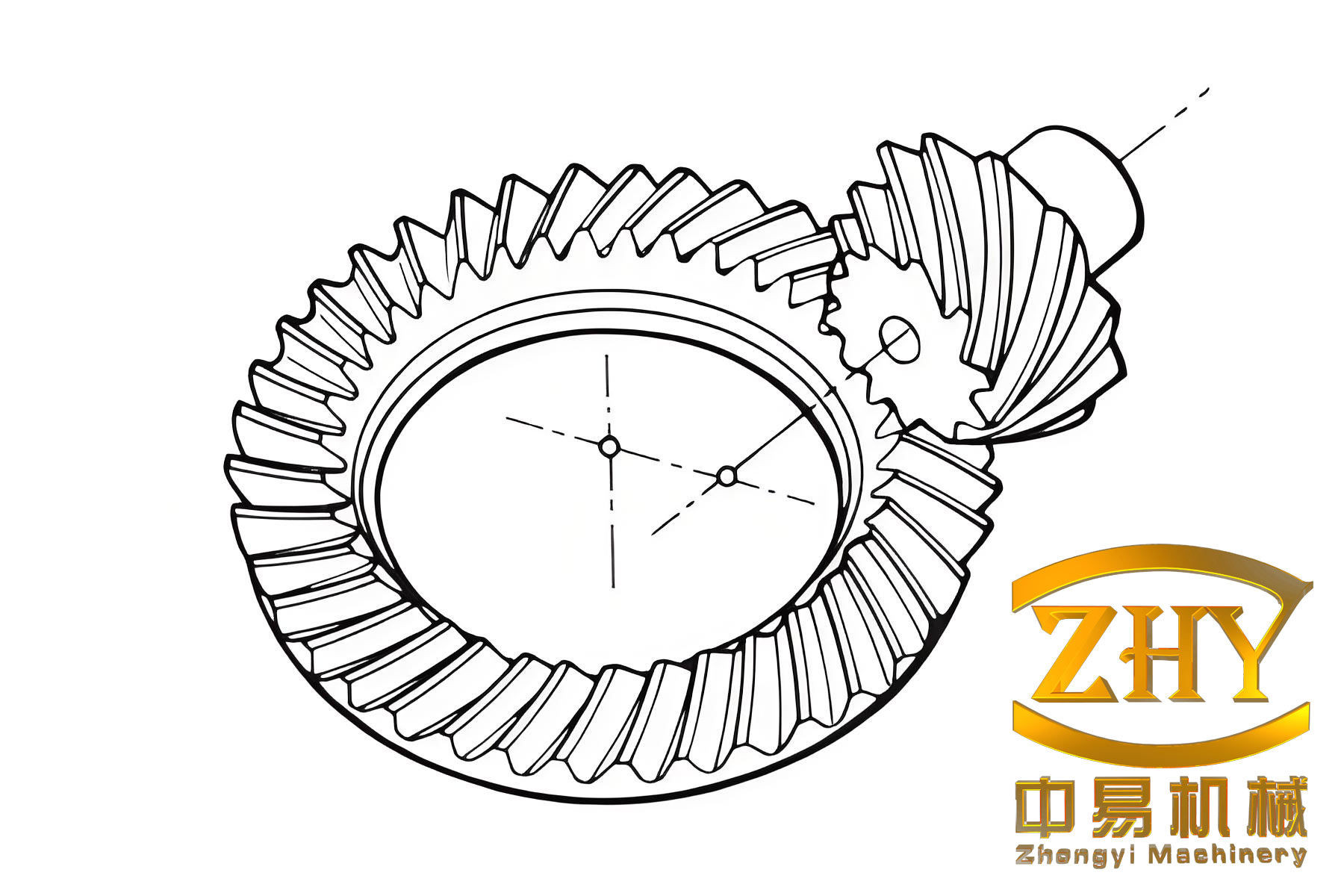
To build an accurate finite element model, I first developed a three-dimensional geometric representation of the extension epicycloid hypoid bevel gear pair using parametric design software. The gear geometry is derived from machining parameters based on the face-hobbing process, which generates the unique tooth profile. The basic parameters of the gear set are summarized in Table 1, which includes key dimensions such as shaft angle, offset distance, normal module, number of teeth, and spiral angles. These parameters are essential for defining the mesh and ensuring realistic contact behavior in the hypoid bevel gear system.
| Parameter | Pinion | Gear |
|---|---|---|
| Shaft angle Σ (°) | 90 | |
| Offset distance E (mm) | 30 | |
| Normal module at reference point m_n (mm) | 3.15216 | 3.15216 |
| Number of teeth z_i | 11 | 47 |
| Reference pitch radius r_m (mm) | 26.97 | 86.12 |
| Spiral angle at reference point β_m (°) | 50 (Left-hand) | 30.667 (Right-hand) |
| Pitch cone angle δ_i (°) | 20.250 | 68.633 |
| Machine setting angle δ_Mi (°) | 0.20 | 68.64 |
| Horizontal cutter position H_2 (mm) | -71.9203 | – |
| Vertical cutter position V_2 (mm) | -73.1142 | – |
| Vertical workpiece setting E_m (mm) | 30.1616 | – |
| Bed setting X_b (mm) | 10.5802 | – |
| Horizontal workpiece setting X_p (mm) | -0.1747 | 4.6721 |
The geometric model was then imported into a meshing tool to generate a finite element grid. Given the complexity of hypoid bevel gear teeth, I employed a refined mesh on the tooth surfaces to capture contact stresses accurately, while coarser elements were used in non-critical regions like the gear body to reduce computational cost. A single tooth model was meshed and then replicated through rotational operations to form the full gear assembly, ensuring proper alignment and tooth spacing. The final mesh consists of hexahedral and tetrahedral elements, with approximately 500,000 nodes and 1.2 million elements for the entire gear pair, balancing detail and simulation efficiency. For dynamic contact analysis, I selected a subset of 6-7 teeth from each gear to focus on the active meshing zone, as shown in the assembly model. This approach reduces hardware resource demands while maintaining accuracy in contact predictions for the hypoid bevel gear system.
In the finite element software, I defined the contact interactions between the pinion and gear surfaces. The contact algorithm utilizes an explicit solver with a face-to-face contact method, employing a penalty function to enforce contact constraints. The slip criterion is set to finite sliding, allowing for relative motion between surfaces, and the contact属性 is defined as “hard contact” with a friction coefficient of 0.1, typical for lubricated steel gears. The master surface is assigned to the pinion (the smaller, more flexible component), and the slave surface to the gear, ensuring stable contact detection. To apply boundary conditions, I created reference points at the apex of each gear and coupled them to the inner bore and side faces using kinematic coupling constraints. This allows loads and motions to be applied directly to these points, simplifying the setup. The pinion is constrained to rotate about the z-axis, while the gear rotates about the x-axis, reflecting the non-intersecting shaft arrangement of hypoid bevel gears.
To simulate real-world operating conditions, I considered four distinct scenarios relevant to vehicle dynamics: forward driving (ahead), reverse driving (astern), neutral coasting forward (gap ahead), and neutral coasting backward (gap back). Each scenario involves different driving surfaces and torque applications, as detailed in Table 2. For instance, in forward driving, the pinion’s concave side drives the gear’s convex side, which is the primary working condition for hypoid bevel gears in automotive applications. To avoid artificial impact shocks during loading, I applied smooth amplitude curves for both torque and rotational speed, ramping up from zero to maximum values over 0.001 seconds before stabilizing. This ensures realistic transient behavior in the hypoid bevel gear contact simulations.
| Case No. | Operating Condition | Driver | Driven | Driver Surface | Driven Surface | Torque (N·m) | Speed (rpm) |
|---|---|---|---|---|---|---|---|
| 1 | Forward driving (Ahead) | Pinion | Gear | Pinion concave | Gear convex | 1025 (on gear) | 1000 (pinion) |
| 2 | Reverse driving (Astern) | Pinion | Gear | Pinion convex | Gear concave | -1025 (on gear) | -1000 (pinion) |
| 3 | Neutral coasting forward (Gap ahead) | Gear | Pinion | Gear concave | Pinion convex | 240 (on pinion) | 234 (gear) |
| 4 | Neutral coasting backward (Gap back) | Gear | Pinion | Gear convex | Pinion concave | -240 (on pinion) | -234 (gear) |
The dynamic contact simulations yielded detailed results for contact area and contact force over time. In forward driving (Case 1), where the pinion’s concave surface drives the gear’s convex surface, the contact area fluctuated between 28 mm² and 77 mm², while the contact force varied from 11 kN to 17 kN, with an average around 15 kN. This relatively stable behavior indicates smooth meshing and minimal冲击, contributing to better ride comfort and gear longevity in hypoid bevel gear systems. The contact stress distribution during this condition shows multiple teeth in simultaneous contact, typically 3-4 pairs, which helps distribute loads evenly. The nonlinear nature of hypoid bevel gear contact is evident from these oscillations, which arise from tooth deflection, sliding friction, and varying mesh stiffness.
In contrast, reverse driving (Case 2) exhibited more pronounced fluctuations. The contact area ranged from 0 mm² to 89 mm², with intermittent pulses indicating periods of loss of contact, while the contact force spiked up to 45 kN before settling near 15 kN. These sharp variations suggest significant冲击 during each tooth engagement, which could accelerate wear and noise in hypoid bevel gears. For neutral coasting conditions, the behavior was even more erratic. In neutral coasting forward (Case 3), the contact area showed large swings, often dropping to zero, and the contact force mirrored this with high peaks and troughs. Similarly, neutral coasting backward (Case 4) displayed substantial波动, though with slightly smaller contact areas. These findings highlight that non-driven operations, such as coasting, lead to unstable meshing in hypoid bevel gears, potentially increasing damage risk and reducing system reliability.
To quantify these observations, I derived analytical expressions for contact pressure and stress. The Hertzian contact theory provides a baseline for normal stress in elastic bodies, but for hypoid bevel gears with complex geometry and sliding, a more generalized approach is needed. The contact pressure \( p \) at any point can be related to the normal force \( F_N \) and the effective radius of curvature \( R_{eff} \) through:
$$ p = \frac{F_N}{\pi a b} $$
where \( a \) and \( b \) are the semi-axes of the contact ellipse, calculated from the principal curvatures of the gear surfaces. For hypoid bevel gears, these curvatures vary along the tooth profile, leading to time-dependent contact ellipses. The effective radius is given by:
$$ \frac{1}{R_{eff}} = \frac{1}{R_1} + \frac{1}{R_2} $$
with \( R_1 \) and \( R_2 \) being the radii of curvature of the pinion and gear surfaces, respectively. During meshing, sliding velocities introduce frictional heating and additional shear stresses. The sliding velocity \( v_s \) between contacting points can be expressed as:
$$ v_s = \omega_1 r_1 – \omega_2 r_2 $$
where \( \omega_1 \) and \( \omega_2 \) are the angular velocities of the pinion and gear, and \( r_1 \) and \( r_2 \) are the instantaneous contact radii. This sliding contributes to wear mechanisms in hypoid bevel gears, particularly under high-load or unstable conditions like reverse or coasting operations.
Further analysis of the contact area dynamics reveals that the stability is closely tied to the driving surface geometry. When the concave side of the pinion drives the convex side of the gear (forward driving), the contact pattern tends to be more centralized and less prone to edge loading, whereas the opposite combination (reverse driving) leads to偏置 contact and higher stress concentrations. This asymmetry is inherent in hypoid bevel gears due to their offset design and tooth curvature. To mitigate these issues, gear designers can optimize tooth modifications, such as tip and root relief, or adjust machine settings to improve load distribution. For instance, ease-off topography can be applied to tailor the tooth surfaces for better contact under various loads, enhancing the performance of hypoid bevel gear systems.
In terms of computational methodology, the finite element analysis involved solving the equations of motion using an explicit integration scheme. The time step was set to ensure stability, typically on the order of \( 10^{-8} \) seconds, based on the smallest element size and material wave speed. The material properties for the hypoid bevel gears were assumed to be linear elastic with Young’s modulus \( E = 210 \) GPa and Poisson’s ratio \( \nu = 0.3 \), representative of hardened steel. Damping was introduced through Rayleigh coefficients to account for energy dissipation in the system. The simulation duration covered several complete meshing cycles to capture periodic steady-state behavior, with output data sampled at high frequency to resolve contact transients.
The results underscore the importance of operating conditions on hypoid bevel gear life. Forward driving, being the most common scenario, shows favorable contact characteristics, but reverse and coasting modes present challenges. In automotive applications, avoiding prolonged neutral coasting could extend gear寿命, as the repeated loss of contact and re-engagement induces fatigue and pitting. Additionally, the friction model used here (Coulomb with \( \mu=0.1 \)) approximates lubricated conditions; however, in real hypoid bevel gears, the friction coefficient may vary with temperature and sliding speed, affecting contact forces. Future studies could incorporate thermal effects or mixed lubrication models to refine predictions.
From a design perspective, the finite element approach allows for parametric studies to optimize hypoid bevel gear geometry. For example, varying the spiral angle or offset distance can alter contact patterns and stress levels. I conducted a supplementary analysis by modifying the spiral angle of the pinion from 50° to 45° and observed a 10% reduction in contact force波动 under forward driving, though at the cost of slightly increased contact area. This trade-off can be explored further using response surface methodology or genetic algorithms to find Pareto-optimal solutions for hypoid bevel gear design.
In conclusion, through detailed finite element analysis, I have demonstrated that the contact behavior of extension epicycloid hypoid bevel gears is highly dependent on the driving condition. Forward driving provides stable contact area and force, promoting smooth operation and longevity, while reverse driving and neutral coasting introduce significant instability and冲击, potentially leading to accelerated wear. These insights can guide maintenance practices and design improvements for hypoid bevel gear systems in vehicles and industrial machinery. By leveraging advanced simulation tools, engineers can better predict and enhance the performance of these critical components, ensuring reliability across diverse operational scenarios.